If you want to teach abroad without relocating, the practical question is no longer whether remote international school roles exist — it is which ones, and whether the time zones work. Start with the arithmetic, because it decides most of it. Japan Standard Time is UTC+9. That puts Manila, Kuala Lumpur and Singapore one hour behind; Bangkok, Hanoi and Jakarta two hours behind; India three and a half hours behind; Sydney one to two hours ahead; Auckland three to four ahead. For teachers across Southeast Asia and Oceania, a Japanese school day is simply a normal working day.
The second number is the one nobody publishes: the cost of moving. A conventional international school post abroad means a work visa, a medical, flights, a deposit on housing, and — if you have children or elderly parents — a decision that is not really about the job at all. A remote role removes that entire column from the budget. Zero visa. Zero relocation. This article is an honest account of which roles are genuinely hired that way, what schools look at when they cannot meet you in person, and where remote teaching still falls short.
What relocation actually costs, and what remote removes
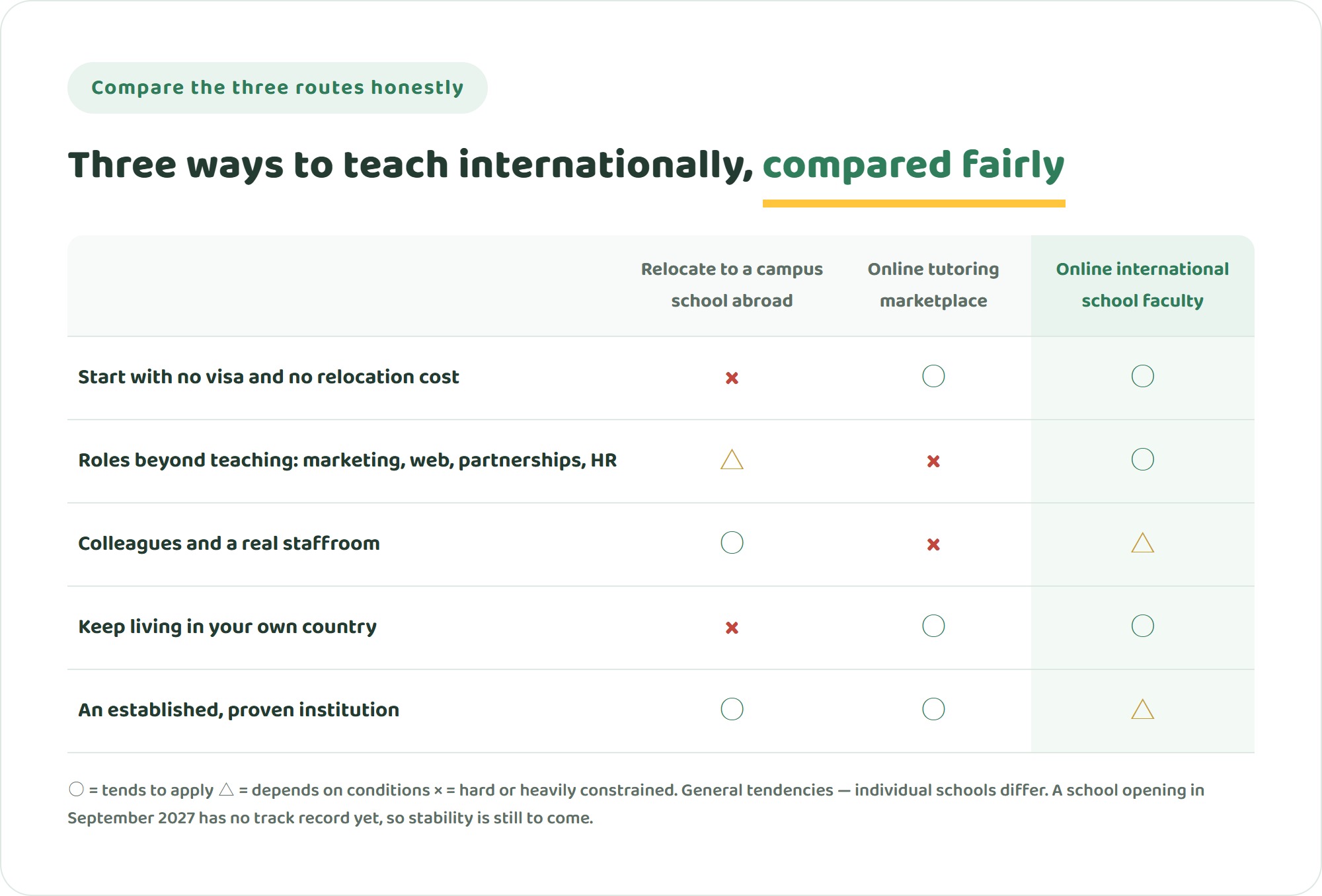
Two things are worth separating. Remote work removes the visa and the move. It does not remove the interview, the credential check, the reference calls, or the need to prove you can hold a room of eleven-year-olds. Those still apply, and they should.
What changes is who gets to apply at all. Under the old model, a school in Tokyo hiring a teacher in Cebu or Penang had to sponsor a visa, budget for relocation, and gamble on whether the family would settle. Most schools simply did not try. A school that teaches online has none of those costs, so the honest constraint becomes narrower: can you teach well, in English, at these hours?
That reframing matters if you are a qualified teacher in Southeast Asia. It also matters if you are an experienced teacher in the US, Canada, Australia or Singapore who does not want a new full-time job at all, but would take one class a week. See the founding member roles at NIJIN GLOBAL ACADEMY → — and the terms are worth knowing before you spend an evening on an application: on the international track, founding roles begin as volunteer positions ahead of the 2027 opening, with detailed terms shared later in the process. What is settled from the start is that the work is fully remote, costs you no visa and no relocation, and that even one class a week is welcome.

Which international school roles are actually hired remotely
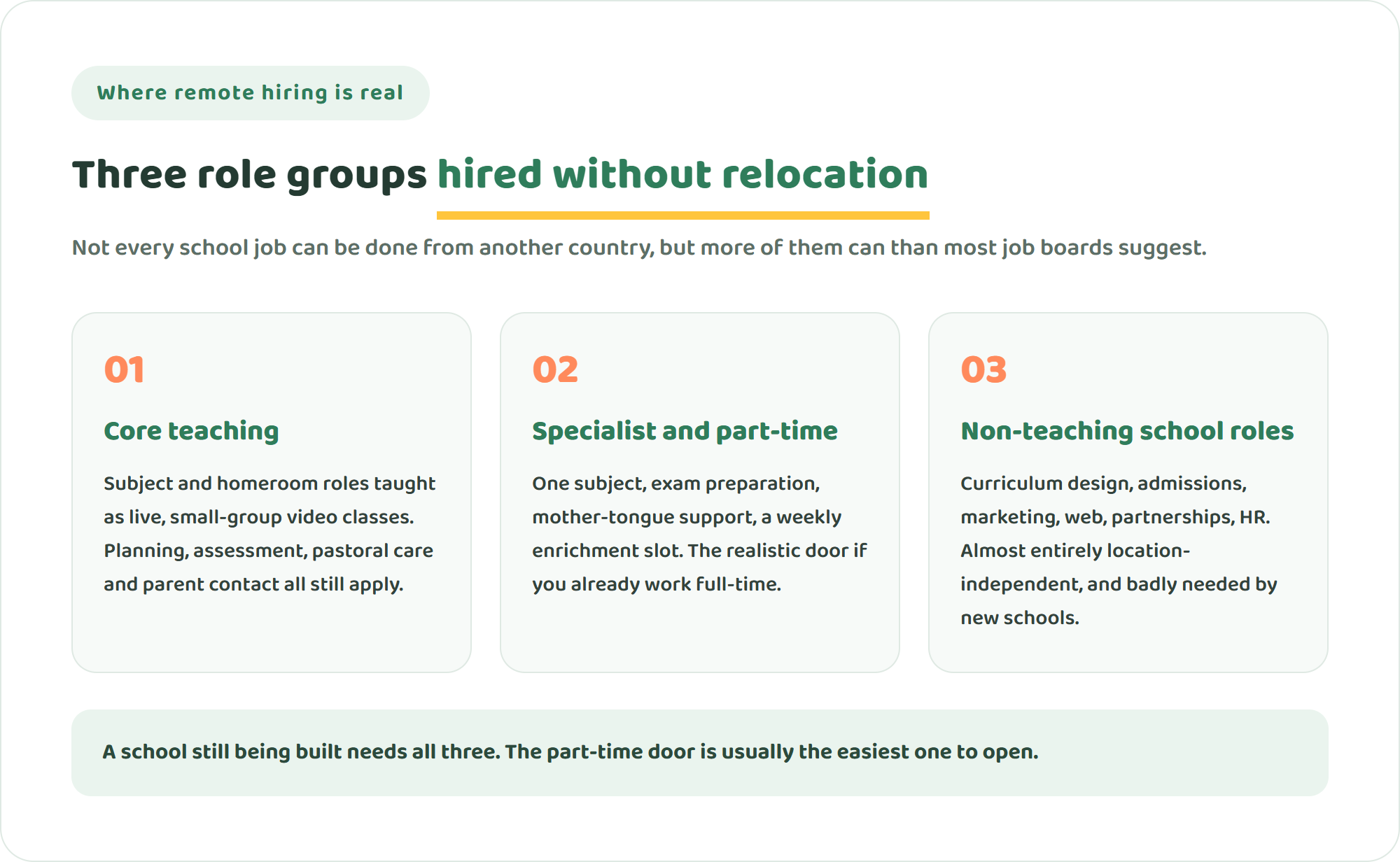
The first group is core teaching: subject and homeroom roles delivered as live, small-group video classes. This is real teaching, not content recording — planning, assessment, pastoral conversations and parent contact all still exist. It is also the most competitive group, because it is the one everybody pictures.
The second group is specialist and part-time: a single subject, exam preparation, mother-tongue or heritage-language support, music, coding, a weekly enrichment slot. If you already hold a full-time position and cannot leave it, this is the realistic entry point, and schools genuinely need it.
The third group is the one candidates overlook: non-teaching school roles. Curriculum design, admissions, marketing, web, partnerships, HR. A school that is still being built needs those as urgently as it needs teachers, and they are almost entirely location-independent.
What a school looks at when it cannot meet you
Hiring someone you will never share a corridor with changes what evidence counts. Three things carry the most weight.
Evidence over credentials. Qualifications travel badly across borders — a licence from one country is often unreadable to an employer in another. A recorded twenty-minute lesson, a unit plan, or student work you have marked travels perfectly. Send it unprompted.
Communication, in writing. A remote school runs on written messages. Clear, prompt, unambiguous writing is not a nice-to-have; it is half the job. Your application is the first sample.
Independence, evidenced. Nobody will walk past your classroom. Schools look for people who have run something without being supervised — a club, a curriculum, a small team.
And the honest counterweight: remote teaching gives up the corridor conversation, the shared staffroom, and the fast, physical way children tell you something is wrong. Good online schools compensate deliberately with small groups and structured check-ins. It is compensation, not equivalence.
Time zones: the constraint that decides everything
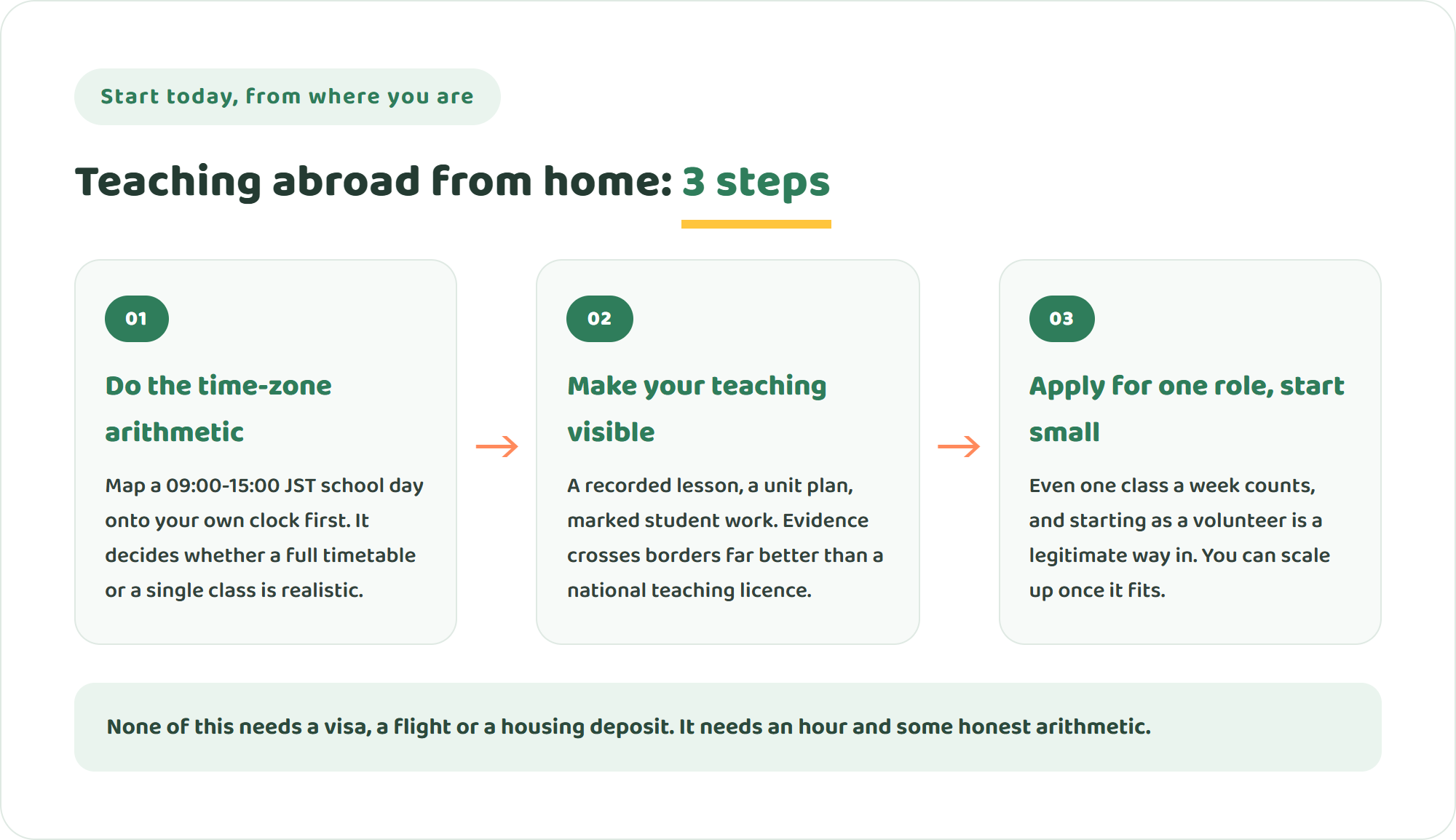
Work it out before anything else. A school day running roughly 09:00–15:00 JST is 08:00–14:00 in Manila or Kuala Lumpur, 07:00–13:00 in Bangkok or Jakarta, 05:30–11:30 in India, and 10:00–16:00 in Sydney. Those are ordinary hours. For the Americas, the same window falls between roughly 16:00 and 23:00 the previous day on the US Pacific coast — workable for an evening class, not for a full timetable.
This is exactly why part-time matters. A teacher in Vancouver or Melbourne who cannot take a full remote timetable can still take a single weekly slot. Even one class a week is welcome, and starting as a volunteer is a legitimate way in — a way to give back to education while living wherever you already live.
Two practical notes. Daylight saving shifts these offsets in Australia, New Zealand and North America but not in Japan or most of Southeast Asia, so the gap moves by an hour twice a year. And working for a school in another country raises tax and contract questions that depend on your own jurisdiction — ask early, and take local advice.
A fully remote school, built to hire across borders
NIJIN GLOBAL ACADEMY (NGA) is an online international school opening in September 2027, run by NIJIN Inc. in Japan, and it is hiring founding members now. Because it is fully remote by design, there is no visa to sponsor and no relocation to fund — which means it can hire from anywhere, and intends to. The aim is not an all-native-speaker staffroom but a genuinely multinational faculty: teachers whose own experience of crossing between languages and school systems is the thing students need most.
Three specifics, including the one that will decide it for many readers. Founding roles on the international track begin as volunteer positions while the school is built toward opening, and detailed terms are shared later in the process — so if you need a salaried contract from day one, this is not the right door, and we would rather you knew that now than after an interview. Second, you can combine teaching with marketing, web, partnerships or HR, and even one class a week is welcome. Third, English at roughly CEFR B2 or above is the working benchmark, and the school is looking for people who can build something from nothing and who believe education should not be ranked by deviation scores.
The honest limits: the school has not opened yet, so there is no track record, no settled system and no institutional stability to lean on. A well-established international school will beat NGA on all three, and if that is what you need right now, take it. Selection runs from application to a group interview, an internship inside NIJIN Academy, and a final presentation — the internship exists so you can see the work before you commit.
Frequently asked questions
Can I really teach at an international school without moving abroad?
For online and hybrid schools, yes — teaching, specialist and non-teaching roles are all delivered remotely. Traditional campus schools still require relocation and a work visa. The distinction is the school’s model, not the subject you teach.
Do I need a teaching licence to be hired remotely?
It depends entirely on the school and, for accredited programmes, on the accrediting body. A licence helps everywhere. At NGA, prior school experience is not a requirement; demonstrated ability and alignment with the school’s philosophy carry more weight.
I live in the Philippines or Malaysia. Are the hours workable?
Yes. At UTC+8 you are one hour behind Japan, so a Japanese school day sits inside a normal working day for you. Indonesia, Thailand and Vietnam are two hours behind, and India three and a half.
I already teach full-time. Can I take just one class a week?
That is a real option and an encouraged one. Part-time and volunteer involvement suits experienced teachers in the US, Canada, Australia and Singapore who want to contribute without changing careers.
The school opens in 2027. Why apply now?
Founding members are recruited during the build phase, which is when curriculum, systems and culture are decided. If you would rather shape a school than inherit one, this is the only window in which that is possible.

The map got redrawn while nobody announced it
For most of the last century, teaching internationally meant packing. That requirement was never pedagogical — it was logistical, and the logistics have changed. If you are a strong teacher in Cebu, Johor Bahru, Da Nang or Chennai, or an experienced one in Auckland or Toronto with an hour to give, the constraint that used to sit between you and an international classroom is no longer the visa. It is only the clock, and the clock is negotiable.
Working at an International School — More Articles
- international school teacher salary
- how to become an international school teacher
- career change from teaching
- career change from teaching in your 30s and 40s
- how much do teachers earn?
- how to become an IB teacher
- jobs for moving abroad
- thinking of quitting teaching
- career change from tutoring
- life after leaving teaching
- a second career for teachers
- private school teacher career change
- teaching jobs without a license
- working at an international school: pros and cons
- online school jobs
- international school staff jobs
- remote jobs that use English
- digital nomad teaching jobs
Teach across borders without crossing one.