You probably didn’t start with a policy question. You started with a moment. The admissions form asked about “previous support,” and you stopped typing. A teacher said your child was “bright but hard to reach.” You watched them light up over one narrow subject and shut down in a noisy hall, and you thought: an international school might suit them — but will anyone actually take them, and what happens if they don’t cope?
Here is the honest answer first. International school special needs support exists, and plenty of neurodivergent children do well in it. But whether your child is admitted, and whether they are genuinely supported afterwards, depends almost entirely on the individual school — not on whether it calls itself international. The variation between two international schools on the same street is usually far wider than the variation between two state schools in the same district. This guide is about seeing that variation from the outside, before you commit. It is not medical advice, and it does not diagnose anything. It is about how to read a school, and what to ask on the visit.
International school special needs provision: the honest starting point
Let’s not soften it. Most international schools sit outside the national special education system of the country they operate in. There is no statutory resource unit, no government-funded support teacher, no legal entitlement to an individual plan. Whatever support exists is something that particular school chose to build and chose to pay for. Some have built a great deal. Some have built almost nothing. And families do get told, honestly and sometimes kindly, that a school cannot meet their child’s needs.
That refusal is usually about capacity rather than attitude. Specialist teachers, psychologists, therapy space and one-to-one time all come out of a private budget. So the same label — “international school” — covers wildly different realities. Parents who assume that an internationally minded school will automatically be neurodiversity-friendly are the ones most likely to be blindsided in term two, and it is the child who pays for that.
One number worth holding on to. Japan’s Ministry of Education surveyed mainstream classrooms in 2022 and estimated that 8.8% of children in public primary and lower secondary schools showed marked difficulty in learning or behaviour without intellectual developmental delay (2.2% at upper secondary). That figure is a measure of children who need support, not a diagnosis rate. The point is simple: children who need adjustments are in every classroom in every country. What differs is whether the school has built anything to meet them.
Why special needs support varies so much between international schools
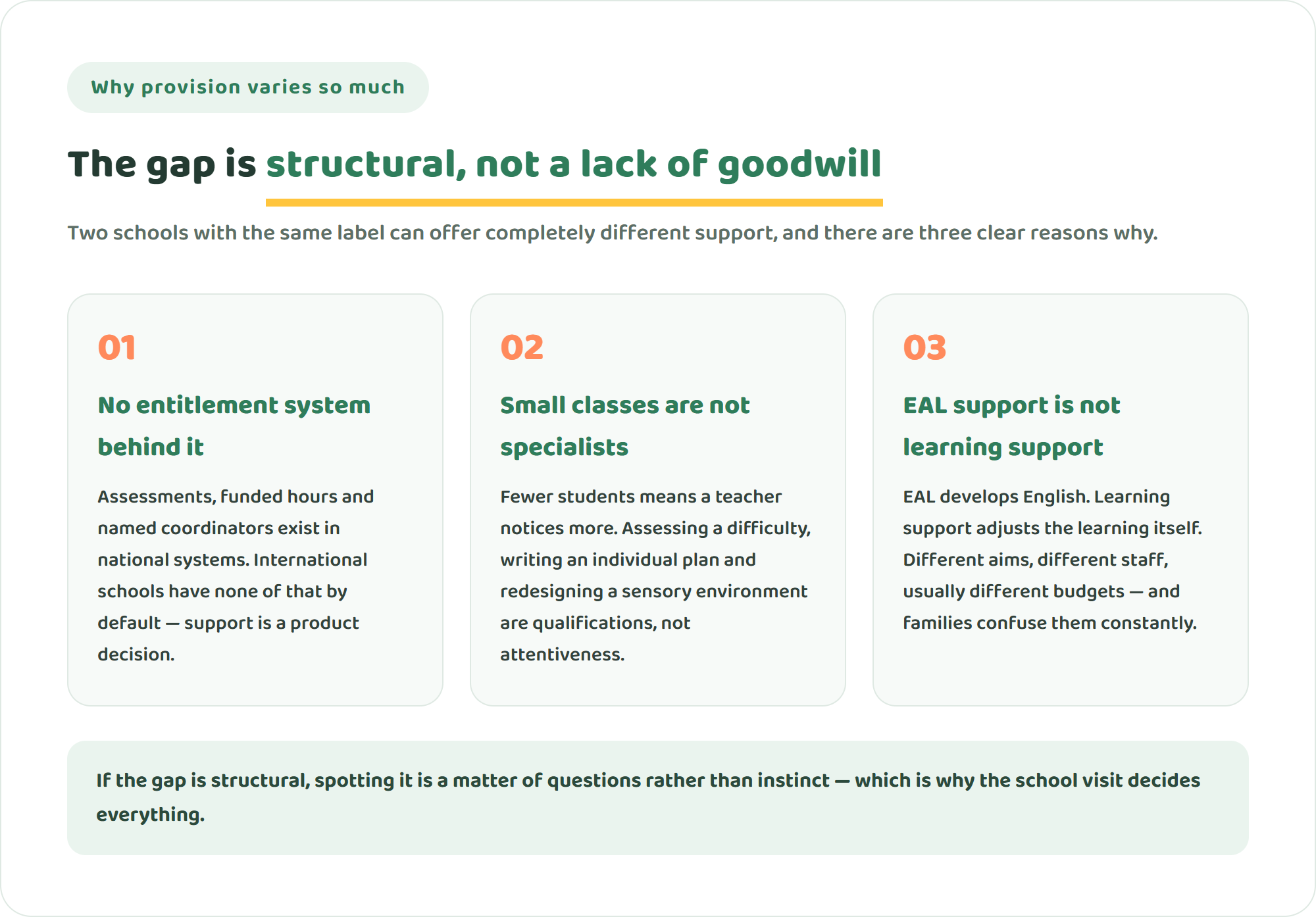
There is no entitlement system behind the school
In most national systems, a child who needs support triggers a process: assessment, a plan, funded hours, a named coordinator. In the private international sector, none of that machinery exists by default. A school can offer an excellent learning support department, and the school next door can offer nothing, and both remain fully legitimate international schools. Support is a product decision, not an obligation. That single fact explains most of what follows.
Small classes are not the same as specialist staff
“We only have 16 in a class” is reassuring and slightly misleading. Smaller classes mean a teacher notices more. They do not mean anyone on site can assess a reading difficulty, write and review an individual plan, or redesign a sensory environment. Those are qualifications, not attentiveness. On a school visit, the useful question is never “how big are the classes” but “who does this work, with what training, for how many hours a week.”
EAL support and learning support are different departments
This is the most common and most costly confusion. EAL (English as an Additional Language) helps a child whose English is still developing. Learning support — often called SEN, student support or inclusion — adjusts the learning itself for children who process, attend or communicate differently. Different aims, different staff, usually different budgets. When a school says “yes, we have support teachers,” find out which kind. Families who hear “support” and picture the second thing while the school means the first are set up for a painful surprise.
Accreditation tells you less than you hope
The International Baccalaureate publishes an inclusive education framework built on removing or reducing barriers so every student can participate, together with an access and inclusion policy governing access arrangements in assessment. The Council of International Schools evaluates member schools against 18 standards across Guiding Principles, Learning and Well-being.
Both matter, and a school engaging seriously with either is a good sign. But neither specifies how many specialists a school must employ, or which needs it must be able to meet. Accreditation is a floor, not an answer about your child. Treat an IB or CIS badge as a reason to ask better questions, not as a reason to stop asking.
Three levels of provision — and how to tell them apart
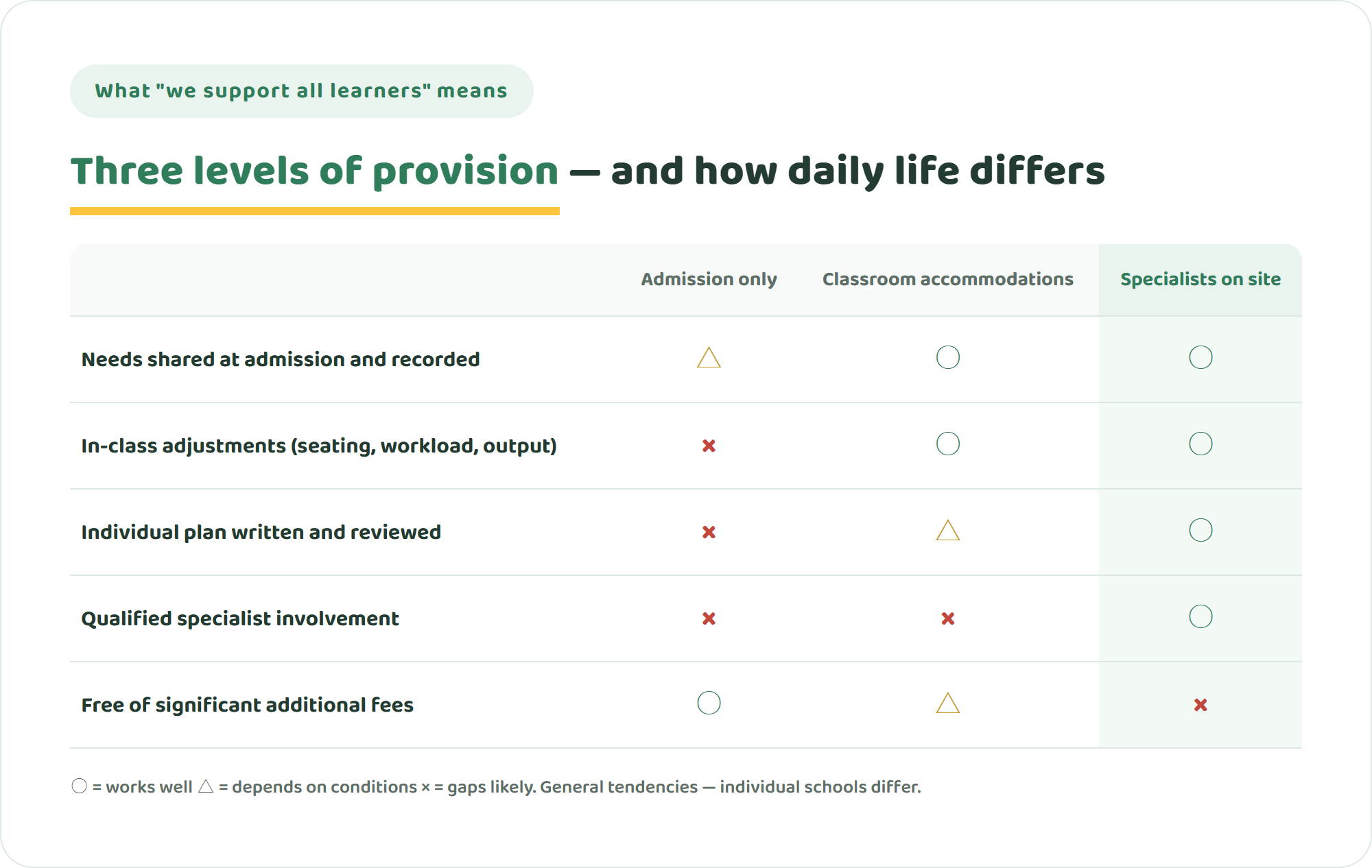
Level 1 — admission only. Your child is welcome; the programme is unchanged. A kind teacher may improvise, but nothing is systematic and nothing is recorded. Schools whose materials talk warmly about diversity yet never name a role, a process or a cost usually sit here.
Level 2 — classroom accommodations. Seating, task volume, alternative ways to submit work, extra time in tests, movement breaks — offered as policy rather than favour, with a coordinator involved and a written record. This is the most common level, and for many families it is a realistic and sufficient landing point.
Level 3 — specialists on site. Qualified learning support or SEN teachers, sometimes a school counsellor, psychologist or speech and language professional, writing individual plans and reviewing them on a schedule. Places are limited and there is nearly always an additional fee, because the school is carrying salaries. Deeper support and higher cost travel together — see is international school too expensive for how those numbers usually stack up.
Ten questions to ask on a school visit
This is the part of the article to screenshot. Prospectuses cannot answer any of it; only people can.
- How many dedicated learning support or SEN staff do you have, and are they separate from your EAL team?
- What are their qualifications, and are they full-time on this campus or shared across sites?
- Roughly what proportion of your students currently receive some form of accommodation?
- Do you write individual learning plans? Who writes them, and how often are they reviewed?
- Can you give me three real examples of adjustments running in classrooms this term?
- What access arrangements do you provide in internal and external assessments, and how are they applied for?
- How is a diagnostic report used in admissions — and can disclosing it count against us?
- If needs emerge after enrolment, can a student be asked to leave? What process would you follow first?
- What are the additional fees, and exactly what is and isn’t included?
- Have you worked with outside therapists or tutors before, and can they come on site?
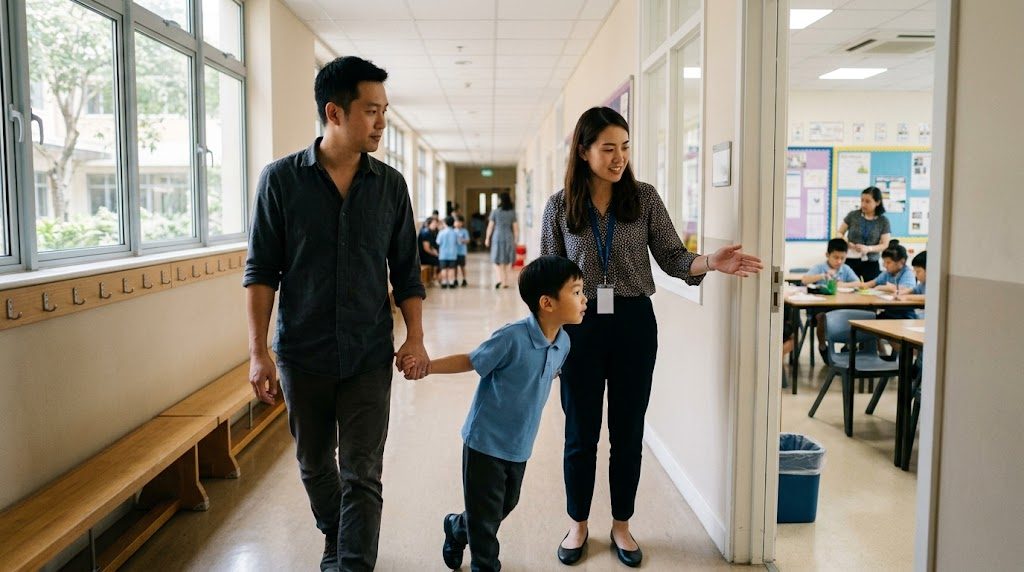
The content of the answers matters. How they are answered matters more. A school running a real programme produces numbers, names and review cycles without hesitation. A school that offers only “we’re flexible and we take each child as they come,” with no figures and no named role, probably has intent rather than infrastructure. Question 8 is the honesty test — a school that answers it calmly and specifically is one you can keep talking to when things get hard.
See how learning works online →
What to prepare before you apply
Preparation turns a vague conversation into a concrete one. Generally, bring:
- Any diagnostic or professional report, plus assessment results
- A record of accommodations tried at previous schools — and which ones actually worked
- What your child is good at and absorbed by (lead with this; it changes the room)
- The situations that go badly, and what has helped in those situations
- Medication or medical considerations, if relevant
- A rough profile of speaking, reading and writing in each language your child uses
Many parents consider staying quiet, and the instinct is completely understandable. But support that never arrives is usually harder on a child than a difficult admissions conversation. You control the framing: open with “here is how my child works best,” not with a label.
If your child has no formal diagnosis
Plenty of families are searching from exactly this position — something is clearly going on, nothing has been named, and every form seems designed for people with paperwork. Three practical things.
First, you can request adjustments without a diagnosis. Most schools respond to described situations rather than labels. “Sustained background noise ends her concentration.” “He loses the third instruction in any spoken sequence.” Specifics like these are more useful to a classroom teacher than a report.
Second, formal provision usually does require documentation — particularly access arrangements in assessment, where schools must justify fairness to an examining body. That is procedure, not coldness. If formal arrangements are likely to matter later, it is worth beginning a professional assessment early. Any decision about assessment or diagnosis belongs with qualified professionals.
Third, for undiagnosed children, school culture does more work than school policy. Where questions are easy to ask, where work can be redone, where groups are small enough to talk in, a lot of difficulty dissolves before it becomes a case file. On a visit, watch how easily children interrupt the teacher. That tells you more than the inclusion page of the website.
Is it language, or is it a learning difference?
Children in international schools carry an extra layer of ambiguity. Not following instructions, not producing written work, not speaking up — is that English, the home language, or a learning difference? The three look remarkably alike from the outside, and they can overlap.
The most useful diagnostic instinct available to a parent is simple: does the same pattern appear in every language your child speaks? If instructions go missing only in English, language load is probably doing much of the work. If it happens equally in the home language, language alone doesn’t explain it. That is also why letting the first language wither makes the picture harder to read, not easier — the argument is set out in raising a bilingual child without losing the mother tongue.
One caution that applies everywhere: a child in their first year of a new language should not be assessed as though the language were settled. Japan’s Ministry of Education makes a version of this point in its guide on receiving foreign students (revised March 2019), which asks schools to judge placement comprehensively while accounting for differences in language, education system and cultural background. Ask any school how it separates the two, and whether it can assess in more than one language. If you are worried, seek a professional opinion that considers the home language too.
Country by country: Singapore, Malaysia, Japan and Bangkok
Singapore
Singapore runs a well-developed government-funded special education (SPED) sector alongside its mainstream schools, and there are national routes into it. MOE states that Singapore Citizen and Permanent Resident children apply to SPED schools through an online application listing up to three schools, while international students approach SPED schools directly about admission and vacancies. Separately, MOE’s compulsory education rules mean a citizen child of compulsory school age must attend a national primary school unless exempted — exemptions include being unsuitable to attend any national primary school due to physical, intellectual or developmental disabilities. For citizens, attending a foreign system school is itself an MOE process, so a Singaporean family choosing an international route should start with MOE, not with the school. Expatriate families face no such step, but face the full range of school-by-school variation instead.
Malaysia and Johor Bahru
Malaysia introduced a Zero Reject Policy in 2019, under which children cannot be refused enrolment at government and government-aided schools on the basis of disability (discussed in the International Journal of Inclusive Education). It is a genuine shift — but it is a policy about government schools, and private international schools do not inherit it. Malaysia, and the Johor Bahru corridor in particular, attracts families for affordability and for the sheer number of campuses. More schools means more chances of a good fit; it does not mean a higher floor. Ask the same ten questions you would ask anywhere.
Japan
Most international schools in Japan are not Article 1 schools under the School Education Act, which places them outside the public special education structures of resource rooms and support classes. Since April 2024, however, a revised disability discrimination law has made reasonable accommodation a legal obligation for private providers, within the limits of what is not an excessive burden — a change that generally covers private schools, and one that emphasises constructive dialogue between provider and family. In practice this strengthens your right to a conversation, not a right to admission. Japanese-national families should also check compulsory-education implications with their local board of education before enrolling; the trade-offs are covered in the real pros and cons of international school.
Bangkok and Thailand
Thailand’s sector is large: the International Schools Association of Thailand reports that since its founding in 1994 it has grown to represent 200 international schools, running American, British, IB and other curricula. Bangkok therefore offers real choice, including a handful of schools with substantial learning support departments and a small number specialising in it. The catch is the same one: size of market, not depth of provision. And in every relocation destination, weigh something that never appears in a fee comparison — whether assessment, therapy and family support in a language you speak are actually available nearby.
Three steps to take this month
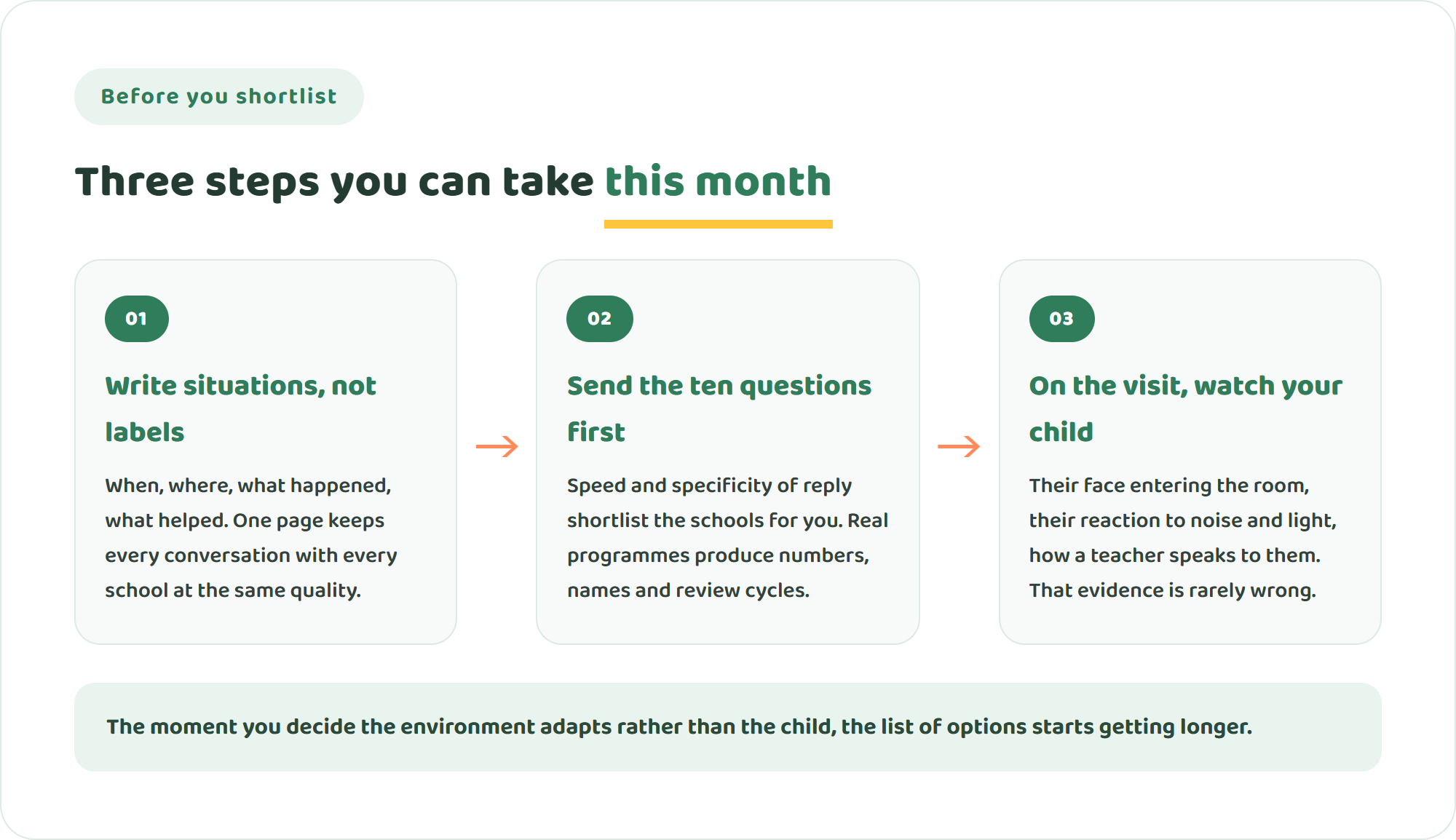
1. Write one page in situations, not labels. When, where, what happened, what helped. The same page works for every school and keeps every conversation at the same quality. 2. Send the ten questions before you visit. Speed and specificity of reply will shortlist your schools for you. 3. On the visit, watch your child rather than the facilities. Their face entering the room, their reaction to noise and light, how a teacher speaks to them. That evidence is not in any brochure, and it is rarely wrong.
A third option — learning that doesn’t assume a commute
If the field looks narrower than you expected, that impression is accurate. But much of the narrowness comes from one assumption: that education means arriving at a specific building at a specific time, every day (background in what is an international school). Crowded corridors, transitions, sensory load, the commute itself — a great deal of what exhausts neurodivergent children lives in the delivery format rather than in the learning.
NIJIN GLOBAL ACADEMY (NGA), opening in September 2027, is designed without that assumption. It is an online international school that does not rank children by test scores, built around small-group dialogue that starts from “what do you think?” The design leans on personalised pacing, a mentor who works alongside the family, and no commute at all — treating a child’s intense interest as the starting point rather than a problem to manage.
NGA is operated by NIJIN Inc., whose alternative school in Japan already serves more than 900 children. It is open to 6- to 18-year-olds across Asia and Oceania, with tuition designed to be around one-fifth of a typical campus international school. Honestly: online is not the same as a playground, we are not a clinical or therapeutic provider and never a substitute for professional support, and as a pre-launch school our record is still ahead of us. But reducing the number of children who can’t learn because they can’t commute is something we can do.
Frequently asked questions
Will an international school accept a child with special needs?
Many do. There is no blanket exclusion. But provision varies enormously between schools, and a school may decline a place if it judges that it cannot meet the child’s needs. Think of it as a question about a school’s capacity rather than its values.
How do I find an international school for special needs kids in Singapore or Malaysia?
Filter before you tour. Email every shortlisted school three questions — dedicated learning support staff, individual plans, additional fees — and only visit the ones that answer specifically. In Singapore, citizens should also confirm MOE requirements for attending a foreign system school before applying.
Do we have to disclose a diagnosis during admissions?
Policies differ and you should ask each school directly how reports are used. In general, disclosure lets a school tell you honestly whether it can support your child, which is information you want before enrolment rather than after. Frame it around what works for your child, not around the label.
Is special education available at international schools in Japan?
Some schools in Japan have well-staffed learning support departments; many do not, and they sit outside the public special education system. Since April 2024 private providers have a legal duty to make reasonable accommodations within the limits of excessive burden, which strengthens the case for dialogue — but it is not a guarantee of a place.
Is a bigger city like Bangkok a better bet?
A larger market improves your odds of finding a match, and Bangkok, Kuala Lumpur and Singapore all have depth. It does not raise the minimum standard at any individual school, and relocation adds its own burden — check what assessment and therapy exist locally, in a language you use.
My child is fluent in conversation but can’t produce written work. Is that language or something else?
Compare across languages. If it happens only in English, language load is likely a major factor; if it happens in the home language too, language alone doesn’t explain it. Ask whether the school can assess in more than one language, and consult a professional who will consider both.
Does an online school work for neurodivergent children?
For some, yes — less sensory load, no commute, more control over pace. Others need in-person contact and physical activity that a screen cannot provide. The better question is not which format is superior, but which part of the current day is draining your child.
The absence of a good fit is not a verdict on your child.
Somewhere in this search you will probably think that the problem is your child. After a declined application, after explaining the same things again to a stranger, that thought is very hard to keep out. But a place that fits being hard to find says something about how few have been built — not about what your child lacks.
Differences aren’t corrected; they’re matched to an environment. Quiet for the child who can’t filter noise, visible steps for the child who loses spoken instructions, protected time for the child who goes deep on one thing. The moment you decide the environment adapts rather than the child, the list of options starts getting longer. Today, sending ten questions in one email is enough.
NIJIN GLOBAL ACADEMY opens in September 2027. We’ll share how personalised, small-group learning is designed to work, and send first-intake news early, by email.
Honest Answers to Your Worries — related reading
- Will My Child Lose Their Mother Tongue?
- The Honest Pros and Cons of International School
- Disadvantages of Bilingualism in Childhood: Myths vs Research
- Who Regrets International School — and Who Doesn’t
- International School vs Local School: How to Decide
- Does International School Hurt Your Child’s Home Language?
- When Your Child Is Struggling at International School
- Do International Schools Make Children Fluent in English?
- Is International School Worth It? What Happens to Graduates
- Should I Send My Child to International School?
- Transfer From a Local School to an International School
- Disadvantages of Early English Education: What Research Says
- What Happens to International School Graduates