

If you searched for “life after leaving teaching,” you were probably looking for more than encouragement. You wanted to know what it is actually like on the other side. Whether the people who left are glad they did. Whether, if it turns out not to fit, there is a way back into the classroom. Some people who type that phrase have a resignation letter half-written. Others simply want to confirm that an option exists, and will stand in front of their class again tomorrow. Both are entirely reasonable things to look up.
This article is not here to tell you to leave. From what we have seen, the difference between people who can honestly say “I’m glad I left” and people who regret it is rarely the leaving itself — it is what they decided before they went. So we will start with an honest picture of what actually happens after you leave: the relief, and what quietly goes with it. Then we will lay out what to settle before you decide — useful whether or not you ever leave, and whether or not you ever apply to us. Finally, we will introduce a third option that sits outside the quit-or-stay binary, without any hard sell.

Life after leaving teaching: the relief, and what goes with it
The first thing former teachers describe is relief. Sunday evenings stop feeling heavy. There is no marking waiting at home. A day off is actually a day off. Getting your time and your energy back is bigger than most people expect — when a tension you have carried for years finally releases, ordinary life changes shape.
But the same people, a little further down the road, also talk about what they lost. Four things come up again and again. First, the relationship with the children: very few jobs put you in the room at the moment something finally clicks for a young person. Second, stability: secure employment, allowances, and a life you could plan years ahead. Third, colleagues: being surrounded by people who understand the specific weight of the work turns out not to have been a given. Fourth, income and social standing: pay can dip in the months right after a move, and employment type is sometimes looked at in mortgage or credit decisions (criteria vary by lender and by country).
There is one more thing worth saying plainly. Some people go back. Teachers step away, then return — sitting a recruitment examination again, coming back as a contract or supply teacher, or moving into a different school system. Eligibility, age limits, and hiring conditions differ by authority, country, and school, so check current requirements rather than assuming. But “once you leave, the door is closed” is not reliably true. Knowing that keeps the decision from becoming a once-in-a-lifetime bet.
Three things the people who are glad they left had in common
So what separates the people who look back calmly and say it was the right call?
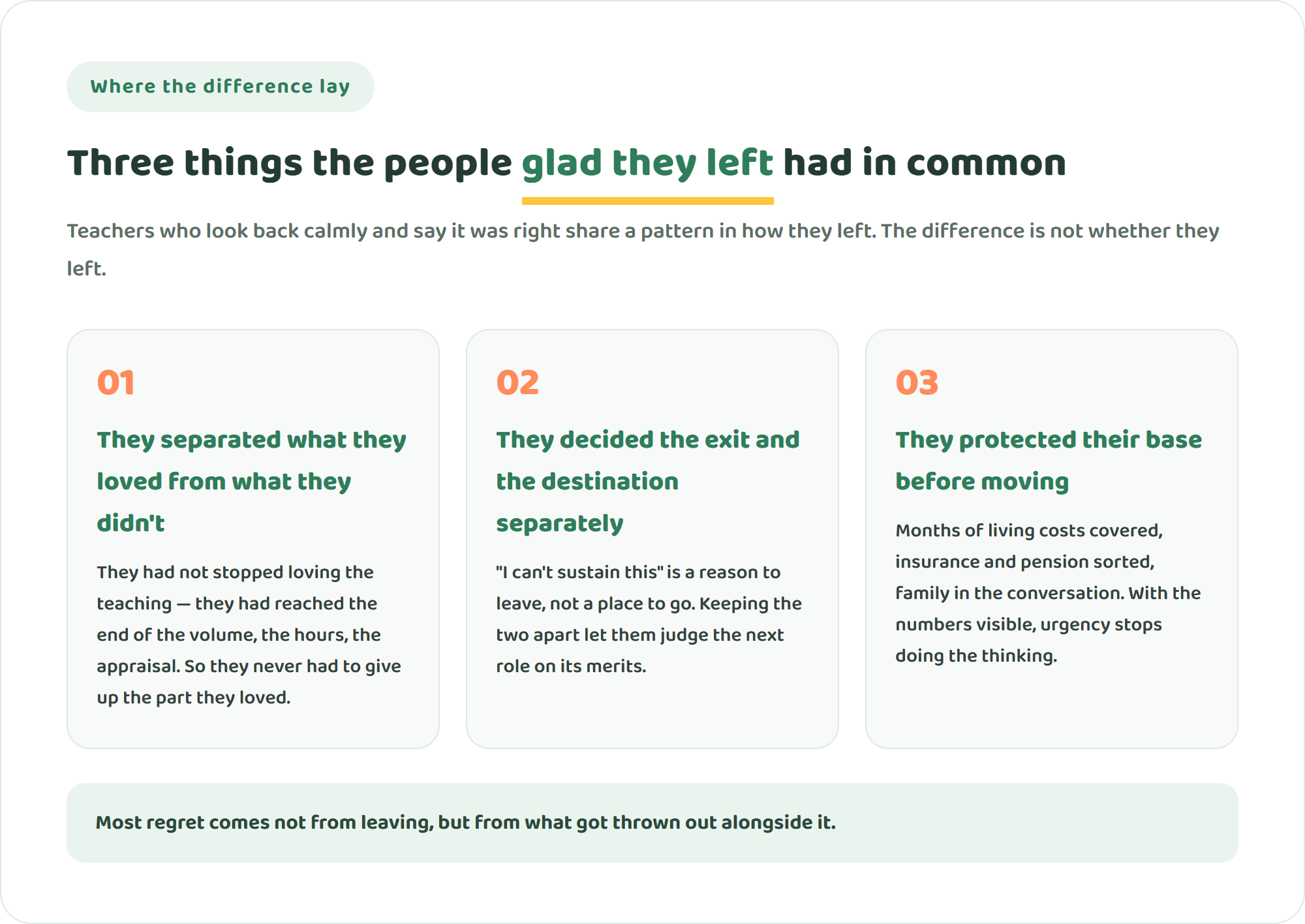
The clearest pattern is this: they did not leave because they had stopped loving the work of teaching. Most still loved it. What they had reached the end of were the conditions around it — the volume, the hours, the way performance was judged. Because they knew that, they chose next steps that kept them close to people and to learning, and they did not have to give up the part they loved. The people who let go of everything at once, without separating the strands, are the ones most likely to say later, “I wish I had kept that one piece.” Most regret comes not from leaving, but from what got thrown out alongside it.
Four things to settle before you decide
This is the heart of the article, and it stands on its own — it is just as useful for someone who ends up staying.
First, separate what you dislike from what you love. On paper or in your phone, list them out: lessons, time with students, designing materials, admin, working hours, staff relationships, appraisal. Mark each one. Most people are surprised to find it is not all of it. Second, decide what you are leaving and what you are moving toward, separately. “I can’t sustain this way of working” is a reason to leave; it is not a destination. Blend the two and getting out becomes the goal in itself, which leaves you unable to judge the next place on its merits.
Third, protect your financial base. How many months of living costs you can cover, what happens to insurance and pension contributions, when and how you talk to your family. Once the numbers and the sequence are visible, urgency stops doing your thinking for you. Fourth, test before you commit. Whether you can take on outside work depends on your employer’s rules, but talking to people, observing, and going through a selection process are all things you can do without resigning. Try it, then decide — that order removes more regret than anything else on this list.
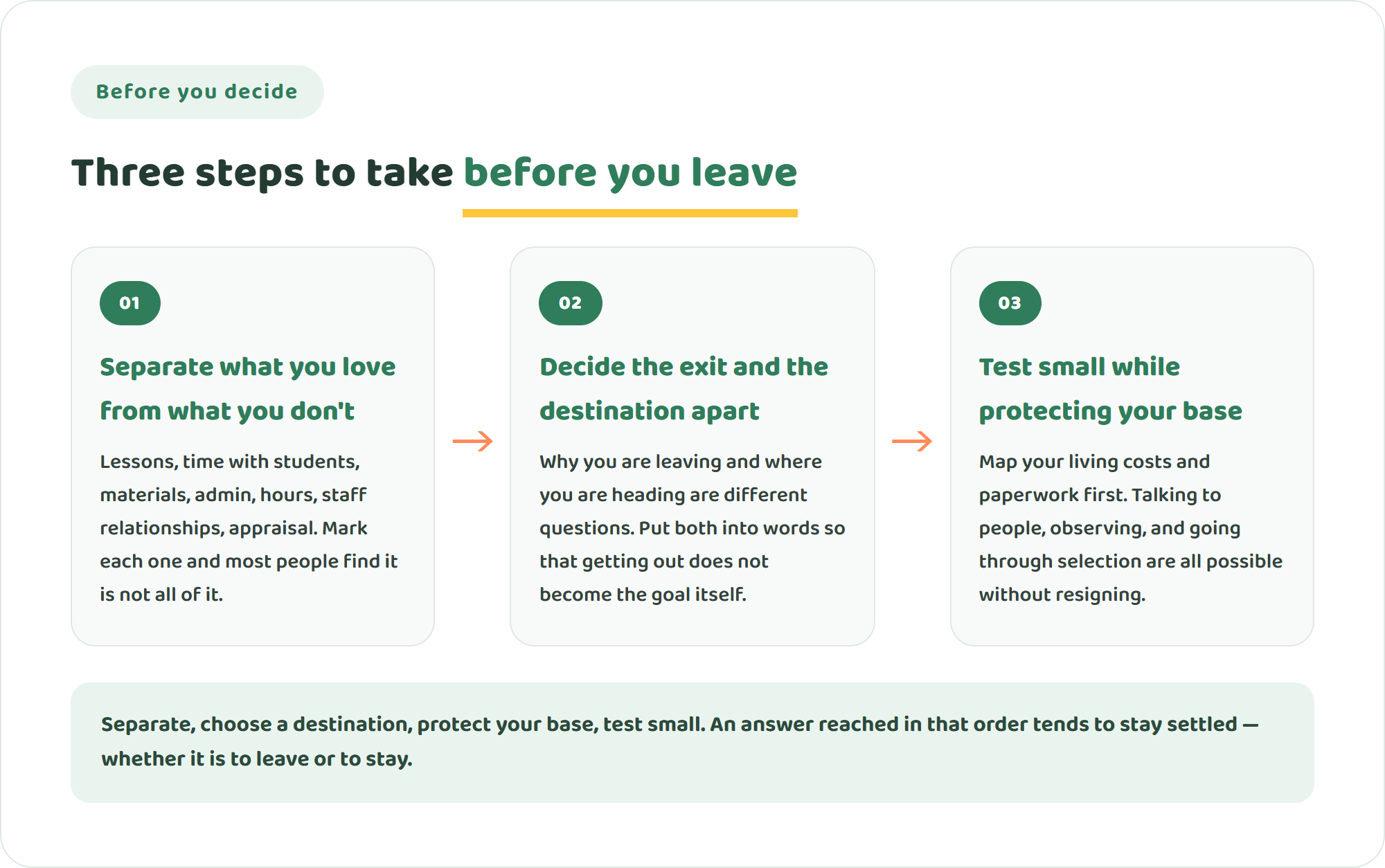
Do that work and it becomes clear the choice was never only “stay at your school” or “leave education.” There is a third place to stand: keep the teaching you love, and swap out only the conditions around it.
See NIJIN GLOBAL ACADEMY’s founding-member roles →

A third path — keep the teaching, change only how you work
NIJIN GLOBAL ACADEMY (NGA) is an online international school opening in September 2027, and we are recruiting founding members ahead of that. Here are the three paths, side by side and fairly.
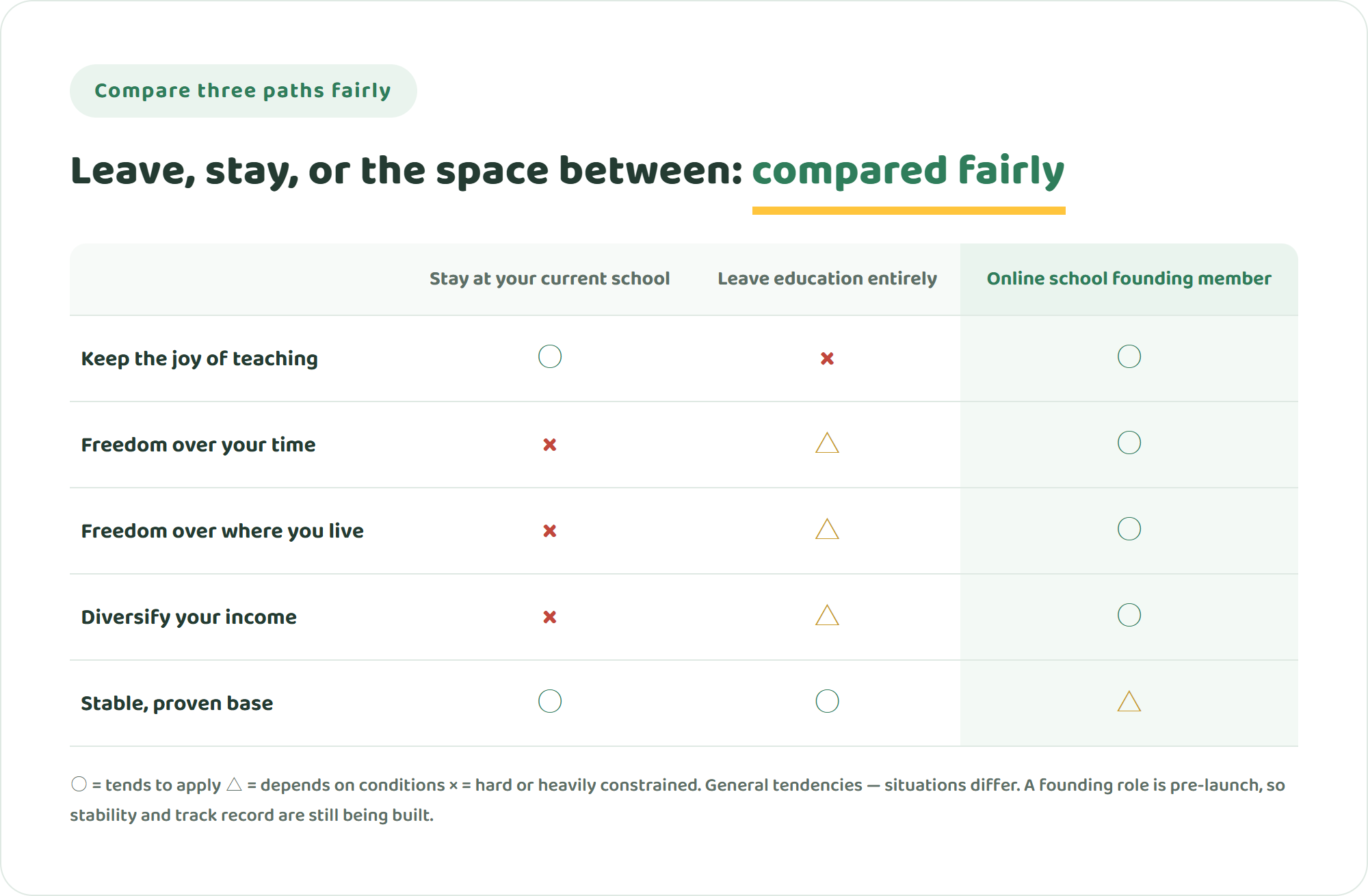
As the table shows, the founding-member route is not a cure-all. Because it is pre-launch, the stability and track record an established school already has are things we would be building together. Even so, for someone who does not want to give up teaching, the shape of the work matters. First, it is fully remote, designed around the premise of working while travelling the world — no commute, no fixed posting. That is equally open to someone leaving the classroom to get their time and location back and to someone who needs to work from home for family or health reasons. Second, there are five working styles: alongside teaching you can take on marketing, web, partnerships, or HR, at anything from part-time to full-time. In practice that means you can start part-time and try it without resigning first.
Third, we say plainly what the terms are. On the international track, founding roles begin as volunteer positions ahead of the September 2027 opening, and the detailed terms are shared later in the process. Fourth, the philosophy: NGA is built on learning beyond test scores, with small-group dialogue that begins from “what do you think?” rather than ranking children by exam results — set out in how we learn. What we ask of applicants is roughly English at CEFR B2+ and an appetite for building from zero. Selection runs from documents to a group interview, an internship at NIJIN Academy, and a final presentation — with time built in to try before you decide.
Frequently asked questions
Will I really end up glad I left?
It depends on how you leave. People whose difficulty was the environment rather than the teaching tend to get closest to a calm “yes” when they change the conditions and keep the work. Let go of everything at once without separating the strands, and the part you loved often goes with it.
Can I go back to teaching later if I want to?
People do return — through recruitment examinations, supply or contract roles, or a different school system. Eligibility and hiring conditions vary by authority and country, so check the current requirements rather than relying on what was true a few years ago. Knowing a route back exists is not a reason to be casual; it is a reason to be calm.
I’m afraid of earning less.
That fear is realistic and worth respecting. Sort out your financial base first and confirm where income will come from before you move. We say up front that the international founding track begins as a volunteer role, precisely so nobody applies on the wrong assumption; the detail comes later in the process.
My English isn’t strong enough.
We work to a rough guide of CEFR B2+, not native-level perfection. What matters is being willing to use English with children and colleagues around the world and to keep improving. We look at your trajectory and drive more than your current level.
Can I apply while I’m still teaching?
Yes. Being pre-launch is exactly why founding members help shape the substance of the learning. Because working styles run from part-time to full-time, you can discuss an arrangement that fits alongside your current role (check your employer’s rules on outside work). Details are on the founding-member recruitment page.
Decide by what you want to keep, not by whether you leave
Teaching is not a job anyone can do. There is real pride in the days you are still putting in, and we are not going to tell you to walk away from them. But if the way you are working now cannot continue, it is worth laying out what you would lose and what you want to keep. Separate the strands, choose a destination, protect your base, test it small. An answer reached that way — whether it is to leave or to stay — tends to stay settled. And whichever path you take, the ability to teach that you built over those years travels with you.
Working at an International School — More Articles
- international school teacher salary
- how to become an international school teacher
- career change from teaching
- career change from teaching in your 30s and 40s
- how much do teachers earn?
- how to become an IB teacher
- jobs for moving abroad
- teach abroad without relocating
- thinking of quitting teaching
- career change from tutoring
- a second career for teachers
- private school teacher career change
- elementary school teacher salary in Japan
- junior high school teacher salary in Japan
- high school teacher salary in Japan
- school principal salary in Japan
- how the Japanese teacher pay scale works
- teacher bonuses in Japan
Turn your passion for teaching into your next way of working.