If you have typed what is an alternative school into a search box late one evening, you are probably not ready to decide anything yet. Something at your child’s current school is not quite working. The mornings have become heavy, or the school reports come back fine while the child clearly is not. And the obvious alternative in your city, an international school, costs more per year than your family can carry. You are standing between two doors that both feel closed, wondering whether there is a third.
This article is written for that in-between moment: what the phrase means, the main traditions it covers, what families worry about after the tour, and a simple way to compare your options. You do not need to decide by the end. One clear next question is enough.
What is an alternative school, in plain terms
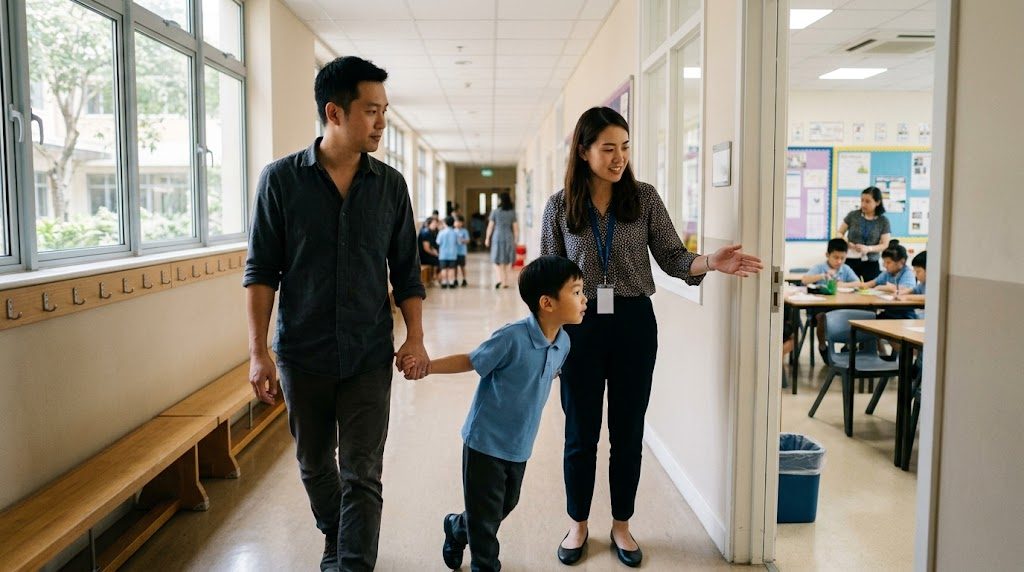
The word alternative simply means another way. So an alternative school is any school that builds learning on a different foundation from the mainstream system around it. It is not one method but a loose umbrella over several traditions that grew up separately, in different countries, for different reasons.
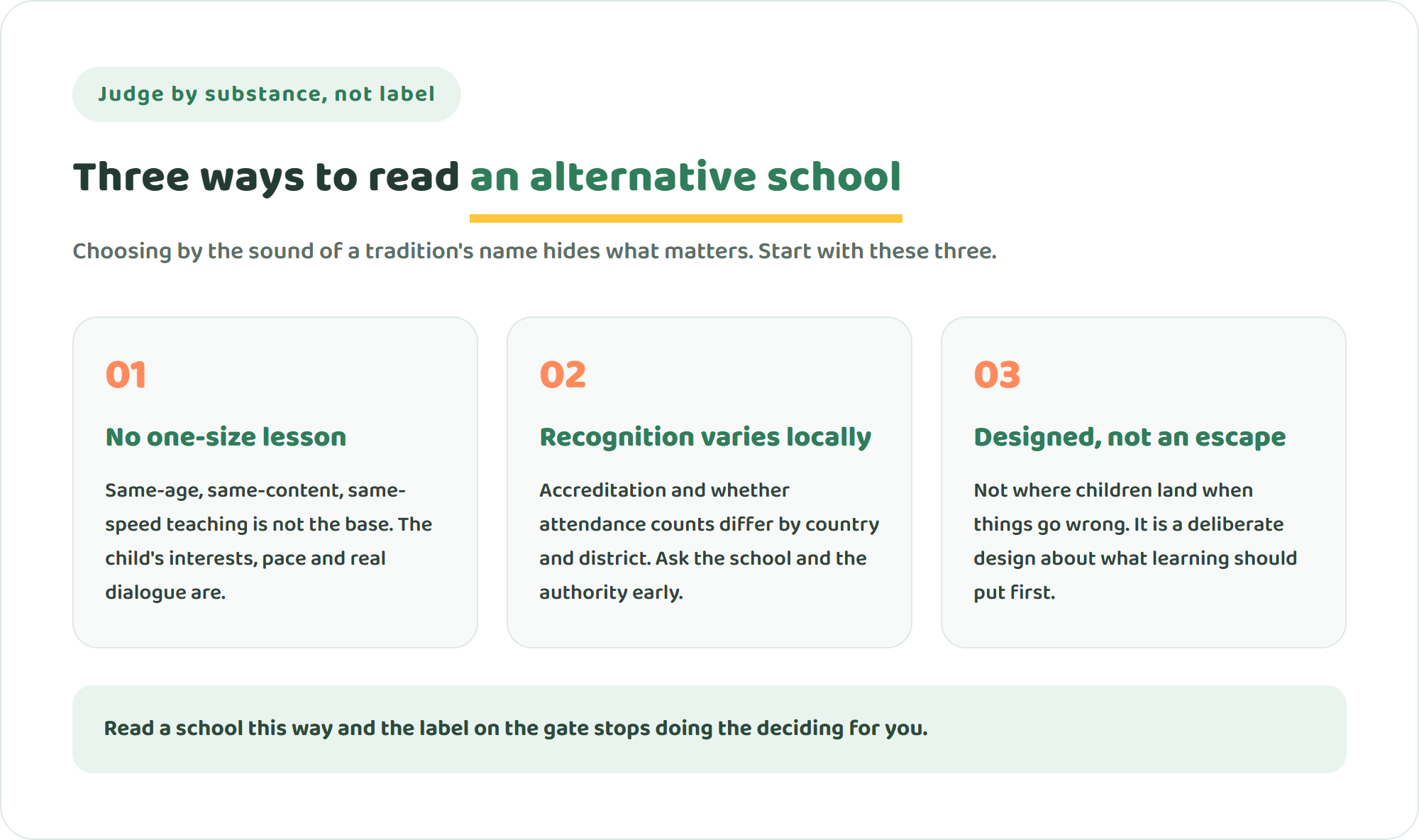
What most of them share is this: they do not assume that children of the same age should cover the same material at the same speed. In its place they put the child’s own interests, the child’s own pace, and real conversation between children and adults. Some have no fixed timetable; many mix ages in one group. Adults act less as lecturers than as people who prepare the environment and walk alongside, and assessment tends to live in portfolios, observations and meetings rather than ranked scores.
Legal status is where families across Asia and Oceania get stuck, and it varies enormously. In some countries an alternative school is fully accredited and issues its own leaving certificate. In others, including Japan, many sit outside the formal school category, so children stay registered at their local school while attending elsewhere, and whether that attendance is officially recorded is decided locally rather than nationally. Never assume. Ask the school and your local education authority about your own case, early. If your child has already started refusing school, this guide to supporting a child who will not go is a gentler place to begin.
The main types of alternative school
Under one umbrella sit traditions that value quite different things. Read them not as a ranking but as an answer to one question: what does this school put at the centre? These are names of broad movements, not of particular institutions.
Steiner or Waldorf education. Content and delivery are matched to developmental stages. Art, handwork and seasonal rhythm carry much of the weight, and in the early years experience comes before facts. Children often build their own main lesson books instead of working from textbooks.
Montessori education. A prepared environment and a set of materials let children choose their own work and stay with it for long, uninterrupted stretches. Mixed-age classes mean older children teach younger ones as a matter of course, and the adult observes and prepares rather than presenting from the front.
Sudbury and democratic schools. The most open form: no set curriculum, no timetable, and the child decides what today is for. School rules are made in meetings where staff and students each hold one vote. It looks like freedom, and it is also daily practice in choosing and living with the consequences.
Jenaplan education. Mixed-age groups form the basic unit of school life, cycling through four activities: conversation, play, work and celebration. Widely practised in the Netherlands and now appearing elsewhere, it balances solitary progress against things that can only be made together.
Free schools and learning centres. Not a method but a category: places created so children who are not attending mainstream school have somewhere safe to be. Some lean into academics, others put rest and relationships first, and operators and philosophies vary widely. A wider map is in learning options when school does not fit.
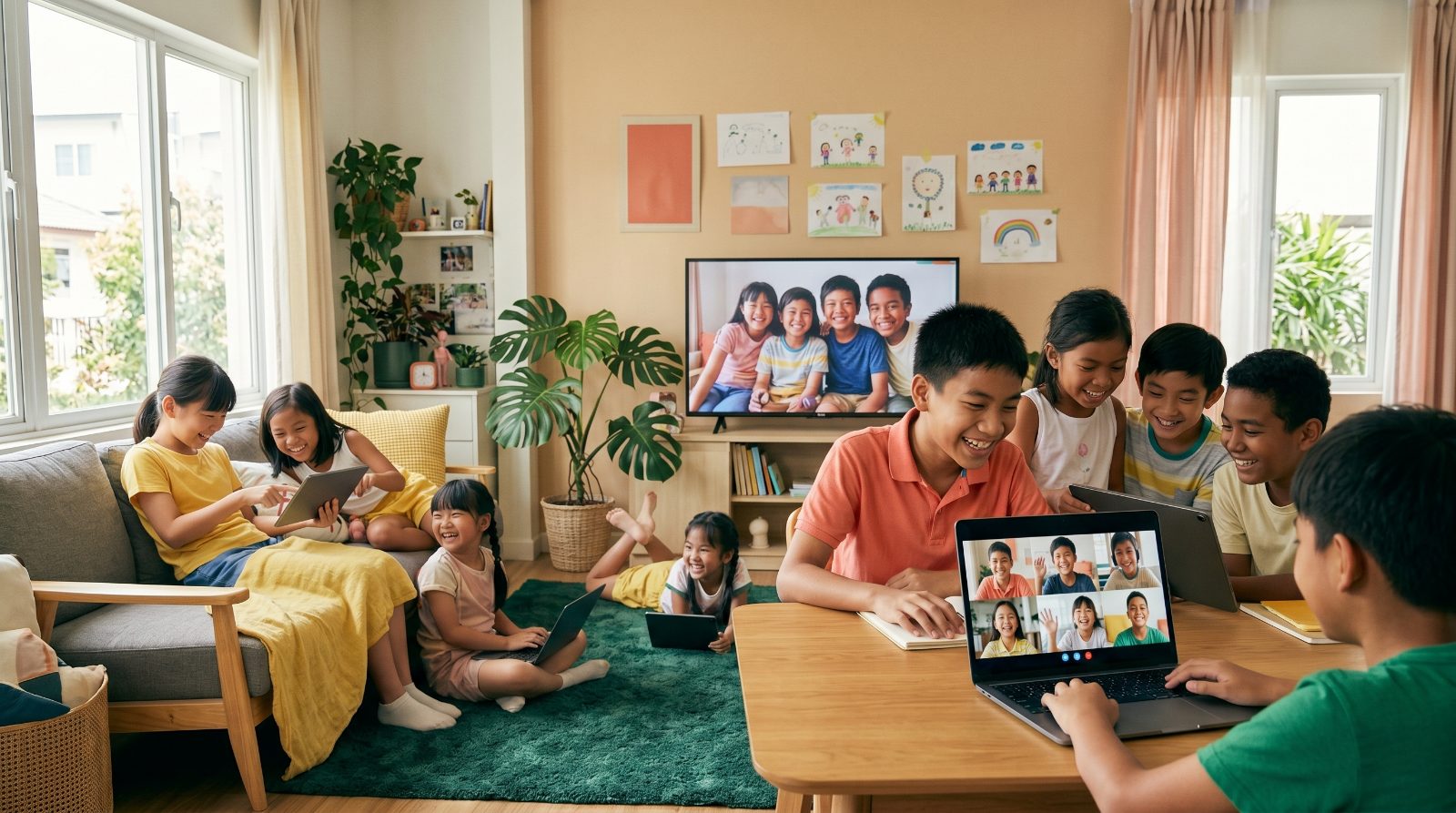
International and online international schools. Learning in English, inquiry-led work and an international curriculum. When the school is delivered online, where you live stops limiting what you can choose, which matters where campus options are few or unaffordable. You can see which exist in this list of online international schools in Asia.
One caution. Two schools flying the same flag can run very differently. The name of the tradition is only a signpost at the entrance. In the end you have to look at the actual school.
What families still worry about after the tour
So far this has been about ideas. Here is what surfaces at the kitchen table afterwards.
Cost. Where these schools sit outside the state system, public funding usually does not reach them, so fees are generally higher than a local state school. Beyond that, the spread is too wide for any honest generalisation — some sit close to a campus international school, others far below it. Ask each school directly, and ask about enrolment fees, materials and trips as well as tuition.
Credentials and pathways. This is the question that keeps parents awake, and the answer depends on your country. Where the school is not formally recognised, the leaving certificate is usually handled through the school where your child remains registered. At secondary level, many families pair an alternative setting with an accredited distance or online programme, so a recognised qualification is built in parallel. Confirm the route in writing before you commit.
Distance. No amount of enthusiasm fixes geography. A school you love two hours away is a school your child will be too tired to enjoy. This is the wall that sends most families to look at online options in the first place.
Four ways to learn, compared on the same terms
Saying that every option has its merits helps nobody choose. Here are four paths measured against the same four things. Nothing scores well on all four.
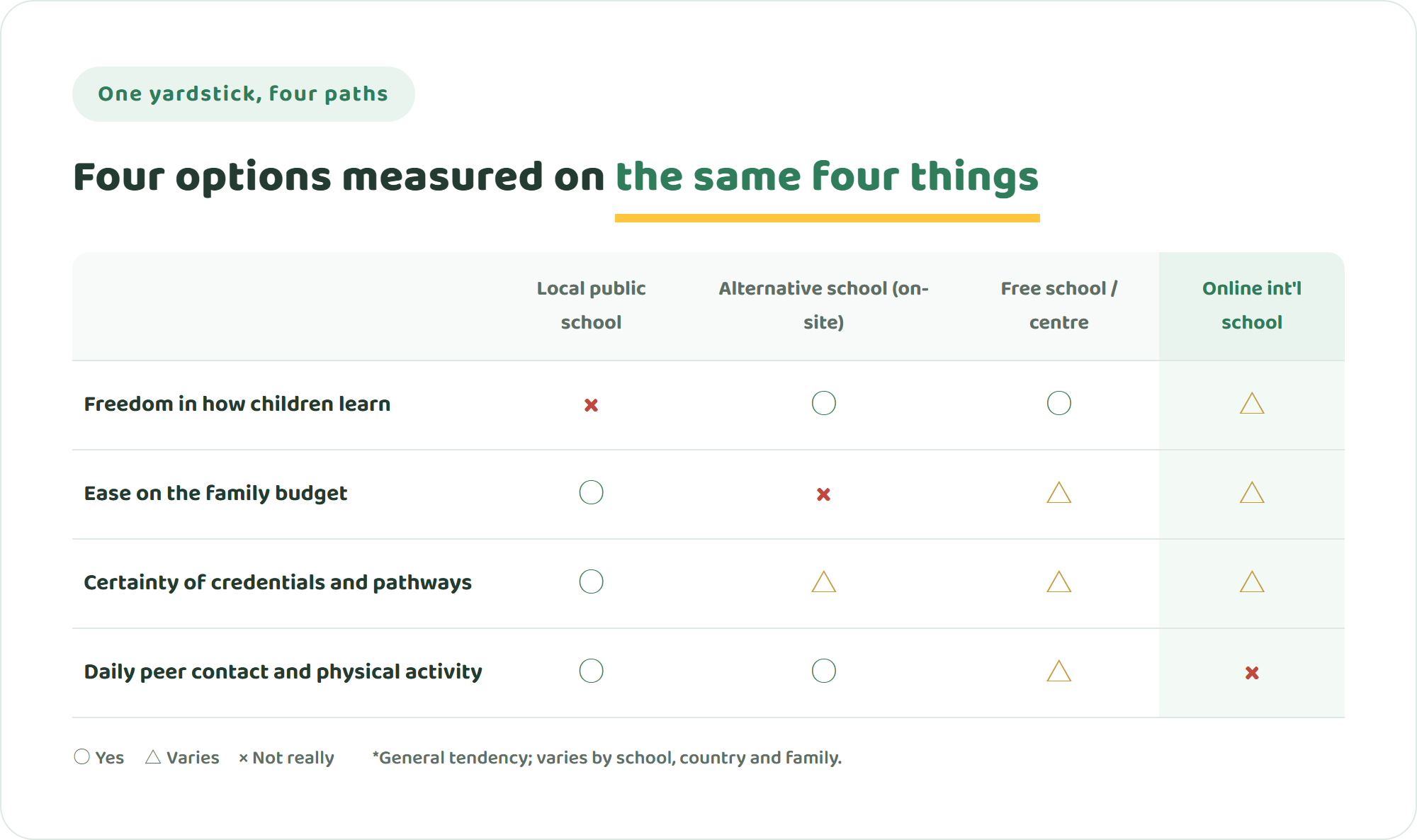
| What you are weighing | Local public school | Alternative school (on-site) | Free school / centre | Online int’l school |
|---|---|---|---|---|
| Freedom in how children learn | × | ○ | ○ | △ |
| Ease on the family budget | ○ | × | △ | △ |
| Certainty of credentials and pathways | ○ | △ | △ | △ |
| Daily peer contact and physical activity | ○ | ○ | △ | × |
○ Yes / △ Varies / × Not really. A general tendency only; it shifts with the school, the country and the family.
The grid makes an ordinary truth visible: choosing something means letting something else go. More freedom in how a child learns usually means you design the pathway yourself. Lower cost usually means less of the density only a shared room provides. Do not try to win every row. Decide which single row your family cannot compromise on, and the shortlist writes itself.
See how learning works at NIJIN GLOBAL ACADEMY →
How to choose an alternative school for your child
Here is a sequence you can start this week. Nothing about it is clever, but following the order genuinely reduces what you regret later.
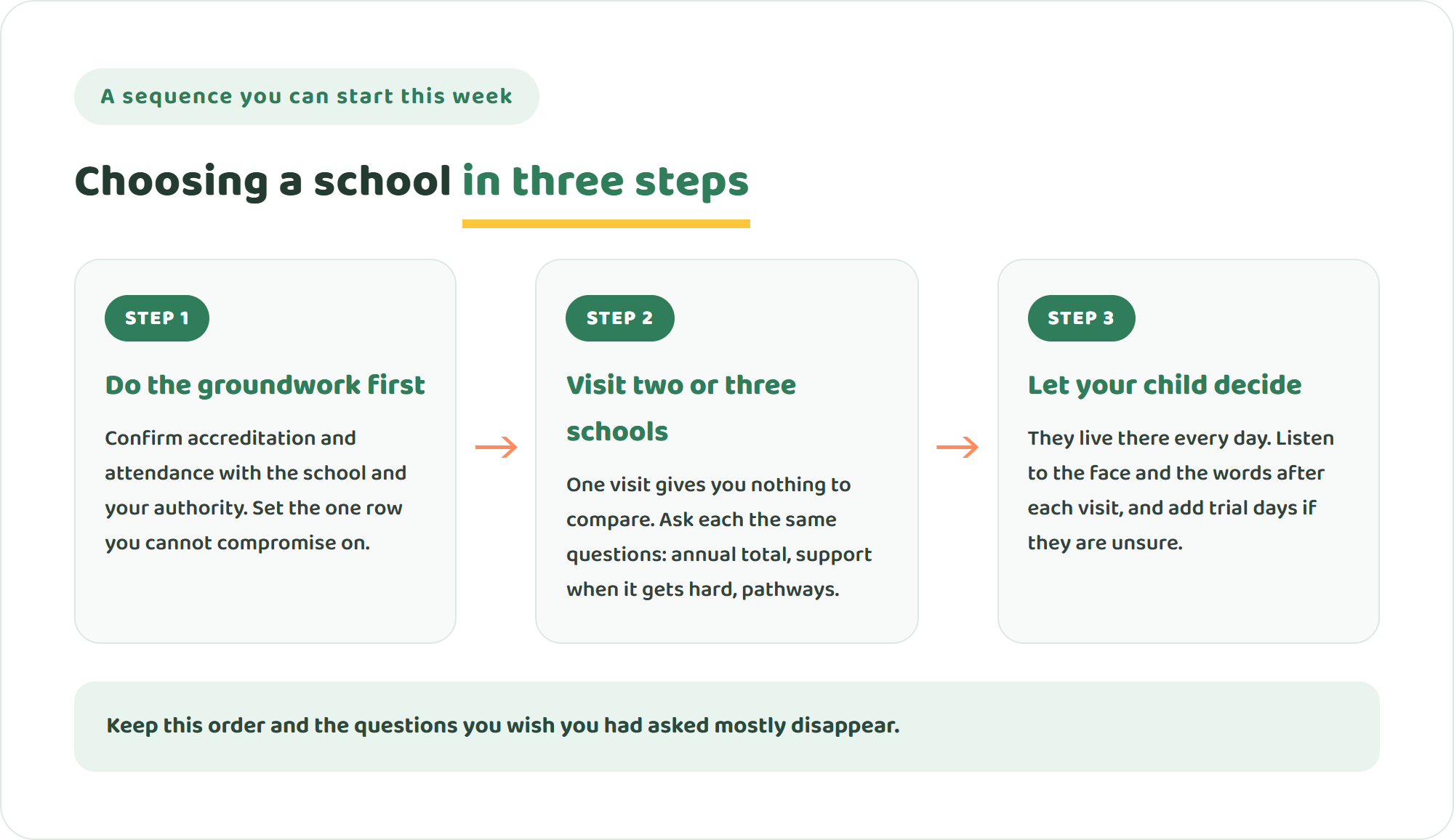
Do not skip the third one. When a child says quietly that a place is not right, that instinct is often more accurate than the adult assessment. And sometimes, in a room that looked unremarkable to you, you will see your child’s shoulders drop for the first time in months. The person who lives there daily should get the final word.
Frequently asked questions
Will attendance at an alternative school count officially?
It depends on your country, and often on your district. In some systems these schools are fully accredited and the question does not arise. In others, attendance is recognised case by case by the registered school and the local authority. Ask both, name the school you are considering, and get the answer in writing rather than from forum posts.
How much does an alternative school cost?
The range is too wide for any honest single figure, and it does not line up neatly against campus international school fees either. Ask each school for the annual total, including enrolment fees, materials and activities, then ask how many years you could sustain it. Stopping midway is harder on a child than not starting.
What happens at secondary level and beyond?
Where the school is not formally recognised, the leaving certificate is usually handled through the school of registration, and at secondary level many families run an accredited distance or online programme alongside. Graduates of alternative settings do reach university, but the route usually has to be built deliberately rather than assumed — which is why the paperwork question belongs in your first meeting, not your last.
What if there is nothing like this near us?
Then do not force a commute. Online schools, hybrid arrangements and home-based learning combined with outside programmes are all real options, and in much of Asia and Oceania they are the only realistic ones. What matters is that your child keeps a place to learn and people to learn with. Write the local options and the location-free ones on the same sheet of paper.
You do not have to decide today
So, what is an alternative school, in the end? Not the place where children land when things go wrong. Learning has always come in several shapes, and you are simply looking at another one. What did not fit was not your child. It was the shape of the room they happened to be sitting in. That thought alone takes some weight off the morning.
NIJIN GLOBAL ACADEMY is an online international school opening in September 2027, with pre-opening trial classes planned for spring 2027. It is built on the idea that children should come to like themselves and the world, and that when something breaks we fix the system rather than blame a person. News about the first intake goes out by email first. You do not have to decide anything today. Just keep in mind that there is far more room in how a child can learn than it looks from inside one classroom.