You saw the tuition figure and quietly closed the tab. There is no international school within commuting distance. Or the mornings have been getting harder, and more days end with your child still in bed. The starting points differ, but the road that leads a family to the phrase “online international school” is remarkably similar. And then the search results are all school brochures — plenty of promises, almost nothing on what is genuinely good and what is genuinely hard.
So here are the online international school pros and cons, five of each, given equal space. We are building an online school ourselves, which is exactly why this article also says who it doesn’t suit.
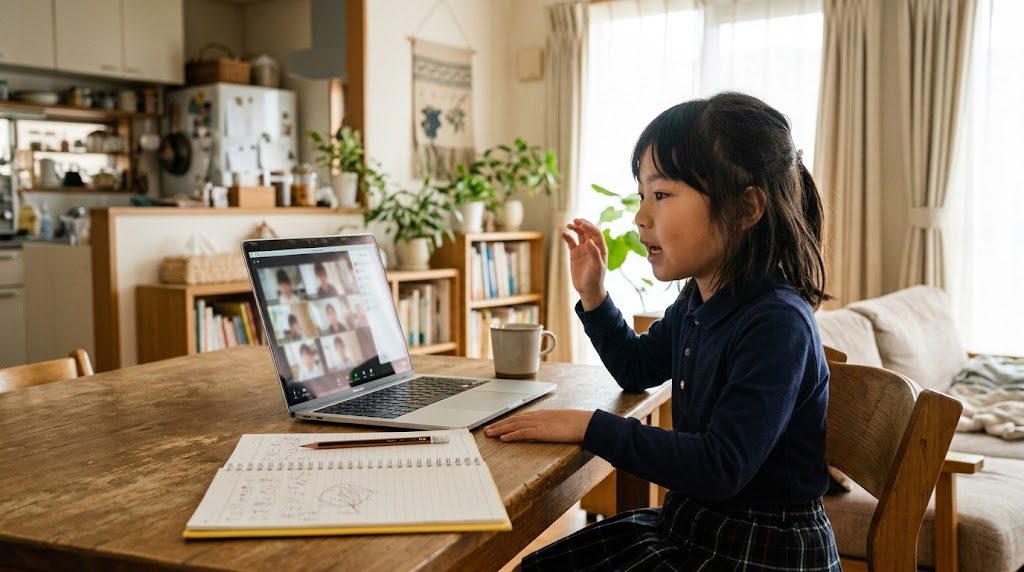
What an online international school is — the structural difference from a campus school
English as the main language of learning, an international curriculum. That core is the same as a campus school (what an international school is). What differs are four foundations: the building, the commute, class size, and the timetable. With no campus there are no facilities costs, and with no commute your address stops deciding your options. Classes are usually small-group dialogue, and timetables can flex.
So it isn’t a lighter version of a campus school. It is a school that puts its constraints somewhere else — removing distance and cost, and taking on a different set of problems in exchange. For the landscape of what exists, see our list of online international schools in Asia.
Online international school: five real advantages
The good side first — but with the reasons, not just the adjectives.
1. Tuition tends to be lower by the cost of the campus
Fees at campus international schools in Japan vary enormously by school: roughly ¥1,000,000 to ¥3,450,000 a year, with the better-known schools clustering around ¥2,000,000 to ¥3,450,000 (see our tuition overview; always confirm figures with each school’s official source). An online school carries no construction, maintenance or bus costs, so the band sits lower. The spread between schools is still wide, and choosing on price alone means skipping the checks below (are online international schools actually affordable?).
2. Where you live stops mattering
A rural town, a job with frequent relocations, a posting overseas — the school stays the same. Campus international schools cluster in a handful of cities, so for most families the honest answer has been that there was nothing to choose from. Online erases that geographic unfairness.
3. No commute, and it flexes around health
Removing an hour each way changes a child’s whole day. Crowded trains, the noise of a classroom, the rush of getting ready. For a child who finds these draining, being able to join from home restores the basic conditions for learning. If missed days can be caught up on recordings, coming back is easier too (learning with the world when school isn’t working).
4. Small groups, and a child can choose how they take part
Class size isn’t dictated by the dimensions of a room. Groups of a few students can run daily, so each child speaks far more. It is also easier to design in real choice: whether the camera goes on, whether to speak aloud or write in the chat. Never putting a child on the spot in front of a crowd is simply easier to implement online than in person.
5. It combines well with a Japanese school or other activities
A flexible timetable is, in practice, a combinable one. A child can stay enrolled at their local school and add international learning alongside it — what families here call the “double school” route: local school in the morning, international learning alongside it. Neighbourhood friendships, club activities and music lessons all stay. Not having to switch everything at once may be the most overlooked advantage of all.
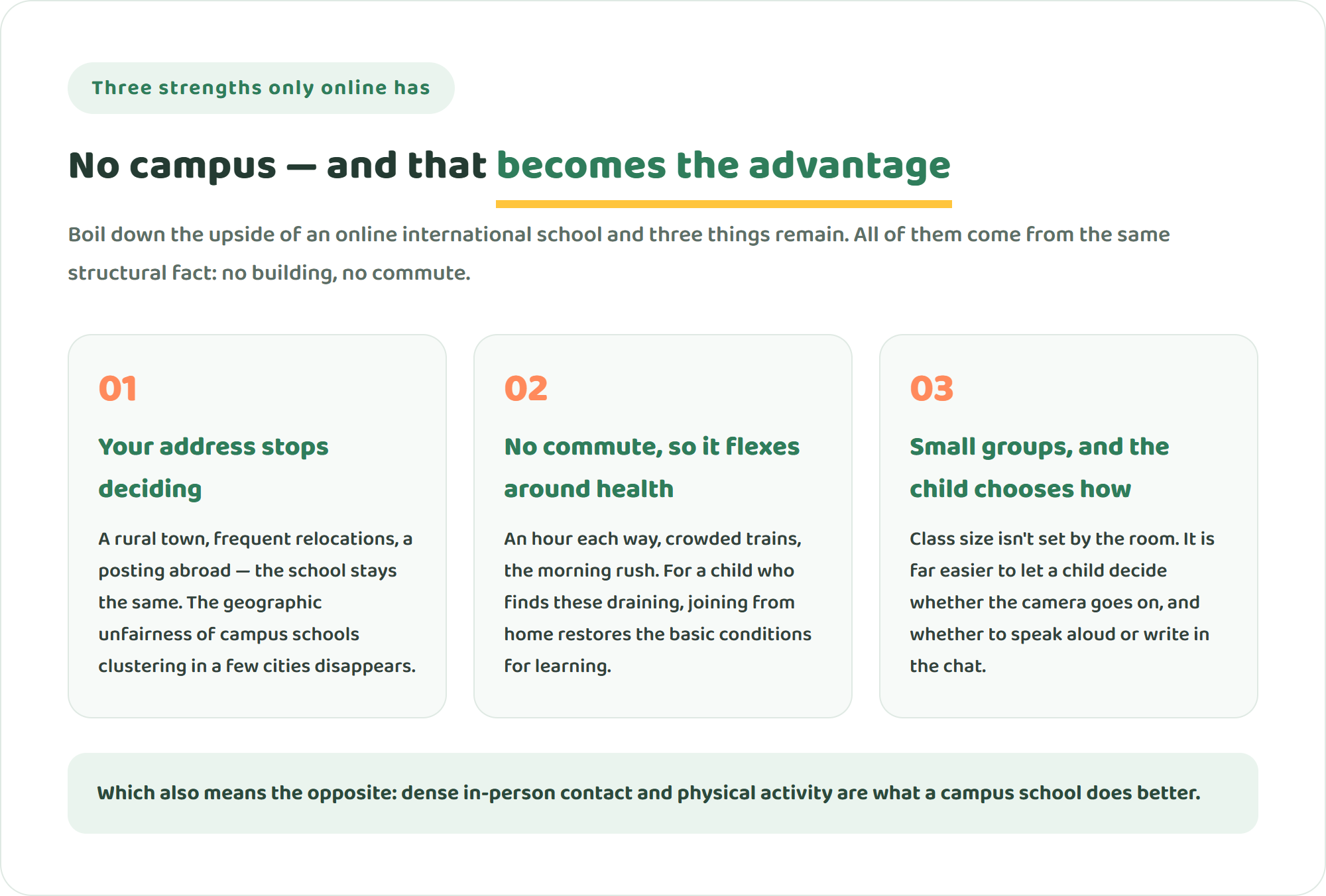
Online international school pros and cons: five honest drawbacks
Now the part most brochures skip. Five, the same number as the advantages — and these five are specific to online. For the drawbacks of international education itself, such as cost and first-language development, see the pros and cons of international school.
1. Incidental contact and physical activity fall short
You can design a lesson; you cannot really design the throwaway conversation at break time, and most friendships start there. Time spent moving isn’t automatic either. Assume you will need deliberate extras — the school’s out-of-class spaces, plus sport or local activities from your side.
2. It asks a child to run their own rhythm
Without the compulsion of a commute, waking up and sitting down are decisions your child makes. That builds self-direction, but not every child arrives able to do it. Ask what scaffolding the school provides, and how often a homeroom teacher or mentor is actually in contact each week.
3. The first few months lean on the parent
Setting up equipment, learning the timetable, handling school communication. The younger the child, the more adult hands the launch requires. If both parents work, budget for that start-up cost realistically. Assuming online means easy is how families get caught out.
4. Connection, devices and time zones are preconditions
A stable line, a device the child doesn’t have to share, and somewhere they can concentrate. Miss one and daily learning erodes. Schools based overseas may run live classes early in the morning or late at night, Japan time. Sit in on a trial class at the real hour before you decide.
5. It is not an Article 1 school, so check compulsory schooling and pathways
Most international schools in Japan are not “Article 1” schools under the School Education Act, and online schools are no exception. For a Japanese-national child of compulsory-school age, the usual arrangement is to stay enrolled at the local school while learning online — confirm the details with your municipal board of education. At high-school level and beyond, what you can progress to depends on the accreditation involved (qualifications you can earn online).
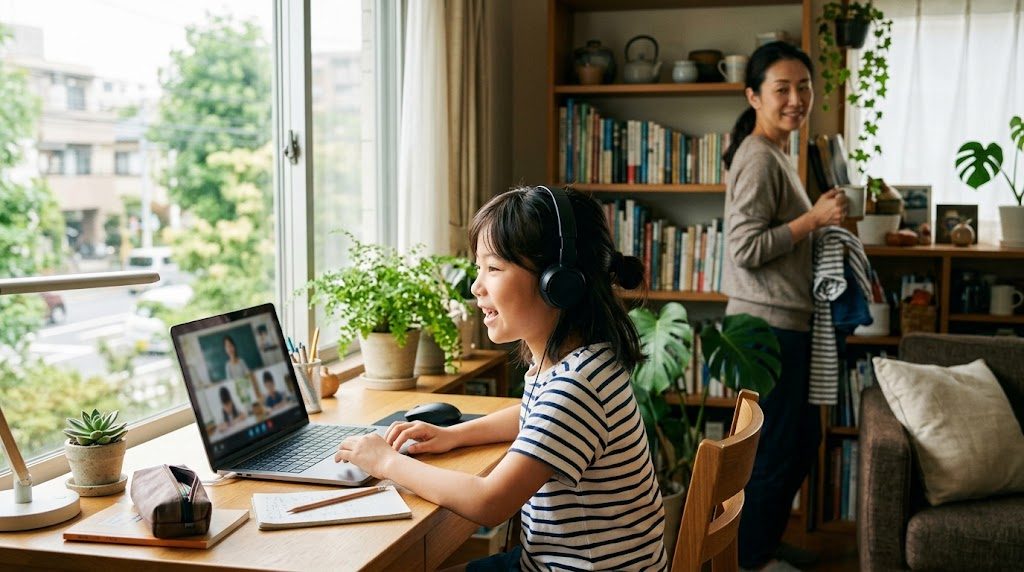
Campus, online, or a Japanese school plus online — compared point by point
Cost, commuting load, everyday English, clarity of onward pathways, and in-person contact. Line those five up and it becomes obvious that every route has a weak spot.
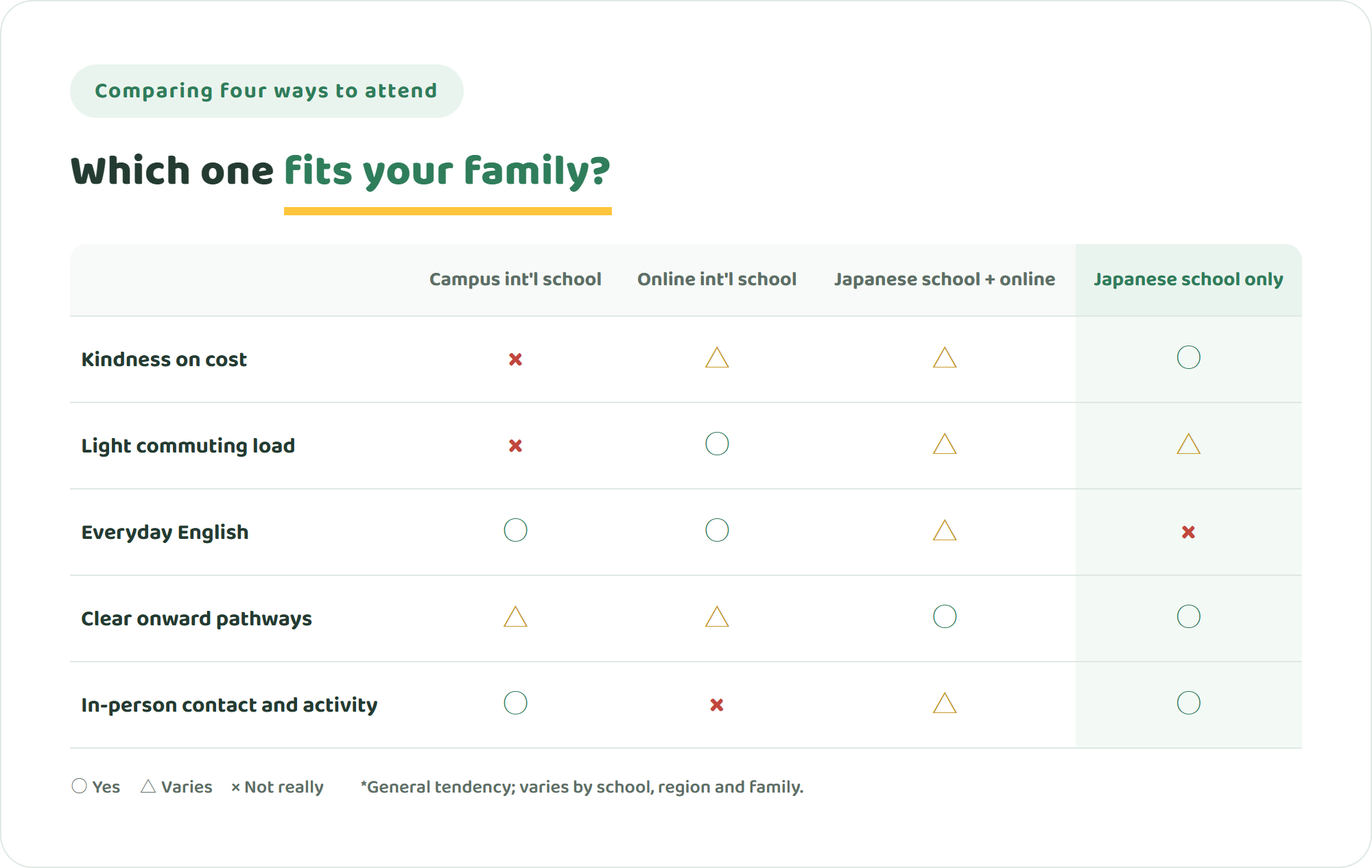
If an English environment at a manageable cost comes first, online is strong. If certainty about pathways inside Japan comes first, keeping the Japanese school as the spine and adding online is the safer build. A campus school is the choice to pay in money and travel for a dense, physical environment. Decide which row your family ranks first and the comparison finishes surprisingly quickly.
Who it suits, and who it doesn’t
It suits families with no realistic option within reach, families facing relocation or a move abroad, children for whom a large classroom is itself the load, and families who want to keep the Japanese school while adding learning in English.
It is a weaker fit when rest has to come first for a child, a situation where in-person professional support is what’s needed, and a home without a stable connection or a device the child can use freely. A child who grows through moving their body among others will find online alone thin. Either way, that isn’t a failure — it is a question of fit.
Five things to check before you choose
Write these down before you request a single brochure. One: accreditation. Which body (WASC, CIS, Cognia, IB and so on), and is it granted or still in application? Two: the qualification and the exit. What does a student finish with, and how is it treated in Japan and abroad? Three: time zone and class hours. What time are live classes in your time zone, and can recordings substitute?
Four: the language of support. What language is academic support delivered in, and what language are parents contacted in? English-only can cost a family more than expected. Five: how easy it is to try. Can your child join a real trial class and see the actual group size and atmosphere? One trial session tells you more than any photograph.
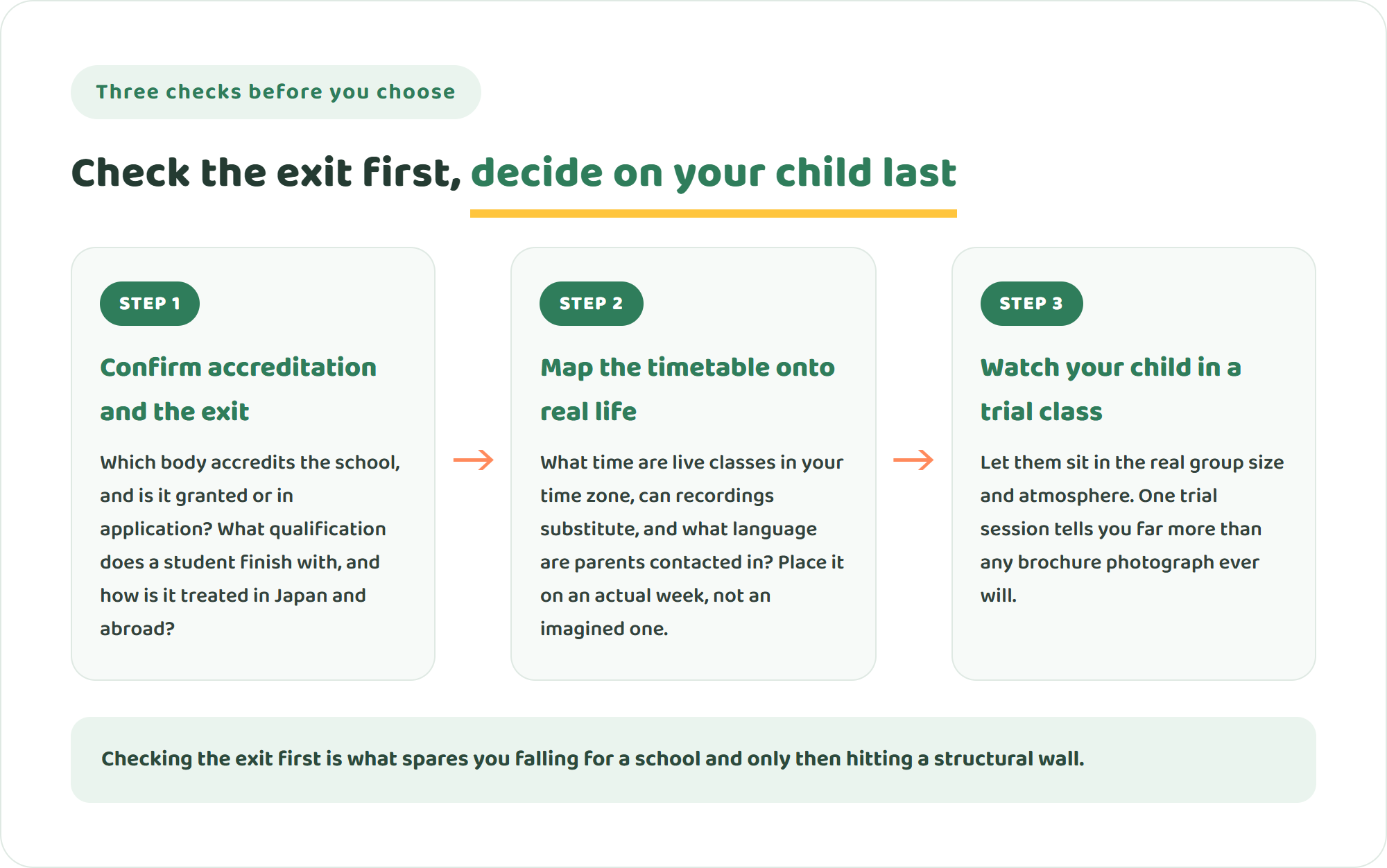
Checking the exit first spares you falling for a school and only then discovering a structural wall. And let the final call rest on your child’s own reaction, not on the version of the school you fell in love with.
See how learning works at NGA →
Where NGA sits — an online international school, described honestly
NIJIN GLOBAL ACADEMY (NGA) is also an online international school beyond the exam race, opening in September 2027, for ages 6 to 18. It is operated by NIJIN Inc., and NIJIN Academy, one of Japan’s largest alternative schools, already has over 900 children enrolled. At the centre of the design is psychological safety — concretely, each child chooses how many people they engage with, and how. The ground beneath it is coming to love yourself and the world, with the world itself as the material.
And in fairness: there are times and families NGA does not suit. When rest has to come first, any school can wait. If in-person professional care is what’s needed, that comes first. If what you want is daily physical group life, a campus school within reach fits better. Not pushing a child into a structure that doesn’t fit them is part of what “don’t blame people, fix the structure” means to us.
Frequently asked questions
Does joining an online international school mean leaving our Japanese school?
Usually not. Most families keep their child enrolled locally and combine the two, because most online schools are not Article 1 schools and cannot replace compulsory schooling in Japan. How attendance is recorded is decided by the enrolled school and the local authority, so ask the homeroom teacher or the board of education directly.
Can a child join with almost no English?
It depends on the school. The dividing line is the depth of English support (EAL/ESL): some run genuine beginner streams, others set an English requirement for admission. The question worth asking is not whether support exists, but how many times a week, delivered by whom, and in what form.
Will my child make friends?
Yes — but not the way friendships form in a corridor. What matters is whether relationships are designed to grow through small-group dialogue and projects, and whether there are spaces outside lesson time. Friends across borders are a genuine upside of online; a friend to play with down the road is something to arrange separately. That is why most families plan for local activities alongside.
There is no perfect option. So compare honestly.
The pros and cons of an online international school come down to this: it lifts three constraints — distance, cost and class size — and leaves three pieces of homework: incidental connection, self-direction, and verifying how the system treats you. Both are true. Keep some distance from anyone who shows you only one half.
What matters isn’t finding a perfect school. It is working out which constraint weighs heaviest on your particular child. NIJIN GLOBAL ACADEMY opens in September 2027. We’ll send you how our learning works and news of our first cohort by email. Nothing has to be decided today.