If you are searching for online teaching jobs from home in India, you are probably weighing two things at once: whether a school abroad will really hire someone who never leaves Bengaluru or Kochi, and whether the schedule can fit around the life you already have. Start with the number that decides most of it. India Standard Time is UTC+5:30 and Japan Standard Time is UTC+9, so India runs 3 hours 30 minutes behind Japan. A class that begins at 4:00 pm in Japan starts at 12:30 pm where you are. For a school that teaches in Japanese hours, an Indian-based teacher is not a stretch — it is an ordinary working afternoon.
The second thing to be clear about is what the arrangement actually is. NIJIN GLOBAL ACADEMY (NGA), an online international school opening in September 2027, is hiring founding members on a fully remote basis, with no visa and no relocation cost — and on the international track those founding roles begin as volunteer positions, with detailed terms shared later in the process. That is said in the first paragraph rather than the last, because it decides whether the rest of this article is useful to you. It covers what international schools actually check when you live in India, how to prepare, and how to tell a real remote role from a scam.
What an online international school checks when you live in India
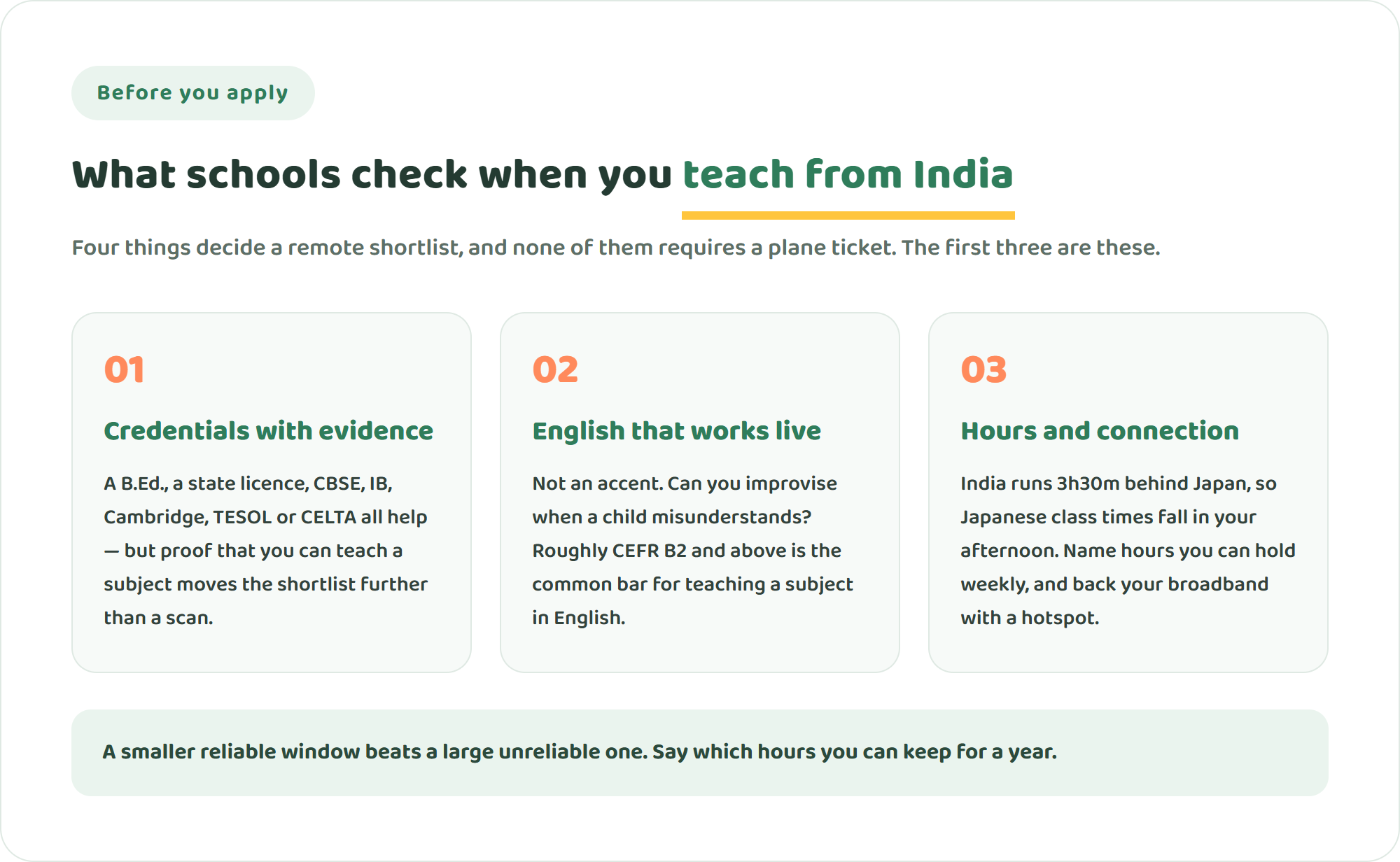
Four things, in roughly this order. First, credentials with evidence behind them. A B.Ed., a state teaching licence, a CBSE or IB or Cambridge background, a TESOL or CELTA certificate — any of these help, but what moves a shortlist is proof you can teach a subject, not a scan of a certificate. Second, English that works in a live classroom. Not an accent. Can you improvise when a child misunderstands you? Most schools describe this as roughly CEFR B2 and above; NGA uses B2+ as its guideline.
Third, overlap with the school’s teaching hours. This is the quiet reason applications fail. Say honestly which hours you can hold every week for a year — a smaller reliable window beats a large unreliable one. Fourth, your connection and setup. A stable broadband line with a mobile hotspot as backup, a headset, a quiet room, and enough light on your face. Schools rarely ask for equipment lists, but they notice all of it in the first video call.
Notice that none of the four requires a plane ticket. If a school is genuinely remote, hiring you in India costs it nothing in visas or relocation — and that changes who it can afford to hire. See the founding-member roles at NIJIN GLOBAL ACADEMY →: it is one of those schools, and even one class a week is welcome. Founding roles on this track begin as volunteer positions ahead of the 2027 opening and detailed terms come later in the process — so the thing to check first is not the money but whether that 12:30 pm window genuinely works for your household.
Three ways to teach from home in India, compared honestly
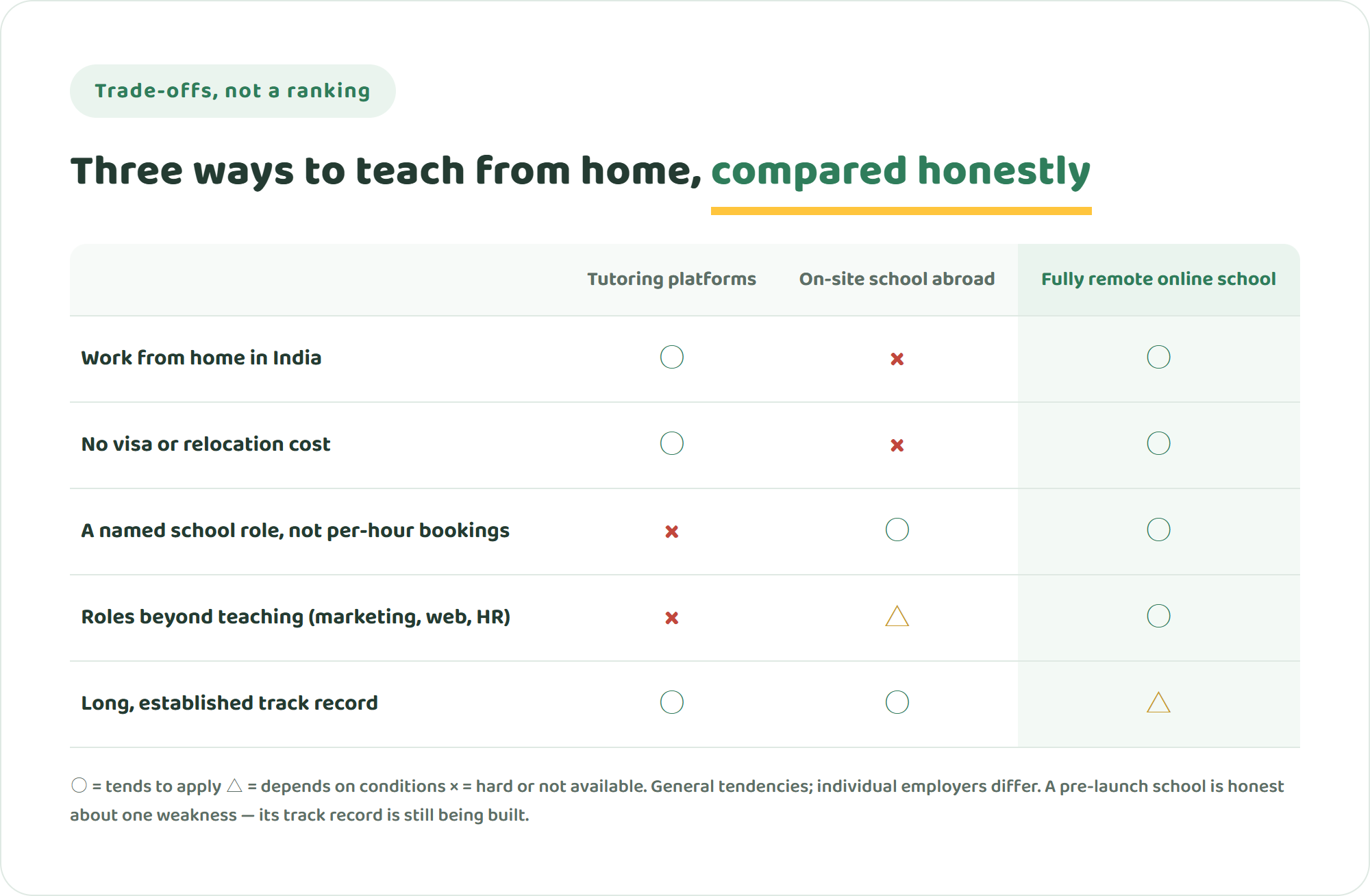
Most home-based teaching work in India falls into three shapes, and they are not equally good at the same things. Tutoring platforms are easy to start and pay per hour, but the hours are fragile and you rarely build a curriculum of your own. An on-site international school abroad pays well and looks strong on a CV, but it requires a visa, a move, and the family conversation that comes with it. A fully remote online international school keeps you at home and keeps the school role — a timetable, colleagues, the same students each term — rather than a queue of bookings. The trade-off is that a school still being built may start you as a volunteer rather than on a contract.
None of them is a universal answer. A pre-launch school has no long track record; an established platform does, even if the work is thinner. Read the table below as a map of trade-offs, not a ranking.
Not a tattoo of certificates — a portfolio and a demo lesson
Applicants from India are often over-prepared on paper and under-prepared on evidence. The two artefacts that change interviews are simple and free to make.
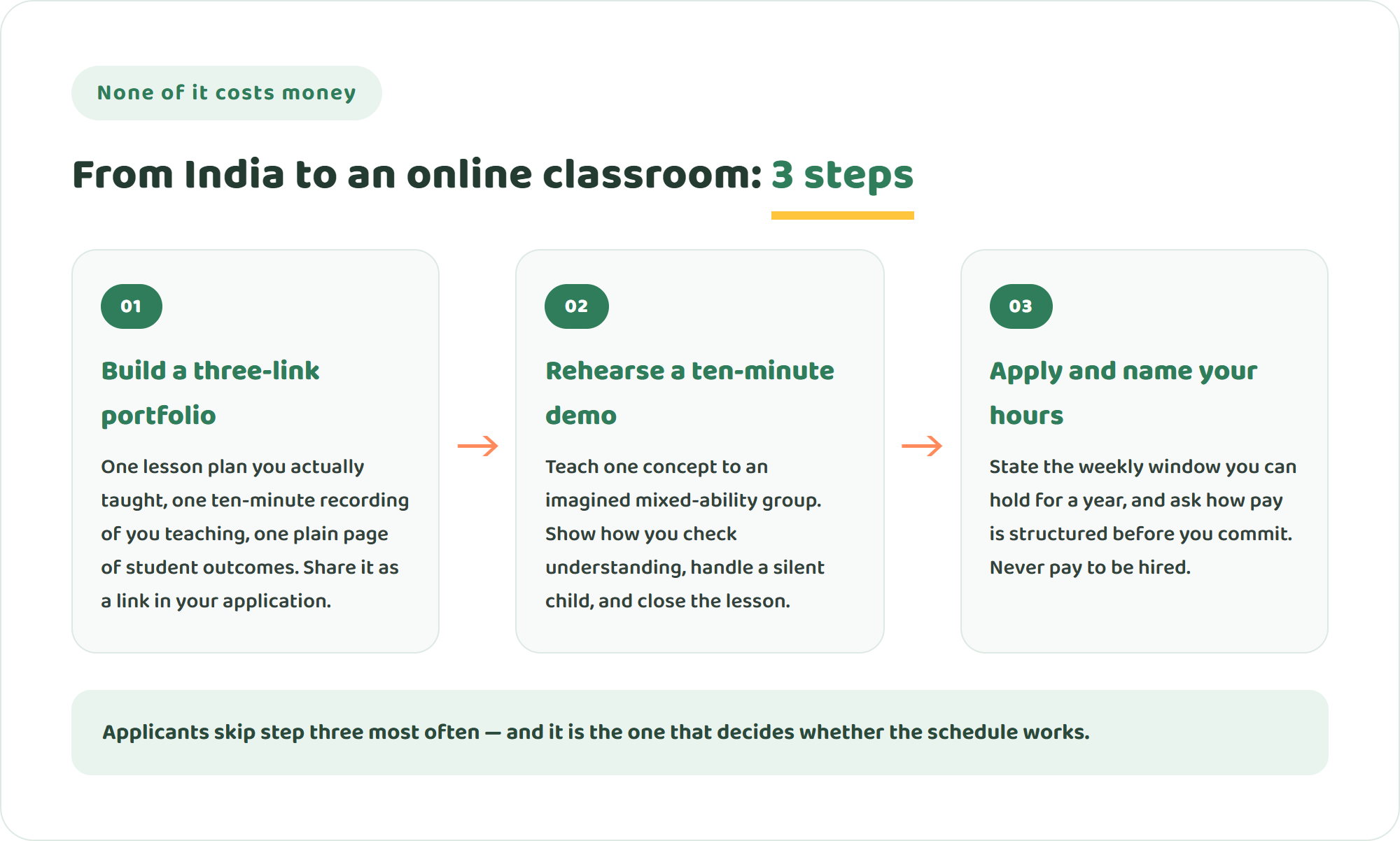
A portfolio of three links. One lesson plan you actually taught, written so a stranger can follow it. One short recording of you teaching — ten minutes of a real or simulated class is enough, phone camera is fine. One page of student outcomes described plainly: what they could not do, what they could do afterwards. Host it anywhere with a shareable link and put that link in your application.
A ten-minute demo lesson you can run cold. Pick one concept in your subject, teach it to an imagined mixed-ability group, and rehearse the parts that show judgement: how you check understanding, what you do when a child goes quiet, how you close. Schools are not testing polish. They are testing whether a child would want to be in your class again tomorrow.
How to tell a real remote job from a scam
The remote-teaching market attracts predatory listings, and teachers in India see more of them than most. A few rules hold up well. Never pay to be hired. Registration fees, mandatory paid training, deposits for equipment, charges for a background check — a legitimate employer pays for its own hiring. Check that a legal entity exists. A real school has a registered company, a named address, staff with traceable professional histories, and a website that predates the job ad.
Be careful with documents. Bank details, Aadhaar, or passport scans belong at the contract stage, never at first contact. Insist on seeing a face. If every step happens over chat and nobody will hold a video call, stop. And read the pay structure, not the headline. A high per-hour rate with unexplained deductions, unpaid preparation, or penalties for cancelled classes can pay less than a modest flat salary. The red flag is not that a listing gives you no figure in the advert — plenty of honest employers settle terms in conversation, and some roles genuinely start unpaid. The red flag is an employer who will not tell you when and how the terms get decided, or who will not put them in writing once you ask.
What NIJIN GLOBAL ACADEMY is offering, plainly
NGA is an online international school run by NIJIN Inc. in Japan, opening in September 2027, currently hiring founding members. Four facts matter for a reader in India. It is fully remote, so there is no visa and no relocation cost and the team is hired from anywhere in the world. There are five ways of working, from part-time through to full-time. You can choose work beyond teaching — marketing, web, partnerships, HR — because a school being built from zero needs all of it. And, by our own test above: founding roles on this track begin as volunteer positions ahead of the 2027 opening, and detailed terms are shared later in the process. We are not exempting ourselves from the paragraph you just read — we are telling you when the conversation happens, and it is not after you have committed.
Two honest notes. We are building a genuinely multinational faculty — not an all-native-speaker roster, and we would rather say so than pretend otherwise. And the school has not opened yet, so stability and track record are still ahead of us rather than behind us. What we can offer now is the rare thing in education: a say in how a school is designed. Selection runs from documents to a group interview, an internship at the sister school NIJIN Academy, and a final presentation.
Even one class a week is welcome — you can start as a volunteer if you want to give something back while keeping your current post. If you want the wider route into this field first, read how to become an international school teacher and which English teaching qualifications schools actually ask for.
Frequently asked questions
Can I teach for an international school abroad while living in India?
Yes, if the school is genuinely remote. What matters is overlap in teaching hours, English that works live, and evidence you can teach — not your postcode. With India 3 hours 30 minutes behind Japan, Japanese school hours fall in your afternoon.
Do I need a B.Ed. or a teaching licence?
It depends on the school. Many international schools require a recognised licence; NGA’s own listing does not set out a licence requirement, describing instead the kind of person it wants — someone who can help build a school from nothing. Never assume a licence is optional — check each posting.
What English level is expected?
Roughly CEFR B2 and above is the common bar for teaching a subject in English, and NGA uses B2+ as a guideline. Fluent Indian English is entirely standard in international schools; clarity and classroom responsiveness matter, accent does not.
Is part-time work realistic alongside a school job in India?
Yes. Part-time patterns exist precisely for teachers who are already employed. State the hours you can hold every week rather than the maximum you could theoretically manage.
You do not have to leave the country to join a school abroad
For a long time, teaching internationally meant emigrating. That is no longer the only version. If you have the subject knowledge, the English, and a window of hours you can keep, the distance between your home in India and a classroom in another time zone is 3 hours 30 minutes and a stable connection. Build the portfolio, rehearse the demo, name your hours — then apply somewhere that shows you the numbers first.
Working at an International School — More Articles
- international school teacher salary
- how to become an international school teacher
- career change from teaching
- career change from teaching in your 30s and 40s
- how much do teachers earn?
- how to become an IB teacher
- jobs for moving abroad
- careers with a teaching license
- qualifications to teach English
- teach one class a week online
- part-time online teaching jobs from home
- teaching jobs without a license
- working at an international school: pros and cons
- online school jobs
- thinking of quitting teaching
- international school staff jobs
- remote jobs that use English
- digital nomad teaching jobs
Teach from where you already live. Help build the school from the ground up.