Search for international schools in Shinjuku and you run into the same wall almost immediately: nearly every result is a preschool. Shinjuku is home to more foreign residents than any other of Tokyo’s 23 wards — Shin-Okubo, Takadanobaba, Yotsuya and Kagurazaka each have their own international character — yet clear, current information about schooling here is oddly hard to assemble. This guide sets out seven international schools genuinely located in Shinjuku Ward, with the fees each school actually publishes. It also answers the question that matters most in this ward — can a child stay in Shinjuku from primary through to high school? — and covers the compulsory-education rules Shinjuku Ward itself warns families about, the options one train stop away, and an eighth route worth knowing if fees or the commute turn out to be the real obstacle.
Quick Answer: Your Options in Shinjuku
If you only read one section, read this. Below are the schools covered in this guide, plus the online option — so you can see every route side by side before the details.
- Waseda International Christian School (WICS) — fees and features: the ward’s only kindergarten-to-high-school route — Ages: kindergarten (4–5) through primary and on to secondary; the published fee table…
- Yotsuya International School — fees and features: a US high school diploma, and a Japanese one too — Ages: elementary, junior high and high school divisions (high school graduation… / Fees: not published on the school website — contact the admissions office directly…
- Tokyo Korean School — fees and features: primary through high school in Wakamatsucho — Ages: elementary, junior high and high school divisions. Co-educational / Fees: not published publicly — contact the school directly
- Tesoro International School — fees and features: a small-group preschool in Ichigaya — Ages: 2 to primary school entry, classes capped at 20 / Fees: ¥92,400 enrolment fee; monthly tuition ¥109,700 (5 days), ¥96,000 (4 days) or…
- Aoba-Japan Bilingual Preschool, Waseda Campus — fees and features: the ward’s only IB PYP school — Ages: 1 to 5 / Fees: not published on the school website — enquire directly or at an open day
- i Kids Star Yotsuya — fees and features: English plus reasoning and physical development — Ages: three year groups from nensho (age 3 class) to nencho, ninety places in total / Fees: base tuition ¥89,250 a month; eligible households may receive up to ¥37,000 a month…
- Frontierkids Global School — fees and features: Montessori meets English — Ages: from around two and a half to five / Fees: not published on the school website — enquire directly
- NIJIN GLOBAL ACADEMY (online) — Ages 6–18 / opening September 2027, currently taking opening-update registrations / fees around one-fifth of a typical campus international school / Japanese-language support. An option when commute or fees are the wall.
International schools in Shinjuku: the landscape and what they cost
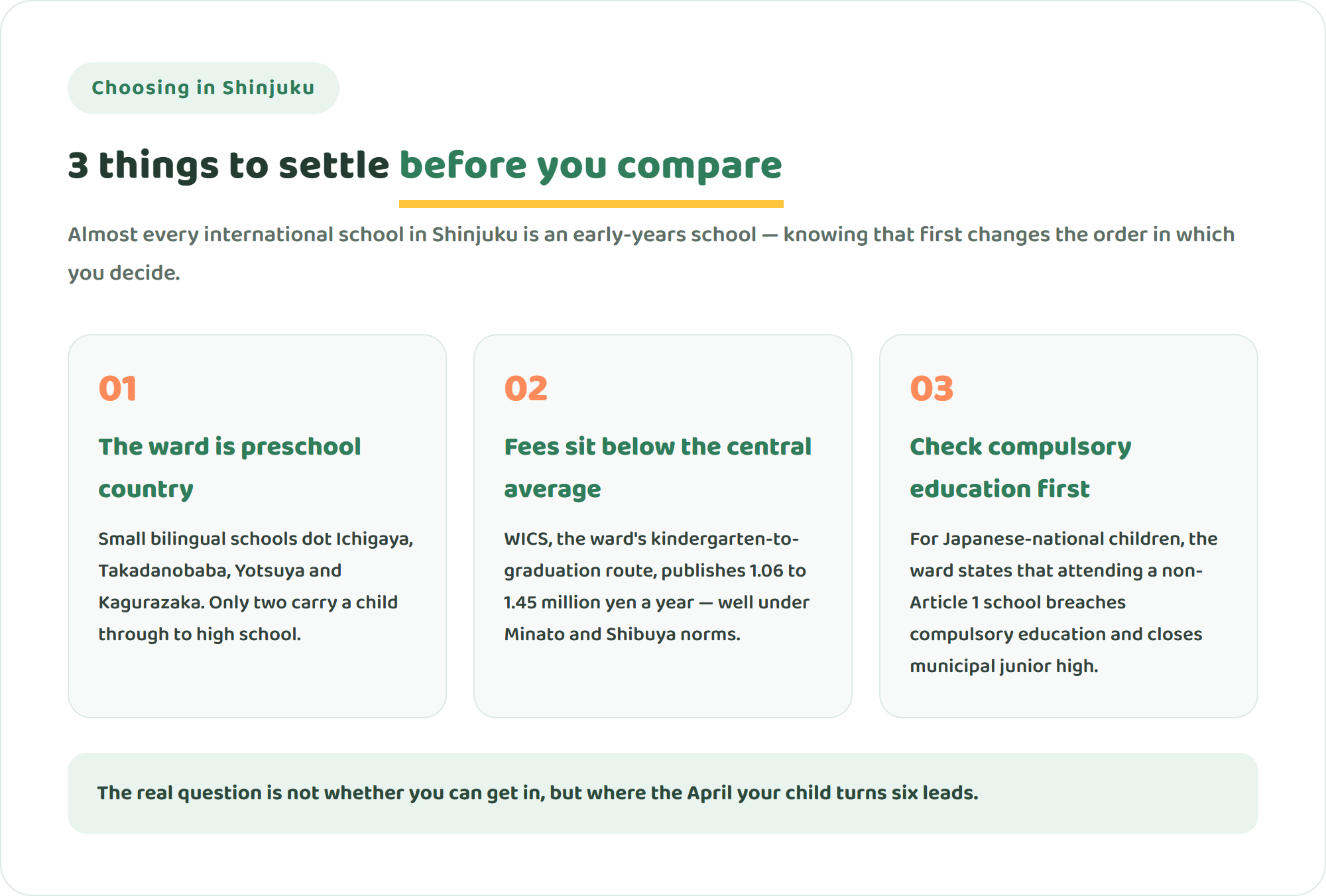
Here is the honest map. The overwhelming majority of international schools in Shinjuku Ward serve children aged roughly two to six — bilingual preschools and kindergartens scattered across Ichigaya-Tamachi, Takadanobaba, Yotsuya, Ichigaya-Kagacho, Shinjuku-Gyoenmae and Kagurazaka. By headcount of institutions, the ward is well supplied. What thins out sharply is everything after age six. Only two schools carry children through primary, middle and high school inside the ward: Waseda International Christian School in Okubo, and Yotsuya International School near Yotsuya Station. Tokyo Korean School in Wakamatsucho also runs primary through high school, though it primarily serves families with Korean roots. Unlike Minato or Shibuya, Shinjuku has no large IB continuum school taking a child from nursery to university entry on one campus.
Fees, though, are where Shinjuku quietly stands out. Established international schools in Minato and Shibuya typically charge between ¥2 million and ¥3 million a year in tuition. Waseda International Christian School — the ward’s one route from kindergarten to high school — publishes annual fees of ¥1,056,000 for kindergarten, ¥1,114,800 for primary and ¥1,448,400 for middle and high school (first child, student insurance included). An English-medium education from kindergarten to graduation for a little over ¥1 million a year is genuinely uncommon in central Tokyo. The ward’s preschools mostly sit between ¥84,000 and ¥110,000 a month for a five-day week: Tesoro International School publishes ¥109,700 a month for five days, and i Kids Star Yotsuya publishes base tuition of ¥89,250 a month.
None of these numbers is the whole number, of course. Enrolment fees, facility fees, materials and catered lunches sit on top. Judge by the total, and by how many years you can sustain it. Our guide to international school tuition costs breaks down where the money actually goes.
Please note: all figures here are publicly available information as of July 2026. Always confirm current fees directly with each school.
Seven international schools in Shinjuku Ward: fees and features, honestly
Rather than padding the list with schools from neighbouring wards, here is what genuinely exists inside Shinjuku: two schools that carry children through to high school, one Korean through-school, and four early-years schools. Curricula and price points differ sharply, so read these with your own child’s age, budget and temperament in mind rather than by reputation alone.
1. Waseda International Christian School (WICS) — fees and features: the ward’s only kindergarten-to-high-school route
Two buildings in Okubo — 2-23-9 for the primary school and 2-23-11 for the secondary school — house a Christ-centred international school that opened in 2016 and marks its tenth anniversary in 2026. It is a member of ACSI (the Association of Christian Schools International), a network spanning more than a hundred countries, and teaching is primarily in English. The student body reflects its neighbourhood: Japanese, Korean, Chinese and other backgrounds sitting in the same classroom, in a school small enough that teachers know every name. If your priority is an English-medium education from kindergarten to graduation without leaving Shinjuku, this is the first school to look at.
- Curriculum: Christ-centred international curriculum taught primarily in English; ACSI member school
- Ages: kindergarten (4–5) through primary and on to secondary; the published fee table runs to Grade 12. Co-educational
- Annual fees: ¥1,056,000 (kindergarten), ¥1,114,800 (primary) and ¥1,448,400 (middle and high school) for a first child, student insurance included, plus a ¥50,000 facility fee and ¥35,000 materials fee. One-off costs are a ¥20,000 application fee and a ¥300,000 enrolment fee (¥200,000 for a second child, waived from the third). Reduced annual fees apply from the third child onward. As published by the school.
- Getting there: walkable from Takadanobaba and Shin-Okubo on the JR Yamanote Line
- Good fit for: families in the Shinjuku, Okubo and Takadanobaba area who want an English-medium pathway from kindergarten to high school at close to ¥1 million a year
2. Yotsuya International School — fees and features: a US high school diploma, and a Japanese one too
Five minutes on foot from Yotsuya Station at 2-11 Yotsuya, this school runs elementary, junior high and high school divisions under one roof and is likewise an ACSI member. Its distinctive feature is the credentialing: graduates receive the school’s own diploma alongside a US high school diploma, and students who wish to can add a Japanese high school diploma at the same time. Classes come in two tracks — predominantly English, or bilingual — so children arriving from a Japanese school have a realistic entry point. Transfers are accepted throughout the year, which matters if your posting or return date is unpredictable. The school describes a deliberately unregimented culture, with elective courses in music, art and drama, volunteering, off-campus programmes and a study-abroad scheme.
- Curriculum: elementary through high school international curriculum; ACSI member; US high school diploma with the option of a Japanese one alongside
- Ages: elementary, junior high and high school divisions (high school graduation achievable in up to three years from junior-high completion). Co-educational
- Fees: not published on the school website — contact the admissions office directly (03-3355-4990)
- Getting there: 5 minutes’ walk from Yotsuya Station (JR Chuo-Sobu, Marunouchi and Namboku lines)
- Good fit for: families moving a child from a Japanese school into an English environment, or looking for a mid-year transfer place
3. Tokyo Korean School — fees and features: primary through high school in Wakamatsucho
At 2-1 Wakamatsucho, this school runs elementary, junior high and high school divisions and is registered as a kakushu gakko (miscellaneous school) rather than a Japanese Article 1 school. Classes are organised into two streams, one following the Korean national curriculum and one following the Japanese curriculum, and the elementary division describes its programme as trilingual in Korean, Japanese and English. Students are mainly children of Korean residents in Japan and of families posted from Korea. It is a different proposition from an English-medium international school, but in a ward that contains Shin-Okubo it is worth knowing about — and it is one of very few schools in Shinjuku that a child can attend from six to eighteen. Eligibility and available places depend on family background, so contact the school directly.
- Curriculum: parallel Korean and Japanese national curricula; trilingual Korean–Japanese–English programme in the elementary division
- Ages: elementary, junior high and high school divisions. Co-educational
- Fees: not published publicly — contact the school directly
- Getting there: walkable from Wakamatsu-Kawada (Toei Oedo Line) and Waseda (Tokyo Metro Tozai Line)
- Good fit for: families with Korean roots who want to maintain a heritage language alongside Japanese
4. Tesoro International School — fees and features: a small-group preschool in Ichigaya
A short walk from Ichigaya Station at 2-38-3 Ichigaya-Tamachi, Tesoro takes children from two until they start primary school, in classes capped at twenty. English is the shared language of the school day, and the programme combines the International Early Years Curriculum (IEYC) with Jolly Phonics and elements of the Reggio Emilia approach to develop expression and creativity. Food is taken seriously here — catered lunches built on organic vegetables, and a daily fruit time with three or four varieties. Attendance can be three, four or five days a week, which softens the leap for families not ready for full-time. Unusually for a Shinjuku preschool, the full fee schedule is published openly on the school’s own site.
- Curriculum: English immersion built on IEYC and Jolly Phonics, with a Reggio Emilia-influenced approach
- Ages: 2 to primary school entry, classes capped at 20
- Fees: ¥92,400 enrolment fee; monthly tuition ¥109,700 (5 days), ¥96,000 (4 days) or ¥84,000 (3 days); annual facility fee ¥38,500; catered lunch ¥14,000 a month for five days; extended care ¥1,166 per hour. As published by the school.
- Getting there: Ichigaya Station (JR Chuo-Sobu, Yurakucho, Namboku and Toei Shinjuku lines)
- Good fit for: families around Ichigaya, Iidabashi and Kagurazaka who want a small-group English environment with close attention
5. Aoba-Japan Bilingual Preschool, Waseda Campus — fees and features: the ward’s only IB PYP school
Six minutes from Takadanobaba Station and five from Nishi-Waseda at 1-14-8 Takadanobaba, this campus serves children from one to five and is an authorised International Baccalaureate Primary Years Programme school — the only place in Shinjuku where a child can meet IB inquiry-based learning this early. From the K3 class onward, children work through four units a year exploring globally significant themes. Daily outdoor play happens in nearby Toyama Park, and the after-school programme runs football, gymnastics, karate and ballet. School buses serve several routes. Some families continue to Aoba’s sister campuses elsewhere in Tokyo, which makes the path after age six easier to picture than at most preschools.
- Curriculum: IB Primary Years Programme, inquiry-based bilingual education (certified unlicensed childcare facility, Tokyo Metropolitan Government)
- Ages: 1 to 5
- Fees: not published on the school website — enquire directly or at an open day
- Getting there: 6 minutes from Takadanobaba (JR Yamanote, Seibu Shinjuku, Tozai lines), 5 minutes from Nishi-Waseda (Fukutoshin Line). School bus available
- Good fit for: families who want IB-style inquiry from the early years, with an eye on an IB school later
6. i Kids Star Yotsuya — fees and features: English plus reasoning and physical development
Three minutes from Yotsuya-sanchome Station and seven from Shinanomachi, at 6-7 Samoncho. Rather than going all-in on English, this bilingual kindergarten layers English together with a structured reasoning programme using 99 different learning materials, physical education, life-skills teaching and an introduction to programming. Three year groups share a total capacity of ninety children. It is a facility covered by Japan’s free early childhood education and care scheme, so households certified as needing childcare can receive up to ¥37,000 a month towards fees. With base tuition at ¥89,250 a month, that subsidy changes the real cost considerably.
- Curriculum: bilingual early-years programme combining English, structured reasoning work, physical education, life skills and programming
- Ages: three year groups from nensho (age 3 class) to nencho, ninety places in total
- Fees: base tuition ¥89,250 a month; eligible households may receive up to ¥37,000 a month under the free early childhood education scheme. Enrolment fee, uniform and materials charged separately at entry. As published by the school.
- Getting there: 3 minutes from Yotsuya-sanchome (Marunouchi Line), 7 minutes from Shinanomachi (JR Chuo-Sobu Line)
- Good fit for: families around Yotsuya, Shinanomachi and Ichigaya who want English alongside broader early development
7. Frontierkids Global School — fees and features: Montessori meets English
Set in a quiet residential pocket at 2-4-27 Ichigaya-Kagacho, five minutes from Ushigome-Yanagicho Station. The defining feature here is a Montessori foundation with English communication layered on top, taught by foreign teachers. Mixed-age classes are the norm, so older children teaching younger ones is part of everyday life. An International Awareness Week and SDGs-focused sessions extend the theme, and the school is consistent in treating English as a tool for connecting with the world rather than a subject to be drilled. Eurythmics and gymnastics round out the week. It suits families who value a child’s own pace and concentration over total-immersion intensity.
- Curriculum: Montessori education with English communication led by foreign teachers, plus international awareness and SDGs learning (unlicensed childcare facility)
- Ages: from around two and a half to five
- Fees: not published on the school website — enquire directly
- Getting there: 5 minutes from Ushigome-Yanagicho (Toei Oedo Line), 12 minutes from Akebonobashi (Toei Shinjuku Line)
- Good fit for: families who want English introduced within an environment that protects a child’s independence and focus
A handful of other early-years options exist in the ward, among them Brighton Nursery School Shinjuku Gyoen at 1-19-8 Shinjuku, Sunny Bunny International Preschool in Kagurazaka, and MAX International School in Takadanobaba. Almost all of them stop at school age. Deciding where your child goes in the April they turn six, before you enrol them anywhere at three, is the single most useful piece of preparation you can do in this ward. If you want to widen the field after primary, crossing one ward boundary does it: from Shinjuku, the Fukutoshin, Oedo and Toei Shinjuku lines reach international schools in Shibuya and the Marunouchi and Namboku lines reach international schools in Minato, both inside thirty minutes. Bunkyo is a short ride on the Tozai or Namboku Line, and Toshima sits directly on the Yamanote. For the whole picture, see our guide to international schools in Tokyo.
Before you enrol: what Shinjuku Ward says about compulsory education and international schools
This is the part most listicles skip, and it can undo a family’s plans. Shinjuku Ward publishes a dedicated page for parents considering international schools, and its guidance turns entirely on your child’s nationality.
If your child holds Japanese nationality only, attending a school that is not an Article 1 school under Japan’s School Education Act is treated as a breach of the compulsory education obligation. The ward goes further and states plainly that graduating from an international school does not entitle a child to enter a municipal junior high school in Shinjuku. The common assumption — international primary now, back into the public system at twelve — does not hold here. The ward asks families to consult its Board of Education (School Administration Section, 03-5273-3089) before deciding.
If your child holds both Japanese and foreign nationality, there is a formal route: an application for deferral or exemption from compulsory schooling. You submit evidence of dual nationality — a passport copy, birth certificate or similar — along with proof of enrolment at the school in question. It is granted where the child is considered likely to take foreign nationality in future and where an alternative educational opportunity is secured. If your child holds foreign nationality only and you want a place at a municipal school, a separate foreign-national enrolment application is required, with a residence card or special permanent resident certificate. Note also that attending a municipal school temporarily during an international school’s long holidays is not permitted.
One more thing: a small number of international schools in Japan are accredited as Article 1 schools, which changes the picture entirely. Always confirm a school’s legal status with the school itself. Most of the schools listed above are registered as miscellaneous schools or unlicensed childcare facilities. The paperwork is dull, but families who skip it are the ones who end up rebuilding their plans two years later. Shinjuku Ward’s own page is here.
Comparing your options: finding the fit for your family
Lists of schools rarely settle the question. Shinjuku becomes easier to think about once you group the choices into three types: schools that carry a child to graduation (WICS and Yotsuya International School), the ward’s many preschools, and online international schools that require no commute at all. The table below sets out how each type tends to perform on cost, continuity past six, admissions, campus life and mother-tongue support.
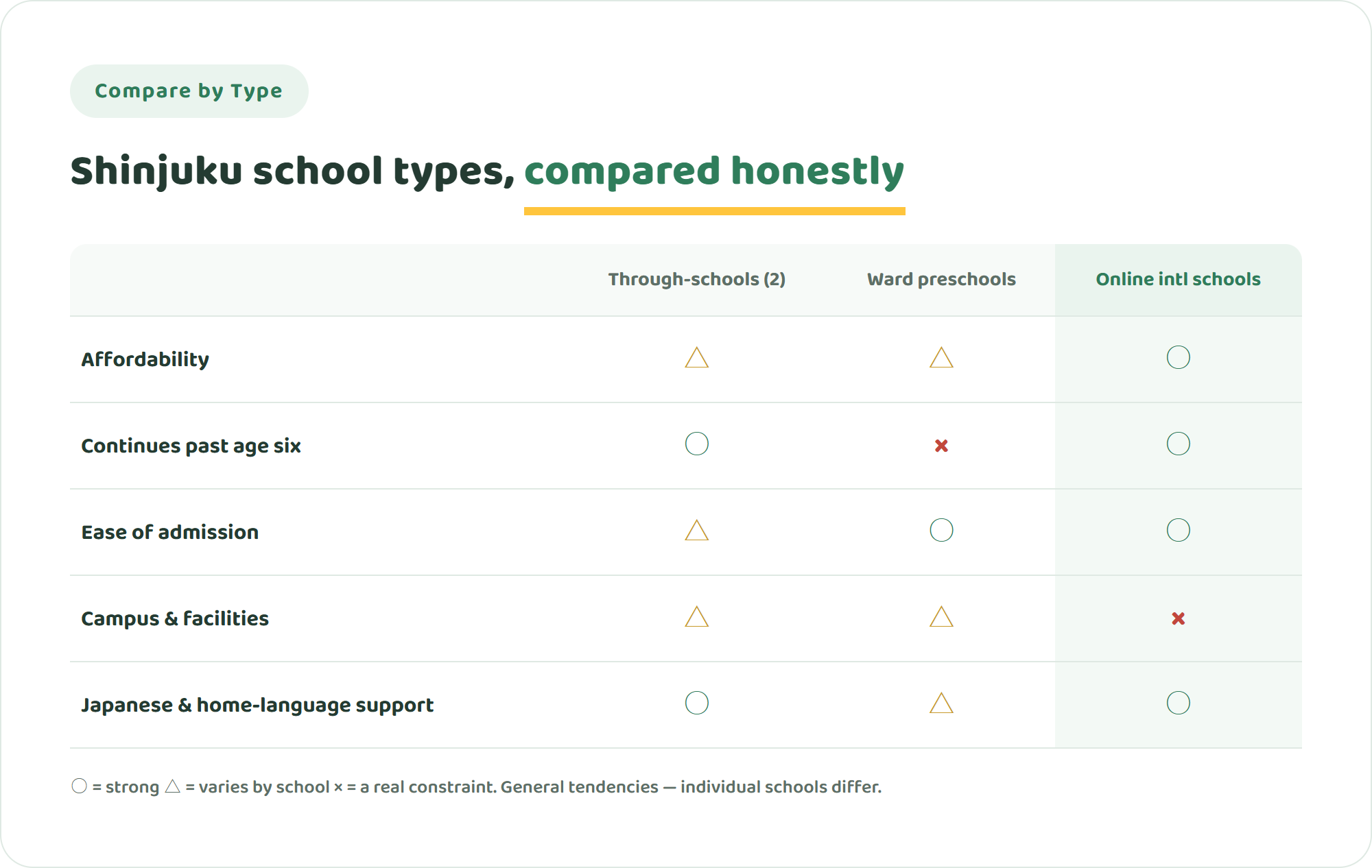
Shinjuku’s genuine advantages are transport and price. Almost anywhere in the ward puts you on a major line within minutes, and a school like WICS taking children from kindergarten to graduation for a little over ¥1 million a year is rare in central Tokyo. What the ward does not have is a large IB continuum school or a campus with extensive grounds. The preschools are easy to start at ¥84,000 to ¥110,000 a month, but nearly all of them end at school age. Think about the April your child turns six and the April they turn twelve at the same time you are thinking about next spring — in Shinjuku, that is what separates a confident decision from a regretted one.
See how learning works online →
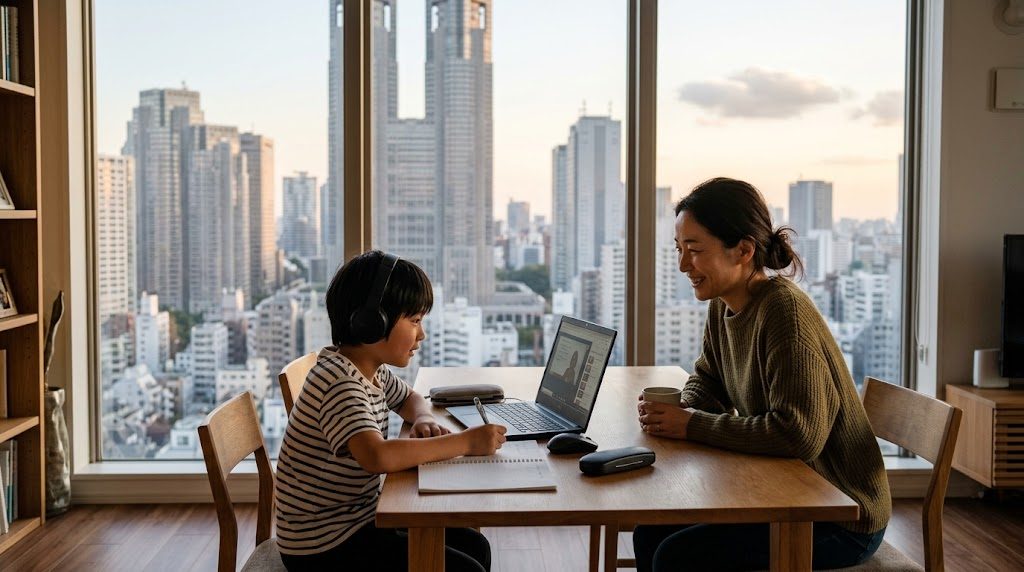
When fees or the commute are the real barrier: an eighth option, online
Shinjuku is a genuinely good place to raise a child — well connected, full of parks, multicultural as a matter of daily life. Even so, three things push against families here: most of the ward’s international schools end before primary, only two carry a child to graduation, and for children with Japanese nationality the compulsory-education rules add a real constraint. If you find yourself thinking “I want an international education for my child, but I cannot see the road past age six,” there is an eighth option that does not depend on a commute at all: an online international school.
We are NIJIN GLOBAL ACADEMY (NGA), an online international school opening in September 2027. We are run by NIJIN Inc., the company behind NIJIN Academy, an alternative school in Japan with more than 1,000 students enrolled. Our approach starts from refusing to rank children by test scores, building learning around small-group dialogue, and helping every student come to like themselves and the world. We are open to students aged 6 to 18 across Asia and Oceania, wherever they live, and the programme is designed so children can move into English gradually with Japanese-language support underneath them. We are working towards fees at roughly one-fifth of a bricks-and-mortar international school.
In fairness, we should say plainly: NGA has not opened yet, and our track record is still ahead of us. We cannot offer the playground, the science lab or the corridor conversations of a physical campus in the same way. And for children with Japanese nationality, the compulsory-education question described above still needs checking with your local board of education. Even so, learning that connects your child to the world without a commute and at a fraction of the cost is, we think, worth putting on your list while you compare options in Shinjuku.
Frequently asked questions
Q. From what age can my child start at an international school in Shinjuku?
A. From age one at the earliest. Aoba-Japan Bilingual Preschool Waseda Campus takes children from one, Tesoro International School from two, Frontierkids Global School from around two and a half, and i Kids Star Yotsuya from the age-three class. Among the schools that continue past primary, Waseda International Christian School starts at kindergarten (ages 4–5) and Yotsuya International School at elementary level. Popular preschools fill a year ahead, so start visiting in the spring before the year you hope to enrol.
Q. Will my child’s Japanese suffer? What language support is available?
A. Shinjuku’s schools tend to be bilingual by design rather than total-immersion. i Kids Star Yotsuya pairs English with reasoning and physical work; Frontierkids builds English onto a Montessori foundation; Tokyo Korean School offers a Japanese-curriculum stream. That said, home-language maintenance is where families most often report regret later. Before you enrol, ask exactly how many hours a week are taught in Japanese and whether children are grouped by level. If your child is arriving from abroad and Japanese is the language you are worried about, ask each school specifically what support exists for beginners — provision varies enormously between the ward’s schools.
Q. Can we transfer in mid-year?
A. Yotsuya International School accepts transfers throughout the year and lets students choose between a predominantly English track and a bilingual one according to their level. Most preschools will also take a child mid-year if a place exists. Availability swings sharply by year group and season, though, and an interview or English assessment is standard. Fees are revised annually, so the figures in a brochure you were handed last year may no longer hold. Contact schools directly six to twelve months before you want to start — and if your child holds Japanese nationality, speak to the Shinjuku Board of Education at the same time.
The time you spend deciding is time spent caring
There is no single right answer here. In a ward like Shinjuku, where the early-years choices are plentiful but the road narrows sharply after six, the useful question is not which school is best but how long your family can keep going. Fees, the morning commute, the paperwork, your child’s temperament — every family weighs these differently. Which is exactly why the hesitation you are feeling is not indecision. It is care. Take your time, visit a few schools in person, and compare them with your own eyes. And if you would like to know more about the option that does not involve a commute, we would be glad to keep you posted.
International Schools in Other Cities
- International Schools in Setagaya: All 14 Schools
- International Schools in Nakano, Tokyo
- International Schools in Tsukuba: Fees
- International Schools in Sendai: 7 Picks and Fees
- International Schools in Karuizawa: All 4 Schools
- International Schools in Sapporo: Fees
- International Schools in Kita, Tokyo
- International Schools in Kobe: All 20 Schools
- International Schools in Tokyo
- International Schools in Minato: Fees
- International Schools in Shibuya, Tokyo
- International Schools in Koto, Tokyo
- International Schools in Shinagawa, Tokyo
- International Schools in Meguro: All 8 Schools