If you have started searching for international schools in Tokyo, you have probably discovered the paradox: there are more options here than anywhere else in Japan, yet that abundance makes the decision harder, not easier. This guide cuts through the noise. We have selected seven schools that represent the real range of what Tokyo offers — American, British, IB, bilingual, and Indian curricula, from the city’s most prestigious names to genuinely affordable options — with honest fee ranges for each. By the end, you will know what international schools in Tokyo actually cost, how they differ, and how to work out which one fits your family.
Quick Answer: Your Options in Tokyo
If you only read one section, read this. Below are the schools covered in this guide, plus the online option — so you can see every route side by side before the details.
- The American School in Japan (ASIJ) — Ages — 3–18 (Nursery to Grade 12) / Fees — approx. ¥2,987,000–3,783,000 per year plus facility fees (official 2026 figures;…
- The British School in Tokyo (BST) — Ages — 3–18 / Fees — approx. ¥2,820,000–2,930,000 per year plus one-time entry fees (official 2026…
- Tokyo International School (TIS) — Ages — Kindergarten to Grade 12 / Fees — approx. ¥3,300,000–3,600,000 per year plus one-time entry fees (official 2026…
- Nishimachi International School — Ages — 5–15 (Kindergarten to Grade 9) / Fees — approx. ¥3,129,000 per year plus annual fees (official 2026 figures; confirm the…
- Seisen International School — Ages — 3–18 (girls; co-ed kindergarten) / Fees — approx. ¥1,600,000 (half-day kindergarten) to ¥2,700,000 per year (official 2026…
- St. Mary’s International School — Ages — 5–18 (boys) / Fees — approx. ¥2,860,000–3,050,000 per year plus one-time entry fees (official 2026…
- India International School in Japan (IISJ) — Ages — 3–18 (Kindergarten to Grade 12) / Fees — approx. ¥600,000–1,200,000 per year (official 2026 figures; confirm the latest)
- NIJIN GLOBAL ACADEMY (online) — Ages 6–18 / opening September 2027, currently taking opening-update registrations / fees around one-fifth of a typical campus international school / Japanese-language support. An option when commute or fees are the wall.
International Schools in Tokyo: The Landscape and Typical Fees
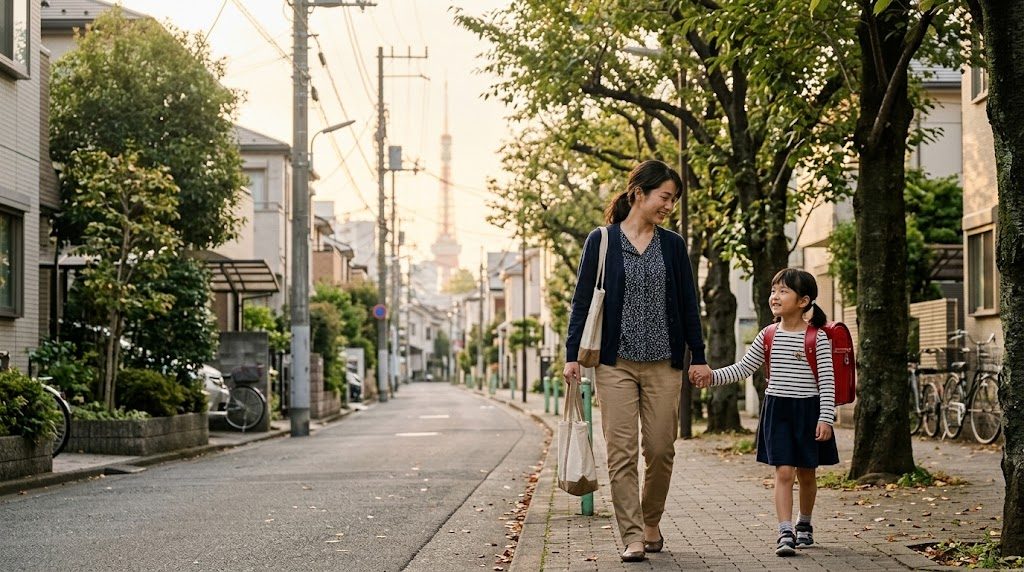
Tokyo is home to the largest concentration of international schools in Japan — several dozen, clustered mainly around Minato, Shibuya, Setagaya, and the western suburbs. The variety is genuine: International Baccalaureate (IB) schools, British curriculum schools running GCSEs and A Levels, American schools with AP courses, and Indian CBSE schools. “An English-medium education” can mean very different things depending on which door you walk through.
As for cost, most major international schools in Tokyo charge roughly ¥2.8–3.8 million per year in tuition, before one-time entrance fees, building funds, and bus fees — so a first year can exceed ¥4 million. At the other end of the spectrum, Indian-curriculum schools charge roughly ¥600,000–1.2 million per year. The spread is enormous, which is exactly why it pays to compare. For a full breakdown of what you are actually paying for, see our guide to international school tuition costs in Japan.
Note: all fees below are based on publicly available information as of July 2026. Please confirm the latest figures on each school’s official website.
The 7 Best International Schools in Tokyo
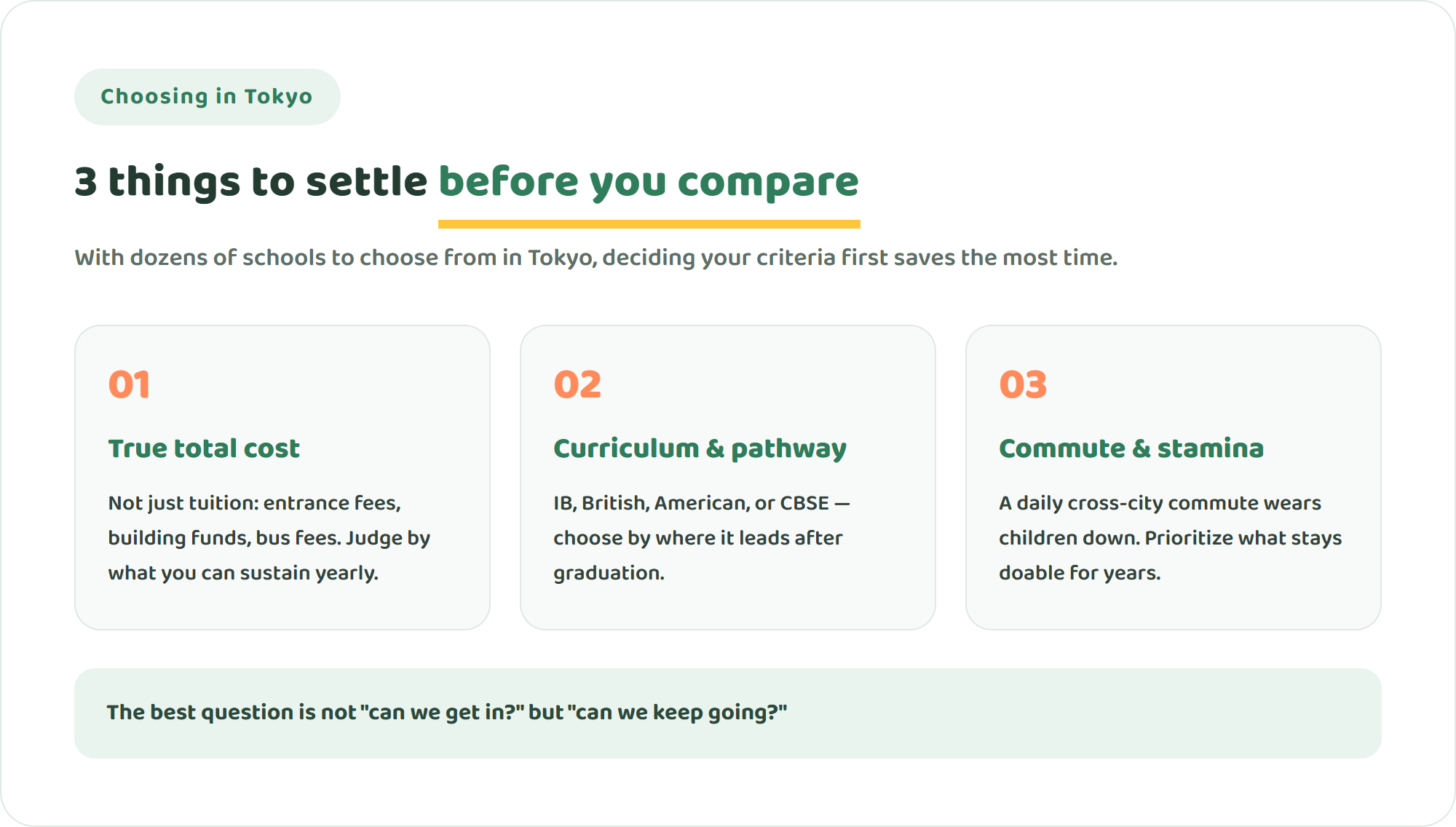
Here are seven international schools in Tokyo worth your shortlist. This is not a ranking — they are seven different types of school, and the right one depends entirely on your family’s priorities.
1. The American School in Japan (ASIJ)
The American School in Japan, founded in 1902, is the grande dame of Tokyo’s international schools, with a sprawling campus in Chofu and an early learning center in Roppongi. Around 1,600 students attend, and the facilities, athletics, and arts programs are among the best in the country.
- Curriculum — American, with AP courses
- Ages — 3–18 (Nursery to Grade 12)
- Fees — approx. ¥2,987,000–3,783,000 per year plus facility fees (official 2026 figures; confirm the latest)
- Best for — families who want an American education with big-school scale and resources
2. The British School in Tokyo (BST)
The British School in Tokyo, founded in 1989, delivers the English National Curriculum through to GCSEs and A Levels across two campuses: a primary campus in the landmark Azabudai Hills development and a secondary campus in Setagaya.
- Curriculum — British (GCSE, A Levels)
- Ages — 3–18
- Fees — approx. ¥2,820,000–2,930,000 per year plus one-time entry fees (official 2026 figures; confirm the latest)
- Best for — families planning a UK-system pathway or a future move to Britain or the Commonwealth
3. Tokyo International School (TIS)
Tokyo International School, founded in 1995 and located in Mita, Minato-ku, is known for taking inquiry-based learning seriously. Built around the IB Primary Years and Middle Years Programmes, it has in recent years extended into the high school grades.
- Curriculum — IB (PYP and MYP), inquiry-driven
- Ages — Kindergarten to Grade 12
- Fees — approx. ¥3,300,000–3,600,000 per year plus one-time entry fees (official 2026 figures; confirm the latest)
- Best for — families who value curiosity and inquiry over test preparation
4. Nishimachi International School
Nishimachi International School, founded in 1949 in Moto-Azabu, is a co-educational K–9 school with a distinctive promise: every student studies Japanese, every day. For over 70 years it has produced graduates rooted in both Japan and the wider world.
- Curriculum — its own inquiry-based program with Japanese-English bilingual education
- Ages — 5–15 (Kindergarten to Grade 9)
- Fees — approx. ¥3,129,000 per year plus annual fees (official 2026 figures; confirm the latest)
- Best for — families who want their child to grow up genuinely bilingual, not English-only
5. Seisen International School
Seisen International School in Yoga, Setagaya, is a Catholic school for girls (the kindergarten is co-ed) offering the IB PYP and Diploma Programme. It is known for a calm, values-driven environment — and its half-day kindergarten is one of the more accessible entry points among established Tokyo internationals.
- Curriculum — IB (PYP and DP)
- Ages — 3–18 (girls; co-ed kindergarten)
- Fees — approx. ¥1,600,000 (half-day kindergarten) to ¥2,700,000 per year (official 2026 figures; confirm the latest)
- Best for — families seeking a nurturing all-girls environment with a strong IB track record
6. St. Mary’s International School
St. Mary’s International School, founded in 1954 in Seta, Setagaya, is a Catholic boys’ school and one of the longest-running IB Diploma schools in Japan. Its culture balances academics with serious sport and music, and graduates go on to universities worldwide.
- Curriculum — American-style program with the IB Diploma
- Ages — 5–18 (boys)
- Fees — approx. ¥2,860,000–3,050,000 per year plus one-time entry fees (official 2026 figures; confirm the latest)
- Best for — families who want a traditional boys’ school with global university outcomes
7. India International School in Japan (IISJ)
India International School in Japan, founded in 2004 with its Tokyo campus in Edogawa (plus a Yokohama campus), follows India’s CBSE curriculum with strong mathematics, science, and ICT taught in English. It is by far the most affordable school on this list, and a growing number of non-Indian families are choosing it for exactly that reason.
- Curriculum — Indian (CBSE), English-medium
- Ages — 3–18 (Kindergarten to Grade 12)
- Fees — approx. ¥600,000–1,200,000 per year (official 2026 figures; confirm the latest)
- Best for — families who want English-medium, maths-strong education at a fraction of the usual cost
Where International Schools Are in Tokyo Metropolis: The 23 Wards and the Tama Area
Most of the seven schools above sit in Minato, Shibuya, or Setagaya, and that is not a coincidence. The Tokyo Metropolitan Government runs its own directory, the Tokyo International Schools Portal, which lists 20 schools across Tokyo Metropolis as of July 2026. Of those, only three have their main campus outside the 23 wards. The rest cluster in Minato, Shibuya, Setagaya, Shinagawa, Koto, Edogawa, Chiyoda, Shinjuku, Nerima, and Kita. If you are still deciding where in Tokyo to live, that concentration will shape your daily life more than almost any other factor on this page.
Three international schools beyond the 23 wards
Living west of central Tokyo does not mean going without. The Tama area has real options, with annual tuition as published on the metropolitan portal (July 2026):
- The American School in Japan (Chofu) — the large American-curriculum campus profiled above. Its scale is precisely what a suburban site makes possible; only the early learning centre sits in Minato.
- Christian Academy in Japan (Higashi-Kurume) — founded in 1950, a North American model K–12 school with around 500 students from 25 countries, accredited by WASC and ACSI. Annual tuition runs about ¥1,845,000 for kindergarten and elementary, ¥2,020,000 for middle school, and ¥2,195,000 for high school, noticeably below the central Tokyo majors.
- Tokyo West International School (Hachioji) — the only school in the Tama area authorised for the IB Primary Years Programme, running kindergarten through high school. Annual tuition is roughly ¥1,140,000 (kindergarten), ¥1,463,000 (elementary), and ¥913,000 (middle and high school).
Japanese-system schools with international programmes
If what you want is an international education rather than an international school specifically, Tokyo Metropolis also offers routes inside the Japanese system (Article 1 schools). Tokyo Metropolitan Kokusai High School in Meguro became the first public high school in Japan authorised for the IB Diploma Programme, in 2015, and remains the only metropolitan high school with an international studies department. In 2022 the metropolitan government opened an elementary school attached to Tachikawa International Secondary School, creating Japan’s first public 12-year international pathway. Tamagawa Academy in Machida holds IB MYP (2009) and DP (2010) authorisation while still awarding Japanese credentials. Public routes change the cost equation entirely, so look at them before ruling out western Tokyo.
One thing to check: accreditation status
International schools in Japan fall into three groups: Article 1 schools under the School Education Act, miscellaneous schools under Article 134, and unaccredited institutions. The second group is licensed at the prefectural level, and in Tokyo that is handled by the metropolitan government’s private schools division, which publishes the establishment criteria for foreign schools. The consequence matters: MEXT states plainly that enrolling a school-age child in an international school that is not an Article 1 school does not discharge the compulsory education obligation under Japanese law, and completion of its elementary programme may not be recognised for entry into a Japanese public junior high school. If your family may return to the Japanese system, ask about this at the open day rather than after enrolment.
Comparing Your Options: Which Type of School Fits Your Family?
Seven schools, three broad types. Rather than asking “which school is best,” the more useful question is “what does our family refuse to compromise on?” Here is an honest comparison.
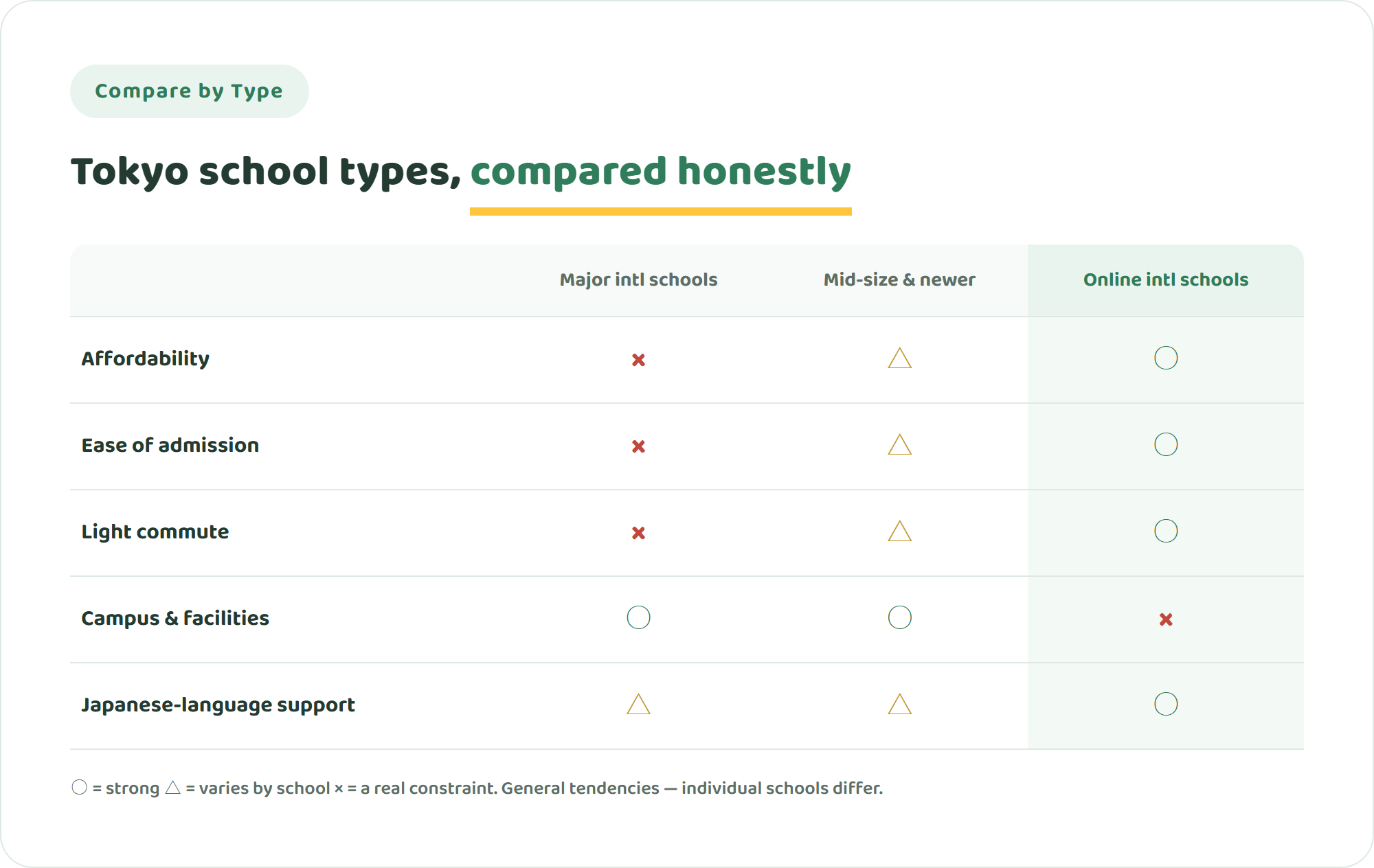
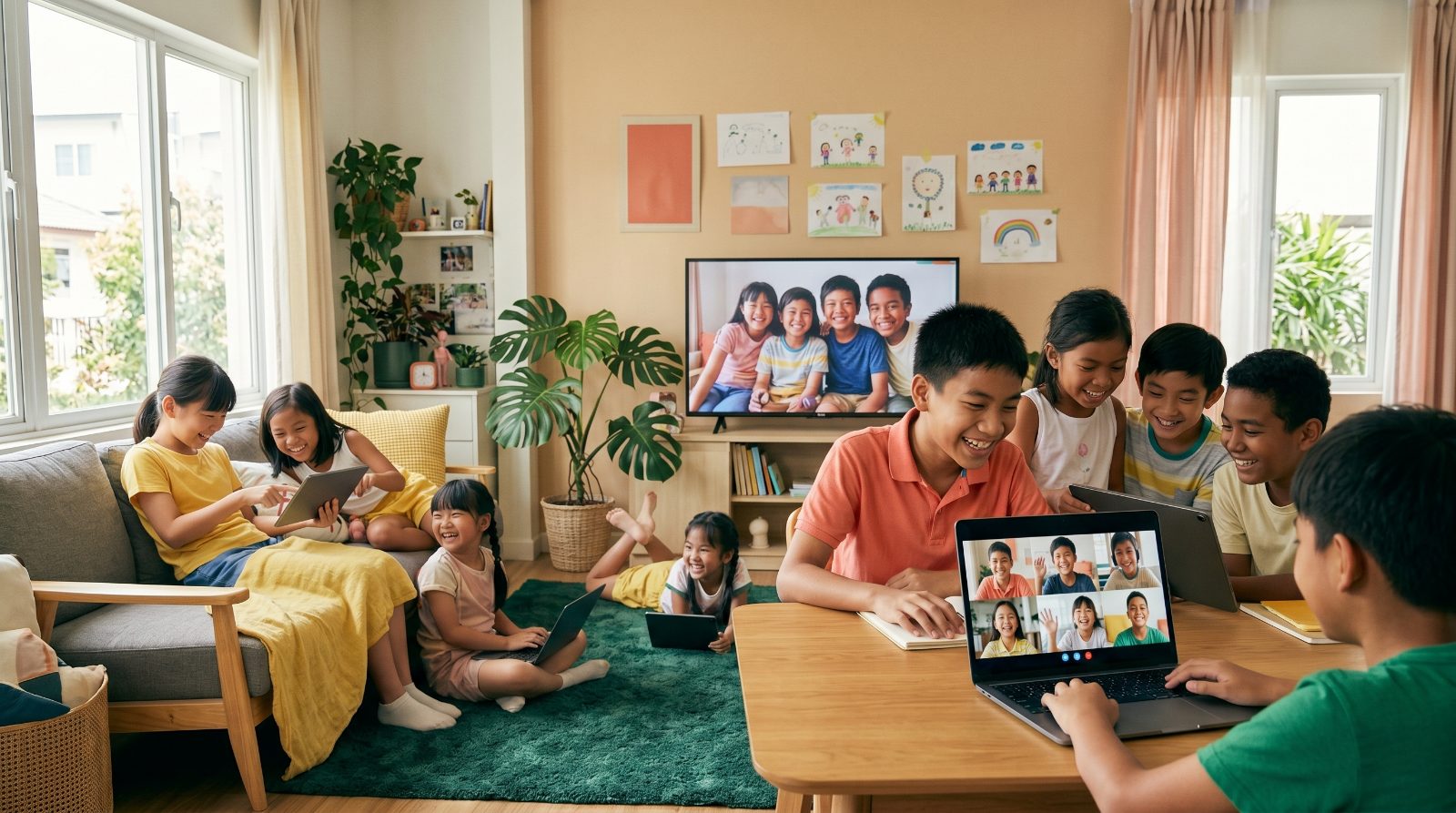
The major schools offer superb environments but come with the steepest fees and the longest waitlists. Mid-size and more affordable schools are easier to sustain financially, though facilities and scale vary widely. Online international schools remove the commute and most of the cost — but they cannot offer a physical playground or campus life, and it is only fair to say so plainly. If you are curious how learning actually works without a physical classroom, take a look here: See how learning works online →
If Fees or the Commute Are the Barrier — an Online 8th Option
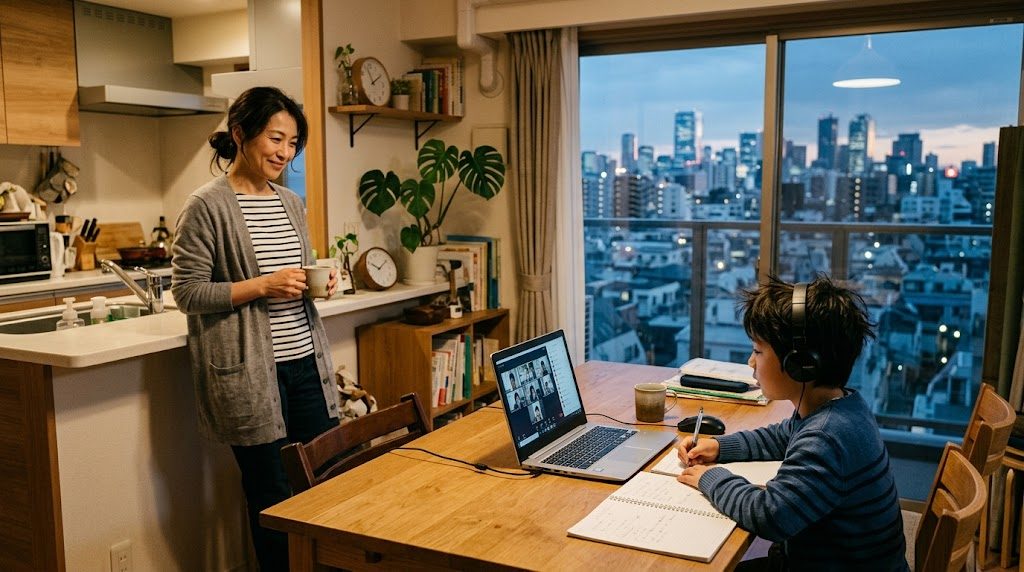
If you read the fee ranges above and felt your heart sink — you are far from alone. For many families in and around Tokyo, ¥3 million a year, every year, is simply not sustainable, and a daily cross-city commute is hard on a young child. That is why we would add an eighth option to this list: the online international school.
脱偏差値のオンラインインターナショナルスクール NIJIN GLOBAL ACADEMY (NGA) is an online international school opening in September 2027, run by NIJIN Inc. of Japan, whose alternative school NIJIN Academy already serves more than 1,000 students. NGA is built on a simple conviction: children should not be ranked by test scores. Learning happens in small dialogue-centered groups, guided by the ethos “come to love yourself and the world.” Tuition is designed to be roughly one-fifth of a typical in-person international school. NGA serves ages 6–18 across Asia and Oceania, and the program is designed so children can start with Japanese-language support and grow into English step by step — no English required on day one.
In the spirit of honesty that runs through this guide: NGA has not yet opened, so its track record is still to be built, and an online school cannot replicate everything a physical campus offers. But if fees or geography were about to close the door on an international education, this is an option worth weighing alongside the seven above.
Frequently Asked Questions
From what age can children join international schools in Tokyo?
Most schools accept children from around age 3 into nursery or kindergarten programs. Be aware that popular schools fill up early and operate waitlists, and admission priorities (siblings, nationality balance, corporate places) differ by school — so contact your target schools well in advance.
Do Tokyo international schools support children who don’t speak English — or Japanese?
EAL (English as an Additional Language) support varies greatly, and entry requirements get stricter in higher grades. Bilingual schools like Nishimachi, and online schools designed around Japanese-language support, allow children to grow into English gradually. The key question is not “how much English does my child need to get in?” but “how much support will they get once they are in?”
Can we enroll mid-year?
The main intake is August–September, but many schools accept mid-year transfers when seats open up — and in Tokyo, seats do open, as expatriate families rotate in and out. If your timing is awkward, ask anyway; availability changes term by term.
In a City of Options, Choose by Your Own Compass
Tokyo gives you American, British, IB, bilingual, and Indian curricula; girls’ schools, boys’ schools, and everything in between; and now credible online options too. That abundance is a gift — it means you can choose based on your family’s priorities, not someone else’s ranking. Take the fee ranges, the commute, the curriculum, and your child’s temperament, and weigh them calmly. The right school is the one your child can thrive in for years, not just get into.
NIJIN GLOBAL ACADEMY opens in September 2027 — a small-group, dialogue-centered online international school at a fraction of typical fees. To hear about the learning model and founding-cohort enrollment first, join our mailing list.
International Schools in Other Cities
- International Schools in Nakano, Tokyo
- International Schools in Tsukuba: Fees
- International Schools in Sendai: 7 Picks and Fees
- International Schools in Shinjuku: Fees
- International Schools in Karuizawa: All 4 Schools
- International Schools in Sapporo: Fees
- International Schools in Shanghai
- International Schools in Shibuya, Tokyo
- International Schools in Shinagawa, Tokyo
- International Schools in Minato: Fees
- International Schools in Setagaya: All 14 Schools
- International Schools in Koto, Tokyo
- International Schools in Meguro: All 8 Schools
- International Schools in Chofu and ASIJ Fees
- International Schools in Bunkyo, Tokyo