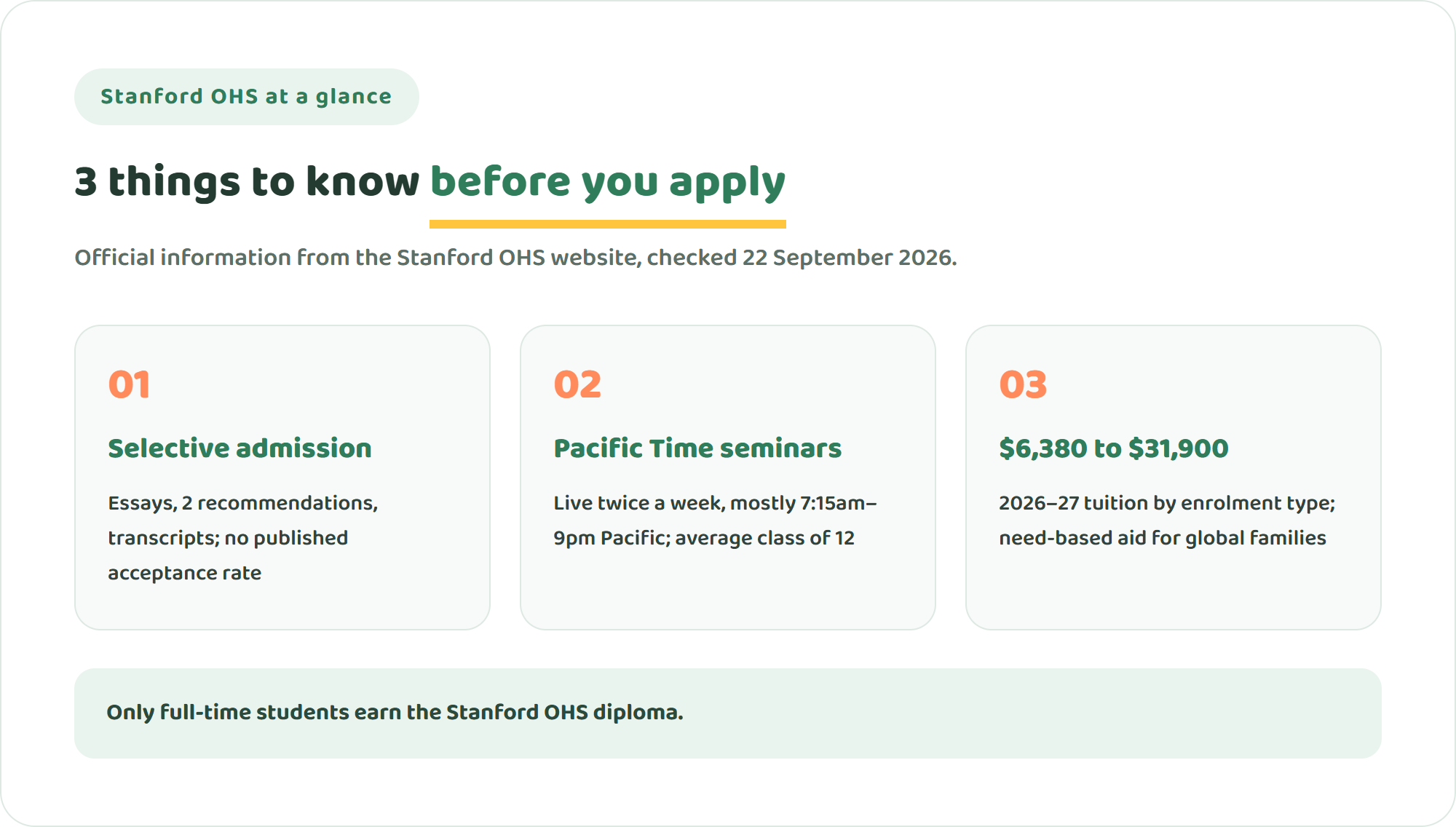
Stanford Online High School tuition for 2026–27 is $31,900 per year for full-time students (four or more courses), $19,140 for part-time (two to three courses) and $6,380 for a single course, with the same rates for international and domestic families (official site, checked 22 September 2026). Books and materials are extra, at roughly $30 to $1,300 per student per year depending on the courses, and need-based financial aid is available — including to families outside the United States.
Most parents searching “Stanford Online High School tuition” or “Stanford Online High School review” want three things answered at once: what the full bill really looks like, whether their child could get in, and whether a live online school run on Pacific Time can work from where they live. This page answers all three from the school’s own pages, then compares Stanford OHS fairly with NIJIN GLOBAL ACADEMY (the school that publishes this site) and two other online options, so you can decide which kind of school fits your child.
The short answer: who Stanford OHS suits — and who it doesn’t
- Suits academically advanced, self-motivated students in grades 7–12 who want university-style seminars and are ready for a demanding workload.
- Suits families who want a WASC- and CAIS-accredited, diploma-granting independent school within Stanford University, taught mostly by instructors with Ph.D.s in their fields (as the school states).
- Suits students who need one or two advanced courses their local school cannot offer — the single-course option exists for exactly this.
- Suits families who qualify for need-based aid: most aid recipients have 75%–100% of tuition covered, according to the school.
- May not suit families looking for guaranteed admission: entry is competitive, by application only, and the school says it cannot accept all qualified applicants.
- May not suit children who are still learning English — students are expected to be fully fluent in written and spoken English.
- May not suit families far from the Americas who need classes at fixed daytime hours: the timetable is rebuilt every year around Pacific Time, and individual course times cannot be predicted in advance.

What Stanford Online High School is
Stanford Online High School (Stanford OHS) was founded at Stanford University in 2006 with a gift from the Malone Family Foundation, originally as a three-year high school associated with Stanford’s Education Program for Gifted Youth. It added a middle-school program in 2009 and today describes itself as an independent school within Stanford University serving grades 7–12. Its stated mission is to foster a worldwide community of intellectually adventurous students and teachers.
The model is closer to a small liberal-arts college than to a typical online school. Classes are live, discussion-based seminars held by video conference, most instructors hold doctorates, and every diploma-seeking high school student takes a philosophy-based Core course each year. The school lists more than 40 advanced offerings at the early-college and college-major level, and says it has replaced many AP courses with its own specially designed advanced courses.
| Basic fact | Stanford Online High School (official) |
|---|---|
| Founded | 2006, at Stanford University |
| Grades | 7–12 (middle school 7–8, high school 9–12) |
| Students | 1,092 enrolled; 55 countries represented (homepage) |
| Format | Fully online; live seminars plus independent coursework |
| Class size | Average 12 students, never more than 17 |
| Accreditation | WASC (since 2010) and CAIS (since 2019); renewed in 2025 |
| Memberships | Council of International Schools (2022); Malone Schools Online Network |
| Enrolment types | Full-time (4–5 yearlong courses), part-time (2–3), single course |
| Diploma | Full-time students only |
Stanford Online High School tuition and fees (2026–27, official)
Stanford OHS publishes one tuition per enrolment level. The school states that yearly tuition covers coursework, academic planning, counseling and online student-life activities. Tuition is the same for international and domestic students.
| Item (2026–27) | Amount | Notes |
|---|---|---|
| Full-time tuition (4 or more courses) | $31,900 per year | Main school; the only diploma route |
| Part-time tuition (2–3 courses) | $19,140 per year | Alongside another curriculum or homeschool |
| Single course | $6,380 per year | 1 yearlong course or 2 semester-long courses |
| Application fee | $100 | Fee waivers by request |
| Books and materials | About $30–$1,300 per student per year | Depends on courses; lab kits cost more |
| Technology | Family-supplied | Computer, stable broadband; some math/science courses need a graphing calculator or graphics tablet |
| Optional in-person events | Homecoming about $250; Pixel Festival about $200; Gathering & Graduation about $300–$800 per person | Travel not included |
| Optional Summer@Stanford (residential) | About $6,000–$7,000 (high school); $3,000–$4,000 (middle school) | On Stanford’s campus, typically August |
| Optional student travel | From about $3,000 | Spring break or summer |
| Sibling discount / payment plan / 2027–28 tuition | Not published on the official site | |
What a realistic total looks like. Using only the published numbers — and assuming tuition stays at the 2026–27 rate, which it will not necessarily do, since schools revise fees each year — four years of full-time high school cost 4 × $31,900 = $127,600 in tuition. Add books and materials at the published range of $30–$1,300 a year, and the four-year total lands between $127,720 and $132,800 before any optional events or travel. A family with two children enrolled full-time for four years each would be looking at 2 × $127,600 = $255,200 in tuition alone. By contrast, a student who stays at their local school and takes one advanced course a year at Stanford OHS for four years would pay 4 × $6,380 = $25,520 in tuition.
Financial aid. Stanford OHS offers need-based financial aid for academic-year tuition; it does not offer merit scholarships. Aid recipients also receive help with books and materials, Summer@Stanford and event tickets (but not travel, internet or computers). The school reports $2.5 million in tuition aid for 2025–26, a further $100,000 for books and in-person events, 145 aid recipients, and tuition coverage of 75%–100% for most recipients. Set against the 1,092 students shown on the homepage, that is roughly 13% of students — our own arithmetic from two figures that may refer to slightly different points in time. International families are eligible. Applications go through School and Student Services (SSS); for 2027–28 entry, new applicants must submit the aid application by 14 January 2027 and supporting documents by 21 January 2027 (Pacific Time).
If you are weighing this price against other kinds of international schooling, our guide to online vs in-person international school costs puts typical fees side by side, and Pearson Online Academy tuition shows what a lower-cost accredited online option looks like.
How a school day works: schedule, live classes and time zones
Stanford OHS runs a college-style block schedule. Most courses meet twice a week — Monday/Wednesday or Tuesday/Thursday — and world-language courses meet three times a week. Each course has about 2.5 hours of live meetings per week (3.5 hours for a world language). On top of that, high school students should expect 5.5 to 7.5 hours per week of coursework per course (readings, labs, writing, recorded lectures); middle school courses have the same live hours with 3.5 to 5.5 hours of coursework. The school’s enrolment page sums this up as 8–10 hours per week per course, which means a full-time load of four to five courses is a genuinely full week.
Time zone is the question most reviews skip. The school runs an extended school day from 6am to 10pm, with most class schedules falling between 7:15am and 9pm Pacific Time — the school itself stresses that class times reflect Stanford’s location. For international students, the school says students may take courses between 6:00am and 10:30pm in their own local time zone, and it builds a new master schedule every spring around the constraints of returning and new students, meeting more than 90% of scheduling requests. It also warns that the schedule can change significantly each year, so you cannot know in advance whether a particular course will run at a particular time.
To make this concrete: 7:15am–9pm Pacific (daylight time) is 10:15am–midnight in New York, 3:15pm–5am the next morning in London, and 11:15pm–1pm the next day in Tokyo. A student in Europe or Asia can usually be scheduled into their local window, but choices narrow the further you live from California. Attendance at every live section is expected. If you want to see how live online schooling works day to day more generally, read how an online international school works.
There is no summer academic term. Enrolled students may apply to the residential Summer@Stanford program on campus.
Accreditation, diploma and college recognition
Stanford OHS is accredited by the Western Association of Schools and Colleges (WASC), first in 2010, and by the California Association of Independent Schools (CAIS), since 2019; both accreditations were renewed in 2025, according to the school’s history page. It was approved as an online provider by the University of California in 2008 and joined the Council of International Schools in 2022. The school describes itself as a fully accredited, diploma-granting independent school, and any current or former student can request an official transcript. You can confirm current WASC status through the ACS WASC school directory at acswasc.org.
Only full-time students earn the Stanford OHS diploma. Diploma candidates must be enrolled full-time for their final two years of high school, take a Core course every year, and complete one year-long advanced or university-level course in the listed subject areas. Part-time and single-course students receive transcripts for their courses; whether another school accepts those credits is up to that school.
On college outcomes, the school publishes acceptances to more than 100 institutions for 2024–2026, including all eight Ivy League universities, MIT, Caltech, Stanford, UC Berkeley and UCLA. For 2026 graduates it reports a middle-50% SAT composite of 1470–1560 (75 exams) and an ACT middle 50% of 34–36 (6 exams). The school is also explicit that Stanford OHS “is not a feeder school” to Stanford University — enrolment does not improve anyone’s odds there.
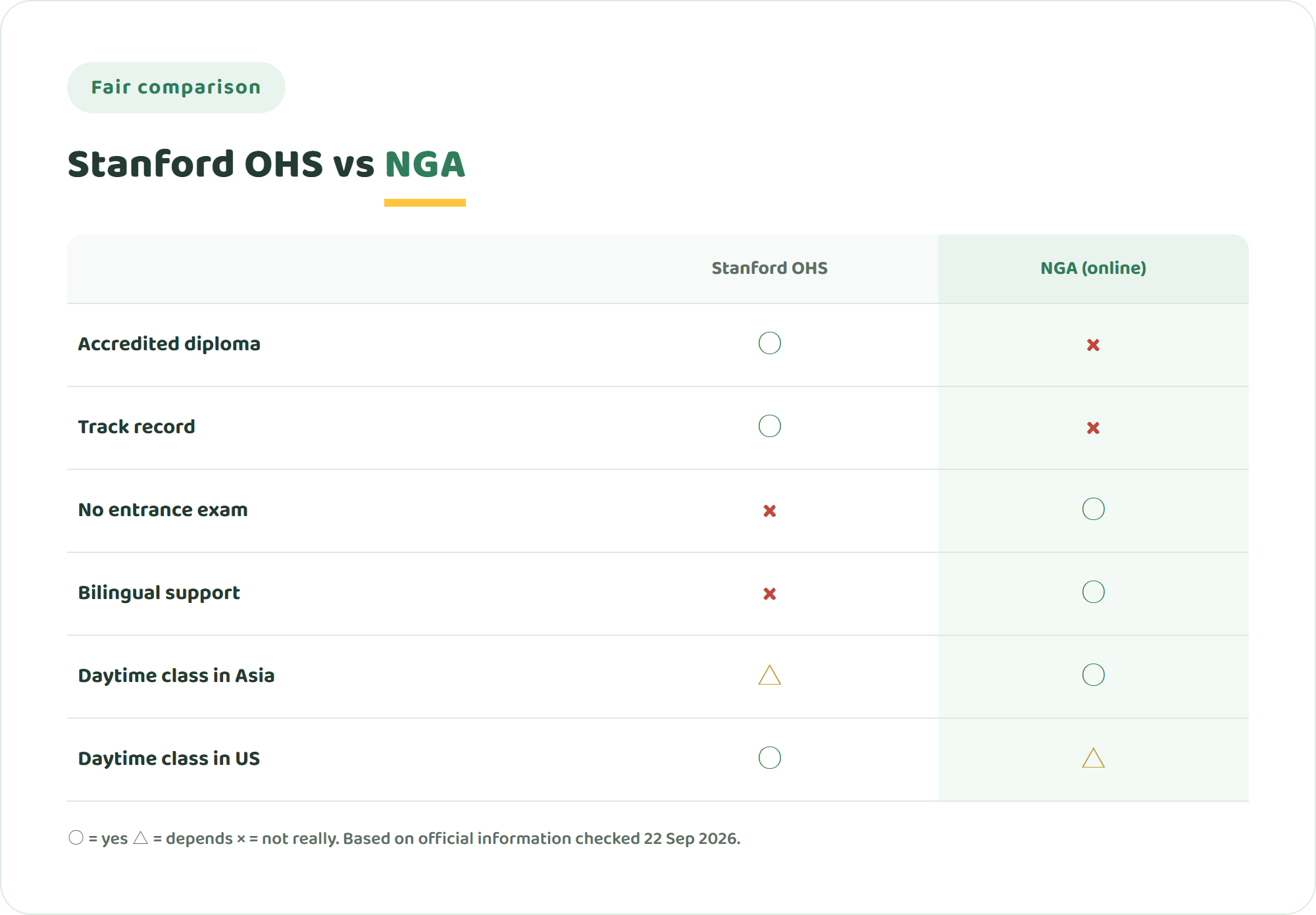
Stanford OHS vs NIJIN GLOBAL ACADEMY vs two other options (official data)
These are different kinds of schools. Stanford OHS is a selective, established U.S. independent school; Laurel Springs and Crimson Global Academy are accredited online private schools with broader access; NIJIN GLOBAL ACADEMY (NGA) is a new online international school that has not opened yet. The table uses each school’s own published information.
| Stanford Online High School | NIJIN GLOBAL ACADEMY | Laurel Springs School | Crimson Global Academy | |
|---|---|---|---|---|
| School type | Selective independent school within Stanford University; fully online | Online international school focused on Asia & Oceania; operated by NIJIN Inc. (Japan) | Online private K–12 school, founded 1991 | Online private school teaching US Diploma, AP, IGCSE and A Levels |
| Grades / ages | Grades 7–12 | Ages 6–18 | K–12 | Ages 7–18 |
| Tuition (2026–27) | $31,900 full-time; $19,140 part-time; $6,380 single course | Not yet published; designed to be far more affordable than a typical international school; no enrolment, facility or uniform fees; materials included; sibling discounts | High school $11,700/year; Academy high school $17,250/year (school year not stated on page) | US Diploma grades 9–12 full-time $19,250–$25,500; part-time $2,000–$4,500 per subject (USD; year not stated) |
| Curriculum | Own advanced courses, philosophy Core; many AP courses replaced | Subjects learned in English with a bilingual mentor; CEFR-based English levels; projects with companies and governments; optional Cambridge IGCSE / A-Level pathway | US college-prep, honors and AP courses | US Diploma with AP; British curriculum (IGCSE, A Levels) |
| Live classes & time zone | Seminars twice a week; mostly 7:15am–9pm Pacific; average class of 12 | Small live dialogue groups of about 8; timetable built for Asia & Oceania daytime — may fall outside daytime in the Americas or Europe | Live Workshops in the Academy; see official site for times | Group or 1:1 classes; see official site for times |
| Accreditation / diploma | WASC and CAIS; diploma for full-time students | Not yet accredited; no diploma or graduates yet (opens 2027) | WASC and Cognia; diploma | WASC-accredited (US site); US Diploma |
| Admission | Competitive; essays, two recommendations, transcripts, writing sample; tests for some applicants; $100 fee; full English fluency expected | No entrance exam; no English requirement | See official site | See official site |
| Start dates | Fall entry; apply by 7 January 2027 for 2027–28; decisions March 2027 | Opening September 2027 (planned); free trial classes monthly from September 2026; pre-opening trial classes April–May 2027 | See official site | See official site |
Sources: Stanford OHS tuition, Stanford OHS how to apply, Laurel Springs tuition, Crimson Global Academy fees; NGA details from our own curriculum and timetable page. Checked 22 September 2026.

Reviews and common concerns, answered honestly
Parent and student reviews of Stanford OHS tend to circle the same handful of themes. Here they are, with what the school officially says about each.
“Is it too hard to get in?”
Admission is competitive. The school says it receives far more applicants than it has space to admit and cannot accept all qualified applicants; it does not publish an acceptance rate. It looks at three areas — academic ability, personal qualities and “good fit” with its online model — and there is no minimum test score. Applications require two 400-word essays, a recent analytical writing sample, two teacher recommendations (one humanities/social science, one math/science), transcripts for the current and past two years, and a parent questionnaire. A standardized test score (SSAT, ISEE, PSAT, PreACT, SAT or ACT) is required only for homeschooled applicants and students at non-English-language schools. An optional interview must be requested by 11 November 2026.
“Is the workload too heavy?”
It is demanding by design. The school itself advises that most students attending another school full-time take only one Stanford OHS course per year to keep a healthy balance of academics, social life and sleep. The expected 8–10 hours a week per course is worth taking literally when planning a timetable.
“Will my child feel isolated online?”
Classes average 12 students and are discussion-based, and the school runs clubs, student government, publications, counseling and optional in-person events such as Homecoming, the Pixel Festival and Summer@Stanford. Those events cost extra and involve travel, so the in-person side is easier for families within reach of California.
“Can we live outside the U.S.?”
Yes. The school enrolls students from 55 countries, charges the same tuition to everyone and offers aid to international families. It does not sponsor or assist with student visas (none is needed to study online), and it does not require or accept English proficiency tests such as TOEFL or IELTS — fluency is simply expected.
“Does it help with Stanford admission?”
No. The school states plainly that it is not a feeder school to Stanford University. Its published college list is broad, but it attributes outcomes to students’ preparation rather than to the name.
Alternatives to Stanford Online High School worth comparing
Laurel Springs School is a WASC- and Cognia-accredited online private school for K–12, with a more collaborative “Academy” track for grades 6–12. Its published full-year high school tuition is $11,700 ($17,250 for the Academy), and single courses are available. It suits families who want an accredited U.S. diploma with more flexibility and less selective entry. See our Laurel Springs tuition and review.
Crimson Global Academy is a WASC-accredited online school for ages 7–18 teaching a US Diploma with AP courses and a British curriculum (IGCSE, A Levels), with full-time and pay-per-subject part-time options. It suits internationally mobile families who want a choice of curricula.
NIJIN GLOBAL ACADEMY (NGA) is a different kind of option: an online international school for ages 6–18 focused on Asia and Oceania, opening in September 2027 (planned) with a first cohort of 100 students. It has no entrance exam and no English requirement, teaches in small live dialogue groups of about 8, pairs subject learning in English with a bilingual English–Japanese mentor, and can run alongside a local school or as the main school. It is honest to say what it is not yet: it is not accredited, has no graduates or track record, and its timetable is built for Asia–Oceania daytime, so families in the Americas or Europe should check class times against local time. Tuition has not been published. For a broader view, see Online International Schools Compared or our Alpha School tuition review.
FAQ
How much does Stanford Online High School cost per year?
For 2026–27, full-time tuition is $31,900, part-time is $19,140 and a single course is $6,380, per the official tuition page. Books and materials add about $30–$1,300 per year, and optional events and Summer@Stanford are extra. There is a $100 application fee.
Is Stanford Online High School accredited?
Yes. It is accredited by WASC (since 2010) and CAIS (since 2019), with both renewed in 2025, and it grants a high school diploma to full-time students who meet its graduation requirements.
Can international students enrol?
Yes. Students from around the world may apply, tuition is the same for all, and international families can apply for financial aid. Students must be fluent in English, and classes follow a master schedule anchored in Pacific Time, with students scheduled between 6:00am and 10:30pm local time where possible.
Is Stanford Online High School worth it?
For an academically advanced, independent student who thrives in seminar discussion and whose family can afford the fees or qualifies for aid, it offers rare depth, small classes and an accredited diploma. For a child still building English, needing a gentler pace, or needing fixed daytime classes far from California, a different school may fit better. The single-course option is a lower-cost way to test the fit.
What are the alternatives?
Accredited online options include Laurel Springs School and Crimson Global Academy. NIJIN GLOBAL ACADEMY is a new, open-access alternative for Asia–Oceania families opening in September 2027 (planned); it is not yet accredited. Our page on why families choose an online international school covers the wider picture.
Choosing calmly, with the facts in front of you
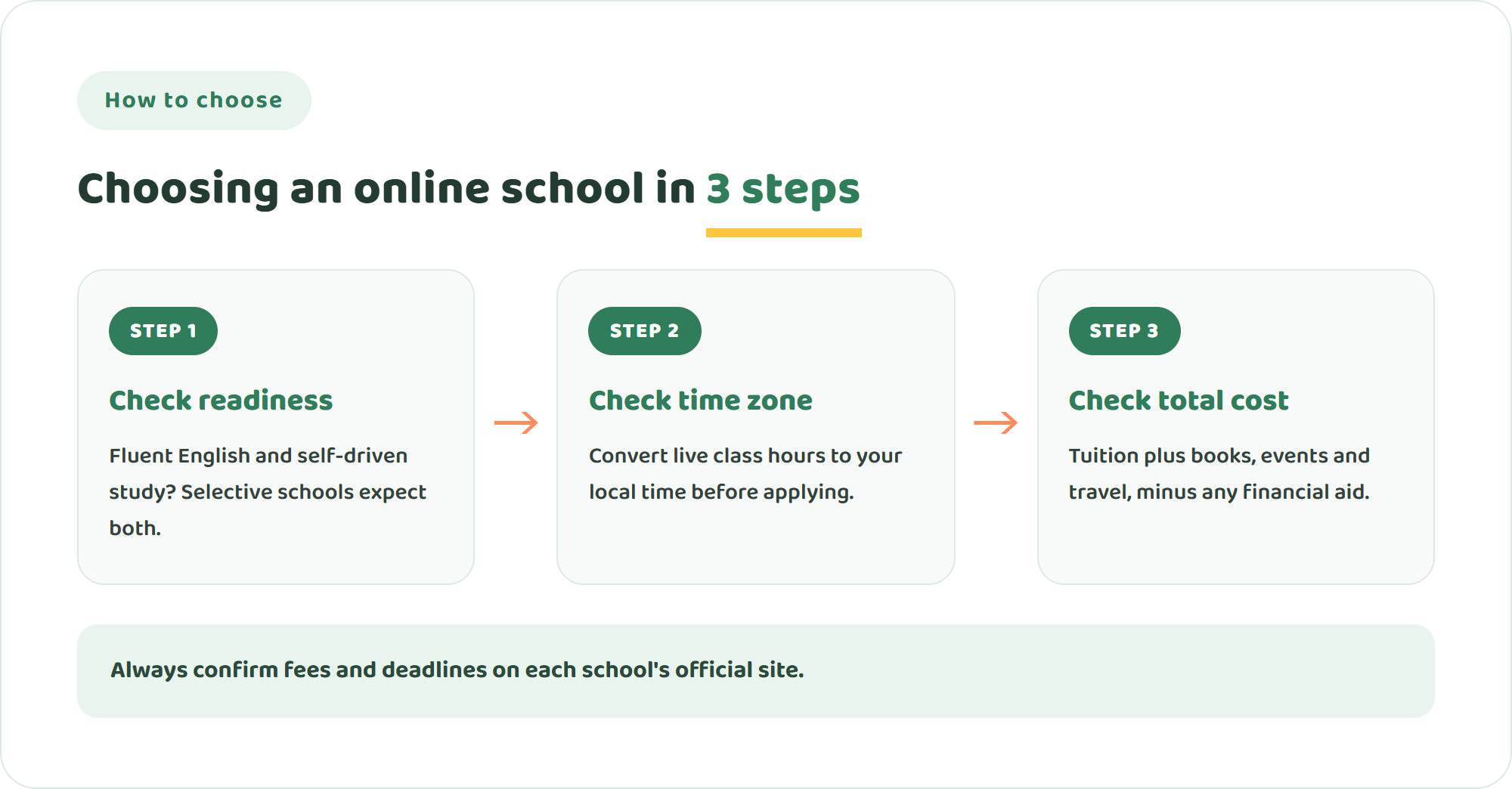
Stanford OHS is an excellent school for the students it is built for, and its tuition, aid and admission rules are unusually well documented. The right question is not which school is “best”, but which one matches your child’s readiness, your time zone and your budget. Tuition and admissions details were checked on the official websites on 22 September 2026. Schools revise fees every year — always confirm on the official site before applying: tuition, financial aid, schedule, history and accreditation, international students.
If an Asia–Oceania, bilingual and exam-free option sounds closer to what your family needs, you are welcome to follow NGA as it prepares to open — no commitment.