If you searched for jobs for moving abroad, you are probably holding two things at once: the pull of living somewhere else, and the very practical worry of how you would pay for it. Maybe a trip stayed with you long after you flew home. Maybe you hit your forties or fifties and thought, quietly, that ending up with the same view out of the same window is not the life you want. And then you started researching, and everything you found was a wall: visas, language, local pay levels. You want to go, but you have no job lined up — and that is where a lot of people stall for years.
This article is written to unstick that. First, an honest look at what work really looks like after you move abroad — no glossy version. Then the heart of it: the idea of taking your job with you — how to pick genuinely location-independent work, what to sort out before you move, and how to build your income. That part is useful with or without us. Finally, as one example of fully remote work that does not care where you live, we will introduce — without a hard sell — the founding-member roles at the online international school we open in September 2027.

Jobs for moving abroad: the honest reality of hiring locally
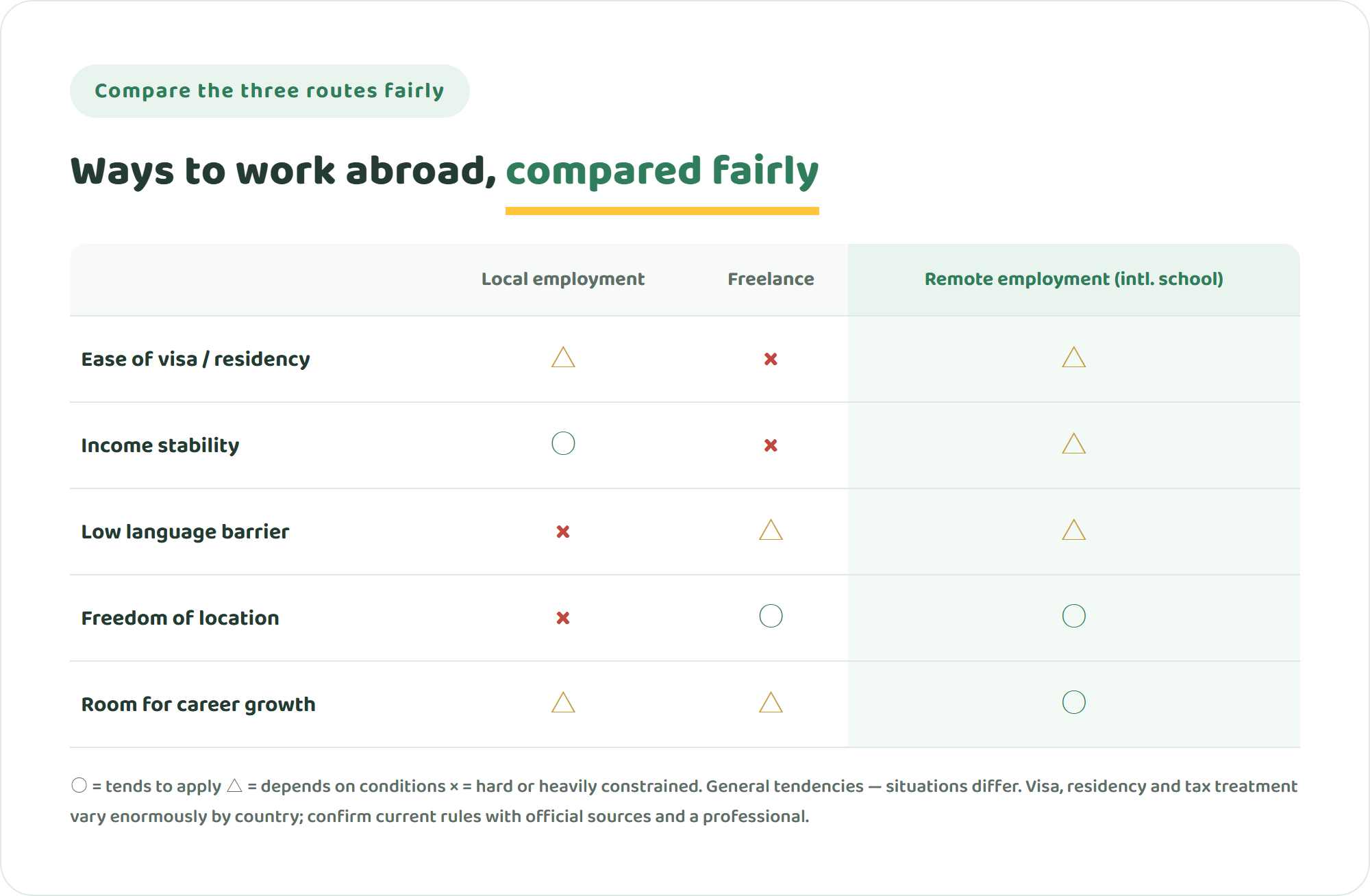
Search for jobs for moving abroad and the first answer is usually “just get hired locally.” Local hiring is a real route, but it generally comes with three walls. First, language: most roles want the local language or English at a working level, not holiday phrases. Second, work visas and residency status: in most countries the right to work is tied to an employer sponsor and to conditions around qualifications, experience, or salary thresholds. These requirements differ enormously by country and are revised often, so please do not take confident-sounding posts on the internet at face value — check each country’s official sources and a qualified professional for the current rules. Third, pay levels: countries where living costs sit below Japan generally have lower wages too. Landing a local contract in the country you love does not guarantee the standard of living you had before.
There is one more thing worth saying plainly: if you search only for work in your own language, the options narrow sharply. Roles that need no local language cluster around companies from your home country, services aimed at your own community, and support desks — and the volume is small. Age changes the picture too. In your twenties and thirties, working-holiday routes exist, but many such schemes have upper age limits. In your forties and fifties it is more realistic to compete on track record, expertise, and management experience than on youth. For women moving with a partner or family, there are often extra questions to check, such as whether a dependant or spouse status permits work at all. Again, this varies by country — never assume the general case applies to yours.
None of this means moving abroad is unrealistic. The walls look tallest when you approach it in one particular order: find the country first, then find the job.
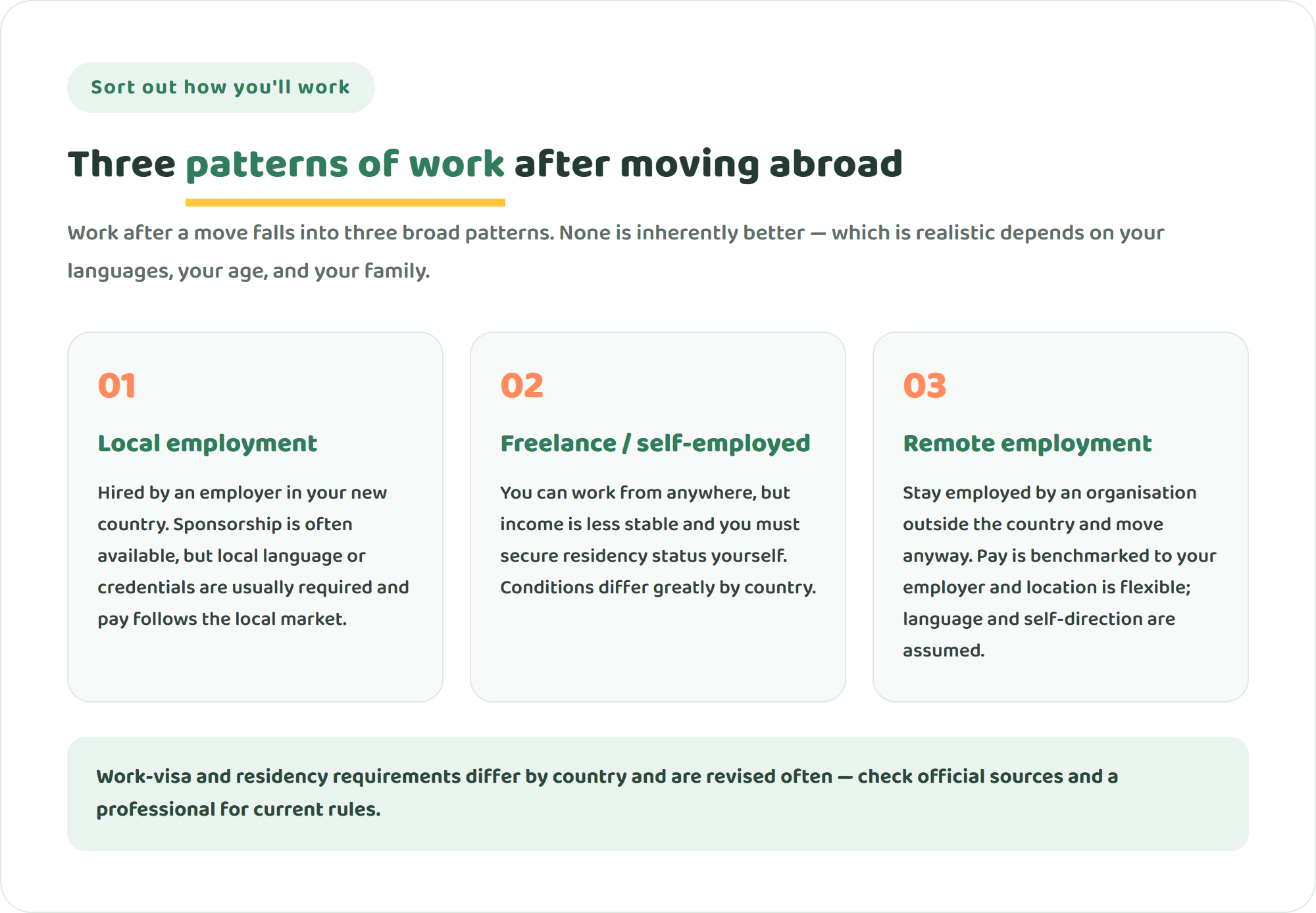
The third pattern — remote employment, staying employed by an organisation outside your new country while changing only where you sleep — has become far more realistic in recent years. Your pay is benchmarked to your employer rather than to the local market, and you never have to job-hunt in a language you are still learning. It is not a magic answer: language ability and self-direction are assumed, and residency rules still differ country by country. But as a way to dissolve the “I can’t move because I have no job there” deadlock, it is the soundest option on the table.
Take the job with you: three things to do before you move
Here is the core idea, and it is simple. Don’t look for work at your destination — move into portable work while you are still at home. Reversing the order lowers the difficulty of the visa, the language, and the income all at once, because the move stops being a gamble and becomes a relocation you make after the job is already secure.
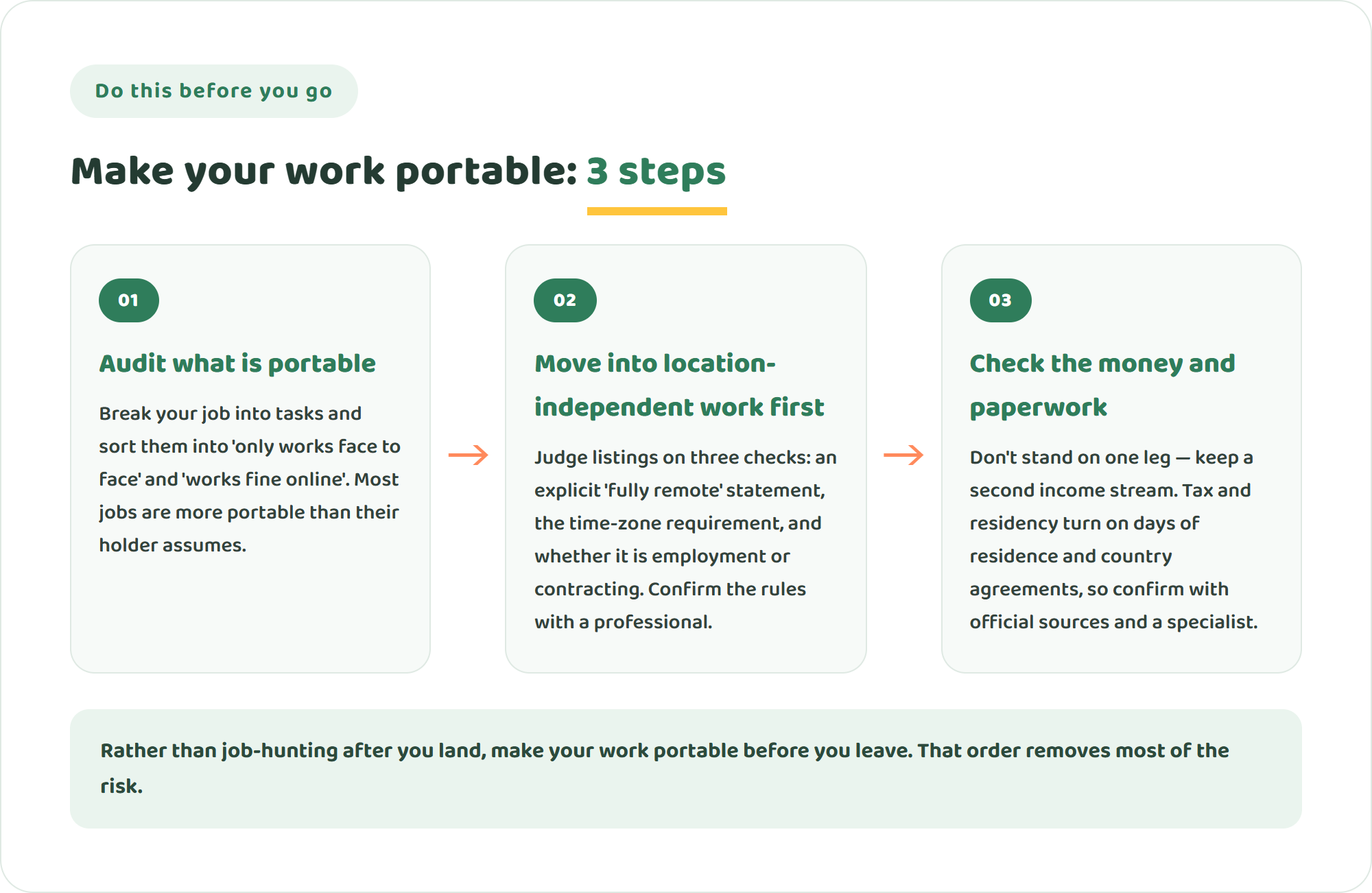
Step 1: audit what is portable. Break your job into its actual tasks and sort them into “only works face to face” and “works fine online.” Planning, teaching, writing, analysing, developing people — most jobs carry more portable weight than their holder assumes. Education is no exception: the core of it, dialogue with learners, building materials, designing curriculum, survives the screen perfectly well.
Step 2: move into location-independent work first. Do not judge a listing by the word “remote” alone. Three checks help. (1) Does the posting explicitly say fully remote or location-independent, with no quiet expectation of office days? (2) What is the time-zone requirement — do core hours follow the employer’s clock or yours? The gap between those two decides what your daily life abroad actually feels like. (3) Is the contract employment or independent contracting? That shapes both income stability and how tax and social insurance are handled. Because those consequences depend on the combination of country and contract type, treat general advice as a starting point only and confirm with a professional.
Step 3: check the money and the paperwork. Don’t stand on one leg. Alongside your main remote income, keeping a second, smaller stream — tutoring, writing, contract work — makes you far more resilient to currency swings and contract renewals. As for tax and residency, outcomes generally turn on days of residence, contract type, and agreements between countries, so once you have narrowed your destination, confirm the current rules with official sources and a tax or immigration specialist. With that in mind, here are the three routes side by side.
See NIJIN GLOBAL ACADEMY’s founding-member roles →
A third path: fully remote, wherever you choose to live
As a concrete example of portable work, here are the founding-member roles that オンラインインターナショナルスクールのNIJIN GLOBAL ACADEMY (NGA) is recruiting for ahead of its September 2027 opening. To be clear, this path is not a cure-all: because it is pre-launch, the stability and track record of an established organisation are still being built. Even so, several things about it line up structurally with what someone planning a move abroad needs.
First, it is fully remote and location-independent. The work is designed around the premise of “working while travelling the world,” so changing countries does not mean starting a job search again. If you have wanted to see more of the world with your own eyes, that wish stops competing with paying your rent. Second, we say plainly what the terms are: founding roles on this track begin as volunteer positions ahead of our September 2027 opening, and the detailed terms are shared later in the process. You cannot plan a move without a view of your income, so being told before you apply that the international track starts as a volunteer role is itself planning material. Third, you can choose how you contribute beyond teaching — marketing, web, partnerships, HR — across five working styles, from part-time to full. You could keep the load light through the chaos of the move and widen it once you have settled.
What applicants need is English at roughly CEFR B2+ and the appetite to build from zero. The narrowing effect of speaking only one language applies here too — but the flip side is that if you have invested in English, this is a field where that investment converts directly into freedom of location. NGA stands for learning beyond test scores, and that view of education is set out in how we learn. If you want a yardstick for international-school economics across Asia, our international school tuition database is a useful comparison.あわせて、インターナショナルスクールの学費はなぜ高いのか(相場の内訳と、対面の約1/5に下げる方法)で、費用の構造そのものを分解しています。

Frequently asked questions
My English isn’t strong. Can I find work abroad in my own language only?
It is possible, but the field narrows considerably: such roles cluster around companies from your home country and services for your own community. If you have time before the move, language is the highest-return preparation you can make. For NGA, the guide is CEFR B2+ — a working level, not native-level perfection.
Is it realistic to move abroad and work in my forties or fifties?
Age is not a reason to give up, but the strategy changes. Schemes with upper age limits, such as working holidays, are usually closed — while your track record, expertise, and management experience are things younger candidates do not have. Rather than competing on youth in a local job market, build around remote employment or contract work where experience counts.
What about visas and taxes?
This article deliberately will not give you a definitive answer. The right to work, residency status, and tax treatment differ substantially by country and are revised frequently. Outcomes generally turn on days of residence, contract type, and agreements between countries. Once your destination is narrowed down, confirm the current rules with official government sources and a tax or immigration professional.
If I work remotely, does the destination matter at all?
The factor that bites hardest in practice is the time difference. If your core working hours sit badly against local daylight, daily life gets hard fast. Beyond that, check connectivity, healthcare, schooling for children, and residency requirements. Because conditions differ by country, start by shortlisting two or three and comparing them properly.
You should not have to give up your work to change where you live
What you really wanted to know when you searched for jobs for moving abroad was probably not “is moving safe?” but “can I choose my own life again?” Whether you want to work while travelling the world or to settle deeply into one country, the key is the same: separate your job from your address. Once your work is portable, moving abroad stops being a reckless bet and becomes a relocation you can plan. Take stock, move into portable work, check the paperwork — step by step, that is how the decision about where you live comes back into your own hands.
Working at an International School — More Articles
- international school teacher salary
- how to become an international school teacher
- career change from teaching
- career change from teaching in your 30s and 40s
- how much do teachers earn?
- how to become an IB teacher
- remote teaching jobs
- remote jobs that use English
- digital nomad teaching jobs
- high-paying jobs that use English
- careers with a teaching license
- private school teacher career change
- qualifications to teach English
- elementary school teacher salary in Japan
- junior high school teacher salary in Japan
- high school teacher salary in Japan
- school principal salary in Japan
- how the Japanese teacher pay scale works
Turn your passion for teaching into your next way of working.