
“Thinking of quitting teaching.” If you typed that into a search box, you’re probably standing one step from your limit. The walk to the classroom feels heavy in the morning. The work you carry home never ends, and even weekends don’t let your mind rest. You love the kids — yet you can’t picture keeping this up for another decade or two. And still, saying “I want to quit” out loud feels like it would be read as weakness, so the thought stays unspoken as the night wears on. If you reached this page carrying that feeling, let us say just one thing first: your exhaustion is not a sign that you are weak.
This article will neither push you toward the door nor shove you back with “just try a little harder.” First, the reality of thinking of quitting teaching — where the pain actually comes from, and how to take burnout seriously. Then, how to sort out your feelings and widen your options — useful for anyone weighing their next career move, with or without us. Finally, as a “third path” that keeps the joy of teaching while changing only how you work, we introduce — without a hard sell — the option of joining the founding team of the online international school we open in September 2027.

The reality of thinking of quitting teaching — first, don’t blame yourself
People who search “thinking of quitting teaching” are wonderfully varied — first-year teachers in their twenties, those who hit a wall in year three, thirty- and forty-somethings juggling family, and fifty-somethings trying to make it to retirement. Different ages, different circumstances, yet one thing runs through them all: what actually hurts is usually not the teaching itself. Trace the reasons back and most lead to long hours, relationships, evaluation, and a lack of time. The hours with the children, and the moment something finally clicks for a student — those, for many, they still love. That is exactly why it’s worth separating out what actually hurts.
The next thing to know is that burnout is not weakness. Pile long hours onto a job of heavy responsibility and even the most dedicated person runs out. Losing the ability to push on is not a failure of will — it’s a matter of load and environment. Resting first, or stepping back, is not running away; it’s a valid move. And third, it isn’t quit-or-stay. Between gritting your teeth at your current school and leaving teaching altogether lies a path: keep teaching, and change only how you work. You don’t have to force a black-or-white verdict in a hurry.
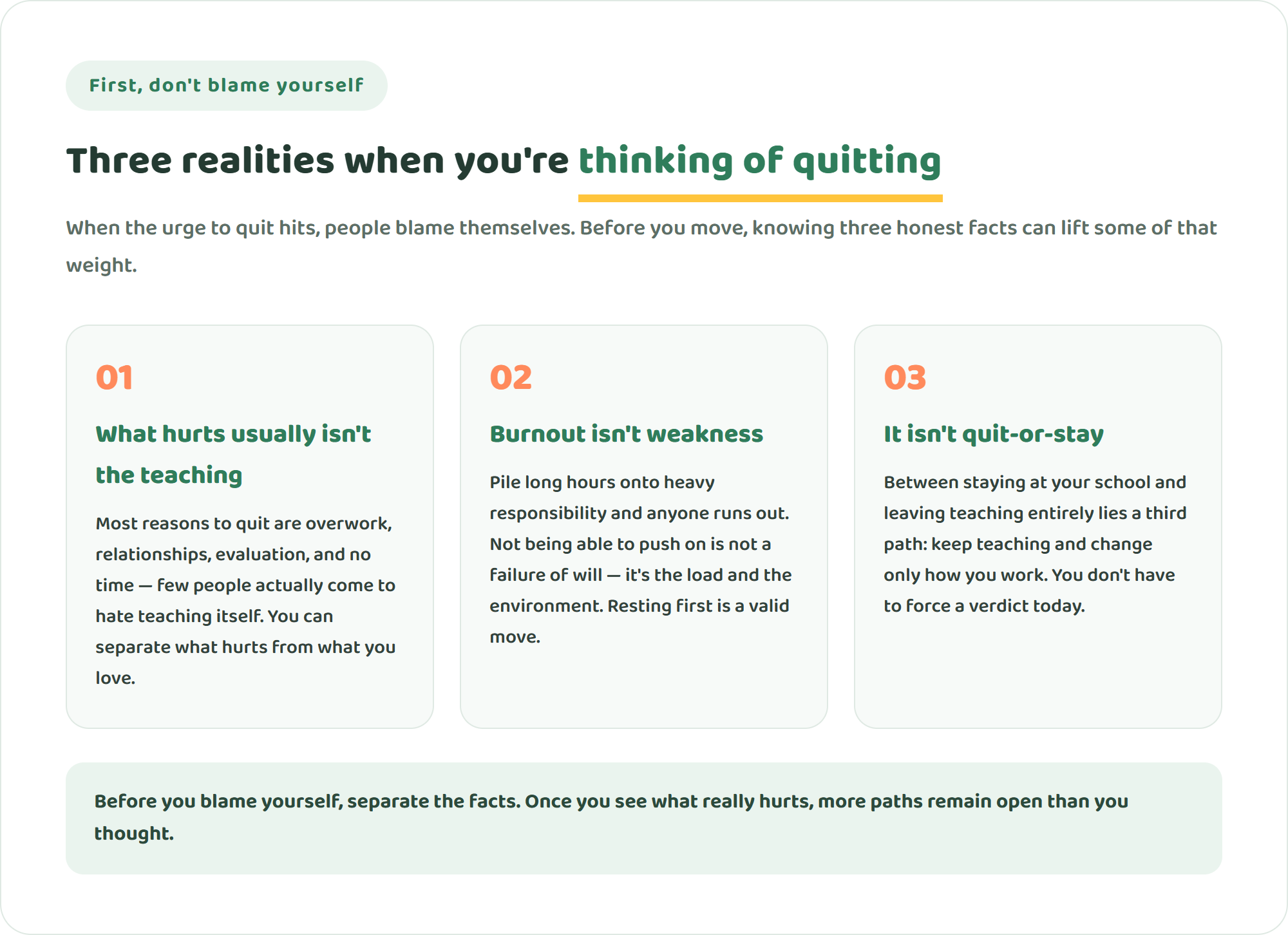
Just knowing these three things shifts the view a little. If you haven’t come to hate teaching, then what you need to let go of may not be the joy of teaching but the environment that drains you. If burnout is an environment problem, changing the environment leaves room to recover. And if it isn’t a binary, you have time to line up your options before rushing to hand in a resignation. What matters is to unpick the substance of the pain once, rather than move on raw emotion.
Before you decide to quit — three steps to sort out how you feel
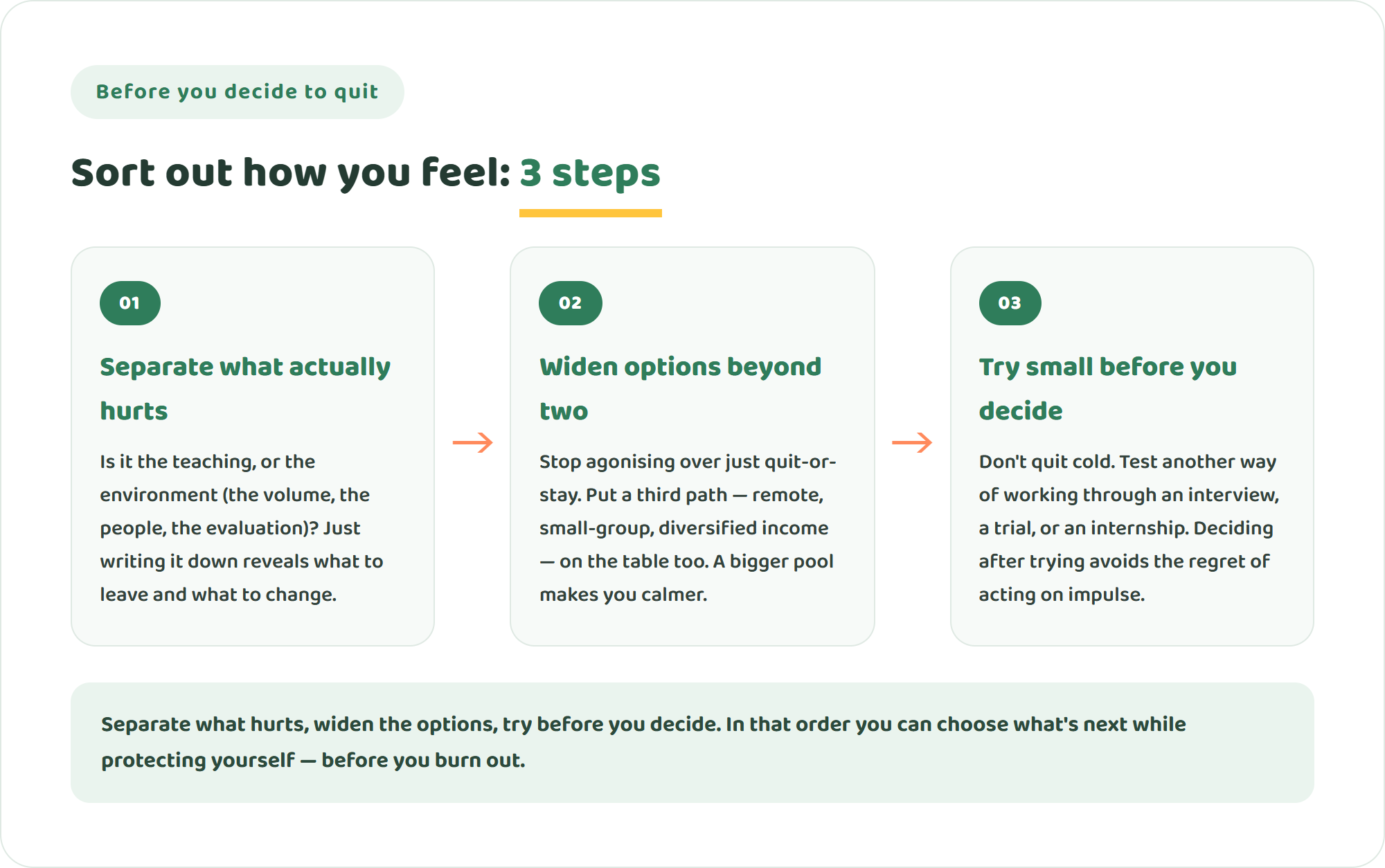
This is the heart of the article. The urge to quit may be genuine, but acting on momentum alone tends to leave regret. So start by separating what actually hurts. Paper or a note on your phone will do. Write down, as it comes, whether “the teaching hurts” or “the environment hurts” (the workload, the relationships, the evaluation, the lack of time). Simply writing it out sorts, with surprising clarity, what to leave from what to change.
Next, widen your options beyond the two. Agonise only over “quit” versus “stay” and your thinking goes in circles. Put a third path on the table too — keep teaching while changing how you work: fully remote, centred on small-group dialogue, income spread across more than one pillar. Oddly, the more options you can see, the calmer you become. Finally, try small before you decide. Rather than quitting cold, take an interview, or experience another way of working through a trial or internship. Deciding after trying is what spares you the regret of acting on impulse.
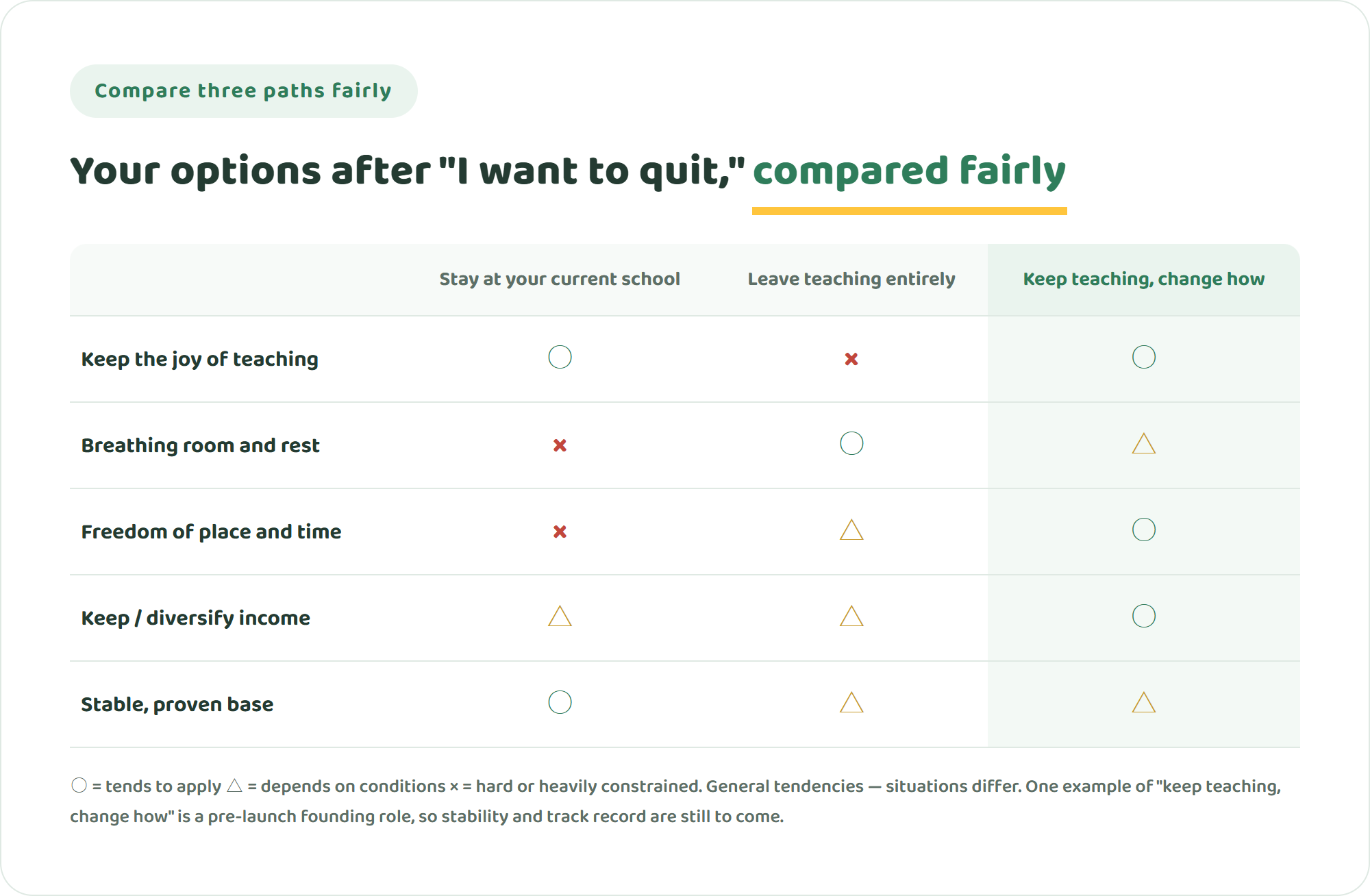
Line the options up and each reveals its own strengths and constraints. Staying at your current school keeps your stability and the record you’ve built, but the cause of the pain tends to remain. Leaving teaching entirely may win you breathing room, yet risks giving up the joy of teaching along with it. Keeping teaching while changing how you work makes it easier to hold onto both the joy and the freedom, but takes the courage to step into somewhere new. The table below sets the three paths out fairly, side by side.
See NIJIN GLOBAL ACADEMY’s founding-member roles →
A third path — keep the joy of teaching, change only how you work
Not enduring at your current school, and not giving up teaching. There is another path: fully remote, taking part in both the teaching and the building of the school. That is the founding-member role NIJIN GLOBAL ACADEMY (NGA) is recruiting for ahead of its September 2027 opening. As the table above makes plain, it is not a cure-all — precisely because it is a pre-launch phase, the “stability and track record” of an established school are still to come. Even so, for anyone near burnout who is “thinking of quitting” yet doesn’t want to lose the joy of teaching, the appeal is real.
First, it is fully remote — designed around the premise of “working while traveling the world,” with no packed commute and no life tied to a posting. You reclaim where you live and the rhythm of your days. Second, it centres on small-group dialogue, so it’s free of the drain of processing a huge class at once, and you engage deeply with each child — a design that suits precisely those who “didn’t want to lose the joy of teaching.” Third, you can choose how you work: beyond teaching, you pick your involvement from five working styles spanning marketing, web, partnerships, and HR, adjusting the load anywhere from part-time to full. When you need breathing room, you can start with a manageable share. And we are straight about the terms — founding roles on this track begin as volunteer positions ahead of our September 2027 opening, and the detailed terms are shared later in the process. What we ask of applicants is roughly English at CEFR B2+ and an appetite for building from zero — we look at that drive more than at a license or a glossy résumé. What NGA stands for is learning beyond test scores — an education that doesn’t rank children by exam marks, laid out in how we learn. It may resonate most with teachers worn down by the scramble for points.

Frequently asked questions
Does wanting to quit mean I’m not cut out for teaching?
Not at all. Most reasons for wanting to quit lie in the working environment and the load, not in any lack of aptitude for teaching. If anything, it’s the people who have engaged most seriously with their students who wear out fastest. What matters isn’t “am I cut out for it” but “in what kind of environment could you keep teaching without running yourself down.”
I’m close to burnout — should I quit my current school right away?
This article isn’t urging you to quit quickly. It’s not too late to decide after you’ve separated what actually hurts and widened your options beyond the two. NGA opens in September 2027 and is designed so you take part through a lead-up period — so you can weigh your next way of working calmly, without the pressure of “I have to quit this instant.”
I have a license, but I’m anxious about making it in a new environment.
What NGA asks for is people who “can build from zero,” and looks at drive and the ability to create more than at a license or a glossy résumé. The skills you built in class management, working with families, and making your own materials become direct strengths in the work of building a school. Selection includes an internship, so you can check the fit before you leap.
You open in September 2027. Is there any point applying now?
Yes. It is precisely because it is pre-launch that founding members help design the substance of the learning itself. The lead-up is built so you can gain experience through the NIJIN Academy internship and more. If you are drawn to “joining the side that builds” rather than “entering a finished organisation,” now is arguably the moment.
Working fully remotely, can I really win back some breathing room?
On top of zero commute and no ties to a location, NGA lets you choose your load from five working styles. When you want to rebuild your health, you can start with a manageable share and widen it as you recover. Because you work within a small team with roles shared, it’s a far cry from carrying everything alone.
You don’t have to give up the joy of teaching, too.
If you searched “thinking of quitting teaching,” a near-limit exhaustion and a love of teaching that still won’t fade almost certainly live side by side in you — and you don’t have to abandon one to keep the other. If what hurts is not “the teaching” but “the environment,” then what you should let go of may be the environment. Don’t corner yourself into quit-or-stay: separate what hurts, widen your options, and try before you decide — each step protects you before you burn out. The teaching skill you’ve built up will never go to waste, no matter where you choose to work.
Working at an International School — More Articles
- international school teacher salary
- how to become an international school teacher
- career change from teaching
- career change from teaching in your 30s and 40s
- how much do teachers earn?
- how to become an IB teacher
- jobs for moving abroad
- career change from tutoring
- life after leaving teaching
- a second career for teachers
- private school teacher career change
- teach abroad without relocating
- high-paying jobs that use English
- careers with a teaching license
- qualifications to teach English
- elementary school teacher salary in Japan
- junior high school teacher salary in Japan
- high school teacher salary in Japan
Turn your passion for teaching into your next way of working.