Preparing English before international school is the quiet worry behind almost every open-day question. My child has barely any English yet — will they be all right? The admissions team says everyone starts somewhere, and means it. It is a kind answer. And still, on the drive home, you turn it over again.
Here is the honest version. Plenty of children arrive with almost no English and do well. Others arrive unprepared and find the first months genuinely hard. What separates them is rarely how much English got crammed in beforehand. It is the school’s support structure, and whether the family also protects the home language. Below are seven things to do before the first day, with no promises attached.
Whether starting with no English is fine depends on the school’s support structure
The largest variable is not your child’s English level. It is how much genuine EAL support the school actually provides — English as an Additional Language, sometimes called ESL. Some schools have specialist teachers, pull-out sessions alongside regular lessons, and subject tasks adapted stage by stage. Others list EAL in the prospectus, and in practice it can amount to little more than a couple of remedial sessions a week.
This is the part worth underlining. The depth of that support varies enormously between schools, and you cannot see it from the outside. Do not judge from one line in a brochure. Ask each school directly: how many children per group, how often, who teaches it, and for how long a child can keep receiving it.
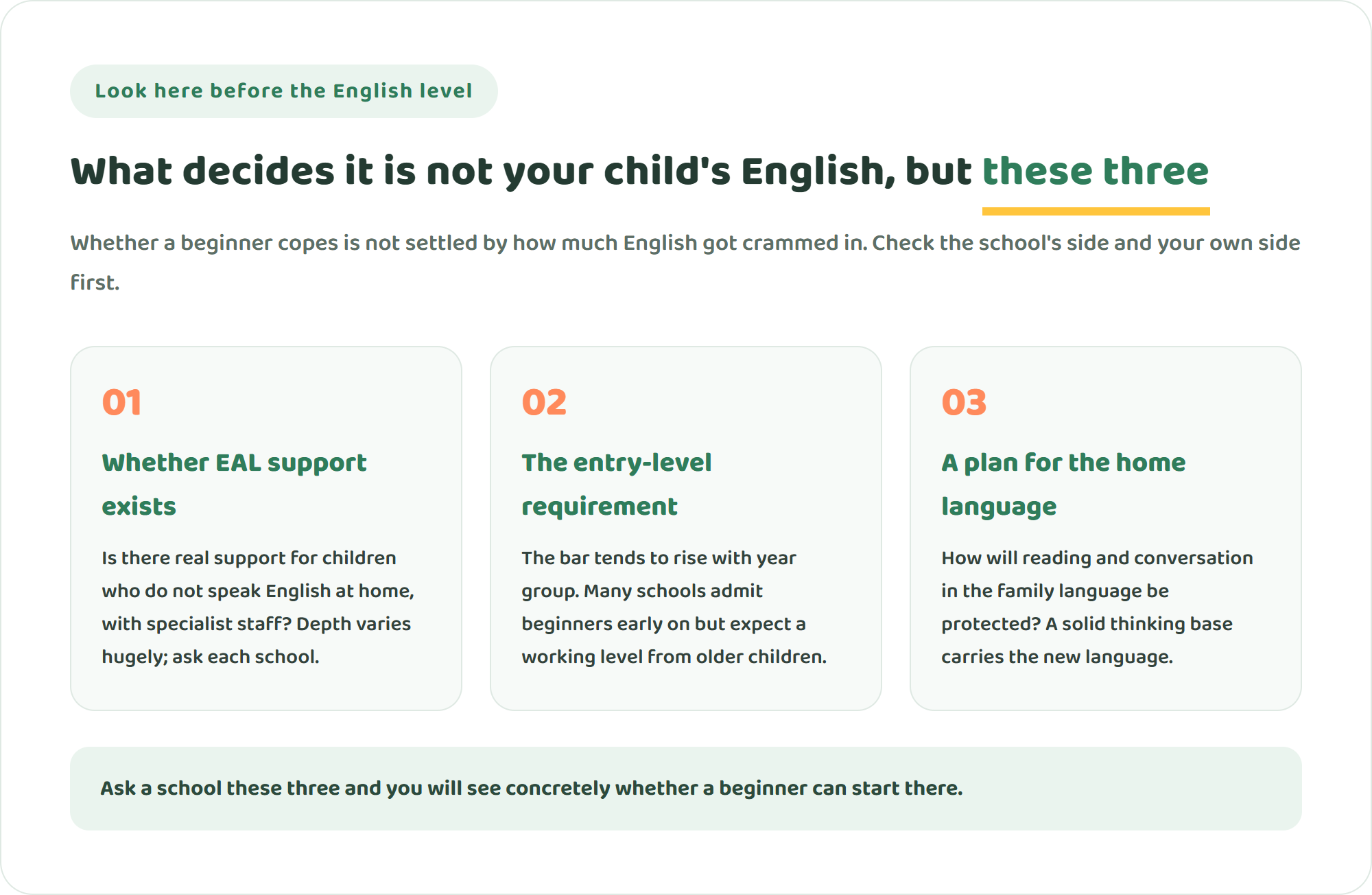
The second thing to check is the entry-level English requirement, which tends to rise with year group. Many schools will admit a beginner in the early primary years while expecting a working level from a child entering secondary. The age at which you move changes how much preparation the year ahead calls for.
Preparing English before international school: seven things you can start now
Seven items follow, but you do not need all of them. Pick the two or three that fit your week. None can be promised to work, but each tends to make the first months lighter.
1. Build listening volume into ordinary daily life
The first hurdle is not vocabulary. It is whether the ear has grown used to the shape of English sound. The purpose: when the teacher gives an instruction, your child at least registers that one has been given. It survives far better as background during breakfast or the school run than as extra time at a desk. The smallest step today is a fixed fifteen minutes a day. Our guide to helping your child learn English at home goes further.
2. Use phonics so they can sound out new words
Phonics teaches the correspondence between letters and sounds systematically. The purpose is that a child who can do this will attempt a word they have never seen, instead of freezing in front of a worksheet. Once c-a-t blends into cat, reading tasks after enrolment get lighter. The smallest step today is going through the twenty-six letters by their sounds rather than their names, three a day.
3. Read picture books aloud to grow known words
Decoding sound is not comprehension if meaning does not follow. The purpose here is that words stored alongside a picture come with a hook, and children learn to infer meaning without reaching for a dictionary. A useful difficulty level is one or two unknown words per page; beyond that, attention drops. The smallest step today is swapping the bedtime book for an English one, with you reading and your child only listening.
4. Use small online classes to guarantee turns to speak
Input on its own does not get a child talking. The purpose is that what helps a child after enrolment is the number of times they have managed to say something, and that number rarely grows in a large class. In a group of twenty for forty-five minutes, one child’s share can be a matter of seconds. The smallest step today is booking two trial lessons and counting how many times your child actually spoke.

5. Meet subject language early
Researchers have long distinguished everyday conversational fluency (BICS) from the academic language used to read, write and reason about subject content (CALP). It explains why a child who sounds fluent in the playground can stall on a science worksheet. Meeting words like add, subtract, half, shape and plant early lets classroom attention go to the content itself. The smallest step today is looking up the English name of your child’s current maths topic.
6. Protect the family language at the same time
This is the item we most want to be honest about. When time tilts heavily towards English, there is a long-discussed concern that neither language reaches age-appropriate depth. A solid base for thinking gives the new language something to build on, so reading and conversation in the family language deserve a protected slot. The smallest step today is putting home-language reading in the calendar before any English; our piece on raising a bilingual child without losing the mother tongue covers the design.
7. Write the questions you will ask on a school visit
The last item is preparation for you, not your child. What a school will actually do for a beginner is invisible unless you ask. Is the EAL lead a specialist or a class teacher doing double duty? How many pull-out sessions a week, and until when? Are subject tasks adapted individually? Whether they can answer concretely tells you more than the answers. The smallest step today is saving those questions in your phone.
Where to build English: four options on one yardstick
Where should the seven happen? The routes divide into four. No option earns a circle on every row, and cost and approach vary widely, so read the table as a general tendency.
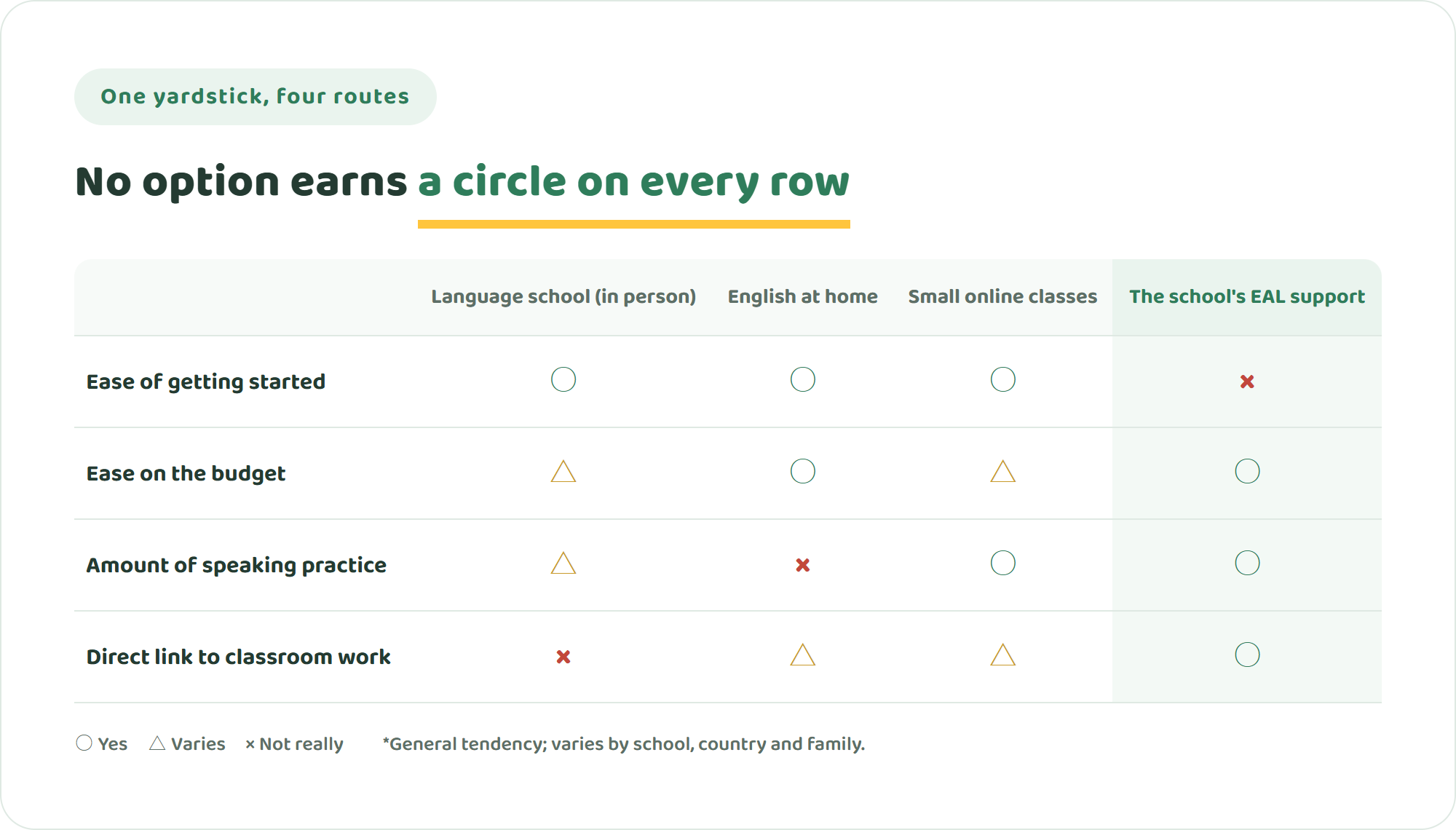
| What you are weighing | Language school (in person) | English at home | Small online classes | The school’s EAL support |
|---|---|---|---|---|
| Ease of getting started | ○ | ○ | ○ | × |
| Ease on the budget | △ | ○ | △ | ○ |
| Amount of speaking practice | △ | × | ○ | ○ |
| Direct link to classroom work | × | △ | △ | ○ |
The school’s EAL support connects straight to classroom work, but only exists after enrolment, so it cannot fill the months beforehand. English at home is gentle on the budget and easy to sustain, yet speaking turns do not appear on their own. Most families settle on a combination: home as the base, speaking turns bought separately.
See how learning works at NIJIN GLOBAL ACADEMY →
How to spread the six to twelve months before international school starts
Whether you have six months or a year, the order does not change. The first move is not choosing material but measuring where your child stands, because without a baseline you cannot tell whether anything is working.
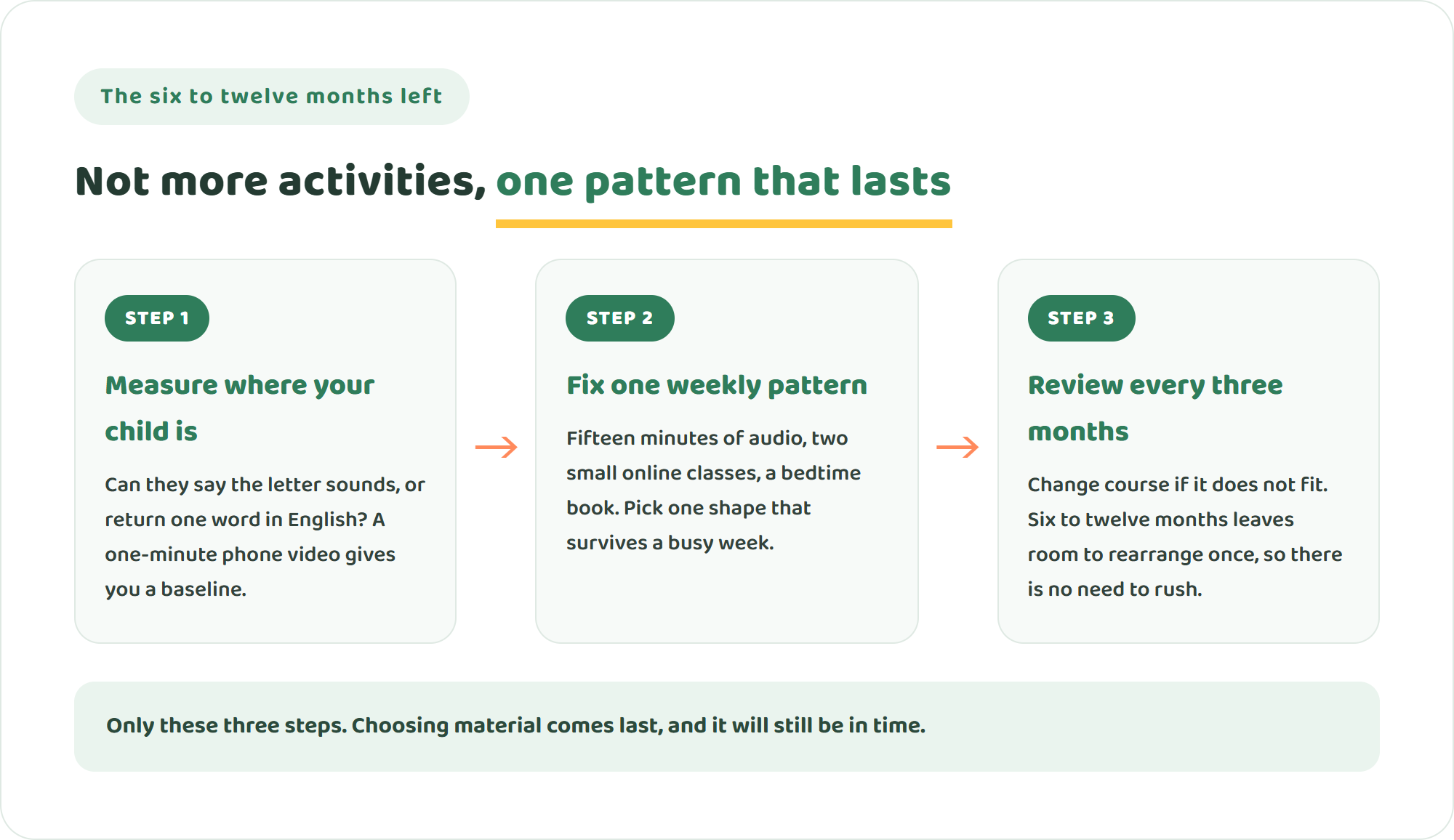
Step 1 is measuring where your child is. Can they say the letter sounds? Can they return one word in English? A one-minute phone video gives you something to compare against in three months. Step 2 is fixing a single weekly pattern: fifteen minutes of audio daily, two small online classes, a bedtime book. The temptation is to add; the discipline is to pick what survives a bad week. Step 3 is reviewing every three months. Six to twelve months leaves ample room to change course once.
Common questions
What age is early enough?
No one can draw a clean line past which it is too late. Younger children tend to pick up sound more easily, while older children handle letters and grammar faster and sometimes reach academic language sooner. What matters more than starting age is the total time you can protect before enrolment.
Will a beginner be able to follow lessons?
It depends on the school’s EAL provision and the year group. In the early years, at a school with real EAL depth, arriving as a beginner is unremarkable. Higher up, the language load and the academic load land together. Which brings you back to asking each school what it provides.
Does it matter that we do not speak English at home?
You do not need to teach English. The family’s job is to build exposure into daily life, protect a routine that lasts, and support your child’s home language and confidence. Correcting pronunciation can be outsourced; deep conversation in the family language cannot. See the myths about bilingual children for what the evidence does and does not say.
Will more English hold the home language back?
Time is finite, so tilting towards English does reduce the hours available elsewhere. That is exactly why item six exists. When you add English hours, schedule home-language reading and conversation in the same breath. That one habit changes the picture several years out.
Starting with no English is still a starting line
Can I really put this child in a classroom where they will not understand a word? That question comes from care, not from doubt about your child. But remember: international schools around the world take in beginners every year. It is an expected entrance, not an exception. Preparation exists to make that entrance gentler, not to earn the right to walk through it.
NIJIN GLOBAL ACADEMY is an online international school due to open in September 2027, with trial classes running in spring 2027 ahead of that. By email, before anywhere else, we share how small-group classes protect every child’s turn to speak, along with news about our founding intake. You do not need to decide anything today. If your child can return one sentence in English six months from now, that is progress enough.