
If you have been quietly wondering how to move from tutoring to international education, you are probably not someone who fell out of love with the work. You still remember the moment a student looked up and said “oh — I get it now.” You remember the message that came the day results were posted. That still lands. And yet the evenings that start when everyone else’s day ends, the holiday intensives that eat your breaks, the enrolment targets, and — somewhere in your thirties or forties — a quiet, shapeless question about where this all leads, keep stacking up. If you found this page late at night carrying that, you are far from alone.
This article tries to sort that out honestly. First, the reality of leaving tutoring: why people say the experience “doesn’t transfer,” the age and salary walls, and where tutors actually end up. Then the part that is useful whether or not you ever apply to us — taking stock of the skills that genuinely do transfer, and how to put them into a CV that a hiring manager outside the industry can read. Finally, a third path: staying on the teaching side while moving to the side that builds.

Is a move out of tutoring really that hard? An honest starting point
Search around this topic and the suggestions fill with “difficult,” “no transferable skills,” “career change at 30,” “no experience.” That alone tells you how many people share the worry. So let us lay it out without softening it. First, the work is hard to see from outside. Recruiters in other industries often picture a tutor as “someone who taught lessons.” In reality you designed the sequence, negotiated expectations with parents, and worked deliberately on retention. But if your CV only says “taught group and one-to-one classes,” none of that depth reaches the reader. Much of what gets called “unusable experience” is not a capability problem — it is a translation problem.
Second, the age wall. Generally, the older you are, the more a move into an unfamiliar job type is judged on what you can run from day one. In your twenties you are read for potential; in your thirties and forties, for what can be handed to you. This is where centre management, hiring and coaching junior tutors, and owning revenue or retention numbers change the picture entirely. Third, pay. Tutoring is a wide industry — contract type and company size vary enormously — and a move can mean a temporary dip, or a rise if you step toward the business side. Judge roles on the real hourly value including working hours, not the headline figure, and you will regret fewer decisions.
Where tutors typically go next
The common destinations are education companies (EdTech, curriculum and materials, publishing), L&D and recruitment work (career advising, corporate training design), B2B sales of intangible services, classroom teaching in private or public schools, and operations roles in online education. The thread running through all of them is the same: helping people understand something and change what they do. That is exactly what you did every evening. These are general tendencies, of course — requirements and packages differ by employer.
“It doesn’t transfer” is a myth — take stock of what does
This is the heart of the article. Before you start browsing roles, do this: take stock of your skills. What you built while tutoring reaches further than you think.
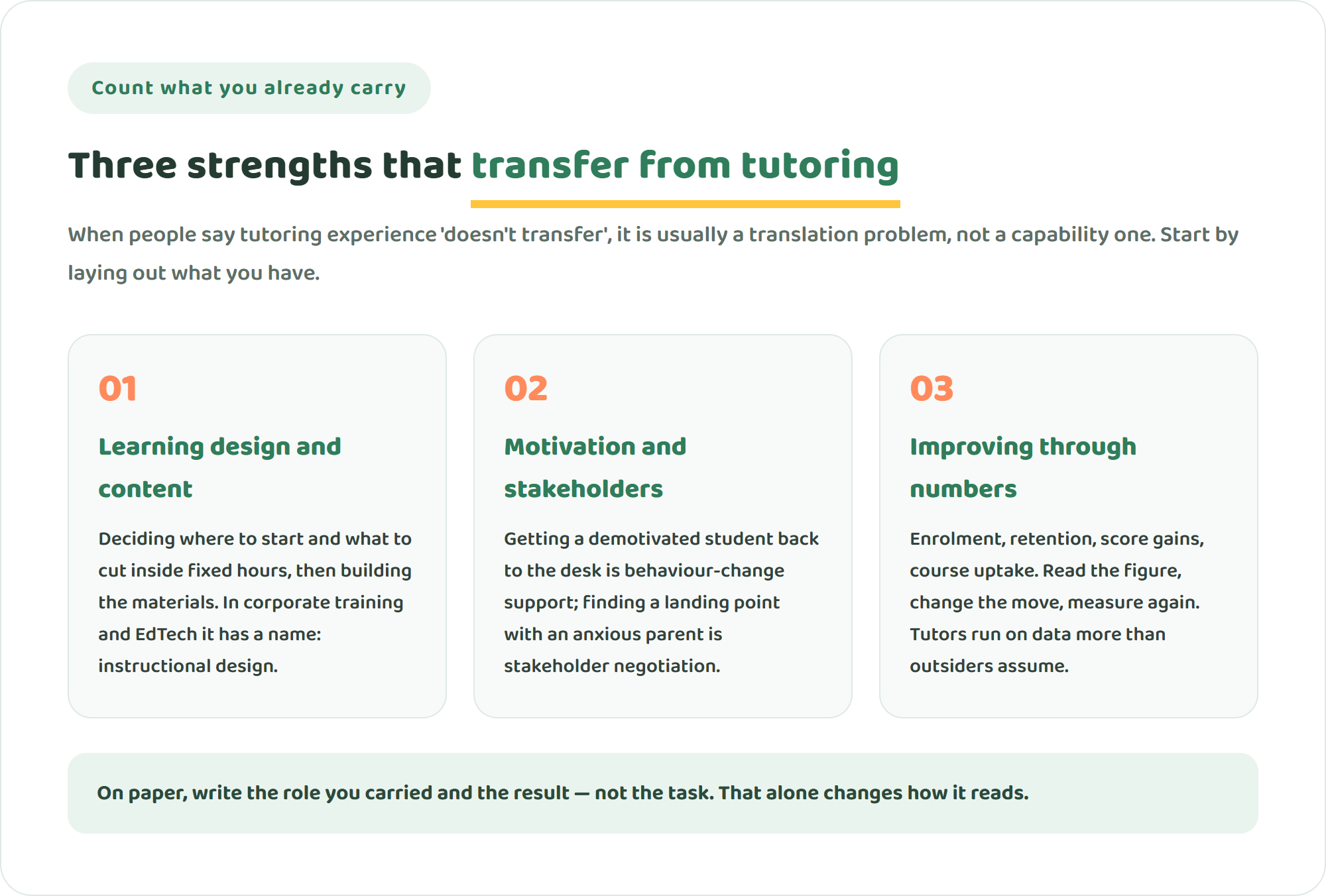
The first is learning design and content creation: deciding, inside a fixed number of hours, where to start and what to cut, then building the materials. In corporate training and EdTech that discipline has a name — instructional design. The second is motivation and stakeholder handling: getting a demotivated student back to the desk is behaviour-change support, and finding a landing point with a parent who arrives carrying both hope and anxiety is stakeholder negotiation. The third is improving through numbers: enrolment, retention, score gains, uptake on seasonal courses — read the figure, change the move, measure again. Tutors run on data far more than outsiders assume.
Putting it on paper — turn “I taught” into “I designed”
Stock-taking only reaches the reader once it is rewritten. The trick is to describe the role you carried and the result, not the task. Not “taught junior-high group classes,” but “ran classes of around N students, revised the teaching plan weekly against unit-test data, and improved year-on-year retention for my cohort.” Not “held parent meetings,” but “reached agreement on learning plans across N meetings a year and fed churn analysis back to operations.” Be honest with the numbers, never inflate them, and never breach confidentiality.
This exercise works wherever you are headed. And what many people realise once they finish it is this: “I don’t dislike teaching — what wore me down was having no say in how the teaching, or the working, was designed.” If that sounds like you, then moving somewhere your teaching craft can go deeper may grow your career further than abandoning the expertise altogether for an unfamiliar field.
See NIJIN GLOBAL ACADEMY’s founding-member roles →
A third path — keep teaching, and move to the side that builds
“Stay in tutoring, or leave education.” The decision is so often framed as that binary. But there is another option: keep the joy of teaching, and cross only the boundary of how you work. The founding-member roles 脱偏差値のオンラインインターナショナルスクール NIJIN GLOBAL ACADEMY (NGA) is recruiting for ahead of its September 2027 opening are built on exactly that idea. First, three paths side by side, fairly.
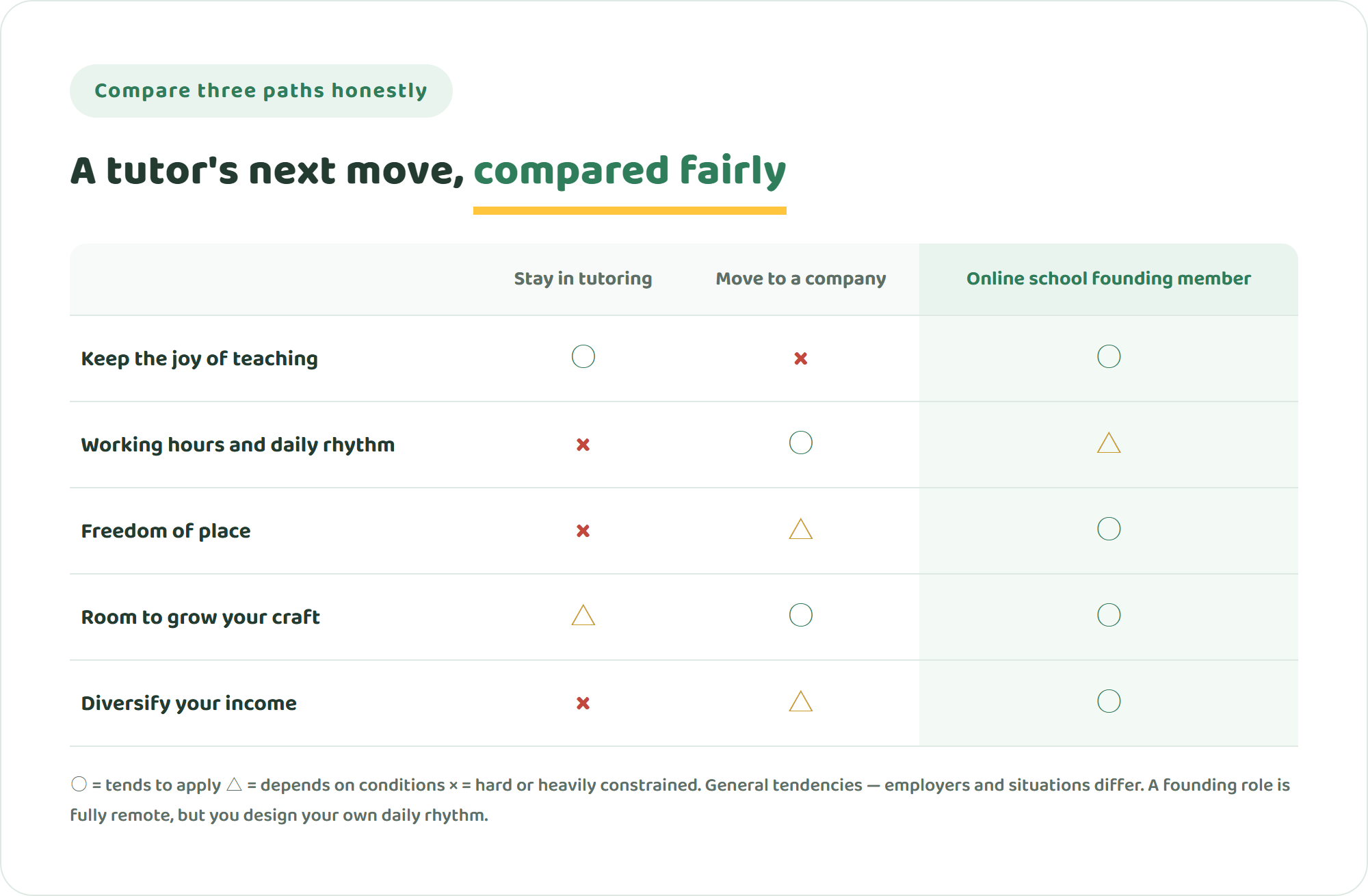
As the table shows, the founding-member route is no cure-all. Pre-launch means stability and track record are still being built, and you have to structure your own use of time. Even so, it fits people who have taught in the tutoring world unusually well.
First, it is fully remote, designed around the premise of working while travelling the world — no commute to a centre, no fixed location. From leaving home at dusk and returning near midnight, to choosing where you work from. Second, it is built on small-group dialogue. Rather than packing in the correct answer efficiently, learning starts from “what do you think?” and is designed as projects. The learning design and motivation craft you built in tutoring keeps growing here as expertise (our approach is set out in how we learn).
Third, we say plainly what the terms are. On the international track, founding roles begin as volunteer positions ahead of the September 2027 opening, and the detailed terms are shared later in the process. Fourth, you can choose roles beyond teaching — five working styles spanning marketing, web, partnerships and HR. If you have run a centre or owned enrolment growth, that experience becomes a business-side asset immediately (for market context, our international school tuition database gives you a yardstick). What we ask for is English at roughly CEFR B2+ and an appetite for building from zero.あわせて、インターナショナルスクールの学費はなぜ高いのか(相場の内訳と、対面の約1/5に下げる方法)で、費用の構造そのものを分解しています。

From tutoring to your next step — three steps
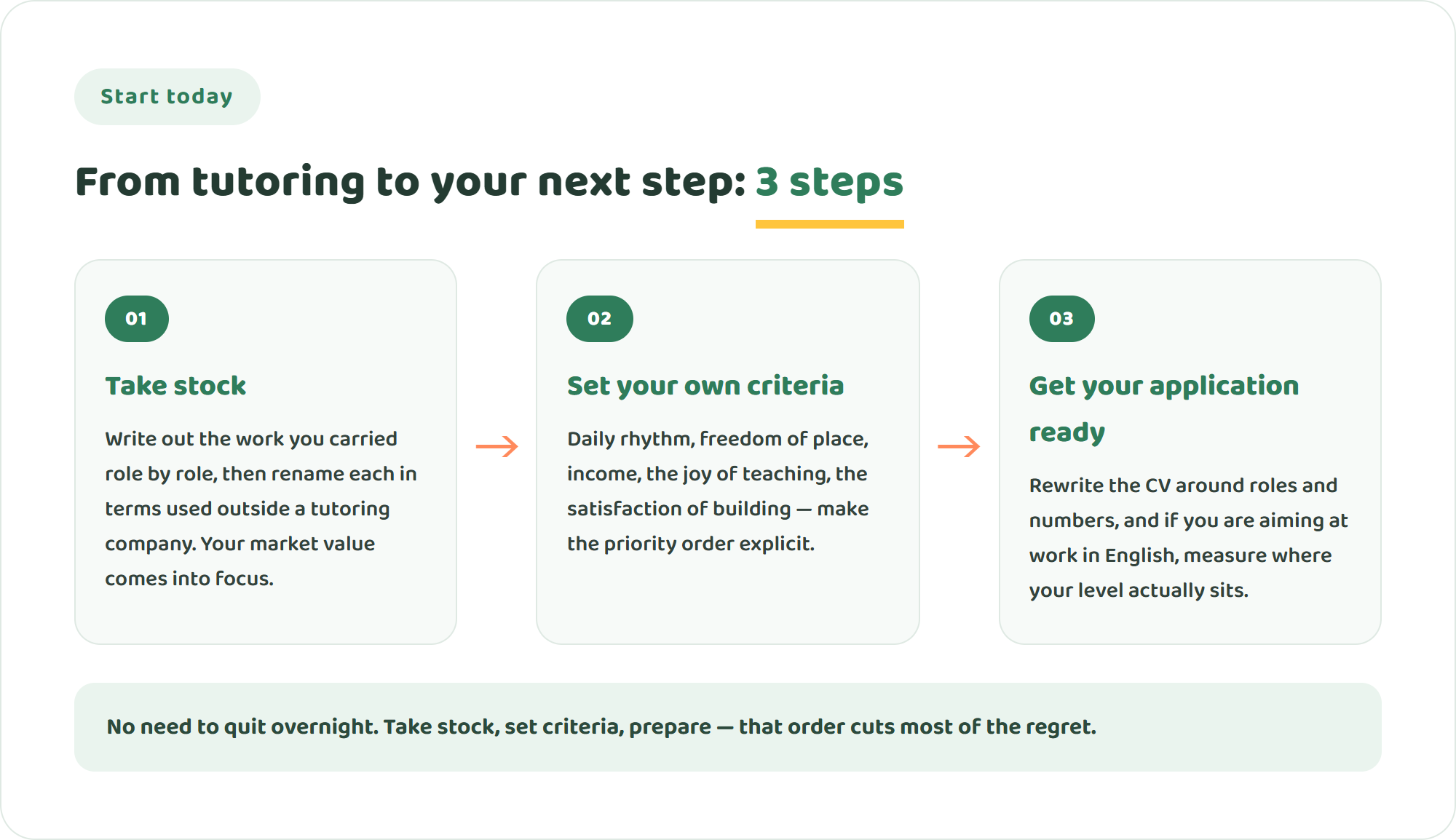
First, take stock: write out the work you carried role by role, and rename each in terms used outside a tutoring company. Second, set your criteria: daily rhythm, freedom of place, income, the joy of teaching, the satisfaction of building — make the priority order explicit. Browse listings with fuzzy criteria and you will be pulled around by surface conditions. Third, get your application ready: rewrite the CV around roles and numbers, and if you are aiming at work in English, measure where your level actually sits. Gather information while keeping your current job, and move only when something fits. NGA’s process runs from document screening to a group interview, an internship at NIJIN Academy, and a final presentation (applications via a Google Form) — so you can try before you decide.
Frequently asked questions
Is a career change at 30 or 40 too late?
No. But it is true that the older you are, the more you are asked what can be handed to you. That is exactly why it pays to articulate centre management, coaching juniors, and owning numbers. What removes the age penalty is not length of service — it is translation of experience.
I have only tutored, and I’m not confident in my English.
We assume roughly CEFR B2+, but we are not looking for native-level perfection. What matters is the willingness to use English with children and colleagues around the world and keep growing it. What the recruiting page asks for, alongside English, is people who can build from zero. You can confirm the expected level during selection.
Can I really change an evening-shaped daily rhythm?
There is no commute to a centre, but you will still coordinate time zones with students and colleagues. It does not become regular by itself — it is a way of working you design. How hours are actually structured varies by working style, and can be discussed during selection.
You open in September 2027. Is there a point in applying now?
Yes. It is precisely because it is pre-launch that founding members help design the curriculum and the school itself. The lead-up is built so you can gain experience through the NIJIN Academy internship.
What you built in tutoring stays yours, whichever path you take.
The time you spent tutoring was never wasted. Reading comprehension off a student’s face, finding the words that meet a parent’s anxiety, the habit of looking at a number and acting on it — all of it follows you down any path. What you need is not to dismiss the industry you came from, but to count your own belongings accurately. You do not have to quit in a panic, and you do not have to grit your teeth and endure. If what you feel is “I want to keep teaching, but I want to change how I work,” then moving to the side that builds is worth putting on the list.
Working at an International School — More Articles
- international school teacher salary
- how to become an international school teacher
- career change from teaching
- career change from teaching in your 30s and 40s
- how much do teachers earn?
- how to become an IB teacher
- jobs for moving abroad
- teach abroad without relocating
- thinking of quitting teaching
- life after leaving teaching
- a second career for teachers
- private school teacher career change
- qualifications to teach English
- elementary school teacher salary in Japan
- junior high school teacher salary in Japan
- high school teacher salary in Japan
- school principal salary in Japan
- how the Japanese teacher pay scale works
Turn your passion for teaching into your next way of working.