How do you teach new vocabulary to your students? Do you share a list of words? Is that fun? Are they motivated?… Why don’t you try to use the CLIL approach to make your students’ interest increase?
First, let’s check what CLIL (Content and Language Integrated Learning) approach means. Students learn about a subject or explore a topic through a foreign language. That way they learn vocabulary and grammar in a context. Using the CLIL approach students use the new language to discover and understand the world around them.
CLIL combines two objectives: learning new content and developing language skills. For example, children might learn about animals, food, traditions, or different countries while practising English. This makes language learning more interesting and encourages kids’ curiosity and motivation.
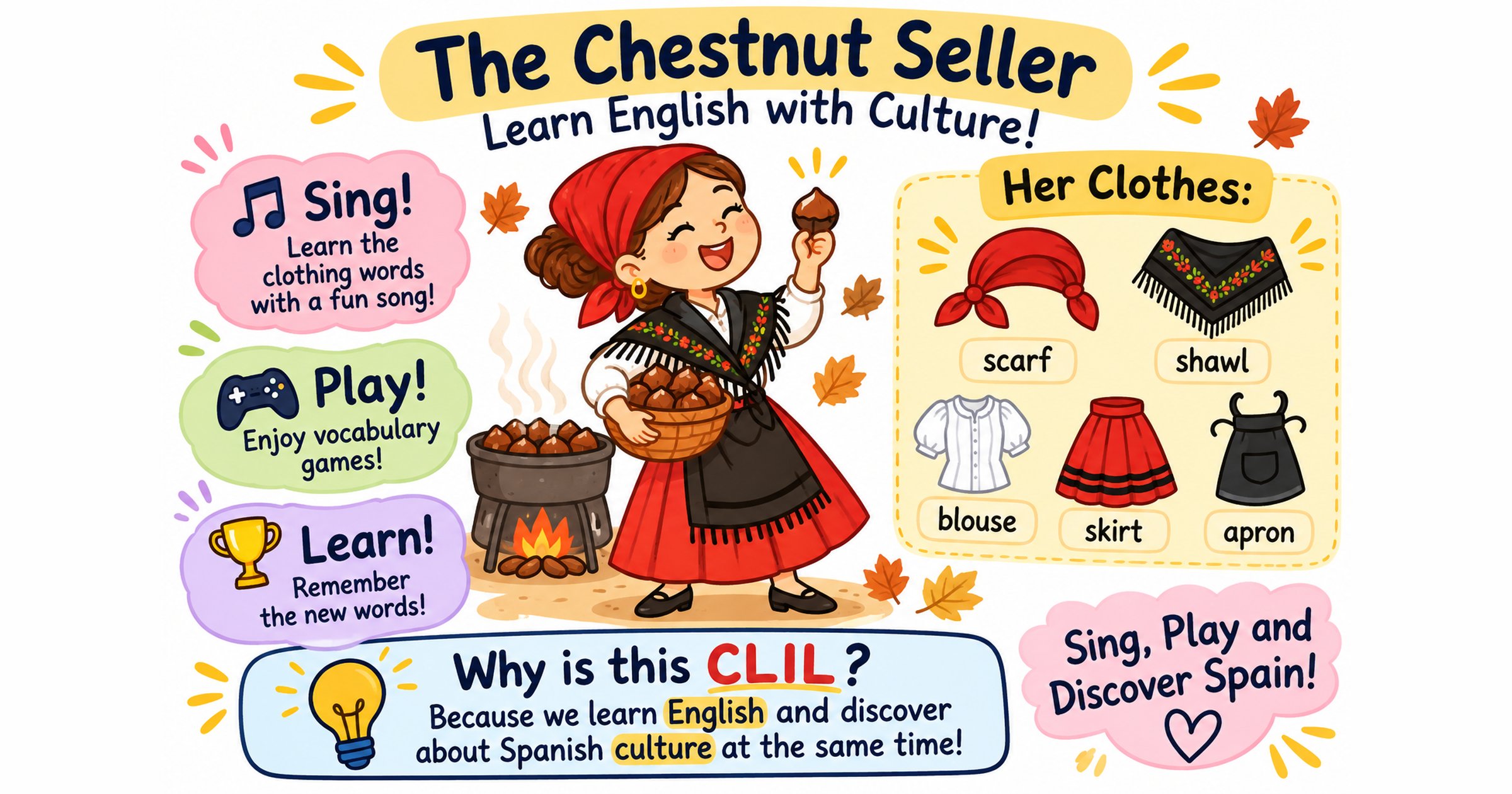
Let me show you how I used CLIL today in my English lesson. I introduced the Spanish tradition of chestnut sellers, known as castañeras, and their traditional clothes through games and a fun song.
In Spain, chestnut sellers are a familiar symbol of autumn. Traditionally, they sell roasted chestnuts from street stalls during the colder months. The castañera is often represented wearing traditional clothing, such as a long skirt, an apron, a shawl, and a headscarf.
My goal was for kids to learn new vocabulary in English. If I had just written those words they would have maybe memorized them maybe not. But since they learned those words while discovering what a traditional chestnut seller looks like with some pictures, games and a song their brain made deeper connections and the words stuck there.
This is an example of CLIL because the lesson integrated cultural knowledge with language development. Children were not simply memorising words; they were using English to understand something new and interesting.
Why is CLIL effective for learning vocabulary?
One of the main advantages of CLIL is that it gives vocabulary a purpose. When children encounter new words in a meaningful context, they can connect them to images, objects, experiences, and ideas they already understand.
For example, learning the word shawl from a vocabulary list may be challenging. However, seeing a shawl worn by a chestnut seller creates a visual connection that can make the word easier to understand and remember.
CLIL also introduces vocabulary in groups of related words. In my lesson, clothing was connected to autumn, food and Spanish traditions. These connections help children develop a richer understanding of language rather than memorising individual words without context.
Today’s lesson demonstrates how English can become a tool for discovering culture rather than simply a subject to study. By exploring Spanish chestnut sellers and their traditional clothing through a song, children experienced language learning in a fun and meaningful way.
Ultimately, CLIL helps children understand that language (English in my lessons) is more than a collection of words. It is a way to communicate, explore traditions, and understand the world.
Learning English becomes much more powerful when children discover something meaningful through it. Their motivation grows when they are not simply repeating a list of words, but exploring new ideas, discovering different cultures, and learning something that sparks their curiosity. By adding fun and interactive elements, such as games, quizzes, and songs, we can make learning even more engaging. When children enjoy the learning process, they become more motivated to participate, use the language, and keep discovering new things.
Why don’t you give it a try? I know your kids’ motivation will grow.
Anna Turro Planellas – Teacher