How much do teachers earn? If you searched that, you are probably not after a single national average. You want to know what it means for your age band, your district or country, and public versus private. One thing we can put on the table straight away is our own position: at NIJIN GLOBAL ACADEMY, international founding roles begin as volunteer positions ahead of our 2027 opening, and the detailed terms are shared later in the process. Opening with the money is the point of this article.
That said, we will not tell you that “a teacher at 30 earns X.” In Japan, public school teacher pay is set by each of the 47 prefectures and 20 designated cities through their own salary ordinances and personnel commission recommendations, so both the level and the rate of increase differ by employer. Private schools follow the pay rules of each school corporation, and international schools differ school by school. So instead of inventing figures, this article does three things: explains how teacher pay is actually structured, points you to the published sources where you can check your own numbers, and looks at an option that is rarely discussed — that raising your income is not only about waiting for the next step on the scale.

What teachers really want to know: three axes, not one average
Nearly every question about teacher earnings sits on one of three axes: age and years of service (starting salary, twenties, thirties, fifties), employer or region (a specific city, prefecture or country), and sector (public, private, international). A fourth question — “can a teacher ever reach a very high income?” — is really about where the ceiling sits. Get the three axes right and you can read your own trajectory instead of borrowing someone else’s average.
How pay rises with age — the structure behind the numbers
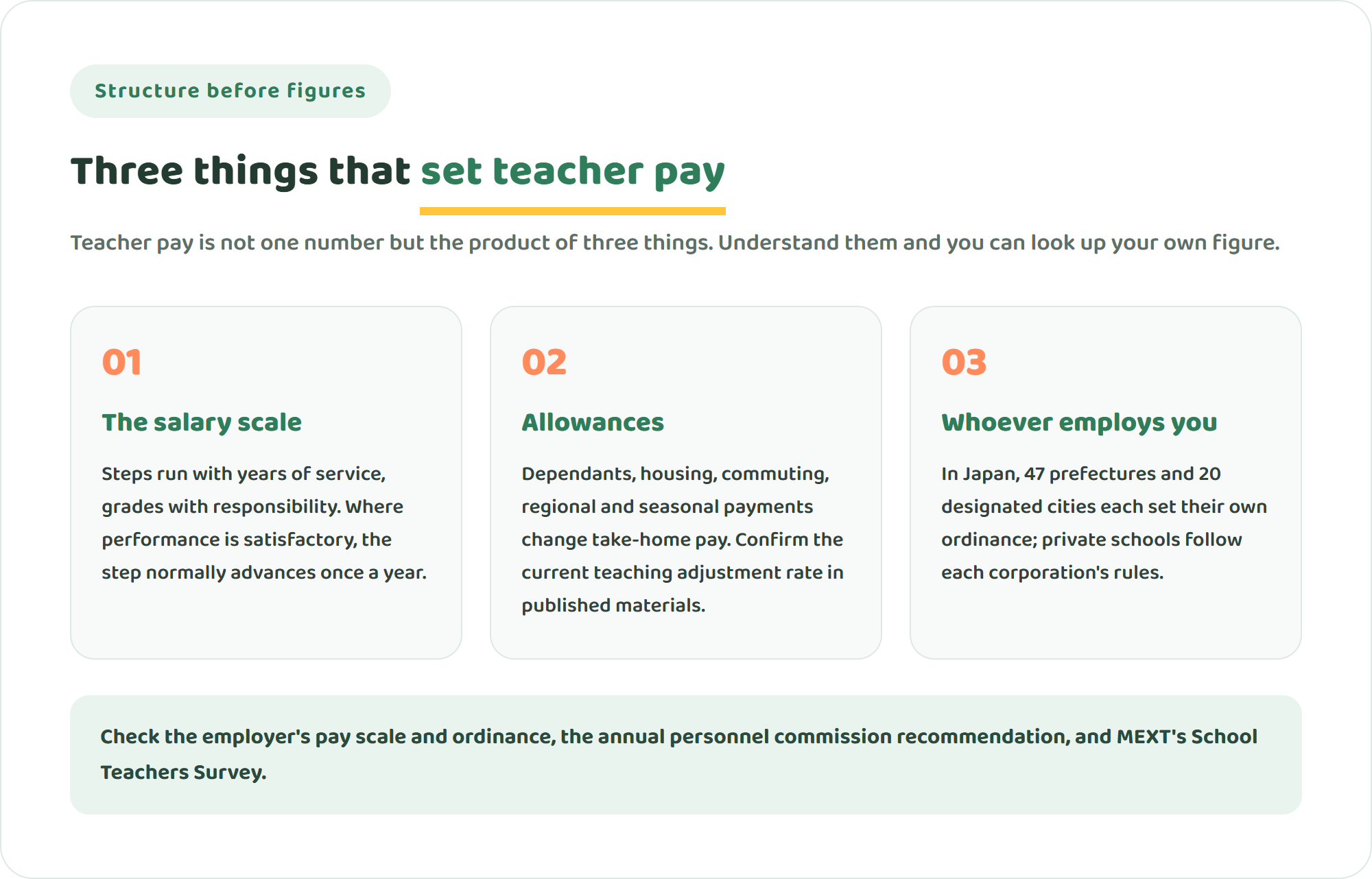
Public school teachers in Japan are typically paid from a salary scale organised by grade and step: steps run down the page with years of service, grades run across with responsibility. Where performance is satisfactory, the step normally advances once a year. That annual increment is the real mechanism behind “teachers earn more as they get older.”
Starting salary and your twenties
Your starting step depends on your qualification level and role, and in most scales the increase in these early years is relatively steep. Allowances — dependants, housing, commuting, regional adjustment, seasonal payments — change take-home pay significantly. To see real figures for a specific employer, read its salary ordinance and the pay scale published by its personnel commission.
The thirties: where the curve begins to flatten
In most scales the annual increment becomes gentler after the twenties, and this is exactly when marriage, housing and children’s costs arrive. It is the age when many teachers first sit down and calculate where the next fifteen years actually lead. If you love teaching but the ceiling is what worries you, that is not greed — wanting to grow your career and loving the classroom sit together perfectly well.
The fifties, and where the ceiling sits
By the fifties many teachers are approaching the top steps of their grade, and further increases mainly come from moving up a grade — senior teacher, deputy head, head. We will not put a figure on it, but one structural point is safe to state: inside the scale, there are only two levers — wait for steps, or move up a grade. The top step of each grade is published in the pay scale itself.
Why the same job pays differently in different places
Pay differs because the rules differ. In Japan, teacher salaries for public compulsory schools are determined by prefectures and designated cities, each with its own scale and regional allowance design. Internationally, the spread is wider still, since each school or system sets its own terms.
So the fastest route to an accurate number is not hunting for averages — it is going to primary sources: the employer’s published pay scale and salary ordinance, the annual personnel commission recommendation that shows each year’s revision, and, for national trends, the School Teachers Survey published by Japan’s Ministry of Education (MEXT). For international and private roles, the equivalent primary source is the job posting itself. Note that the teaching adjustment payment made in place of overtime pay has been under legislative revision, so always confirm the current rate in MEXT’s published materials.
Private and international schools: read the posting, not the average
Private school pay is set by each school corporation. Some mirror the public scale, some run their own system, and full-time, fixed-term and part-time contracts differ sharply. Rather than chasing an average, check the base pay, allowances, contract type and renewal terms in each posting, one by one.
International school pay varies the same way, shaped by subject, experience, certification and location. We keep that topic separate — if you want the detail, see our guide to international school teacher salaries. If you are weighing the move itself, changing careers from teaching without regret may help.
Raising your income is not only about waiting for the next step
Conversations about teacher pay usually collapse into “is this profession paid well or badly?” Look at the structure, though, and there are two directions. One is upward inside the scale — steps and grades. The other is outside it: adding a second source of income. The first is predictable but its speed is set by the system; the second carries no guarantee but moves at the speed of your own choices.
This is not a criticism of the profession. A scale that rises reliably every year is a genuine strength — it lets you plan a life. But that strength is the flip side of having a single pillar of income. Add to your teaching one of building (materials and curriculum), communicating (marketing and outreach), or connecting (partnerships and operations), and you have two pillars. The skills teachers accumulate — moving a room of people, structuring complex ideas, reading whether someone has understood — transfer directly to the business side.
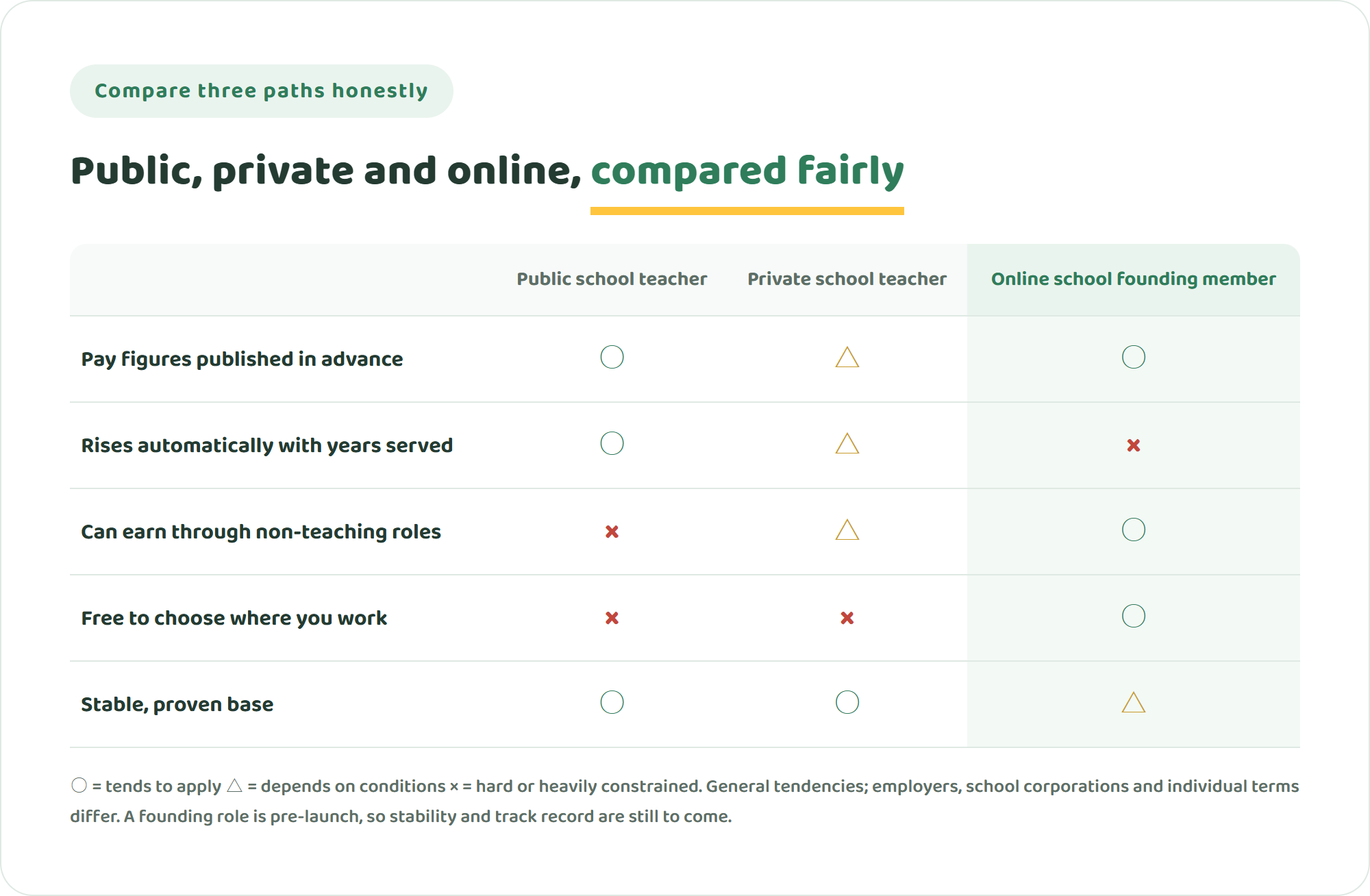
As the table shows, a founding role is not a universal answer. There is no automatic annual increase, and because the school opens in September 2027, stability and track record are still being built. What it does offer is a structure where income does not rest on a single pillar. See the NIJIN GLOBAL ACADEMY founding member roles → — internationally, founding roles begin as volunteer positions ahead of the opening, with detailed terms shared later; worth knowing before you decide anything.

A third way of working: terms stated plainly, and diversified income
The hardest part of any pay conversation is not knowing the number until you are already inside. The founding members オンラインインターナショナルスクールのNIJIN GLOBAL ACADEMY (NGA) is recruiting for its September 2027 opening face that directly. First, we say plainly what the terms are: founding roles on this track begin as volunteer positions ahead of our September 2027 opening, and the detailed terms are shared later in the process. Second, diversified income: alongside teaching you can take on marketing, web, partnerships or HR across five working patterns — the “second pillar” of the previous section, designed into the job itself.
Third, fully remote, built around working while travelling the world, with no fixed workplace. What we look for is English at roughly CEFR B2+ and the appetite to build from zero, experience or not. Careers can also continue across the eleven companies of the NIJIN group.
Three steps to design your own income
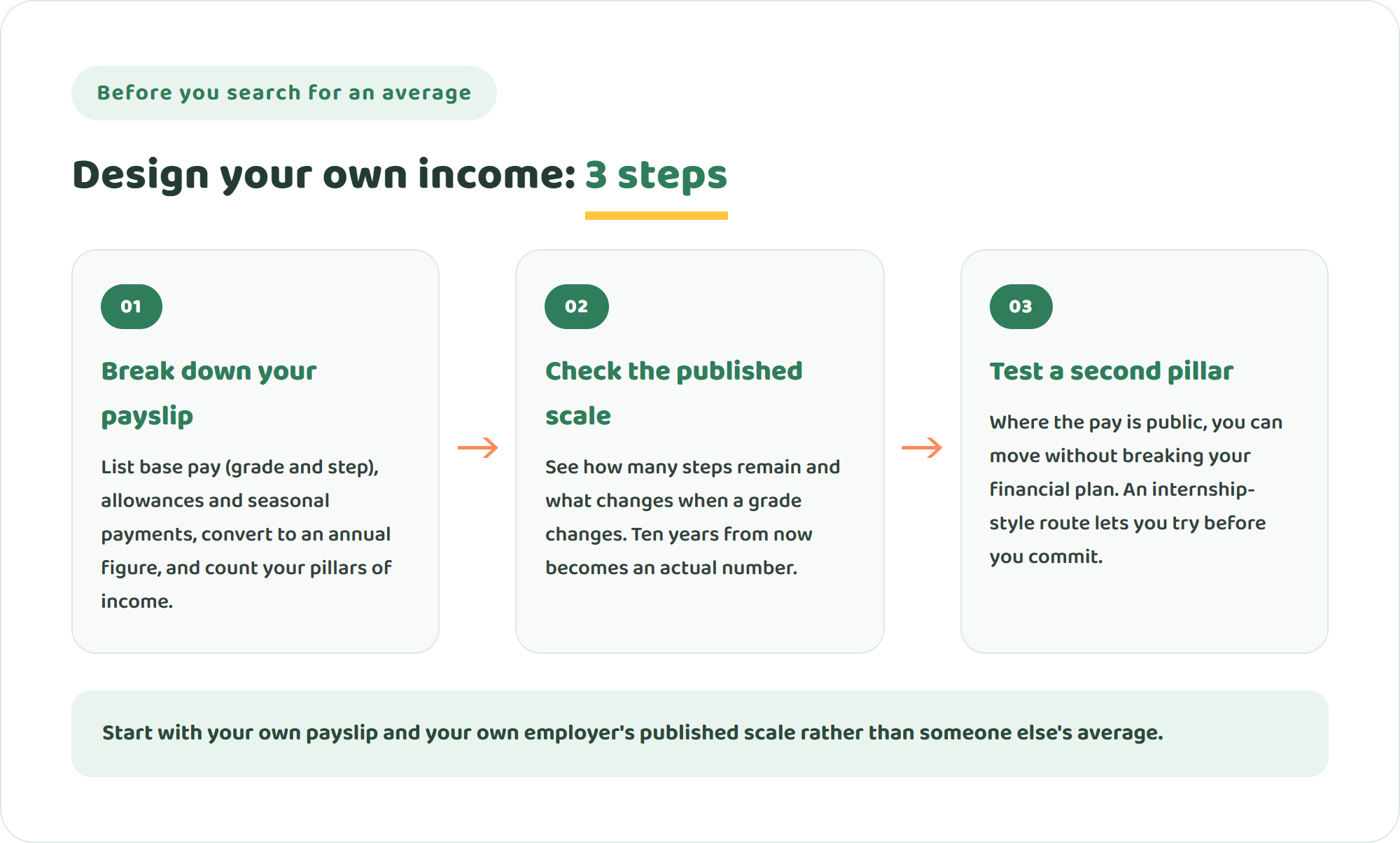
First, break down your payslip into base pay, allowances and seasonal payments, and convert it to an annual figure. Second, check the published scale to see how many steps remain and what changes when a grade changes — that turns “ten years from now” into an actual number. Third, test a second pillar somewhere the terms are stated plainly. NGA’s process runs from application to a group interview, an internship at NIJIN Academy, and a final presentation, so you can try before you commit.
FAQ
How much do teachers earn by age — where can I see it?
We do not state figures, because they differ by employer. The pay scale and salary ordinance published by each personnel or education board show starting salaries by qualification and the size of each step. Since steps normally advance once a year, counting forward from the starting step gives you a reasonable picture by age.
Do teachers earn more in large cities?
Not simply. Both the scale and the regional allowance design differ by employer, so put the pay scale and allowance rules of each place side by side. Cost of living has to be compared alongside them, or the take-home comparison is meaningless.
Do private school teachers earn more than public school teachers?
It cannot be generalised: each school corporation sets its own pay rules, and full-time, fixed-term and part-time contracts differ widely. Check base pay, allowances, contract type and renewal terms in each posting individually.
Can a teacher reach a high income?
Inside a salary scale, the levers are accumulating steps or moving up a grade (senior teacher, deputy head, head), and the published scale shows where the structural ceiling sits. Separately, there is the other direction entirely: adding income sources through roles beyond teaching.
Teacher pay is something you can design, not only look up
If you searched how much teachers earn, you are trying to reconcile a commitment to education with the reality of a life to fund — and that is exactly the right thing to do. Teacher pay is not only a number handed to you; once you understand the structure, it is something you can design. Start with your own employer’s published scale rather than a national average, and know that waiting for the next step is not the only road. Keeping the joy of teaching while changing only the design of your income is a real option.
Working at an International School — More Articles
- international school teacher salary
- how to become an international school teacher
- career change from teaching
- career change from teaching in your 30s and 40s
- how to become an IB teacher
- jobs for moving abroad
- private school teacher salary in Japan
- online international school teacher salary
- remote teaching jobs from the Philippines
- online teaching jobs in Malaysia
- international school staff jobs
- high-paying jobs that use English
- elementary school teacher salary in Japan
- junior high school teacher salary in Japan
- high school teacher salary in Japan
- school principal salary in Japan
- how the Japanese teacher pay scale works
- teacher bonuses in Japan
Keep the passion for teaching. Redesign the income around it.