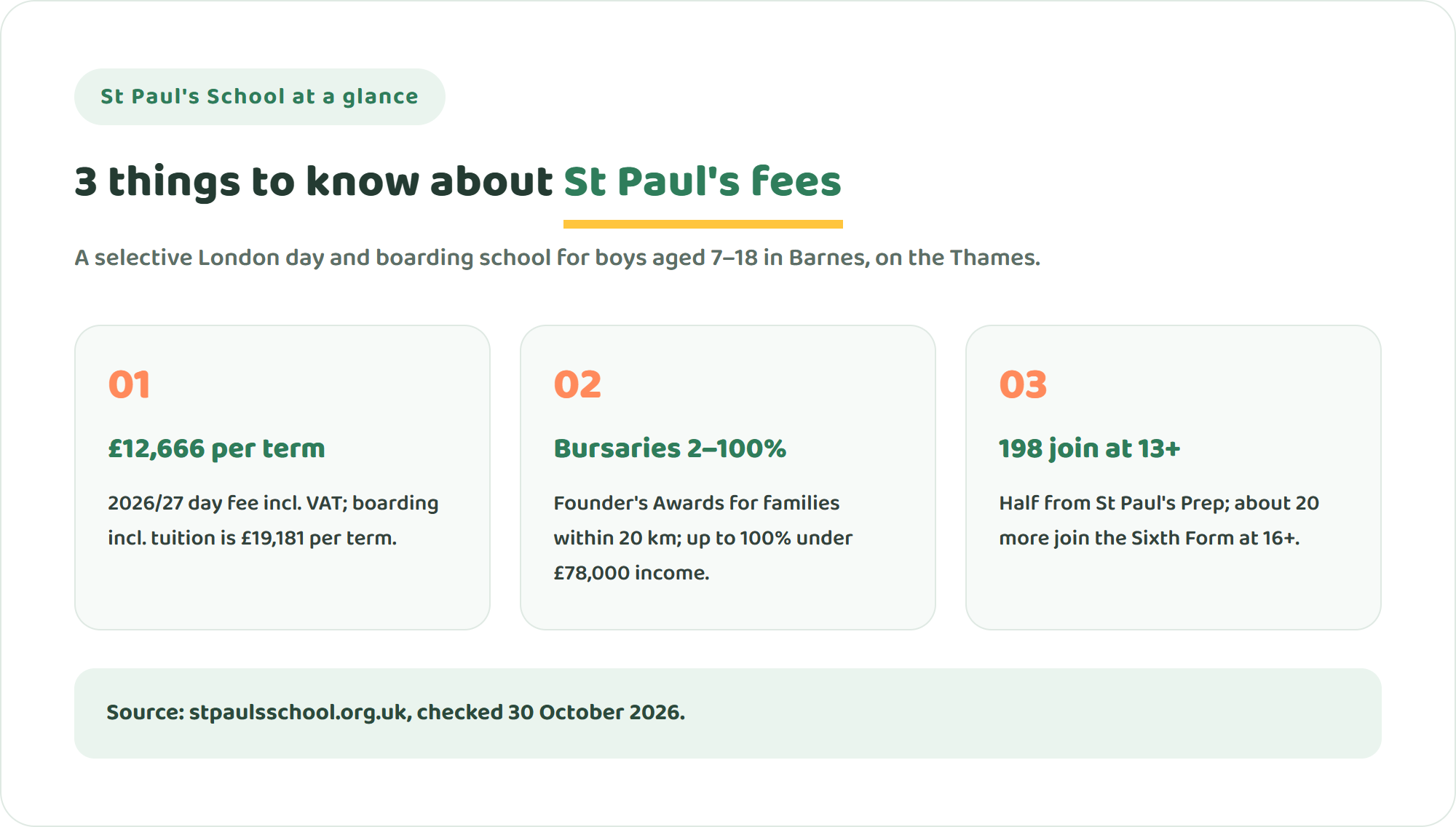
St Paul’s School fees for 2026–27 are £12,666 per term for day pupils in Years 9–13 (£37,998 a year), £12,905 per term for boys joining the Eighth Form at 16+ (£38,715 a year) and £19,181 per term for boarders including tuition (£57,543 a year) — all inclusive of VAT (official fees page, checked 30 October 2026). St Paul’s Prep School, which feeds the senior school, charges £10,221 per term for Years 3–8. The termly fee covers tuition, games, loan books, stationery, libraries and lunch; a new 13+ pupil also pays a £240 registration fee and a refundable £3,300 deposit, with a further £2,500 deposit for boys who board or whose normal home is outside the UK.
If you searched “St Paul’s School fees”, “St Paul’s School fees per term” or “St Paul’s School admissions”, you are probably weighing one of London’s most academically selective boys’ schools against Westminster, Eton or a different kind of education altogether. This page sets out the official numbers, explains how 13+ and 16+ entry actually work, summarises the bursary rules that matter for families inside and outside London, and compares St Paul’s with Westminster School, Eton College and NIJIN GLOBAL ACADEMY (NGA) — an online international school for ages 6–18 that opens in September 2027. Note that St Paul’s School in Barnes (boys, 7–18) is a separate school from St Paul’s Girls’ School in Hammersmith; everything below is about the boys’ school.
The short answer: who St Paul’s School suits — and who it doesn’t
- Suits: academically gifted boys who will thrive in a demanding, intellectually curious day school. The school describes itself as “academically selective” and “for gifted boys”, and its 2025 A Level results were 59.3% A* and 92.5% A*–A.
- Suits: London families who want a day school with a lower published fee than Westminster: £12,666 per term in 2026–27 against Westminster’s £16,456 for 13+ day pupils, both including VAT.
- Suits: families on moderate incomes within 20 km of Barnes. Founder’s Awards (bursaries) can cover between 2% and 100% of fees, with up to 100% possible for households earning under £78,000 a year (2025–26 figures), subject to assets.
- Suits: overseas boys aiming at A Levels. Full boarding is described as popular with international pupils joining at 16+, and the school sponsors Child Student visas from Year 9 — on condition that the pupil boards full time.
- Harder fit: families with daughters. St Paul’s School is a boys’ school; its sister school, St Paul’s Girls’ School, is a separate institution with its own admissions and fees.
- Harder fit: families who want a traditional boarding community. Boarding is not available below Year 9, Year 9 places are described as “a small number”, and most boys are day pupils.
- Harder fit: boys whose English is still developing. At 16+, non-native speakers must submit an IELTS Academic result of at least 7.5, and the entrance papers reward analysis and problem-solving rather than recall.
What St Paul’s School is
St Paul’s School is an independent day and boarding school for boys aged 7 to 18 in Barnes, south-west London, on a 45-acre riverside site on the Thames (Lonsdale Road, SW13). It was founded in 1509 by John Colet, Dean of St Paul’s Cathedral, who — in the words quoted on the school’s own site — opened it to boys “from all nacions and countres indifferently”. Boys aged 7–13 attend St Paul’s Prep School (formerly St Paul’s Juniors) on the same campus; boys aged 13–18 attend St Paul’s School. The school’s year-group names are its own: Year 9 is the Fourth Form and Years 12–13 are the Lower and Upper Eighth.
The school is one of the strongest academically in the UK. Its official pages report 2025 A Level results of 59.3% A* and 92.5% A*–A, 2025 GCSE results with more than 65% of grades at 9 and more than 88% at 9–8, and, for 2026 leavers studying in the UK, “over a quarter” going to Oxford or Cambridge and 96% to Russell Group universities, with 31 boys accepting places at 17 American universities. The Sunday Times named it Independent School of the Year for Academic Excellence 2026. Since 2008 the school has not released its results for newspaper league tables, so you will not find it in those lists.
| Item | St Paul’s School (official information, checked 30 October 2026) |
|---|---|
| School type | Independent, academically selective day and boarding school for boys, Barnes, London SW13 |
| Ages / years | 13–18 (Year 9 to Year 13); St Paul’s Prep School for ages 7–13 on the same site |
| Founded | 1509, by John Colet |
| Fees 2026–27 | Day £12,666 per term (Years 9–13); new 16+ joiners £12,905; boarding £19,181 (new 16+ boarders £19,420); all inclusive of VAT |
| Boarding | Full, weekly (Sunday evening to Friday afternoon) and flexi boarding from Year 9; School House and West House |
| Entry points | 7+ and 11+ (Prep School), 13+ (198 boys join Year 9) and 16+ (about 20 boys join Year 12) |
| Inspection | Independent Schools Inspectorate (ISI), January 2025: all five required standards met; co-curricular programme a “significant strength” |
| Financial aid | Founder’s Awards (means-tested bursaries) of 2%–100% of fees; honorary scholarships worth £60 a year |
St Paul’s School fees 2026–27 (official, including VAT)
All figures below come from the school’s fees page, checked on 30 October 2026. The table is headed “Fees per term (inclusive of VAT)”. VAT at 20% has applied to UK private school fees since 1 January 2025, so there is no further tax to add to the published figures. Annual totals are our arithmetic (three terms), not a published number.
| Pupil type (2026–27) | Per term | Per year (3 terms) |
|---|---|---|
| St Paul’s Prep School, Years 3–8 | £10,221 | £30,663 |
| St Paul’s School, Years 9–13 (day) | £12,666 | £37,998 |
| New joiners into the Eighth Form at 16+ (day) | £12,905 | £38,715 |
| Boarding fee, including tuition | £19,181 | £57,543 |
| Boarding fee for new 16+ joiners, including tuition | £19,420 | £58,260 |
Two details stand out. First, boys who join at 16+ pay a slightly higher rate (£239 more per term) than boys already in the school. Second, the boarding fee is a single all-in figure that includes tuition — the boarding premium over a day place is therefore £6,515 per term, or £19,545 a year.
One-off charges when your son joins
| Charge | 13+ entry | 16+ entry |
|---|---|---|
| Registration / exam fee | £240 including VAT, non-refundable | £75 exam fee, non-refundable (a passport copy is uploaded at registration) |
| Entrance fee on acceptance | Not charged at 13+ | £150 including VAT, paid with the deposit |
| Deposit | £3,300, returnable when the boy leaves, or beforehand if he does not keep up the required academic progress and conduct | £3,300, returnable when he leaves, or if he does not reach the required GCSE standard |
| Additional deposit (boarders or home outside the UK) | £2,500, held until he leaves and credited without interest against the final fee payment | £2,500, same terms |
| Child Student visa sponsorship | £1,200 + VAT administration charge on accepting a place, plus an annual retainer of £600 + VAT; sponsored pupils must board full time | Same |
For the 7+ route the registration fee is also £240, and for 11+ it is a £75 exam fee; successful 11+ candidates pay £150 plus the £3,300 deposit on acceptance, and that deposit then covers the whole of the boy’s time at St Paul’s, including the senior school.
What the fee includes — and what costs extra
The basic fee covers tuition, games, loan books, stationery, libraries, medical inspection, careers aptitude tests, certain school publications and lunch, which the school says all boys must attend. In the senior school, some books that become the boy’s property and public examination fees are charged as extras. Individual instrumental lessons cost £38.84 per 35-minute lesson, paid directly to the visiting music teacher; these teachers review their rates annually and may increase them in September 2027. Fees are paid by Direct Debit on the first day of each term, with direct bank transfer possible by prior agreement with the Finance Office. Governors offer some fee remission where three or more children from one family attend St Paul’s School, St Paul’s Prep School or St Paul’s Girls’ School; parents apply in writing to the Finance Director, and the remission starts the term after the application.
The following are not published on the official site: the typical annual cost of trips and other extras, public examination fees, any fees-in-advance or instalment scheme, the date on which 2027–28 fees will be announced, and 2025–26 fees (the current page shows 2026–27 only).
What five years at St Paul’s cost at today’s prices
Using only the official 2026–27 figures, with no bursary and no fee rises, for a boy who enters Year 9 and stays to Year 13 (15 terms):
- Day pupil: 15 × £12,666 = £189,990, plus £240 registration; the £3,300 deposit comes back when he leaves.
- Boarder from Year 9: 15 × £19,181 = £287,715, plus £240 registration and a refundable £5,800 in deposits (£3,300 + £2,500).
- International boarder joining at 16+ for two years: 6 × £19,420 = £116,520 in fees, plus £75 exam fee, £150 entrance fee, £5,800 in refundable deposits, and visa sponsorship of £1,200 + VAT on acceptance and £600 + VAT a year (at 20% VAT, £1,440 and £720 — our arithmetic). Guardianship, flights and extras are on top.
- Two brothers, both day pupils, from Year 9 to Year 13: 2 × £189,990 = £379,980 at today’s prices. The three-child remission does not apply to two children.
For how a London day-school budget compares with boarding and with learning from home, see our guide to online vs in-person international school costs.
Bursaries and scholarships: Founder’s Awards explained
St Paul’s calls its means-tested bursaries Founder’s Awards. The Founder’s Awards page says an award “could be between 2% and 100% of fees”. For 2025–26, families with a gross household income below £78,000 a year may be eligible for up to 100% of fees, subject to net assets; families with gross household income of up to £144,000 and net assets of up to £1.6m may be eligible for some support. An allowance of £15,000 per child is deducted from assessable income for other dependent children in school or higher education. The school says the money for bursaries “all comes from the school” and that awards are discretionary and subject to its financial resources.
The eligibility rules are specific. The candidate must have lived within a 20 km radius of St Paul’s School (measured in a straight line) for at least one year at the time of application, and parents and candidate must be British or Irish citizens, hold Indefinite Leave to Remain or Settled Status, or have long-term residency with an appropriate visa. The bursaries FAQ adds that boarding is covered by a bursary “if applicable”, so boarders are not excluded in principle. An award covers more than tuition: at the same percentage as the fee award, the school also funds uniform and sports kit, academic and sports trips, school transport, music lessons and instrument loan, textbooks, examination fees and the Duke of Edinburgh’s Award. Families on a bursary pay a reduced deposit (the Founder’s Awards page gives £200, the FAQ page £500), and 100% award holders pay no deposit.
Timing matters. You tick the bursary assessment box when you register and pay the normal registration fee (£240 at 7+ and 13+, £75 at 11+ and 16+); parents who struggle with the registration fee can contact the Head of Bursaries. The financial assessment itself happens only after a boy has made significant progress in admissions — in the Spring of Year 7 for 13+ candidates, and after interview at 16+ — and it is separate from academic selection. Awards are reviewed through an annual means test on a sliding scale, so they can go down if income rises. The number or percentage of pupils on bursaries and the school’s total annual bursary spend are not published on the official site. Note also that the bursaries FAQ page still shows the 2024–25 thresholds (£73,000, £135,000 and £1.5m), which differ from the 2025–26 figures on the Founder’s Awards page; use the newer figures as a guide and confirm with the school.
Scholarships at St Paul’s are honorary rather than financial. The academic scholarships page says all academic scholarships are worth £60 a year, with about 30 awarded in total each year. External 13+ candidates who have accepted an offer may sit the scholarship examinations in May (papers in English, History, Geography, Latin, French, Theology & Philosophy, Mathematics and Science, with optional Greek); Prep School boys are assessed on their Year 8 end-of-year exams. No new academic scholarships are awarded at 16+, though 17+ awards are made for the final year. Music awards, art scholarships (at 16+) and sports awards also exist. If reducing the fee is the point, the Founder’s Award is the route; scholarships are a mark of distinction, not a discount.
How a school week works: day, boarding and time zones
St Paul’s is an in-person school on UK time. The 2026–27 term dates are Autumn Term from Friday 4 September to Thursday 17 December 2026, Spring Term from Thursday 7 January to Wednesday 24 March 2027, and Summer Term from Tuesday 20 April to Wednesday 7 July 2027. The daily timetable and start and finish times are not published on the pages we checked, so ask at an open day. The academic pages list 18 subjects plus the Extended Project Qualification for ages 13–18, including Economics, Politics, Engineering and Computing alongside the sciences, humanities and modern languages, and the co-curricular programme (sport, arts, societies, trips and volunteering) was singled out by inspectors as a significant strength.
Boarding is deliberately small. The boarding page describes School House as “a small and welcoming community of mainly senior boarders” and West House, opened in September 2021, as the home of flexi boarders. Three patterns are offered: full boarding; weekly boarding from Sunday evening to Friday afternoon; and flexi boarding of one to four nights a week, space permitting, aimed at boys with a very long commute, parents away for a period, or early-morning or after-school activities. Boarding is not available below Year 9, and only “a small number” of Year 9 boarding places may be offered. Boarders join weekend trips — the page mentions cooking classes, restaurant meals, landmark tours and activities such as go-karting and indoor skydiving. The number of boarders and whether there is Saturday school are not published on the official site.
For international families, the practical consequence is that St Paul’s works best as a day school for families living in London, or as a full-boarding Sixth Form for boys from abroad. Sponsored visa pupils must board full time and must have an educational guardian who is a British citizen or holds Indefinite Leave to Remain. If you are comparing that with a child learning from home in your own country, our explainer on how an online international school day works shows the other side of the trade-off.
Entry points: 13+ and 16+ admissions, step by step
St Paul’s admits boys at 7+ and 11+ (into the Prep School), 13+ and 16+. Boys applying from prep schools that end at Year 6 may choose the 11+ or the 13+ assessment, but not both; the school says the 11+ route is more suitable for boys from state primaries because it gives them two years at the Prep School first. About 36 boys join at 11+ (for 2027 entry, registration closed on 16 October 2026, with the ISEB assessment on 14 November, written exams on 9 December, interviews on 14–19 January 2027 and offers on 12 February 2027). The two main senior entry points are below; the dates come from the official 13+ and 16+ dates pages and the school says they may change.
13+ entry (Year 9, the Fourth Form)
198 boys join Year 9, roughly half from St Paul’s Prep School and half from other London prep schools ending at Year 8. The number of applicants is not published. External candidates register online in Year 5 or at the start of Year 6; for September 2029 entry, registration opened in the week of 20 April 2026 and closed on 16 October 2026, and registration for 2030 entry opens in April 2027.
- Stage one — ISEB pre-test and school report (October–November of Year 6): all registered candidates sit the ISEB online Common Pre-Test, preferably at their current school (for the 2029 cycle, between 1 October and 20 November 2026; boys who cannot sit it at school take it at St Paul’s on 20 November). The candidate’s Head Teacher provides a report on character, academic strengths and interests. Parents are told the outcome in mid-December.
- Stage two — written assessments (early January of Year 6): selected candidates sit a 75-minute Mathematics paper and a 45-minute English paper at St Paul’s (5 January 2027 in the current cycle). Guidance and sample questions are on the school site.
- Stage three — interview (late January or early February, a Saturday): interviews were on 30 January and 6 February 2027 for the current cycle. The interview tests numeracy and the ability to analyse source material critically, and explores co-curricular interests in a general conversation. While boys are interviewed, parents attend a talk with the High Master and senior leaders.
- Outcome (end of February of Year 6): an offer, an invitation to the Year 8 assessment, or no place. Offers must be accepted, with the £3,300 deposit, by March of Year 7.
Every 13+ offer is conditional. Boys at schools following St Paul’s prescribed Year 7 and 8 curriculum must maintain good conduct and academic progress and provide an unreserved reference from their Head Teacher in Year 8; boys at other schools face the same conditions and may be set additional ones, such as at least 70% in prescribed subjects at Common Entrance. Boys who show potential but are not offered a place can be reassessed in September of Year 8 (English and Mathematics papers, then an interview in early October), after which some are offered a Year 9 place and a few are placed on a waiting list. Overseas candidates can sit the ISEB pre-test at their own school if it will invigilate, or at a British Council office; written assessments can also be taken at a British Council office or another approved centre, but interviews take place in London.
16+ entry (Year 12, the Eighth Form)
Approximately 20 boys join Year 12 each year. Applications open in June of Year 10 and selection takes place in the Autumn Term of Year 11. For September 2027 entry: online registration opened on Monday 1 June 2026; the deadline for applications — and for IELTS results from non-native speakers — was 12.00 GMT on Wednesday 30 September 2026; entrance examinations were on Friday 6 November 2026; interview invitations went out on 17 November; interviews with Heads of Department took place at St Paul’s on Saturday 21 November 2026 between 09.00 and 13.30, with no exceptions to the date or location; offers followed in early December, to be accepted by 17 December 2026, with conditions confirmed against final Year 11 results in August 2027. Registration for 2028 entry opens in June 2027.
Candidates sit papers in their chosen A Level subjects, drawing mainly on GCSE syllabuses but emphasising analysis and problem-solving over recall, and most also sit a numerical problem-solving paper. Overseas candidates may take the exams on the same date at their local British Council if agreed in advance. Boarding applicants also meet the House Master and tour the boarding house; Art candidates bring a portfolio, Music candidates perform a short piece and Drama candidates prepare a monologue. An offer is conditional on at least eight (I)GCSE passes at grade 7, with at least six at grade 8 or 9 including the A Level subjects; overseas candidates whose schools do not offer GCSEs must achieve equivalent results. Non-native English speakers need IELTS Academic 7.5 or above.
Inspection, qualifications and recognition
UK independent schools are not “accredited” in the North American sense; they are registered with the Department for Education and inspected. St Paul’s School’s most recent inspection by the Independent Schools Inspectorate was in January 2025. The school’s inspections page says it met all five of the required standards, and inspectors identified the co-curricular programme as a significant strength; the full report is published as a PDF on the same page.
Boys take (I)GCSEs and A Levels, which universities in the UK and worldwide recognise. Because the school publishes its results and destinations on its own site rather than through league tables, the figures above (59.3% A* at A Level in 2025; over a quarter of UK-bound 2026 leavers to Oxbridge; 31 boys to American universities) come directly from the school’s exam results and university destinations pages. The results-day announcement in August 2025 quoted slightly lower provisional A Level figures (57% A*, 91% A*–A), so expect small differences between pages.
St Paul’s School vs Westminster vs Eton vs NIJIN GLOBAL ACADEMY (official data)
Westminster School is the comparison most London families make: another highly selective central-London day school with weekly boarding, now moving to full co-education. Eton College is the full-boarding alternative for boys. NIJIN GLOBAL ACADEMY (NGA) is a different kind of school altogether — online, for ages 6–18, and not yet open. For the full breakdowns, see our Westminster School fees guide and our Eton College fees review. All figures are 2026–27, inclusive of VAT, from each school’s official fees page, checked 30 October 2026.
| St Paul’s School | Westminster School | Eton College | NIJIN GLOBAL ACADEMY | |
|---|---|---|---|---|
| School type | Independent selective day and boarding school for boys, Barnes, London | Independent day and weekly boarding school, central London; fully co-educational by 2030 | Independent full boarding school for boys, Windsor | Online international school focused on Asia & Oceania; opens September 2027 (planned) |
| Ages / entry | 7+, 11+ (Prep), 13+ and 16+ | 11+ (via Under School), 13+ and 16+ | 13+ and 16+ | Ages 6–18 |
| Day fee per term | £12,666 (new 16+ joiners £12,905) | £16,456 (13+) / £17,482 (16+) | No day places | Not yet published (no enrolment, facility or uniform fees; materials included; sibling discounts) |
| Boarding fee per term | £19,181 (new 16+ boarders £19,420) | £23,094 | £21,891 per Half | Not applicable |
| Day fee per year (3 terms, our arithmetic) | £37,998 | £49,368 (13+) | — | Not yet published |
| One-off fees | Registration £240 (13+) or £75 exam fee + £150 (16+); deposit £3,300; +£2,500 for boarders or homes outside the UK | Registration £360; entrance fee £2,400; deposit £4,000 (£5,000 international boarders at 16+) | Registration £480; acceptance fee £3,840 (£500 refunded on leaving); overseas deposit of one term’s fees | No enrolment fee |
| Visa sponsorship | £1,200 + VAT on acceptance, £600 + VAT a year; full boarding required | £1,200 at 16+ only | £3,000 a year | Not needed — learn from home |
| Bursaries | Founder’s Awards 2%–100%; 20 km residence rule; up to 100% below £78,000 income | About £2m a year, up to 100% of day fees; parents inside the M25 | Means-tested 5%–100%; see official site | Not applicable (tuition not yet published) |
| Curriculum | (I)GCSEs and A Levels; 18 subjects plus EPQ at 13–18 | (I)GCSEs and A Levels | GCSEs and A Levels | Subjects learned in English, CEFR-based English levels, projects; optional Cambridge IGCSE / A-Level pathway |
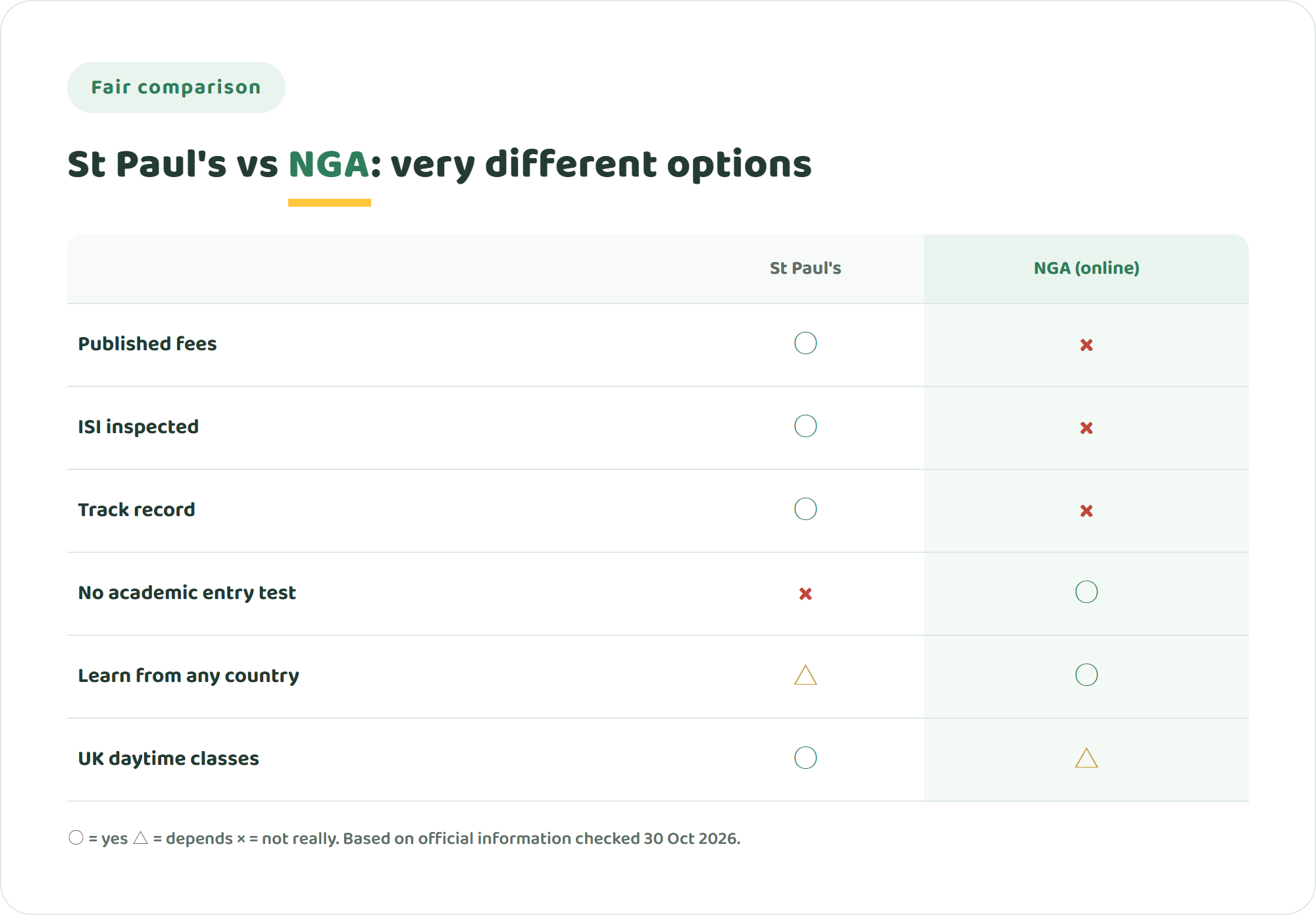
| Classes & time zone | In person, UK; mostly day pupils | In person, UK; Saturday morning school | In person, UK; full boarding | Small live online dialogue groups (about 8); built for Asia–Oceania daytime — may fall outside the day in Europe or the Americas |
| Inspection / diploma | ISI January 2025, all standards met; public (I)GCSE and A Level exams | ISI February 2024, fully compliant | ISI November 2024, all standards met | Not yet accredited; no graduates yet |
| Admission | ISEB pre-test, written papers and interview (13+); subject exams and interview, 8 GCSEs at 7 with 6 at 8–9 (16+) | ISEB pre-test, tests and interview (13+); four subject exams and interview (16+) | ISEB pre-test, interview and test (13+); conditional on King’s Scholarship / Common Entrance / Eton Entrance | No academic entrance exam, no English requirement |
| Girls | No (sister school: St Paul’s Girls’ School) | Sixth Form now; Year 9 from 2028 | No | Yes |
Sources: St Paul’s School fees, St Paul’s international applicants, Westminster School fees, Eton College fees — checked 30 October 2026.
Read across the day-fee row and the gap is clear: a St Paul’s day place costs £11,370 a year less than a Westminster 13+ day place at 2026–27 rates, and a St Paul’s boarding place costs £8,130 a year less than Eton. Other boys’ schools in the same bracket are covered in our Harrow School fees review and Winchester College fees review; for co-educational boarding alternatives, see our guides to Wellington College fees and Charterhouse fees.
Reviews and common concerns, answered honestly
St Paul’s has an outstanding academic reputation and a long waiting list of admirers; it also attracts the questions any highly selective school attracts. These are the concerns parents raise most often, with what the official pages say.
“How hard is it to get in at 13+?”
Hard, and the school does not publish applicant numbers, so no honest ratio can be given. What is published is the shape of the process: a pre-test, a school report, written papers for a selected group, an interview for a smaller group, and conditional offers that depend on good progress through Year 8. Roughly half of the 198 Year 9 places go to boys coming up from St Paul’s Prep School. If your son is at a state primary, the school itself suggests the 11+ route into the Prep School, which also means the deposit is paid once and carries through.
“Is the pace too intense?”
The school is explicit that it selects for academic gift and sets high standards, and its results reflect that. Inspectors in January 2025 found all standards met and praised the co-curricular programme, which suggests the pressure is balanced by a broad life outside the classroom. Whether that balance suits your son is a question for a visit, not a web page: ask about pastoral support, the timetable and how boys who find a subject difficult are helped.
“We live abroad — can we apply, and can we get a bursary?”
You can apply at every entry point for a day place, with no separate process for overseas candidates, and pre-tests and written papers can often be sat at a British Council office; interviews are in London. Visa sponsorship is available from Year 9 but requires full boarding, and most overseas boys join at 16+. A bursary is unlikely: Founder’s Awards require at least one year’s residence within 20 km of the school and UK or Irish citizenship, settled status or long-term residency. Budget for the full fee, the £2,500 additional deposit, the visa charges and a guardian.
“Will the fees go up again?”
Fees at UK independent schools are normally revised every year, and the music teachers’ note on the fees page already flags a possible rise in September 2027. VAT at 20% has applied since January 2025 and is already inside the published figures. The official page does not say when 2027–28 fees will be announced, so ask the Finance Office before you commit.
“What about the extras?”
Lunch, games, loan books, stationery and libraries are inside the fee, which is more inclusive than at some schools. Public examination fees, some books and individual music lessons (£38.84 per 35 minutes) are extra, and the cost of trips is not published. Ask the school for a typical annual extras figure for a boy in your son’s year.
“Is it really worth £38,000 a year?”
Compared with Westminster or Eton, St Paul’s is the lower published fee for a comparable academic outcome — that is the strongest financial argument for it. Against a good state school or a lower-fee independent, the question is whether your son needs this particular pace and depth. The honest answer is that it is worth it for a boy who will use it, and an expensive mismatch for a boy who would be happier elsewhere.
Alternatives to St Paul’s School worth comparing
Westminster School is the closest like-for-like alternative: a central-London day school with weekly boarding, a higher published fee (£16,456 per term for 13+ day pupils in 2026–27) and, from 2028, girls in Year 9. Eton College and Harrow School suit boys who want full boarding, at £21,891 and £21,990 per term respectively. If you would consider a British curriculum studied online instead, compare our King’s InterHigh fees and review and our overview of online British curriculum school fees.
NIJIN GLOBAL ACADEMY (NGA) is a different kind of option. It is an online international school for ages 6–18 focused on Asia and Oceania, opening in September 2027 (planned), with free trial classes monthly from September 2026 and pre-opening trial classes in April–May 2027. Its first cohort is 100 students, and it is operated by NIJIN Inc. in Japan, whose alternative school NIJIN Academy has more than 1,000 students. NGA does not rank children by test scores: lessons are small-group live dialogue (classes of about 8), subjects are learned in English with a bilingual English–Japanese mentor, English levels follow the CEFR, and students join social co-creation projects with companies and governments plus international exchange. An optional Cambridge IGCSE / A-Level pathway is listed on the curriculum and timetable page. There is no academic entrance exam and no English requirement; it can run alongside a local school or as the main school, and it travels with the family if they relocate. Tuition is not yet published; NGA says it will be far more affordable than a typical international school, with no enrolment, facility or uniform fees, materials included and sibling discounts.
Be clear about the trade-offs. NGA is not yet open, is not yet accredited and has no graduates or track record. It is not a London school and offers nothing like St Paul’s riverside campus, its teaching in person or its five centuries of history. Its timetable is built for Asia–Oceania daytime, so for families in the UK, Europe or the Americas live classes may fall outside their day — check the timetable against your local time. If your son is a strong candidate for a selective London school and you can plan from Year 5, St Paul’s, Westminster and Eton are the schools to compare.
For a wider view, see our online international schools compared guide.
FAQ
How much does St Paul’s School cost per year?
For 2026–27, a day place in Years 9–13 costs £12,666 per term, or £37,998 a year over three terms, inclusive of VAT. Boys joining at 16+ pay £12,905 per term (£38,715 a year). New 13+ pupils also pay a £240 registration fee and a refundable £3,300 deposit (official fees page, checked 30 October 2026).
What are St Paul’s School’s boarding fees?
The boarding fee, which includes tuition, is £19,181 per term (£57,543 a year) in 2026–27, or £19,420 per term for boys joining the Eighth Form at 16+, all inclusive of VAT. Boarders and boys whose home is outside the UK pay an additional £2,500 deposit, repaid as a credit against the final fee bill. Boarding is available from Year 9 only, in full, weekly or flexi form.
Does St Paul’s School offer bursaries?
Yes. Founder’s Awards range from 2% to 100% of fees and, at the same percentage, cover uniform, trips, music lessons, textbooks and exam fees. For 2025–26, families earning under £78,000 may be eligible for up to 100%, and families earning up to £144,000 with net assets up to £1.6m may qualify for some support — provided the boy has lived within 20 km of the school for at least a year and the family meets the citizenship or residency rules.
Can international students apply to St Paul’s School?
Yes, at every entry point for a day place, and most overseas boys join as full boarders at 16+. The school sponsors Child Student visas from Year 9 (£1,200 + VAT on acceptance and £600 + VAT a year) on condition of full boarding and a UK-based educational guardian. Non-native English speakers applying at 16+ need IELTS Academic 7.5, and entrance exams can often be sat at a local British Council office.
Is St Paul’s School worth it, and what are the alternatives?
For an academically gifted boy in London, many families decide it is — not least because its day fee is the lowest of the three most selective London and Thames-valley boys’ schools. Families most often compare Westminster School (day and weekly boarding) and Eton College (full boarding). NIJIN GLOBAL ACADEMY is a very different, online option for ages 6–18 focused on Asia and Oceania, with no academic entrance exam and no English requirement; it opens in September 2027 and is not yet accredited.
Choosing calmly
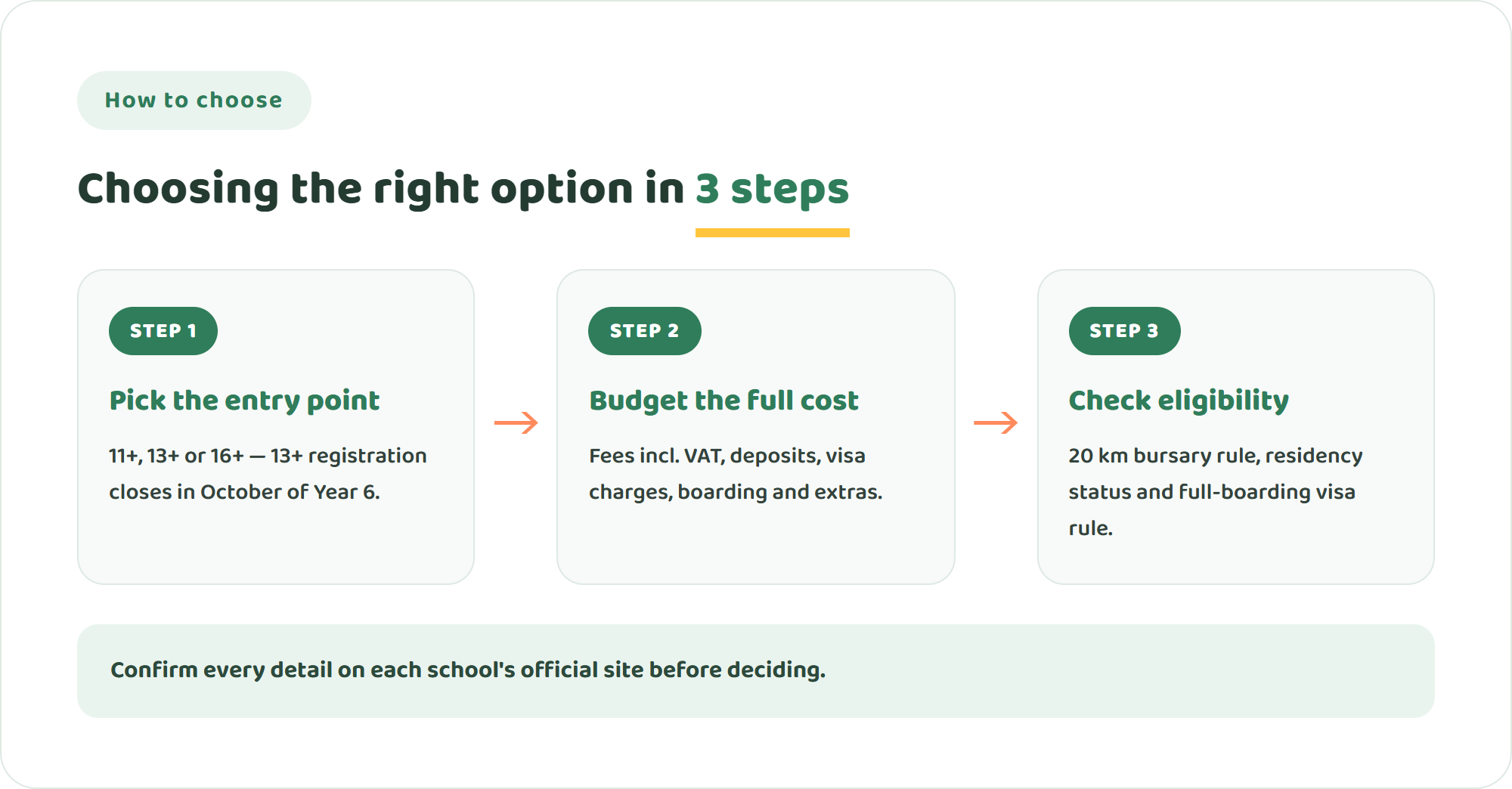
St Paul’s is an exceptional school, and applying is a long project — registration opens in Year 5, the pre-test comes in Year 6, and the place is confirmed only in Year 8. The most useful things you can do now are to decide between the 11+ and 13+ routes, budget the full cost honestly, and check the 20 km bursary rule before you register. Whichever school you choose, the right one is the place where your son will be known, stretched and happy.
Tuition and admissions details were checked on the official websites on 30 October 2026. Schools revise fees every year — always confirm on the official site before applying.