If you have been searching for international schools in Miyagi prefecture and mostly finding English conversation classes, you are not doing it wrong — the information genuinely is scattered. Sendai is the largest city in the Tohoku region, so families reasonably expect a long list of options. What they find instead is a short one. This guide covers the ten schools in Miyagi prefecture we could verify through official school websites, municipal records and established databases: the one school that takes children all the way from age three to eighteen, the Japanese-accredited schools that teach through English, the preschools clustered around Sendai Station, and the honest reality that being inside the prefecture does not always mean being within commuting distance. By the end you should know exactly which area and which type of school to look at for your own family.
International schools in Miyagi prefecture: the landscape and what fees look like
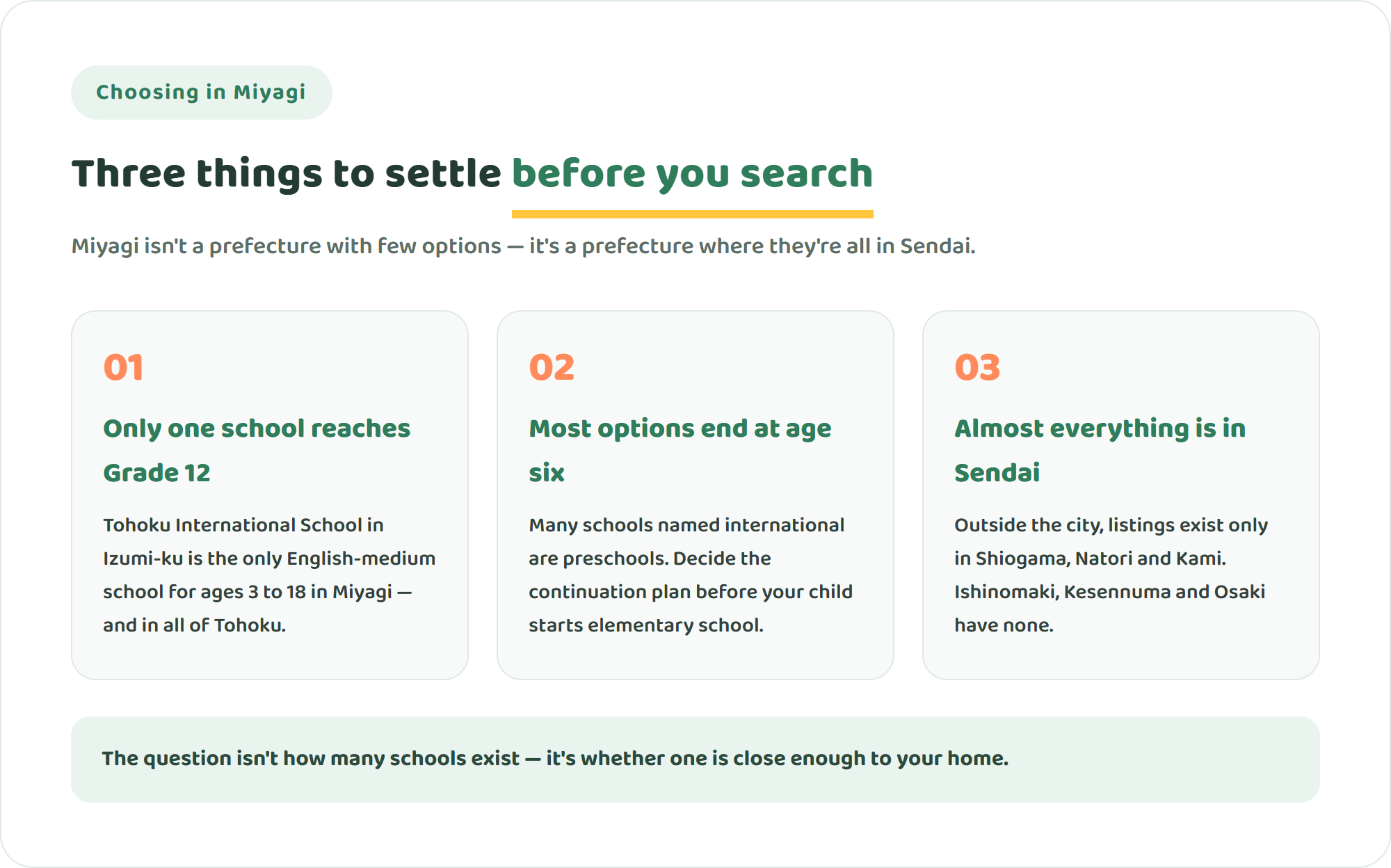
Three facts shape everything about international schools in Miyagi prefecture.
First, only one school takes students through to high school graduation in English. Tohoku International School (TIS) in Izumi-ku, Sendai, is the only school in the entire Tohoku region offering an English-medium programme from Kindergarten through Grade 12. Second, most of the remaining options are preschools — places where children spend their early years in English and then move on to a Japanese elementary school. Third, nearly everything is inside Sendai city.
That concentration follows the population. According to the Immigration Services Agency’s resident foreign national statistics for the end of December 2025, Miyagi had 38,210 foreign residents — the highest of the six Tohoku prefectures — and roughly 70% of them, more than 26,000 people, live in Sendai itself (Tohoku foreign resident rankings). Tohoku University and its research institutes, corporate branch offices and international routes through Sendai Airport all pull international families to the same place, and the schools followed.
Fees reflect that structure too. TIS publishes annual totals of ¥990,000 to ¥1,690,000 for 2026-2027 depending on grade. Horizon Academy Sendai, a Japanese-accredited elementary school, publishes ¥1,135,000 per year from April 2026. Preschools generally sit between ¥57,000 and ¥110,000 a month. Set against the ¥2–4 million a year that large Tokyo and Yokohama campuses charge, Miyagi is noticeably more affordable than the national picture. If you want the full breakdown of where international school money actually goes, see our honest guide to international school costs. If you are still deciding whether this type of school is right for your child at all, what is an international school is a good place to start.
The other factor to plan around is distance. The preschool directory Preschool Park lists 27 facilities inside Sendai city and only five outside it — one in Shiogama, three in Natori and one in Kami town. Ishinomaki, Kesennuma, Osaki and Shiroishi show zero. Ishinomaki to Izumi-ku is roughly an hour and a half each way; from Kesennuma it is well over two hours. In Miyagi, in the prefecture and reachable are not the same thing, so it pays to search by daily-life radius rather than by prefecture.
Every international school in Miyagi prefecture, by area
Below are the schools we could verify through official sites, municipal listings or established databases. To compare Miyagi with the rest of the country, see our index of international schools across all 47 prefectures.
Izumi-ku, Sendai (Yakata, Takamori, Izumi-chuo) — the centre of gravity
The northern end of Sendai’s subway line holds the densest cluster in the prefecture, and it is the only area where a child can keep going past kindergarten.
- Tohoku International School (TIS) — 7-101-1 Yakata, Izumi-ku, Sendai
Operated by Nanko Gakuen and serving the region for close to 50 years, TIS is the only school in Tohoku running an English-medium programme from Kindergarten to Grade 12 (ages 3 to 18). It is an authorised IB school for both the Primary Years Programme and the Diploma Programme, and is accredited by the Western Association of Schools and Colleges (WASC). Students who are not yet fluent are supported through an EAL (English as an Additional Language) programme, which matters enormously if you are relocating mid-year.
Published 2026-2027 annual totals: Kindergarten (full day) ¥990,000; Grades 1–8 ¥1,340,000; Grades 9–10 ¥1,540,000; Grades 11–12 (IB Diploma) ¥1,690,000. First-year families also pay a ¥400,000 entrance fee and a ¥15,000 administrative fee. EAL runs ¥4,000–¥25,000 per month by level, and the school bus ¥5,000–¥7,000 per month by route. (Source: TIS Tuition & Fees)
Best for: families who want one school all the way to graduation, with an IB Diploma that travels internationally. - Horizon Academy Sendai (ELC kindergarten + Horizon Gakuen Sendai Elementary School) — 4-2-540 Takamori, Izumi-ku, Sendai
An Early Learning Centre for ages 3 to 5 alongside a private elementary school that opened in April 2016. Because the elementary school is a Japanese-accredited school, enrolment satisfies Japan’s compulsory education requirement — a significant reassurance for mixed or returning families. Teaching follows an inquiry-based IB PYP framework, with Japanese, Turkish and Chinese offered alongside English. Class sizes average around 18.
Published annual totals from 1 April 2026: kindergarten ¥1,010,000; elementary ¥1,135,000 (previously ¥918,000 and ¥954,000). Entrance fee ¥200,000, waived for children continuing from the kindergarten. Bus, daycare membership, lunches and uniforms are additional. (Source: Horizon Academy Sendai fees)
Best for: families who want an English learning environment during elementary years without leaving the Japanese system. - Little Wonders International School, Sendai Izumi — Izumi-chuo, Izumi-ku, Sendai
A preschool and English school five minutes’ walk from Izumi-chuo Station, built on the American Creative Curriculum with bilingual teachers who can read a child’s development in both languages. Classes continue past kindergarten age, so children can stay on after starting Japanese elementary school.
Indicative fees: about ¥57,240 per month for a four-day preschool week, plus a ¥32,400 joining fee (Source: Preschool Park Miyagi fee comparison — confirm directly, as fees are revised).
Best for: families who want a long, steady English thread from early childhood into the elementary years.
Central Sendai (Aoba-ku and Miyagino-ku) — where the preschools are
Around Sendai Station and Ichibancho, schools cluster where commuting parents can drop off and pick up. Almost all of them, however, are for children under six.
- Horizon Japan International School Sendai Aoba (formerly Abroad International School Sendai) — 2-5-22 Ichibancho, Aoba-ku, Sendai
Ages 1 to 5, with Infant, Toddler, Preschool, Pre-K and Kindergarten classes and a choice of three, four or five days per week — useful flexibility for families easing into full-time care.
Indicative fees: Toddlers ¥864,000 per year; Preschool and above ¥830,000 per year; entrance fee ¥103,000 (Source: Preschool Park — confirm directly).
Best for: parents working in central Sendai who want early years spent in English. - Global Tree International School, Sendai — 4-7-7 Miyamachi, Aoba-ku, Sendai
A preschool from age two plus after-school programmes for kindergarten and elementary students, extending to advanced classes and TOEFL preparation. That upper end matters: it gives children somewhere to continue once they enter a Japanese elementary school.
Indicative fees: ¥68,200 per month for weekdays 9:00–14:00, or ¥110,000 per month for 8:00–18:00; joining fee ¥110,000 (Source: Preschool Park — confirm directly).
Best for: families who need long hours now and a continuation path later. - i Kids Star Sendai Higashiguchi — Tsutsujigaoka, Miyagino-ku, Sendai
Opened in 2024 for ages 2 to 5, built on three pillars: bilingual education, cognitive development and physical instruction. Six minutes from the east exit of JR Sendai Station, open weekdays 7:30 to 20:00.
Indicative fees: about ¥89,250 per month for the older classes (Source: Miyagi international preschool roundup — confirm directly).
Best for: families who need the longest possible day within walking distance of Sendai Station. - Unison World English Nursery School — Tsutsujigaoka, Miyagino-ku, Sendai
An unlicensed childcare facility listed in Sendai city’s own directory, taking children from 18 months to age five. Its distinguishing feature is Chinese instruction alongside English. Five minutes from Tsutsujigaoka Station.
Indicative fees: around ¥80,000 per month (Source: roundup above — confirm directly).
Best for: families interested in more than one additional language in the early years. - Mori no Kodomo International School — 4-7-25 Chuo, Aoba-ku, Sendai
An English immersion school with an unusually wide age range: infant classes from age one, nursery, kindergarten, after-school classes for elementary students, a pre-J class and Eiken preparation. Note that reports indicate the school is not currently accepting trial visits or enquiries through its website, so contact them directly. Fees on enquiry.
Outside Sendai (Natori, Shiogama and beyond)
There are a handful of options beyond the city limits, and for families in southern Miyagi they may well be closer than anything in Izumi-ku.
- Penguin International School — 5-31-11 Mori-Sekinoshita, Natori
Opened in February 2017 as the first English-medium childcare facility in the Sennan area, taking children from two years to age five. About 11 minutes’ walk from Mori-Sekinoshita Station on the Sendai Airport Access Line, or two minutes by car from the Natori Chuo interchange. Fees on enquiry.
Best for: families in Natori, Iwanuma or southern Taihaku-ku. - Preschools in Shiogama and Kami town
Preschool Park lists one facility in each. How much English is actually spoken during the day varies enormously between these smaller programmes, so treat the word international in a name as a starting question rather than an answer, and ask specifically during your visit.
A different route — studying the IB inside a Japanese school (Miyagino-ku)
This option never appears in searches for international schools in Miyagi prefecture, but it is one of the prefecture’s real strengths: you can study the International Baccalaureate without leaving the Japanese school system.
- Shukoh Junior High School and Sendai Ikuei Gakuen High School (Shukoh Course) — 2-4-1 Miyagino, Miyagino-ku, Sendai
Sendai Ikuei Gakuen High School was authorised for the IB Diploma Programme in February 2015. Combined with the Middle Years Programme at Shukoh Junior High School, it forms the only combined junior-and-senior school in Tohoku where a student can study the IB continuously for six years — graduating with both a Japanese high school diploma and an IB Diploma.
Indicative fees: roughly ¥578,000 per year for junior high and ¥714,000 for high school (Source: roundup above; varies by course and year, so confirm officially).
Best for: families who want an international qualification while keeping a Japanese school life.
One caution on the numbers you will see elsewhere. Some aggregator sites claim 30 or more international schools in Miyagi; most of those counts include English conversation schools and cram schools. The list above is what we could verify as genuine full-day schools or English-medium early years programmes.
Fees and curriculum details reflect information published as of July 2026. Always confirm current figures on each school’s official site.
Comparing your options honestly
Families in Miyagi tend to arrive at the same three questions. Can we realistically commute to Izumi-ku every day? Is a preschool enough, or do we need to plan through to graduation? And what do we do if we live somewhere Sendai simply isn’t reachable from?
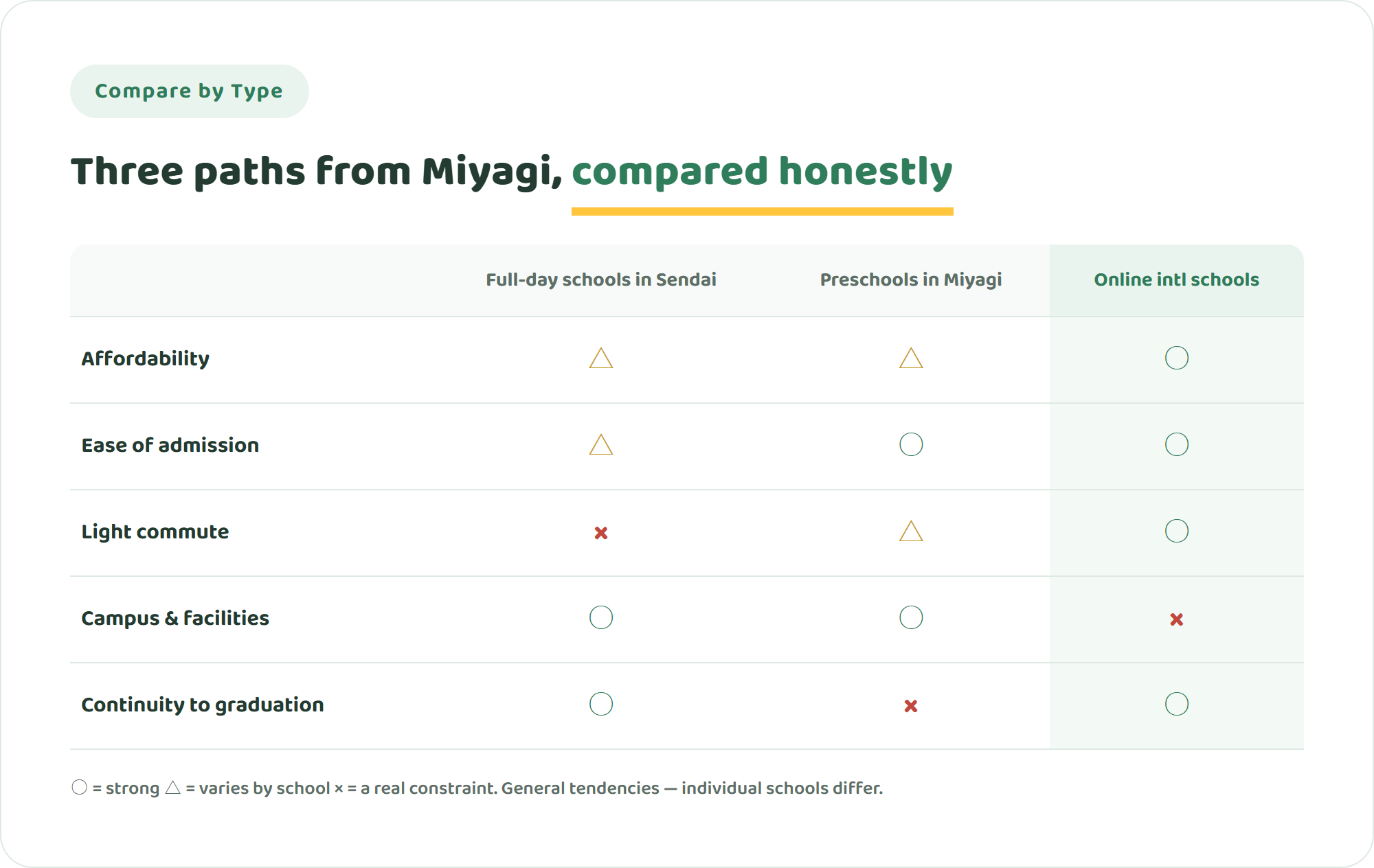
Tohoku International School and Horizon Academy Sendai are, by national standards, good value and serious in substance. TIS in particular holds both IB PYP and DP authorisation and accepts children with no English through its EAL programme. But both sit in Izumi-ku. From southern Sendai or Natori, a subway-plus-bus journey approaches an hour each way, and the honest question is whether that is sustainable for twelve years, not for one.
If you choose a preschool, the decision that matters is what happens after graduation. Three years of English followed by a Japanese public elementary school usually means English exposure falls off a cliff. That is why more families here now decide the continuation plan before the child turns six. Keeping a Japanese school place while studying in English on evenings and weekends — the double-school approach — is one of the more practical shapes available in Miyagi right now.
The goal is not the school you can get into. It is the learning you can keep going. Price out twelve years of fees and twelve years of travel time together, and the answer usually becomes clear.
See how learning works online →
When nothing is within reach — the online option
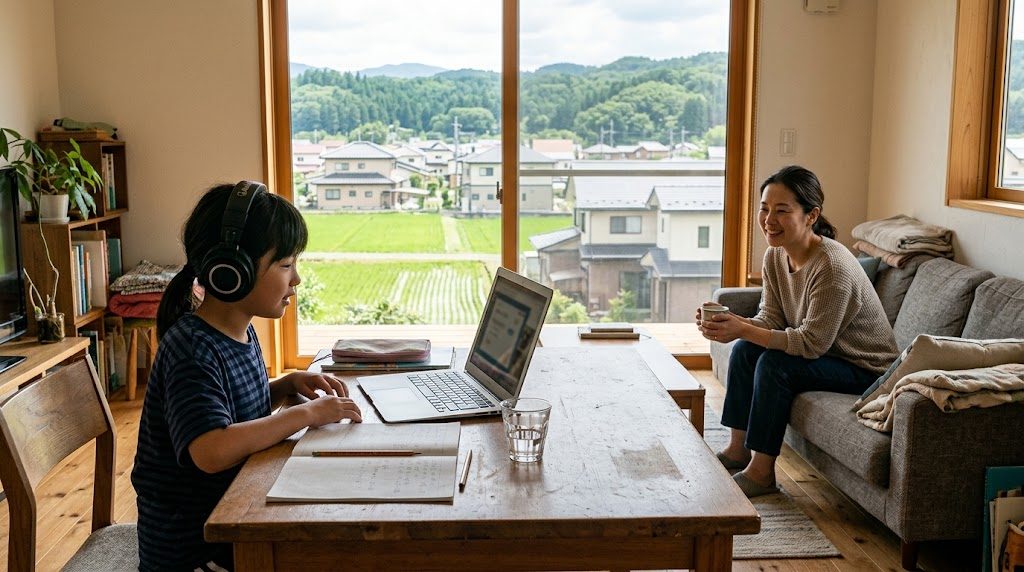
The most common sticking point in Miyagi is not finding a good school. It is finding a good school you cannot get to. From Ishinomaki to Izumi-ku, from Kesennuma to Sendai, from Kurihara or Tome to the far north end of the subway line — same prefecture on a map, different world as a daily routine. No amount of family effort dissolves that distance.
Which is why it is worth considering learning that does not depend on a commute at all. NIJIN GLOBAL ACADEMY (NGA) is an online international school opening in September 2027, operated by NIJIN Inc. in Japan. Our alternative school in Japan, NIJIN Academy, already has more than 1,000 students enrolled.
What we care about is not ranking children by test scores, and small-group learning built around dialogue. Our promise is simple: helping children come to like themselves and the world. NGA is for 6 to 18 year olds across Asia and Oceania, wherever they happen to live, and we are aiming for roughly one-fifth the tuition of an in-person international school. English does not arrive all at once either — the design assumes Japanese as a support and builds English gradually. Neither language has to be sacrificed, which matters especially in a prefecture where the schools are all in one city.
The honest caveats: we have not opened yet, so there is no graduate track record to show you. And because we are online, we cannot offer a playground, or the walk home with friends, in the way a campus can. If those things sit at the top of your list, a school in Izumi-ku is the better fit. But if the choice is between giving up because you cannot commute and continuing because you do not have to, we think that is worth a look.
Frequently asked questions
Q. Can we commute from anywhere in Miyagi prefecture?
No — there is no school reachable from the whole prefecture. Both Tohoku International School and Horizon Academy Sendai are in Izumi-ku, Sendai. Ishinomaki to Izumi-ku is around an hour and a half each way, and Kesennuma over two hours, which is not a viable daily journey. Preschool directories show the same pattern: outside Sendai there are listings only in Shiogama, Natori and Kami town, with zero in Ishinomaki, Kesennuma or Osaki. Decide first how long a one-way trip you could sustain for twelve years, then look only at what falls inside that circle.
Q. Could we commute to a school in a neighbouring prefecture?
Realistically, no. Tohoku International School is the only school in the whole Tohoku region running English-medium education from kindergarten through high school, so there is no closer full-day international school in a neighbouring prefecture. Heading south takes you toward Fukushima and Tochigi and then into the Tokyo area, where shinkansen commuting becomes expensive and exhausting. For Miyagi families, the practical set of choices is a school inside the prefecture, a local preschool combined with learning at home, or a format that requires no commute at all.
Q. Can a child with no English be admitted? Is there Japanese language support?
At preschool and kindergarten level, almost all schools accept children with no English. From elementary level upward, some assessment of English is normal, but Tohoku International School runs a formal EAL (English as an Additional Language) programme for students whose first language is not English. On the Japanese side, accredited schools such as Horizon Gakuen Sendai Elementary and Shukoh Junior High include Japanese language as part of the regular curriculum, so first-language attrition is less of a worry there. If your family’s concern runs the other way — a child whose Japanese needs support — our sister service Tomodachi Japan (online Japanese for children, also run by NIJIN) may help.
Fewer options doesn’t mean no choice
Searching in Miyagi, there may be a moment when you think: in Tokyo or Yokohama we would have had options. But Miyagi has the only school in Tohoku that carries a child from three to eighteen in English. It has an accredited Japanese elementary school teaching through IB inquiry. It has the only junior-senior school in the region where a student can build six continuous years of IB. The list is short, but every entry on it is the only one of its kind for hundreds of kilometres.
The real question is simply whether one of them is close enough to your home. So put all three on the same table — the schools in Izumi-ku, a local preschool, and learning without a commute — and choose the shape your family can actually sustain. Whichever road you take, if your child ends up liking themselves and the world, you chose right.
International School Guides for Other Prefectures
- International Schools in Sendai (city guide in Miyagi)
- International Schools in Fukushima Prefecture
- International Schools in Hokkaido Prefecture
- International Schools in Kanagawa Prefecture
- International Schools in Aichi Prefecture
- International Schools in Hyogo Prefecture
- International Schools in Chiba Prefecture
- International Schools in Saitama: All 34 Listed
- International Schools in Miyazaki Prefecture
- International Schools in Nagano Prefecture
- International Schools in Nagasaki Prefecture
- International Schools in Nara Prefecture
- International Schools in Niigata Prefecture
- International Schools in Oita Prefecture
- International Schools in Okayama Prefecture
- Browse all 47 prefectures of Japan