Search for an online international school comparison and you will find plenty of lists. Read one to the end, though, and it is often still unclear which school would suit your child. There is a reason for that: most comparisons are built around the number that should be looked at last — the annual fee.
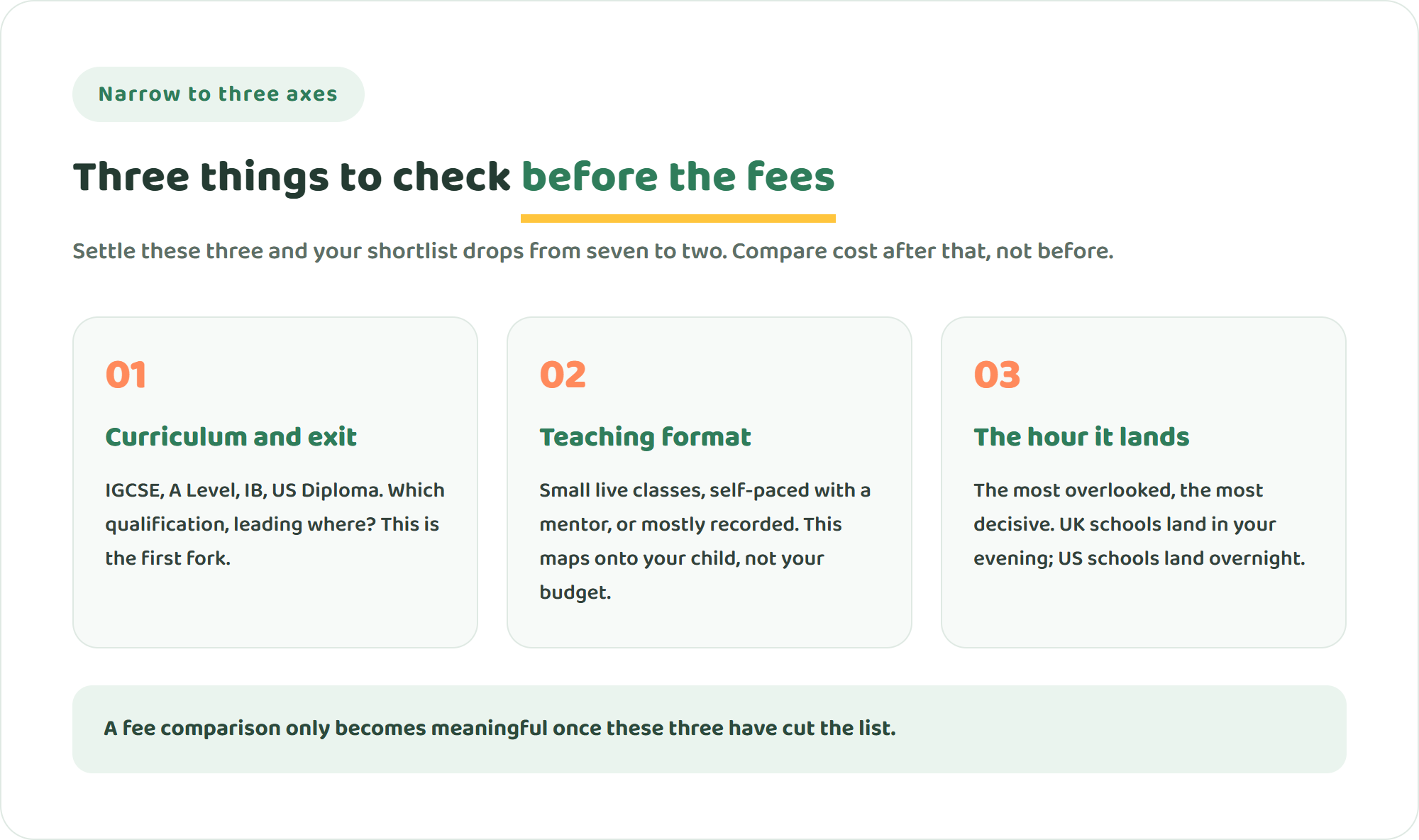
This one changes the order. Three axes genuinely separate online international schools: the curriculum and where it leads, the teaching format, and the hour lessons land in your time zone. Settle those three and a list of seven becomes a shortlist of two. Compare cost after that.
Everything below comes only from what each school publishes on its own site, checked in September 2026. No third-party summaries, no remembered figures. Programmes and fee structures change, so confirm anything decisive on the school’s own pages.

Three axes, and why fees come last
1. Curriculum and exit. IGCSE, A Level, the IB Diploma, a US high school diploma. Which qualification, and where does it lead? Does your family need to keep the door open to a local system, or are you aiming squarely at universities abroad? This single question removes half the list.
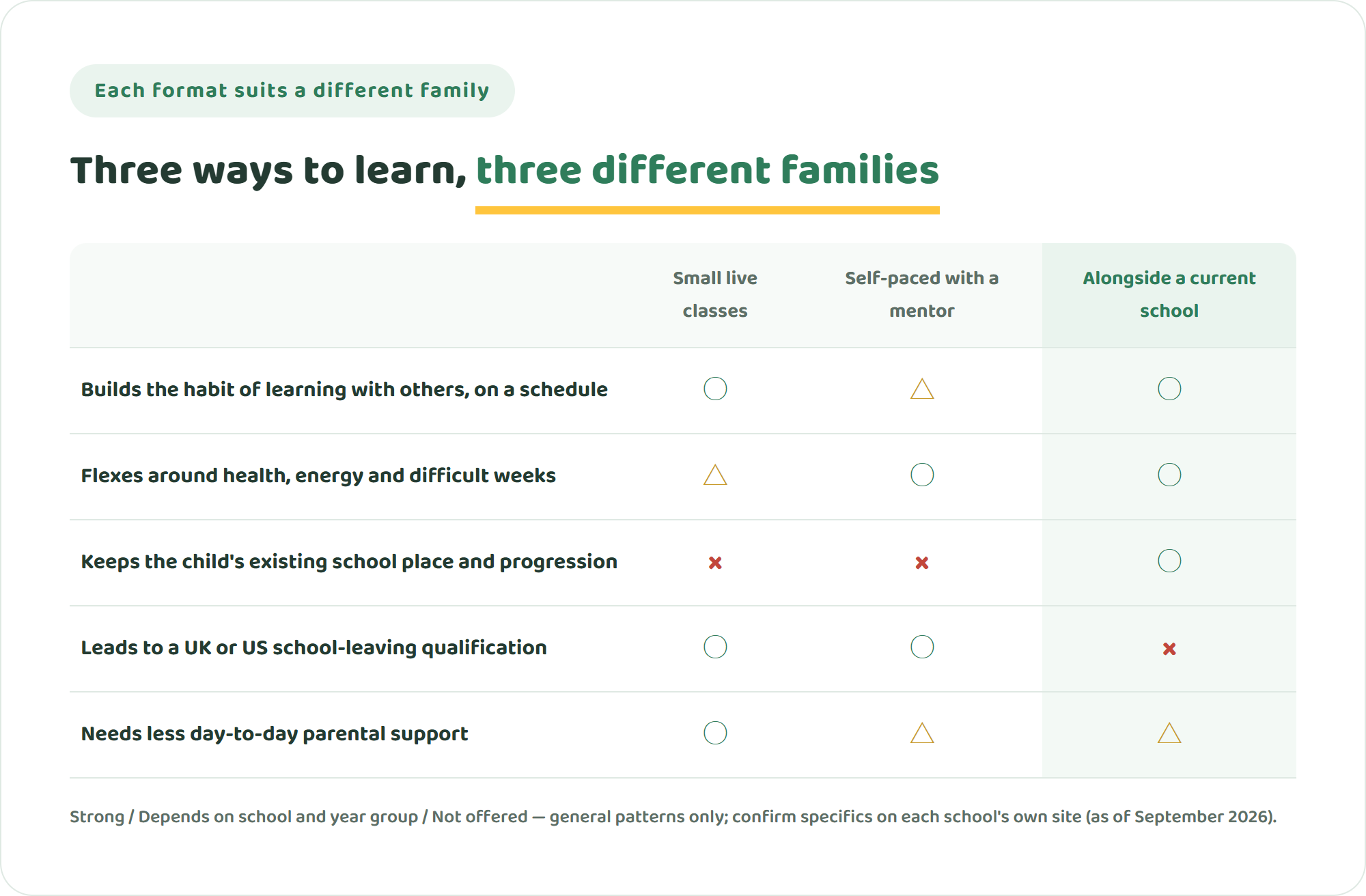
2. Teaching format. Scheduled small live classes, self-paced study with a mentor alongside, or largely recorded and asynchronous. This axis has nothing to do with budget and everything to do with your child. A student who only moves when others are moving and a student who is exhausted by groups need opposite answers.
3. The hour it lands. The most overlooked and the most decisive. A British school day (roughly 09:00–15:00 local) falls in the evening for families across East and Southeast Asia; a US Eastern Time school day falls overnight. No curriculum survives a schedule a household cannot keep. We walk through this in detail in a day in an online international school.
Seven options open to families in Asia
This is not a ranking. Read it as which family each one is for.
1. King’s InterHigh (UK) — live classes, with A Levels or a fully online IB
A British online school running from Primary (ages 7–11) through Middle (11–14) and Senior (GCSE) to Sixth Form (16–19), where students can take A Levels or, as the school states, a fully online IB Diploma (source: King’s InterHigh).
It is also one of the few that publishes its fees openly. For 2026/27 the annual contract is listed from £4,395, with a higher band at £5,995, plus a one-off £100 registration fee, a deposit of £500 for UK students and £1,000 outside the UK, and £405–£435 per year for each additional subject (source: King’s InterHigh fees, checked September 2026). That breakdown is itself the lesson: the headline annual figure is not the figure a family pays.
Suits: families who want a recognised British qualification. Watch: lessons fall in the evening across Asia.
2. Minerva Virtual Academy (UK) — a dedicated mentor for every student, weekly
A British online school for ages 11–18 which states that it is accredited by the UK Department for Education. It runs Years 7–8, Year 9, Years 10–11 (GCSE) and Sixth Form (A Level and BTEC), and the design centres on every student having a dedicated mentor they meet one-to-one every week (source: Minerva Virtual Academy).
Notably, it also runs a separate GST timetable for families in the Middle East and the GCC — an online school conceding, in its own product design, that the time zone is not a detail. From Asia you would be joining on UK hours.
Suits: students who stall when working alone, or whose energy comes in waves. Watch: evening hours for Asian families.
3. Nisai (UK) — built around students who need the environment to adapt
Delivers the UK curriculum through live lessons with qualified teachers and qualifications accredited by Pearson. Its site states that it is Section 41 approved by the Department for Education, recognised as an IQM Centre of Excellence, and teaching students in over 30 countries (source: Nisai).
The parent accounts published on its own site point clearly to where its strength lies: students for whom a conventional school environment had become unbearable, and students with additional needs.
Suits: anxious students, students for whom large groups are costly. Watch: it is not designed around any Asian curriculum or language.
4. Crimson Global Academy (global) — both British and American routes in one school
An online private school for ages 7–18 offering International GCSEs, International A Levels, APs and the US Diploma, taught in small live classes, and describing itself as accredited (source: Crimson Global Academy).
Carrying both the British and American routes under one roof is a genuine practical advantage for a family whose destination is not yet fixed.
Fees are published. As listed in September 2026, full-time study is $17,875 a year for IGCSE and $18,000 a year for A Level, with part-time study priced per subject ($3,255 for an IGCSE subject, $4,100 for an A Level subject). An application fee of $160 applies to every enrolment, and examination fees are charged separately depending on where the student sits them (source: Crimson Global Academy, Fees and Scholarships).
Suits: families aiming abroad who want to stay open between the UK and US systems. Watch: because you can start with a single subject, the total moves a great deal as subjects are added — budget on both the annual and the per-subject figures.
5. Pearson Online Academy (US) — an American programme and a US diploma
A US online private school which states that it is accredited by the Southern Association of Colleges and Schools Council on Accreditation and School Improvement, the Northwest Accreditation Commission, the North Central Association CASI, and the Middle States Association (source: Pearson Online Academy).
For families in Asia the time difference is decisive. A US Eastern Time school day falls overnight, so in practice this is a choice to study asynchronously, through recordings and coursework. That works for some students; it disappoints families who expected live classroom life.
Suits: self-directed older students aiming at US universities. Watch: live attendance is not realistic from Asia.
6. Keep the current school, and add subject learning in English online
Not a school name but a shape — and in Asia, often the most realistic one. The child stays enrolled where they are and studies in English after class or at weekends. Its great advantage is that none of the regulatory questions arise at all: the existing school place, progression and leaving qualification are untouched, because the additional study sits legally in the same category as any other after-school activity.
The trade-off, stated plainly: this route does not itself award a British or American school-leaving qualification.
Suits: families who do not want to dismantle a life that is working, and who want a reversible first step.
7. NIJIN GLOBAL ACADEMY (Japan) — Asian hours, designed to run alongside
NIJIN GLOBAL ACADEMY (NGA) is an online international school opening in September 2027, operated by NIJIN Inc. It runs on Asian hours and is built for the sixth shape above: a child keeps their current school and studies with us after class. Subjects are taught in English rather than English as a subject, in small, discussion-led classes that are deliberately unranked. Trial classes run as a pre-opening in April–May 2027.
What honesty requires us to add: as a school that has not opened, we have no graduate outcomes yet. There is no campus, no sports day, and no British or American leaving qualification issued by us. We are aiming at a different place from options 1–5. See how learning works at NGA →
The seven at a glance
| Option | Curriculum and exit | Teaching format | When it lands in Asia |
|---|---|---|---|
| King’s InterHigh | GCSE / A Level / online IB | Small live classes | Evening |
| Minerva Virtual Academy | GCSE / A Level / BTEC | Live plus a weekly 1:1 mentor | Evening |
| Nisai | UK curriculum / Pearson-accredited | Small live classes, high support | Evening |
| Crimson Global Academy | IGCSE / A Level / AP / US Diploma | Small live classes | Varies by class |
| Pearson Online Academy | US programme / US Diploma | Asynchronous in practice | Overnight |
| Current school + online alongside | Keeps the local qualification | After class and weekends | After school |
| NIJIN GLOBAL ACADEMY | Subjects in English, alongside school | Small, discussion-led, unranked | After school (Asian hours) |
Based on what each school published on its own site as of September 2026. Hours can differ by class and year group. Fees are deliberately excluded from this table because the structures and currencies are not comparable line by line — read each school’s own fee page.
Three traps that catch almost everyone
One: budgeting from the annual figure. As King’s InterHigh’s own published breakdown shows, registration, deposits and per-subject charges stack on top, and external examination entries are typically billed separately again. Compare totals you have added up from official pages, not headline numbers.
Two: trusting a ranking. Many online-school rankings never disclose their criteria, and a rank cannot express who a school is good for. Read every list against your own three axes instead.
Three: leaving the “coming back” question until last. Overseas online schools do not teach any Asian national curriculum and do not assume a return. If there is any chance your child re-enters a local system, find out what re-entry looks like before you enrol, not after.
Cutting seven down to two
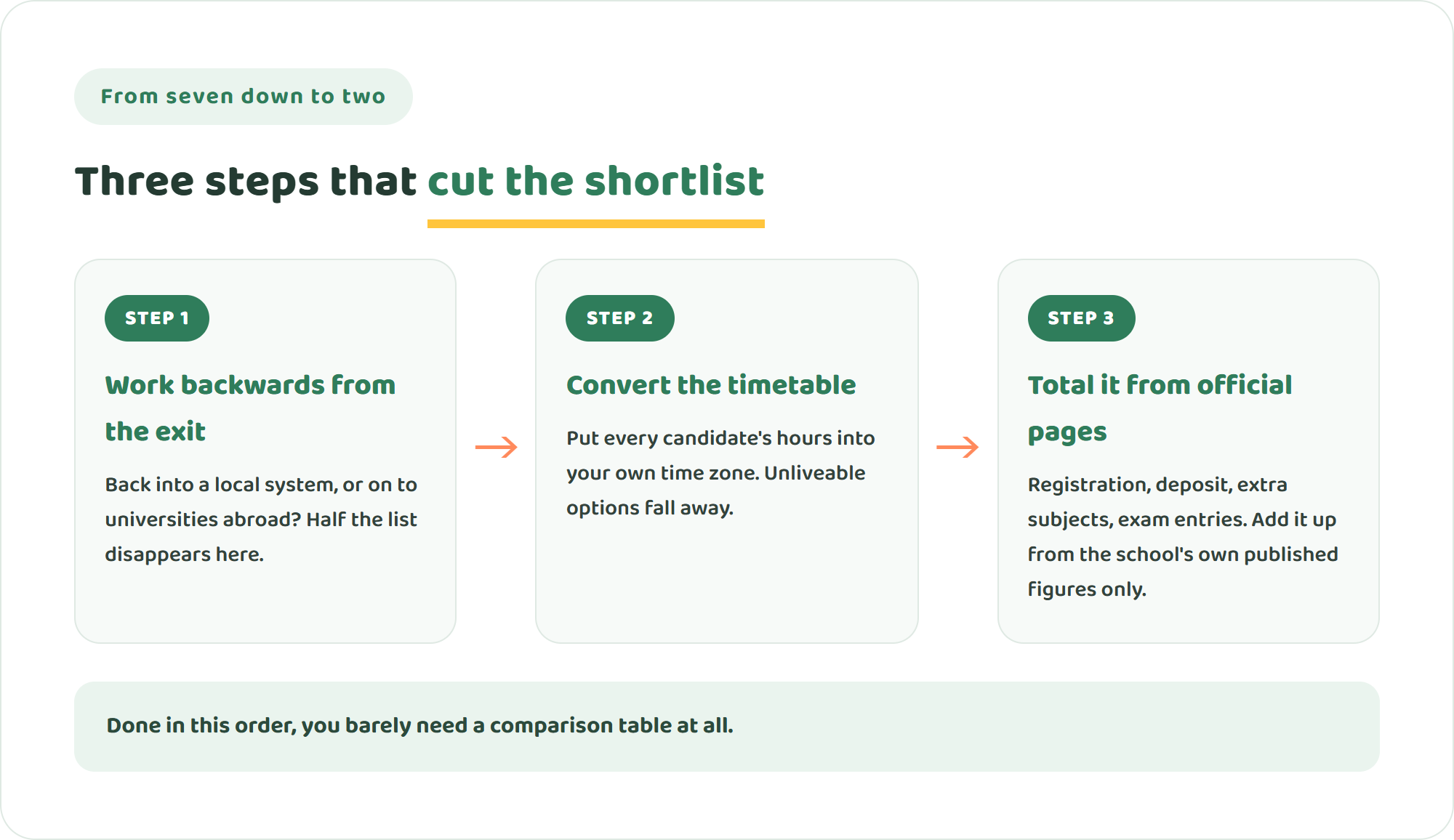
Step 1 — work backwards from the exit. “Keep the option of returning locally” points to options 6 and 7; “aiming at universities abroad” points to 1 through 5. One question, half the list gone.
Step 2 — convert every timetable into your own time. Do it by hand. Options your household cannot live with fall away here — which is far cheaper than discovering it in term two.
Step 3 — total the cost from official pages only. Annual fee, registration, deposit, extra subjects, exam entries. If two are still standing, your comparison is finished.
Questions families ask
What should I compare first?
The exit. Which qualification, leading where. Comparing fees or reputations before that produces information you cannot act on. Decide this one thing as a family and the shortlist halves immediately.
Can my child really take IGCSEs or A Levels from Asia?
Yes. Cambridge IGCSE is designed for 14–16 year olds and is sat at approved exam centres, with an established route for private candidates (source: Cambridge International). But centres and sittings are limited, and entry fees sit outside tuition. Confirm where in your country your child would actually sit the exams before you choose a school.
Can we trial more than one school?
Attend as many open events and taster lessons as you like — you should. Enrolling full-time in two schools at once is not realistic, in cost or in load on a child. If you genuinely cannot choose, start small alongside the current school, then move to full-time once you have evidence. That order is reversible; the other one is not.
The point of comparing is not to produce a ranking
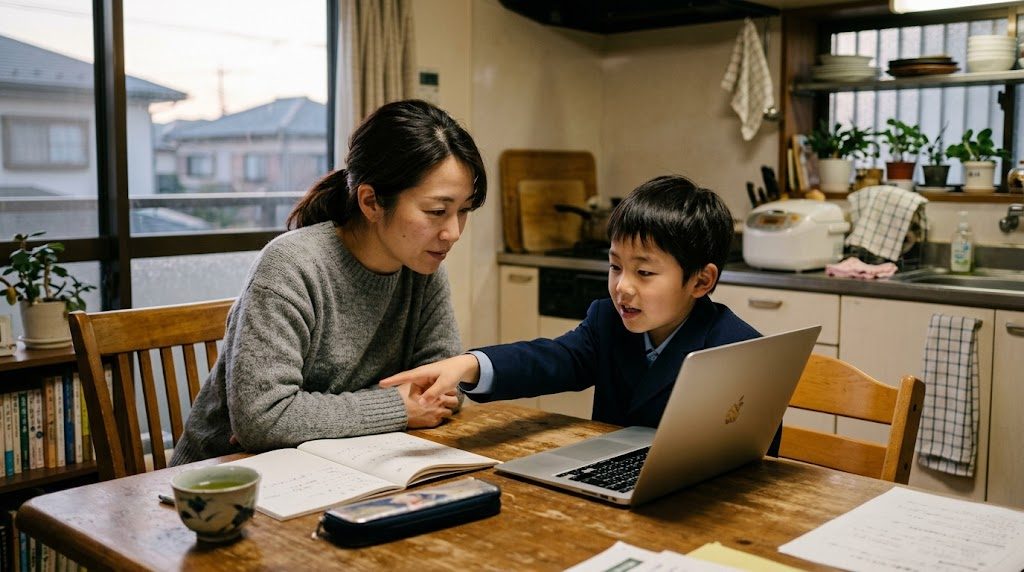
If you have read this far, you are probably not looking for the best school in the world. You are looking for a place your child can keep going without being worn down. You do not need a complete comparison table for that. Decide the exit, convert the timetable, total the cost from official pages — for most families, those three steps are the whole answer.
And you do not need to settle it today. Children change; so does this market. Keep gathering information, and keep the conversation going at home.