If your family is moving to Asia and you want your child to keep learning in Japanese, you will soon be searching for Japanese school abroad tuition. In this guide, “Japanese School” means a nihonjin gakkō: a full-time school overseas that teaches the Japanese national curriculum in Japanese and is accredited by Japan’s Ministry of Education (MEXT) as equivalent to a school in Japan. As of 15 April 2026 there are 91 of them in 47 countries and one region, with about 15,000 students.
Working out the cost is harder than it should be: each school bills in its own currency and adds its own mix of entrance fees, levies, donations and association fees. This article puts the official 2026 fees of eight Japanese Schools in Asia (Singapore, Shanghai, Taipei, Seoul, Hong Kong, Bangkok, Manila and Jakarta) into one table, then answers the questions families ask most: is there an entrance exam, who can enrol, what happens after Grade 9, and how the fees compare with international schools in the same city.
Every figure comes from the schools’ own websites or PDFs, checked on 24 October 2026. Yen equivalents use reference rates of 23 October 2026 (SGD 1 = JPY 122.65, CNY 1 = 23.508, KRW 1 = 0.11839, HKD 1 = 19.9913, THB 1 = 4.6467, PHP 1 = 2.4638, IDR 1 = 0.00866; TWD 1 = 4.814569 from a separate source) and are rounded estimates.
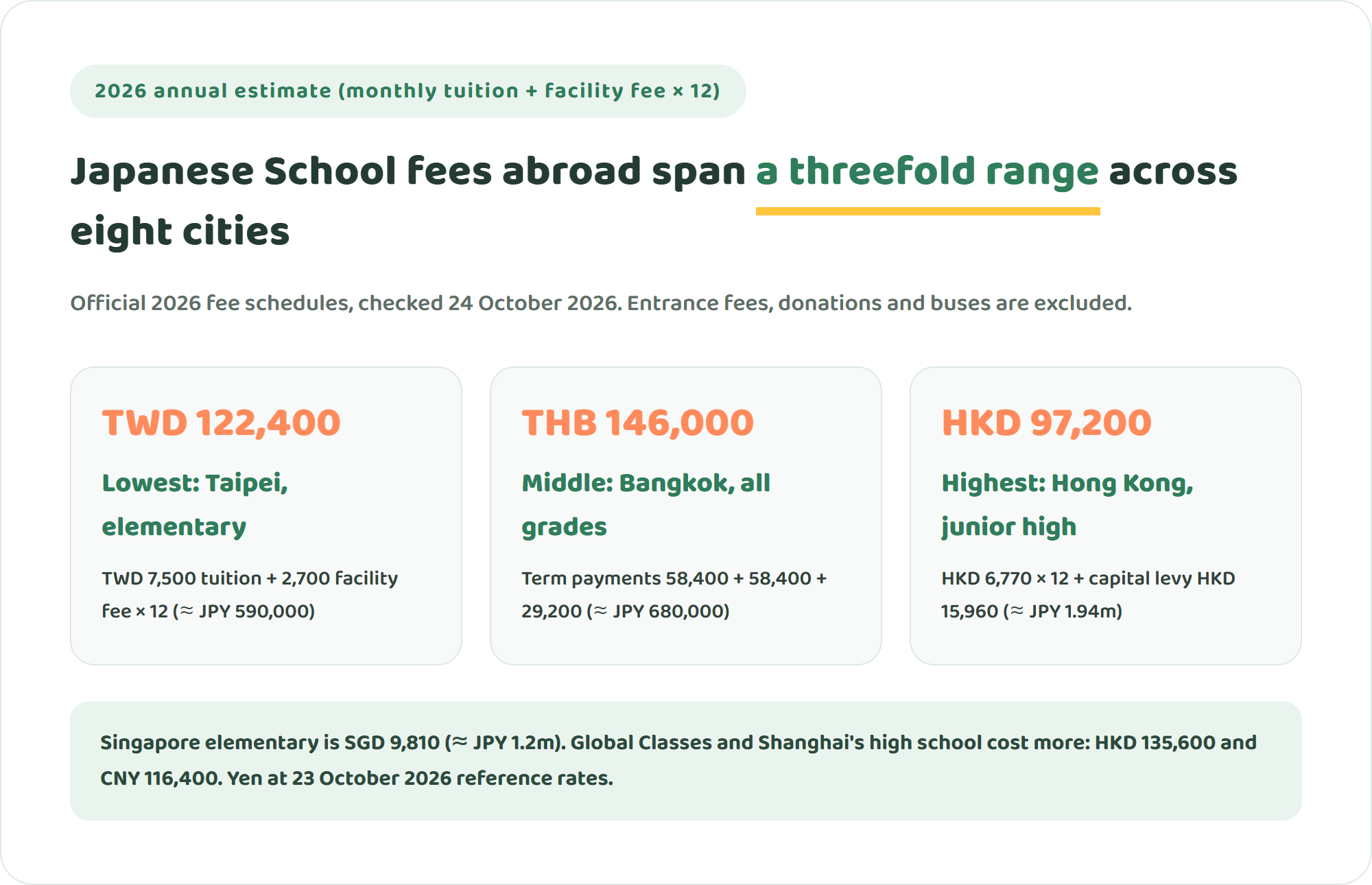
The short answer: about JPY 590,000 to 1.94 million a year, with one-off fees that vary even more
- Annual cost (monthly tuition plus any monthly facility fee, times 12; one-off fees excluded): from Taipei’s elementary section at TWD 122,400 (about JPY 590,000) to Hong Kong’s junior high at HKD 97,200 (about JPY 1.94 million). Jakarta, Seoul, Bangkok, Shanghai and Manila fall between roughly JPY 600,000 and 800,000; only Singapore and Hong Kong exceed JPY 1 million.
- Special tracks cost more: Singapore’s junior high Global Class SGD 14,388 (about JPY 1.76 million), Hong Kong’s elementary Global Class HKD 135,600 (about JPY 2.71 million), Shanghai’s high school CNY 116,400 (about JPY 2.74 million).
- Entrance fees run from zero to THB 160,000: Hong Kong charges none, on its government’s instruction; Bangkok charges THB 160,000 (about JPY 740,000).
- Donations and membership fees depend on the city: a donation is a condition of admission in Manila, Singapore asks families at non-Japanese employers for SGD 3,000 plus GST, and Jakarta requires membership of its supporting association. The other five list no donation.
- No academic entrance exam at seven of the eight. Manila sets a written test.
- Only Shanghai has a high school section. The other seven end at Grade 9.
A Japanese School costs roughly a half to an eighth of an international school in the same city. The trade-off: your child learns in Japanese, and in most cities the road ends at Grade 9.
Japanese school abroad tuition in eight Asian cities (official 2026 fees)
The table lists each school’s published fees for the 2026 school year (April 2026 to March 2027). The annual estimate is monthly tuition plus any monthly facility fee, multiplied by 12. It excludes one-off payments on entry (entrance fee, facility levy, donation, association membership), PTA dues, materials and buses. Two exceptions: Hong Kong’s Annual Capital Levy is included because it is charged every year, and Bangkok’s figure is the sum of its three term payments, since no monthly rate is published.
| City | Section | Annual estimate (local / ≈ JPY) | Entrance fee | Donations, levies, membership | Bus | Source |
|---|---|---|---|---|---|---|
| Singapore | Elementary / Junior high / JH Global Class | SGD 9,810 / 10,725.60 / 14,388 (≈ JPY 1.20m / 1.32m / 1.76m) | SGD 1,090 (Japanese Association member) / 3,924 (non-member company) | Building surcharge SGD 2,725 once. Donation SGD 3,000 + GST (non-Japanese employer); corporate donation in yen | Not published | Fees PDF |
| Shanghai | Elementary / Junior high / High school | CNY 30,000 / 32,400 / 116,400 (≈ JPY 0.71m / 0.76m / 2.74m) | CNY 10,000 (5,000 for second child or internal promotion) | Facility payment CNY 10,000 once per family. No donation | CNY 1,000–1,100 / month | Admissions guide |
| Taipei | Elementary / Junior high | TWD 122,400 / 123,600 (≈ JPY 0.59m / 0.60m) | TWD 40,000 | Facility fee TWD 60,000 once. No donation | Not published | Transfer guide |
| Seoul | Elementary and junior high / Kindergarten (youngest year) | KRW 5,640,000 (≈ JPY 0.67m) / 7,560,000 (≈ JPY 0.90m) | KRW 650,000 (waived for internal promotion) | No donation. Building reserve and heating/cooling (KRW 80,000 / month) included above | KRW 283,500 / month | 2026 admissions guide |
| Hong Kong | Elementary / Junior high / Elementary Global Class | HKD 84,480 / 97,200 / 135,600 (≈ JPY 1.69m / 1.94m / 2.71m) | None (government instruction) | Annual Capital Levy HKD 15,960 (included above). No donation | HKD 2,132–2,613 / month | List of fees |
| Bangkok | Elementary and junior high (same fee) | THB 146,000 (≈ JPY 0.68m) | THB 160,000 (60,000 for internal promotion) | No donation. No separate facility fee | Not published | Enrolment rules |
| Manila | Elementary and junior high (same fee) | PHP 312,000 (≈ JPY 0.77m) | PHP 26,000 | Donation required: US$2,000 per household (self-employed / personal); US$500 first child (government, international organisations); corporate donation for employees | Paid to bus company (not published) | 2026 handbook |
| Jakarta | Elementary and junior high / Kindergarten | IDR 71,760,000 (≈ JPY 0.62m) / 73,680,000 (≈ JPY 0.64m) | IDR 15,000,000 | Association entry fee IDR 38,100,000 (individual); corporate rate set by parent company’s capital | IDR 52,493,000 / year | Cost estimation PDF |
Source: each school’s official website or PDF, checked 24 October 2026. Exchange rates are reference rates for 23 October 2026 (TWD from a separate source); yen figures are estimates. Fees are revised every year and tax treatment (for example Singapore’s GST) differs by school, so confirm the final amount with the school.
City by city: what makes each school’s fees different
Singapore: membership category changes the entrance fee more than threefold
The largest of the eight, with 1,687 students (April 2025). Tuition is SGD 675.80 (elementary) or 752.10 (junior high) a month plus a SGD 141.70 facility fee. The entrance fee is SGD 1,090 for Japanese Association members but SGD 3,924 at non-member companies, plus a one-off building surcharge of SGD 2,725. Families at non-Japanese employers pay a SGD 3,000 + GST donation. A junior high Global Class costs SGD 1,057.30 a month. See international schools in Singapore.
Shanghai: the only one with a high school section
Tuition is CNY 2,500 (elementary), 2,700 (junior high) and 9,700 (high school, including textbooks and mock exams) a month. No monthly facility fee; families pay CNY 10,000 on entry per child and a CNY 10,000 facility payment once per family. No donation. Intake is limited to set windows (for 2026, 1 April 2026 to 29 January 2027). Compare with international schools in Shanghai.
Taipei: the lowest annual cost, transfers accepted year-round
551 elementary and 177 junior high students (15 April 2026). Tuition is TWD 7,500–7,600 a month plus a TWD 2,700 facility usage fee, the lowest of the eight. On entry: TWD 40,000 entrance fee and TWD 60,000 facility fee. Parents must belong to the Japanese Association of Taiwan. Transfers are handled at any time with, in principle, no waiting list; Grade 9 transfers close at the end of September. See international schools in Taipei.
Seoul: kindergarten included, no entrance fee for internal promotion
Tuition is KRW 390,000 a month plus a KRW 50,000 building reserve and KRW 30,000 heating and cooling; the youngest kindergarten year is KRW 550,000. The KRW 650,000 entrance fee is waived for pupils moving up to junior high. The bus is KRW 283,500 a month, set by the bus users’ association. Parents must join the Seoul Japan Club, and a Japanese parent must be posted to Korea. See international schools in Seoul.
Hong Kong: no entrance fee, but the highest annual cost
No entrance fee is charged, on the instruction of the Hong Kong government, but an Annual Capital Levy of HKD 15,960 is due on entry and then each year. With tuition of HKD 5,710 (elementary) or 6,770 (junior high) a month, the annual estimate of HKD 84,480–97,200 is the highest regular-section fee of the eight. The Grade 4–6 Global Class is HKD 9,970 a month. Hong Kong is also the only school stating that nationality is not a condition; admission follows an aptitude check.
Bangkok: termly billing and the largest entrance fee
According to MEXT, the first Japanese School anywhere opened in Bangkok in 1956. Tuition is billed by term: THB 58,400, 58,400 and 29,200, or THB 146,000 a year, the same for elementary and junior high. The THB 160,000 entrance fee is the largest of the eight, reduced to THB 60,000 for pupils moving up from the school’s own elementary. No donation; payments from a parent’s employer are not accepted. See international schools in Bangkok.
Manila: a donation is a condition of admission, and there is a written test
Tuition is PHP 18,000 a month plus PHP 8,000 in facility fees, paid three months in advance. The PHP 26,000 entrance fee is separate from a donation the handbook calls a condition of admission: US$2,000 per household for self-employed or private applicants, US$500 for a first child from government or international organisations, and a corporate donation for employees. Manila is also the only school requiring a written test (Japanese and arithmetic; plus English at junior high). See international schools in Manila.
Jakarta: a separate association entry fee that is easy to miss
Tuition is IDR 4,700,000 a month plus a IDR 1,280,000 maintenance fee; the entrance fee is IDR 15,000,000. The item families miss is that the parent’s employer, or the family itself, must join the school’s supporting association (yayasan): IDR 38,100,000 for an individual member, with corporate rates set by the parent company’s capital. The bus, at IDR 52,493,000 a year, is around 70% of the annual tuition estimate.
Is there an entrance exam? Who can enrol
Japanese Schools do not rank applicants by test score the way selective private schools in Japan do. Across the eight schools’ published requirements, four conditions recur.
- Nationality: Japanese as a rule. Taipei and Bangkok include children the school approves; Shanghai asks families with another or dual nationality to consult in advance; Jakarta accepts Japanese–Indonesian dual nationals. Hong Kong alone says nationality is not a condition.
- Ability to learn in Japanese: Seoul asks that the child “can cope with education in Japanese”; Manila asks for age-appropriate reading, writing, listening and speaking.
- The parents’ status: membership of the Japanese Association (Singapore, Taipei, Manila), the Seoul Japan Club or the supporting association (Jakarta).
- An interview or aptitude check (Shanghai, Hong Kong, Taipei), which assesses whether the child can settle in, not academic rank.
The exception is Manila, which requires a pass in its written test. Singapore does not admit Singaporean nationals as a rule and assigns elementary pupils to a campus by home address. Read the specific school’s requirements before you move.
After Grade 9: only Shanghai has a high school section
Only Shanghai Japanese School continues to high school, at CNY 9,700 a month. The other seven end at Grade 9, so the next step needs deciding early. There are three main routes.
- Return to Japan for high school: under MEXT regulations, students of accredited Japanese Schools are granted eligibility for admission to Japanese high schools.
- Move to an international school in the same city. Fees are several times higher and schools set English requirements.
- Move to a local school: Seoul’s admissions guide states that graduating from the Japanese School does not by itself confer eligibility for Korean secondary or high schools. Rules differ by country.
If the plan after Grade 9 is an international school or a high school abroad, the gentlest preparation is to add some English-medium learning while your child is still at the Japanese School, rather than switching languages all at once at 15. Our overview of international school tuition costs shows what that next step would cost.
How Japanese Schools compare with international schools in the same city
Japanese School fees look high until you place them next to the international school down the road. One representative school per city, from our city guides:
- Singapore: UWCSEA, SGD 39,069 tuition for K1–G1 (2026-27), about four times the Japanese School’s SGD 9,810.
- Shanghai: Shanghai American School, about CNY 246,000–311,000, more than eight times CNY 30,000.
- Taipei: Taipei American School, about TWD 930,000–1,030,000 in total (2025-26), more than seven times TWD 122,400.
- Seoul: Seoul Foreign School, about KRW 40–56 million, more than seven times KRW 5,640,000.
- Hong Kong: Hong Kong International School, HKD 231,600–272,600 plus a HKD 24,500 capital levy (2026-27), about 2.7 to 3 times HKD 84,480.
- Bangkok: NIST, about THB 630,000–1,090,000, more than four times THB 146,000.
- Manila: International School Manila, about PHP 650,000–1,500,000, more than twice PHP 312,000.
- Jakarta: Jakarta Intercultural School, IDR 204,246,000–532,384,000 tuition plus admission and capital fees, about three to seven times IDR 71,760,000.
Grade bands and inclusions differ, so this is rough, but the pattern holds: a Japanese School costs roughly a half to an eighth of an international school in the same city. That gap is why many families abroad want English-medium schooling but cannot see how to afford it. See international school fees across Asia compared.
Combining a Japanese School, a local or international school, and online learning
Choosing a school abroad looks like picking one option. In practice it is about how you combine them: a Japanese School for the Japanese curriculum and an easy return to Japan; a local or international school for learning in English, at a much higher cost; a supplementary Japanese school (hoshūkō, 246 of them in 51 countries and one region, with about 20,600 students) for Saturday Japanese classes alongside a local or international school; and an online international school as a third route that does not depend on your city, adding English-medium learning alongside a Japanese School or keeping learning continuous through relocations.
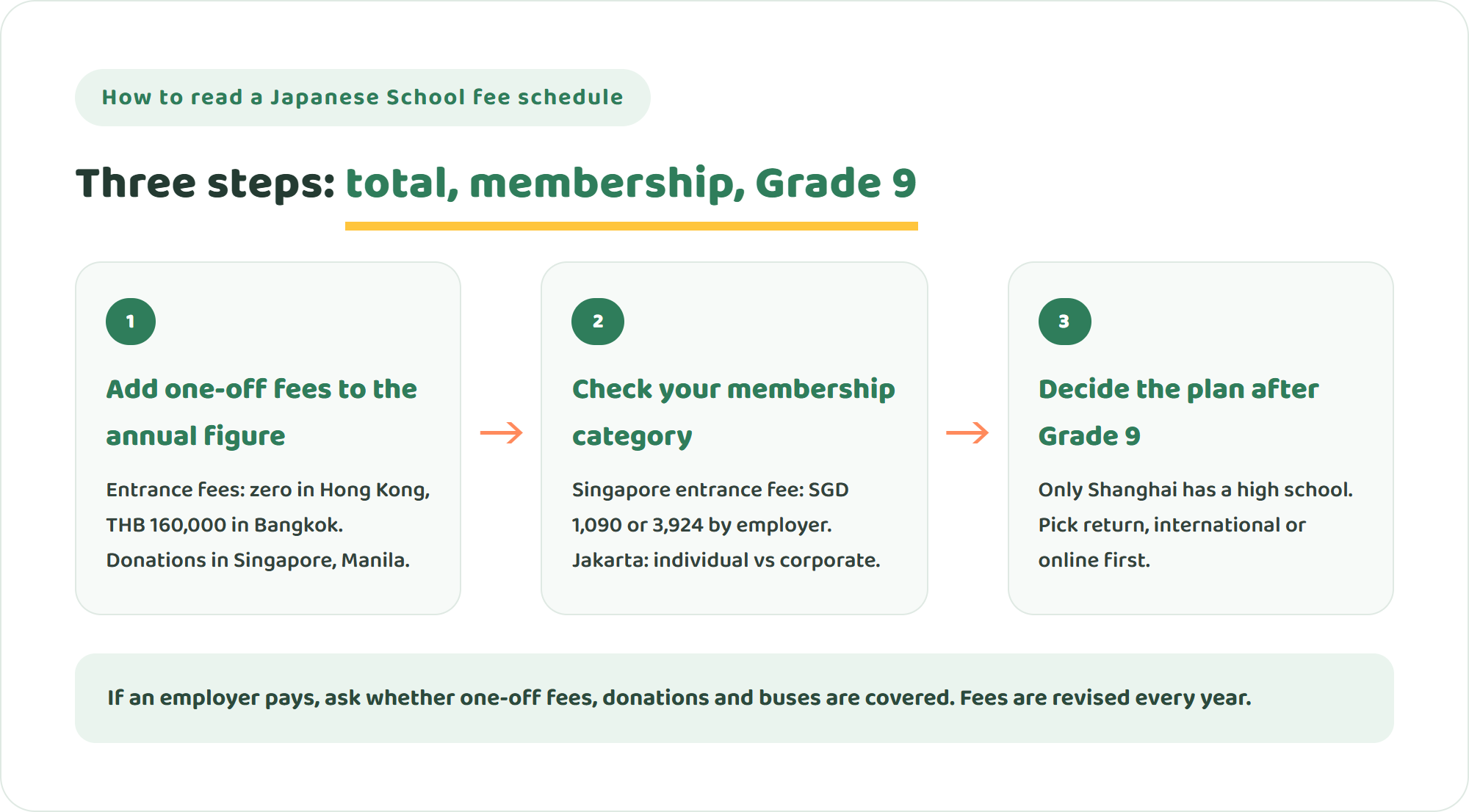
Three steps make the comparison manageable. First, look at the total: add the entrance fee, levy and any donation or association fee to the annual figure. Second, check whether your membership category (Japanese Association, employer) changes the amount, as in Singapore and Jakarta. Third, decide the post-Grade 9 plan before you enrol, because it determines how much English your child will need. If an employer pays, ask whether one-off fees, donations and buses are covered. You can see how we structure English-medium learning in our online school curriculum.
Where NIJIN GLOBAL ACADEMY fits
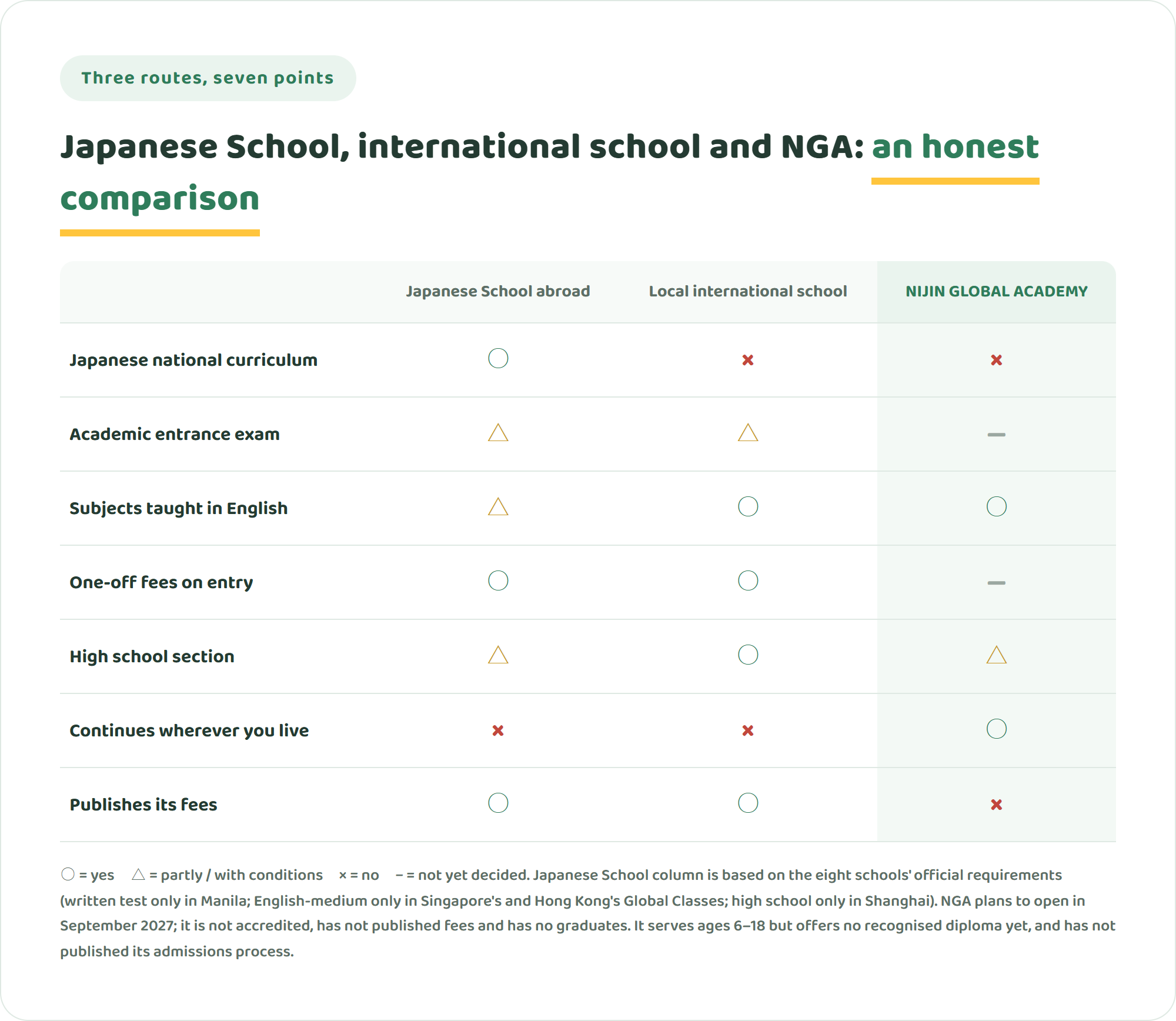
NIJIN GLOBAL ACADEMY (NGA) is an online international school for ages 6–18, planned to open in September 2027. It is run by NIJIN Inc., which operates NIJIN Academy, an online school in Japan for children who do not attend school, where more than 1,000 children have studied. NGA plans small live classes in which subjects are taught in English and supported by bilingual Japanese–English mentors, with admission that does not depend on test-score rankings.
To be clear about the limits: NGA has not opened, is not accredited, has not published its fees and has no graduates. It does not replace a Japanese School where a family needs the Japanese curriculum, nor an international school where a recognised diploma is required. Where we hope to help is as English-medium learning alongside a Japanese School, and as preparation for a move to an international school after Grade 9.
Frequently asked questions
Do Japanese Schools abroad have entrance exams or academic rankings?
No. None of the eight selects by test score. Admission depends on nationality, the ability to learn in Japanese and the parents’ membership or posting, confirmed by an interview or aptitude check. Manila is the exception: it requires passing a written test in Japanese and arithmetic (plus English at junior high).
Can a child without Japanese nationality attend?
It depends on the school. Hong Kong states that nationality is not a condition. Taipei and Bangkok admit children the school approves, Shanghai asks families with another or dual nationality to consult in advance, and Jakarta accepts Japanese–Indonesian dual nationals. Seoul admits children without Japanese nationality only in specific cases approved by its committee, and Singapore does not admit Singaporean nationals as a rule. Contact the specific school.
What is the difference between a Japanese School and a supplementary school?
A Japanese School is full time on weekdays and delivers the same curriculum as a school in Japan. A supplementary school (hoshūkō) teaches some subjects in Japanese on Saturdays or after school to children at local or international schools. There are 91 Japanese Schools and 246 supplementary schools worldwide (15 April 2026).
Decide the Grade 9 question now, not later
Japanese school abroad tuition ranges from roughly JPY 590,000 to 1.94 million a year across these eight cities, and the picture changes again once entrance fees, donations and association fees are added. What does not change is that it remains a fraction of international school fees. That is why the harder question is not “how much” but “what happens after Grade 9”, and where your child will get the English they will need by then.
While you check the official fee schedules, you are welcome to keep NIJIN GLOBAL ACADEMY on your list as well. Ahead of the planned September 2027 opening, we expect to run trial classes in April–May 2027.