“Career change from teaching.” If you typed those words, your finger may have hovered for a moment before you hit search. You still love the classroom — the moment a child’s eyes light up can still catch in your chest. And yet the grading you carry home, the endless admin, the parent meetings, and a way of working with no clear horizon are wearing you thin. “It’s not that I hate this job. It’s that I’m not sure I can keep working like this.” Whether you teach in a public school, a private one, primary or secondary, in Japan or elsewhere in Asia, you are far from the only teacher who reached this page late at night carrying that quiet doubt.
This article meets that doubt honestly. First, we will be candid about why career changes from teaching can lead to regret, and about the fears around age and having “only ever taught.” Then we will look at how to change careers without regret — taking stock of your skills and setting your own criteria, which is useful for any move, with or without us. Finally, as a “third path” that lets you keep teaching while changing only how you work, we will introduce — without a hard sell — the option of joining the founding team of the online international school we open in September 2027. By the end, the binary of “quit or stay” should look a little wider.

Does leaving teaching lead to regret? An honest starting point
Search “career change from teaching” and the suggestions fill with “regret,” “at 30,” “burnout.” That alone tells you how many people share the same worry. Honestly, a move out of teaching does have places where people stumble. First, a temporary drop in income: letting go of a stable public-sector salary and its allowances can mean a lower income right after the switch. Second, the gap with corporate culture: the way you are evaluated and the rhythm of the day differ from school, and the early months can feel disorienting. Third, anxiety about age and about having “only taught” — changing careers in your 30s or 40s, with no private-sector experience, and wondering whether your skills will translate.
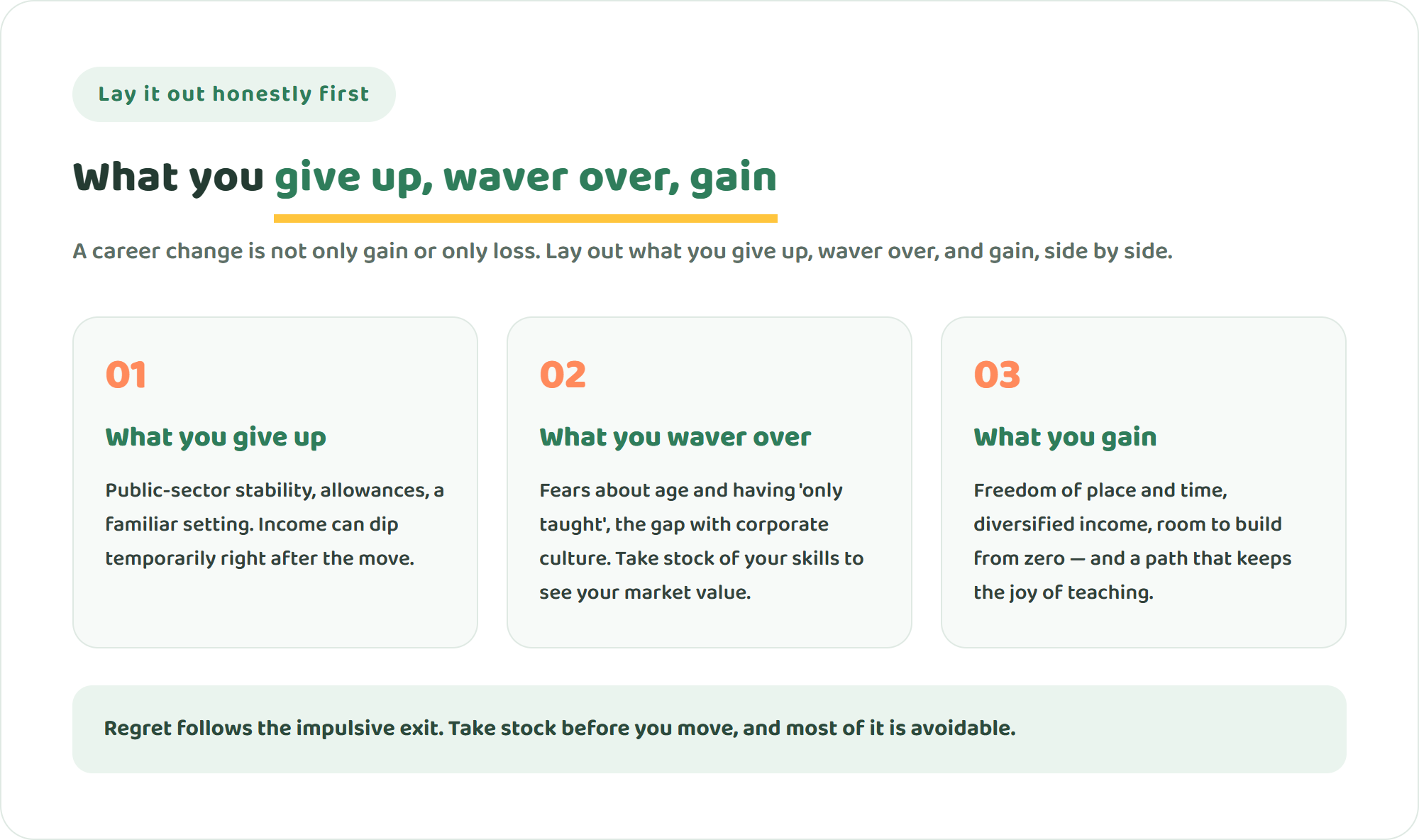
But as this chart shows, it is not all loss. The strengths you built as a teacher — moving a whole group at once, structuring an idea so it lands, reading how well someone understands, facing the wide range of people that parents represent — are genuinely marketable skills outside a school. Regret tends to follow the move made on impulse, not the one made after taking honest stock of what you already carry. That is the fork in the road.
How to change careers without regret — take stock, then set your criteria
This is the heart of the article. Before hunting for a new role, do this first: take stock of your skills. The teachers most convinced they “can only teach” are often the ones carrying the most transferable strengths. Running a classroom is project management; making materials is content production; running a school event is logistics and consensus-building, back to back. Write out, role by role, the work you have carried, then rename each one: “what is this job called outside a school?” That alone brings the outline of your market value into focus.
Next, decide your own criteria for the move — the priority order of what you will not compromise on. Freedom over where you work. Diversifying your income. Not losing the joy of teaching. The satisfaction of building something from zero. Which of these matters most to you? Browse job listings with fuzzy criteria and you will be tossed around by surface conditions and end up regretful. With clear criteria, even a temporary dip in pay reads as “this was my choice.” Taking stock and setting criteria is the foundation that protects your career — whether or not you ever apply to us.
See NIJIN GLOBAL ACADEMY’s founding-member roles →
A third path — crossing over without leaving teaching behind
“Quit, or stay.” Career changes from teaching are so often framed as this binary. But there is another path: keep the joy of teaching, and cross only the boundary of how you work. The founding-member roles that NIJIN GLOBAL ACADEMY (NGA) is recruiting for ahead of its September 2027 opening are built on exactly that idea. The table below sets three paths side by side: staying at your current school, moving to a general company, and joining the founding team of an online international school.
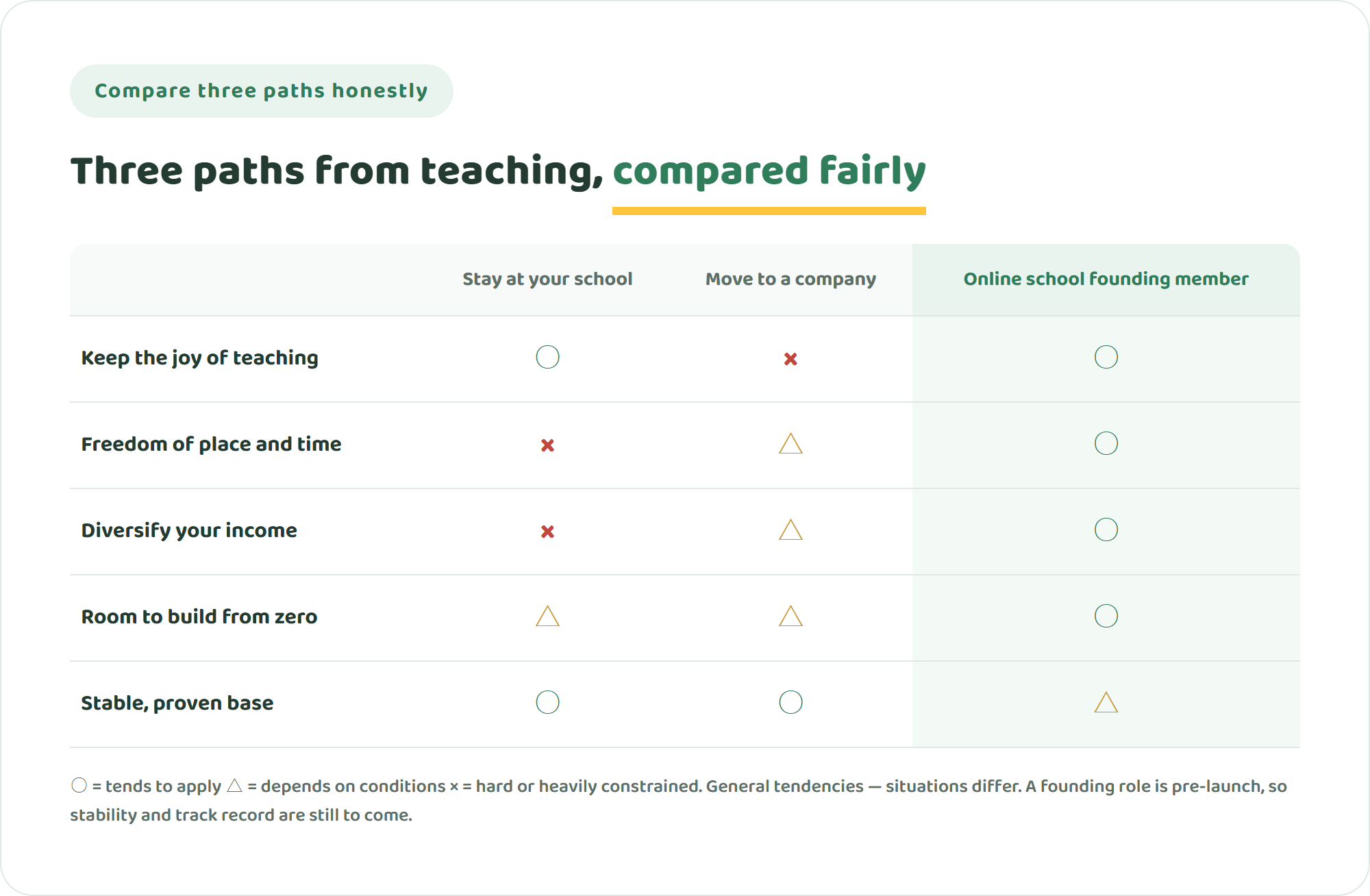
As the table makes plain, the founding-member path is not a cure-all. Precisely because it is a pre-launch phase, the “stability and track record” of an established school are still to come. Even so, this way of working holds real appeal for someone with teaching experience. First, it is fully remote — designed around the premise of “working while traveling the world,” free of a commute or a fixed location. Second, you can combine teaching with running the business: beyond lessons, you can choose your involvement from five working styles spanning marketing, web, partnerships, and HR. Third, we say plainly what the terms are — founding roles on this track begin as volunteer positions ahead of our September 2027 opening, and the detailed terms are shared later in the process. If you want a feel for how international-school economics compare, our international school tuition database gives you a yardstick for the market.あわせて、インターナショナルスクールの学費はなぜ高いのか(相場の内訳と、対面の約1/5に下げる方法)で、費用の構造そのものを分解しています。
Above all, NGA stands for learning beyond test scores — no ranking of children by exam results. Our view of education, built around small-group dialogue that starts from “what do you think?”, is laid out in how we learn. It is often the teachers most worn out by drilling fixed answers who connect with this philosophy. What we ask of applicants is roughly English at CEFR B2+ and an appetite for building from zero. We look at that drive more than at a teaching license or a glossy résumé.

From teaching to your next step — three steps
Here is a manageable, three-step way to turn worry into action.
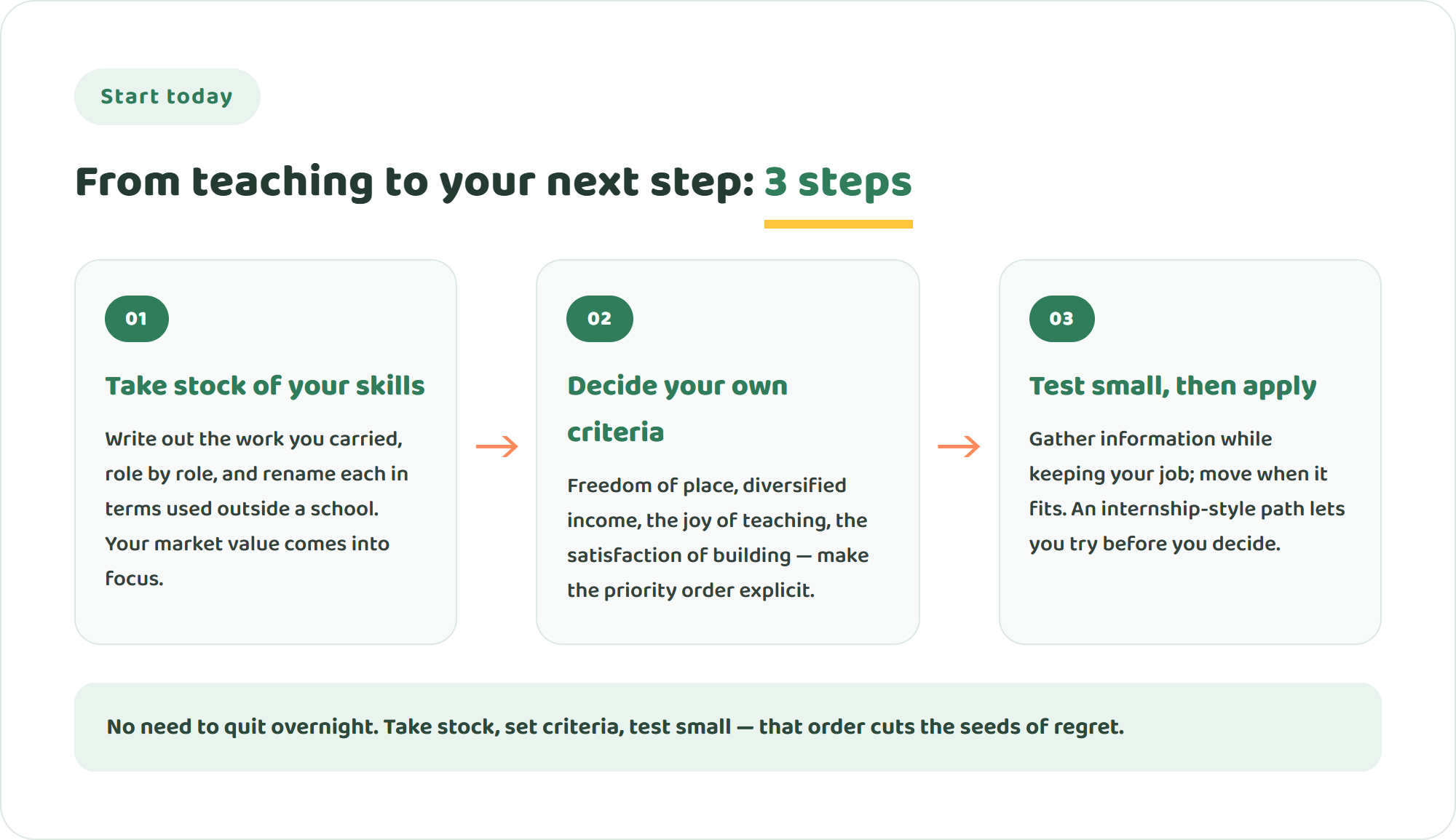
First, take stock of your skills. As in the chapter above, write out the work you have carried role by role, and rename each in terms used outside a school. Second, decide your criteria — freedom of place, diversified income, the joy of teaching, the satisfaction of building — and make the priority order explicit. Third, test small, then apply. Gather information while keeping your current job, and move only when something feels like a fit. NGA’s selection runs from document screening to a group interview, an internship at NIJIN Academy, and a final presentation (applications are via a Google Form). Being able to “try before you decide” through the internship — rather than leaping in blind — is, I think, a reassuring design for anyone coming from teaching.
Frequently asked questions
I’m not that confident in my English. Can I still apply?
We assume roughly CEFR B2+, but we are not looking for native-level perfection. What matters is the willingness to use English to work with children and peers around the world, and to keep growing it. We look at your room to grow and your drive more than your current level. You can confirm the exact expectations during selection.
I have no corporate or international-education experience — is teaching alone enough?
What NGA asks for is people who “can build from zero.” The strengths you built as a teacher — moving people, communicating clearly, creating a space where learning happens — come into their own in a founding phase. We value the drive to build a school together from scratch over a license or a polished background.
You open in September 2027. Is there any point applying now?
Yes. It is precisely because it is pre-launch that founding members help design the substance of the learning itself. The lead-up is built so you can gain experience through the NIJIN Academy internship and more. If you are drawn to “joining the side that builds” rather than “entering a finished organisation,” now is arguably the moment.
Can you really teach children remotely?
NGA is an online international school built around small-group dialogue. Because it is dialogue that draws out each child’s thinking — not one-way lecturing to a large class — deep engagement is possible even remotely. Being able to teach fully remotely, unbound by location, can be the thing that changes the very shape of work for a teacher worn out by a demanding school posting.
Your passion for teaching can be a reason to leave — or a reason to keep going.
If you searched “career change from teaching,” some love of teaching probably still lives in you. That passion can be a reason to leave your current post — but it can just as easily be a reason to keep it burning in a new way of working. Your days at your current school were never wasted; the strengths you built there follow you as your own, whichever path you choose. You do not have to quit in a panic, and you do not have to grit your teeth and endure. Take stock, set your criteria, test small — each step moves you toward a choice you won’t regret. The steering wheel of your career has always been in your own hands.
Working at an International School — More Articles
- international school teacher salary
- how to become an international school teacher
- career change from teaching in your 30s and 40s
- how much do teachers earn?
- how to become an IB teacher
- jobs for moving abroad
- thinking of quitting teaching
- career change from tutoring
- life after leaving teaching
- a second career for teachers
- private school teacher career change
- teach abroad without relocating
- remote teaching jobs
- international school teaching jobs
- teaching jobs without a license
- working at an international school: pros and cons
- online school jobs
- international school staff jobs
Turn your passion for teaching into your next way of working.