“Remote jobs using English.” If you typed that, you probably don’t dislike English itself — quite the opposite. You built it through study, travel, or work, and now you want to put it to use without a commute or a fixed address. Maybe you have care responsibilities at home. Maybe you live somewhere the English-using jobs simply aren’t. Maybe you just want back the hours you currently pour into getting to a desk. The reasons differ, but the question lands in the same place: are there really jobs that use English and can be done fully remotely?
The short answer is yes. But the number of openings, the pay, and the stability vary enormously by role. This article starts with an honest map of the remote work that actually uses English — the appealing parts and the hard parts. Then it covers the practical side that helps wherever you apply: the English level typically expected, what certificates are and aren’t worth, how to build a track record, and how to read a job listing properly. Finally, it offers a third option that few people think of — using English to teach — through the founding-member roles at NIJIN GLOBAL ACADEMY (NGA), an online international school opening in September 2027. No hard sell; just an option on the table.

The remote English job list — three types worth separating
Open any job board and the remote English listings sprawl: translation, localisation, subtitling, bilingual customer support, English-language admin, online assistant roles, cross-border e-commerce support, online English tutoring, language teaching. Scrolling a list that long rarely helps you decide. Split the work by its nature into three types and your own fit becomes much easier to see.
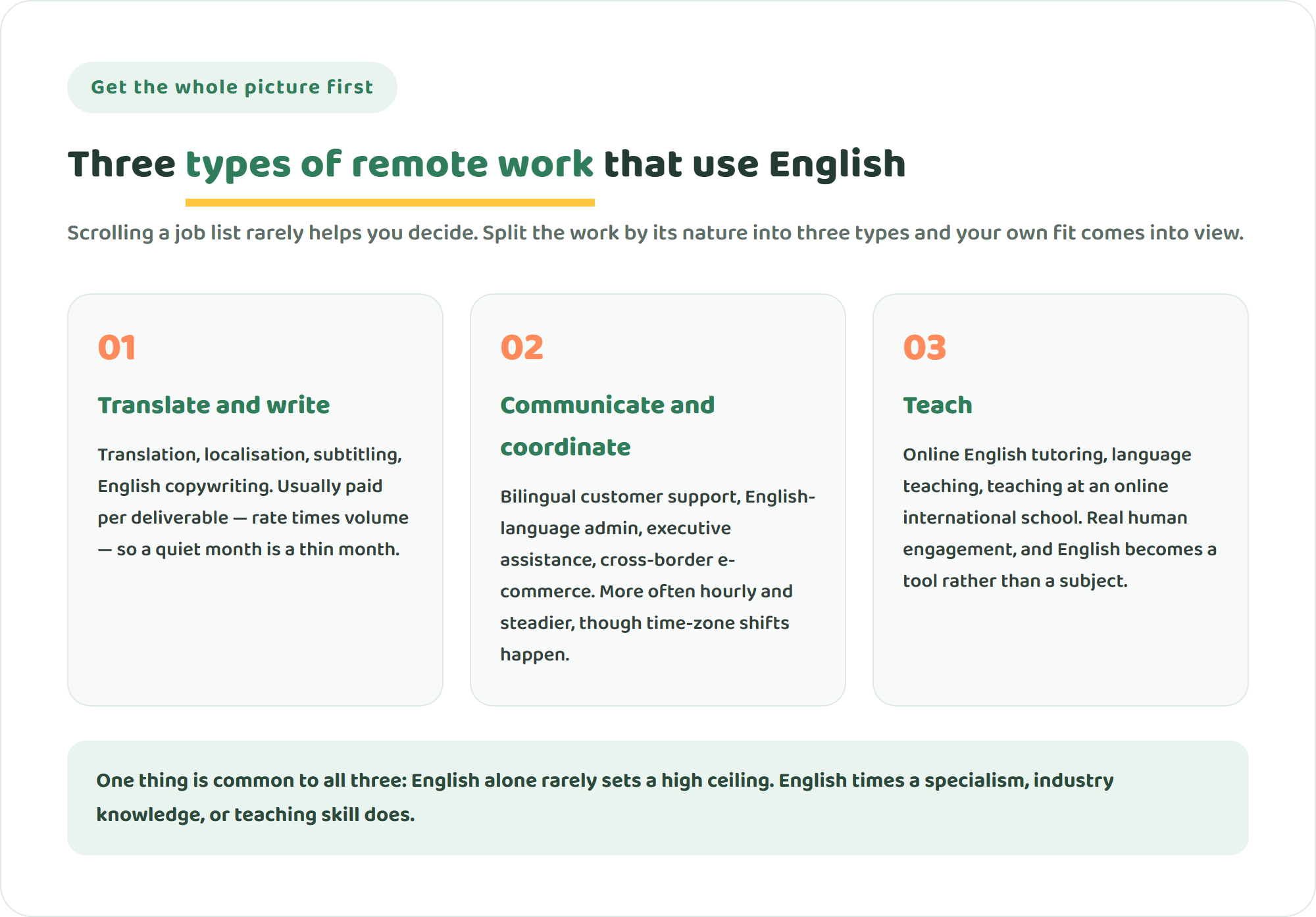
Now the honest part. Work paid per deliverable is generally rate multiplied by volume, so a quiet month is a thin month; there is no floor under you. Beginners usually start at lower rates, and in some segments machine translation and AI tools have pushed prices down. Communication-type roles are more often paid by the hour and tend to feel steadier, but may require shifts aligned to a client’s time zone. And the genuinely good listings — fully remote, stable contract, decent pay — attract heavy competition precisely because they are good. Which leads to the uncomfortable truth behind the “high-paying remote jobs” searches: English on its own rarely commands a high rate. English times a specialism, English times industry knowledge, English times the ability to teach — the multiplier sets your ceiling, not the English alone.
What English level do remote jobs need — and do certificates matter?
“How good does my English have to be?” is the most common worry. Nothing here is a universal rule, but as a rough guide: support roles built on fairly predictable exchanges often expect something around CEFR B1–B2, while negotiation, client-facing, or specialist-document work tends to ask for B2–C1. Requirements differ by role, company, and country, so read the wording in the listing itself (“business level”, “conversational”) rather than assuming. Certificates such as TOEIC, IELTS, or Cambridge exams are useful as a screening threshold and as an honest measuring stick for yourself. But what most employers ultimately watch is simpler than a score: does the work move forward in your English? Can you check a misunderstanding before it becomes a problem, and write the necessary thing concisely? Willingness to keep growing usually beats polish.
Building a track record, and reading a remote listing properly
If you are starting from zero, chasing a big contract is slower than stacking small proof. Volunteer for the English-facing tasks in your current job, take on translating internal material, pick up modest jobs on freelance platforms, publish in English within your own field. Once you have three or four concrete examples of what you produced, at what quality, in what volume, your applications change character entirely. When you assess a listing, check five things: (1) is it fully remote or hybrid — “remote-friendly” often means occasional office days; (2) employment or contract; (3) how pay is determined — salary, per-unit rate, or per-lesson; (4) workload swings and required hours, including time-zone overlap; and (5) whether the work compounds your skills. That last one gets skipped most often, and it is the one that decides your market value a year from now. Wanting to work from home and wanting to build a serious career are treated as a trade-off far too readily. Choose work that compounds, and they are not.
See NIJIN GLOBAL ACADEMY’s founding-member roles →
A third option — using English to teach, not to translate
There is a path that is neither translating nor coordinating: using English to teach — and not teaching English itself, but using English as the tool to build learning with children. The founding-member roles NIJIN GLOBAL ACADEMY (NGA) is recruiting for ahead of its September 2027 opening are one version of that. The table below compares general remote English work, online English tutoring, and a founding role at an online international school.
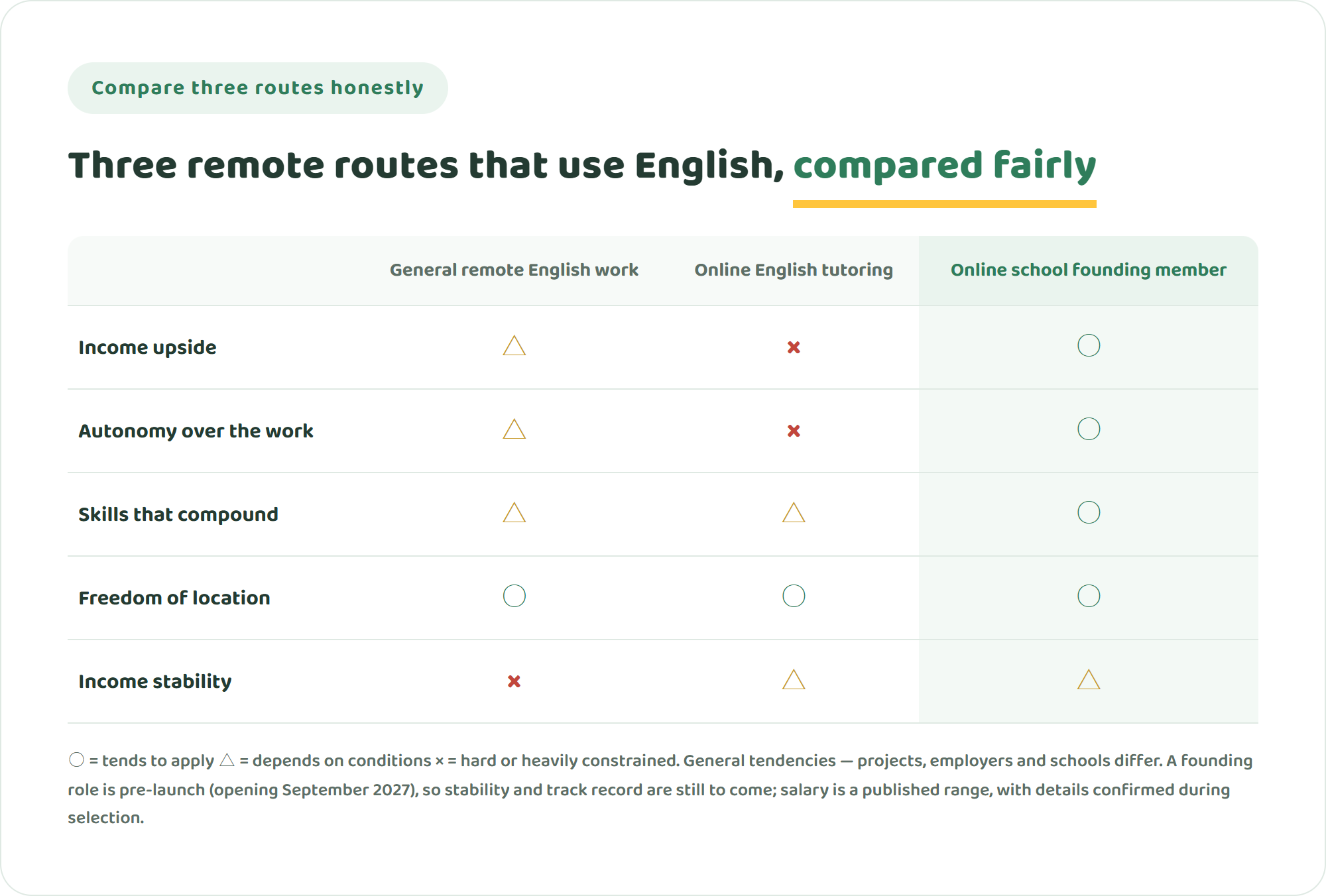
As the table shows, the founding-member route is not a cure-all. Being pre-launch, it does not yet carry the track record of an established company or school. Still, several things line up well for someone who wants to use English from home. First, it is fully remote, designed around the premise of working while travelling the world — there is no work location to relocate to. Second, you can choose work beyond teaching: alongside lessons, you can build your role from five working styles spanning part-time to full-time and covering marketing, web, partnerships, and HR. Third, we say plainly what the terms are. On the international track, founding roles begin as volunteer positions ahead of the September 2027 opening, and the detailed terms are shared later in the process. If you have ever been frustrated by remote work where the rate breakdown is invisible, that transparency is worth weighing.
The English expectation is around CEFR B2+ — not native-level perfection. What matters is using English to work with children and colleagues around the world, and continuing to grow it. What we look for is people who can build from zero — whether you can enjoy creating a school where nothing exists yet. NGA’s founding idea is learning beyond test scores — children are not ranked by exam results. That view, built on small-group dialogue starting from “what do you think?”, is set out in how we learn. Selection runs from document screening to a group interview, an internship at NIJIN Academy, and a final presentation (applications via a Google Form), and there is room to continue a career across the eleven companies of the NIJIN group.

Three steps to start a remote job using English
Here is an order you can start on this week. None of it requires quitting anything first.
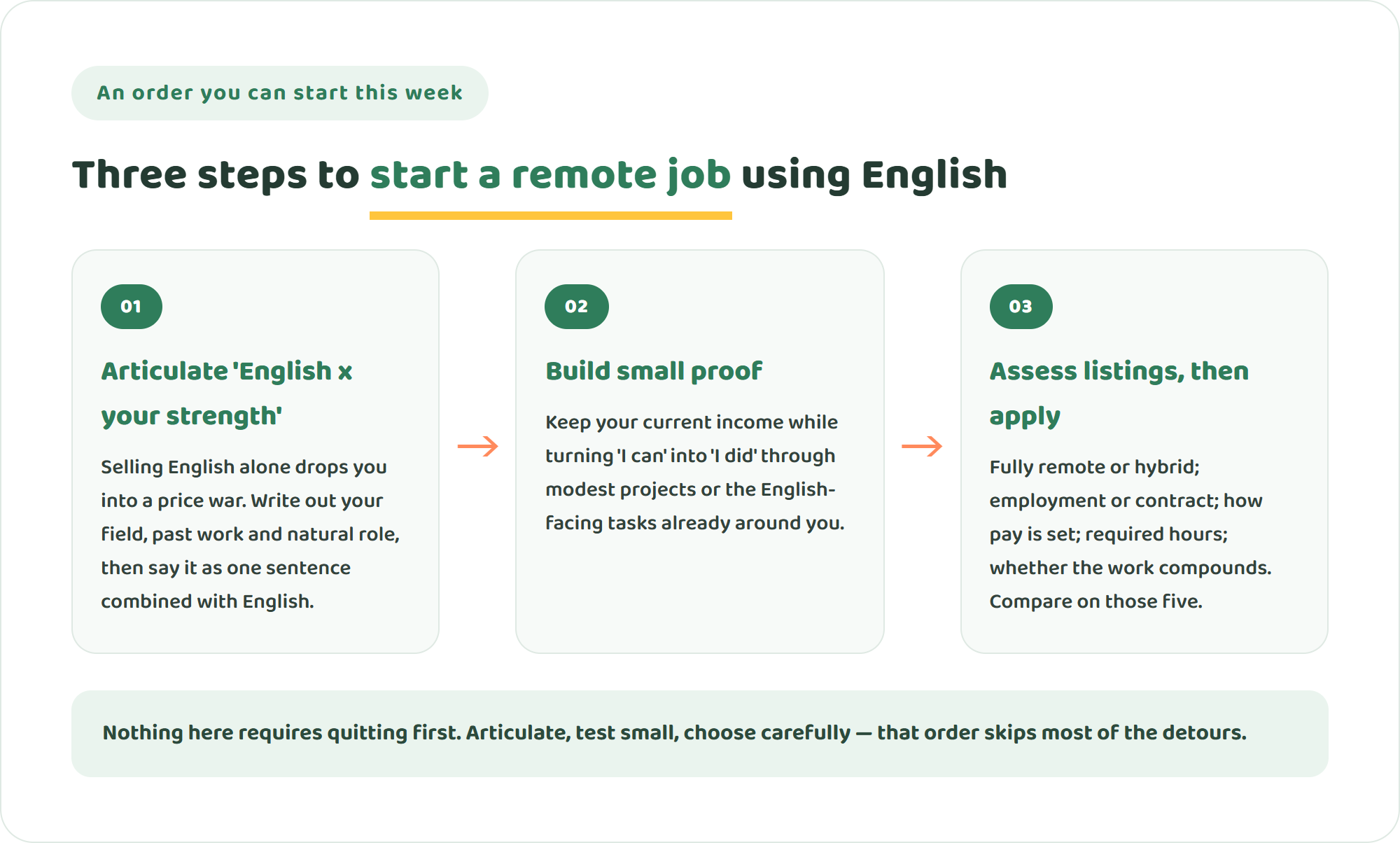
First, articulate your “English × strength”. Selling English alone drops you into a price war. Write out your past work, your field, the role you naturally take — then say it as one sentence combined with English. Second, build small proof. Keep your current income while turning “I can” into “I did,” through modest projects or the English-facing tasks already around you. Third, assess listings and apply. Compare using the five checkpoints above and favour work that compounds. Where a process includes an internship stage, as NGA’s does, you get to try before you decide rather than leaping blind.
Frequently asked questions
Can I get a remote job using English with no experience?
Generally the realistic route is to start with smaller projects or support roles, build a record, and move up in rate and conditions from there. How open a given role is to newcomers varies widely, so read each listing carefully. What NGA’s founding-member roles ask for is people who can build from zero.
Do I need a certificate? What TOEIC or IELTS score is expected?
Whether a certificate is required depends on the role and the employer. In general they serve as a screening reference, while day-to-day work is judged on whether things move forward in your English. NGA assumes roughly CEFR B2+ as a guide rather than requiring one specific test score across the board; the exact expectations can be confirmed during selection.
Can remote work using English actually pay well?
English by itself seldom converts into high pay. The lever is combining it with a specialism, industry knowledge, or the ability to teach, and choosing work where results move your compensation. For NGA, the international founding-member track begins as a volunteer role ahead of the 2027 opening, and detailed terms are shared later in the process.
The school opens in September 2027 — is there any point applying now?
Yes. Being pre-launch is exactly why founding members shape the substance of the learning itself. The lead-up is designed so you gain experience through the NIJIN Academy internship and similar work. If joining the side that builds appeals more than entering a finished organisation, now is arguably the better moment.
English is the strongest thing you own for working from anywhere.
If you searched “remote jobs using English,” you already hold a real asset. What remains is deciding what to multiply it by. There is the translating path, the coordinating path, and the teaching path — and whichever you choose, the English does not depreciate. You do not need to rush the decision, and you do not need to grind yourself down in poorly structured work to prove something. Articulate the combination, test it small, and choose work that compounds. Step by step, that is what brings a life unbound by place and hours within reach. Your English can reach the world from inside your own home.
Working at an International School — More Articles
- international school teacher salary
- how to become an international school teacher
- career change from teaching
- career change from teaching in your 30s and 40s
- how much do teachers earn?
- how to become an IB teacher
- jobs for moving abroad
- remote teaching jobs
- international school teaching jobs
- online school jobs
- international school staff jobs
- digital nomad teaching jobs
- bilingual remote jobs
- a second career for teachers
- high-paying jobs that use English
- careers with a teaching license
- private school teacher career change
- qualifications to teach English
Use English to teach — fully remote, from anywhere.