“Online school jobs.” If you searched those words, you are probably thinking something like: “I want to work in education without being tied to a place.” The hours lost to a commute, a life fixed to one location, and the pull toward work that touches children and learning. As schools that run entirely online keep multiplying, plenty of people have felt, “maybe this is where my skills could count.” But the moment you start looking through listings, the questions pile up: “What jobs exist besides teaching?” “Can I apply with no experience?” “What are the pay and the working conditions really like?”
This article meets those questions honestly. First, we map what roles online school jobs actually include — teaching, operations, admin, curriculum, and customer success — laid out plainly. Then we look at which roles fit whom, and how to prepare for the things specific to online work — useful for any online-education job, with or without us. Finally, we introduce, without a hard sell, a newer kind of role: the “founding member” who both teaches and runs the business. By the end, the assumption that “an online school job means teaching” should look a good deal wider.

What roles do online school jobs include? Start with the whole map
Search “online school jobs” and the suggestions fill with “teaching,” “operations,” “admin,” “remote.” And in truth, online education does not run on teachers alone. Laid out honestly, the work falls into three families of roles. First, teaching roles: as an instructor, tutor, or mentor, you face children directly in lessons or one-on-one support. Second, building and operating roles: curriculum design, school operations, marketing, web — designing and running the substance of the learning and the systems that bring learners in. Third, supporting roles: admin, customer success, family support — holding up learners and households, and keeping the foundation of the learning in order.
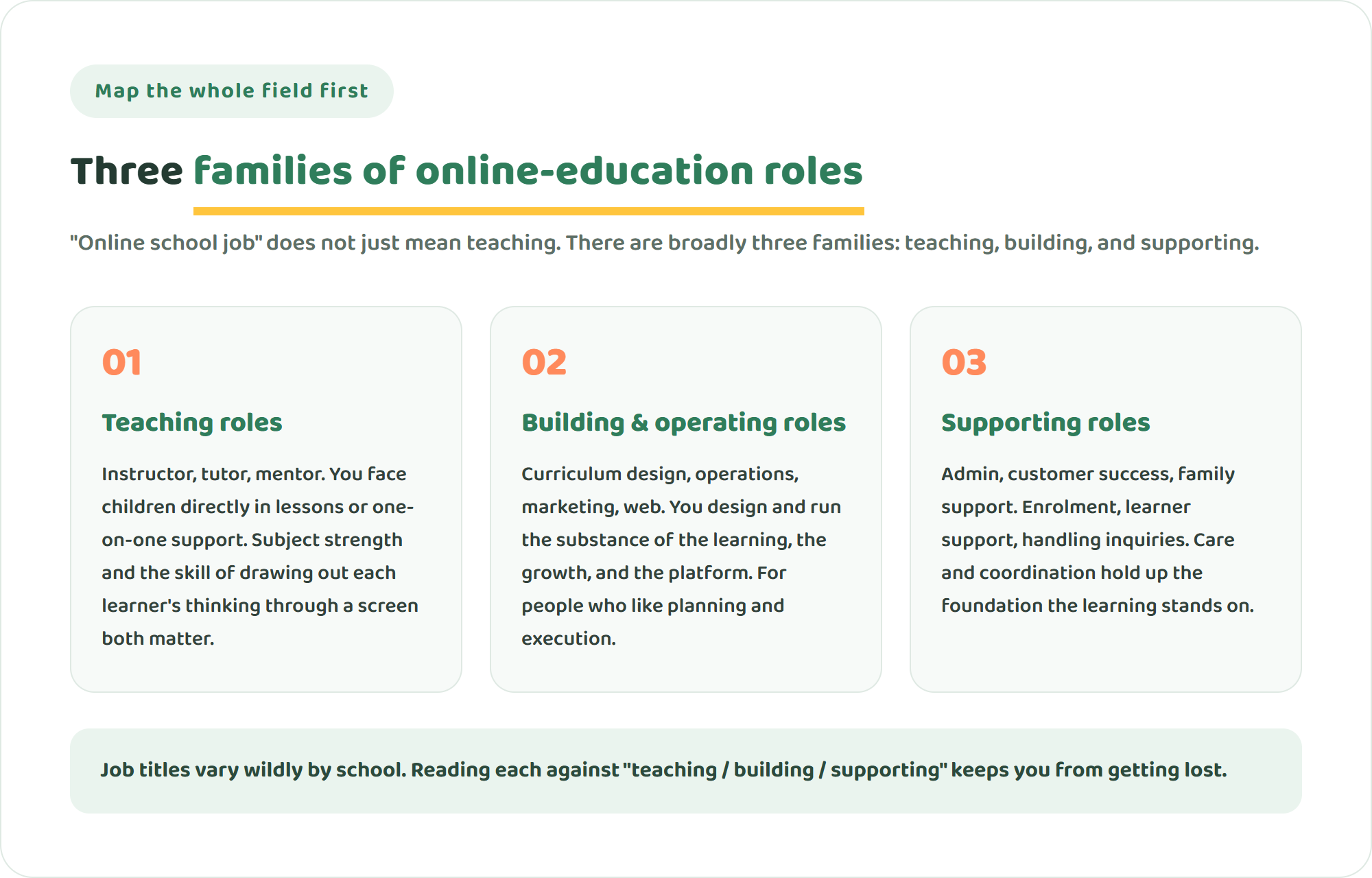
As the chart shows, the job titles written in listings differ from school to school, but reading each against “teaching / building / supporting” makes it far easier to spot the work that fits you. And to be honest, online-education listings come with things worth watching for. Contracts are often freelance or part-time, so hours can end up fragmented. Pay is often “so much per session,” so income can be less stable than you expect. A listing may look polished while the reality is a small organisation where one person wears many hats. These are less flaws to avoid than premises to confirm before you join.
Which roles fit whom, and how to prepare for online work
This is the heart of the article. Start by asking which family fits you. Teaching roles call for subject strength plus the skill of drawing out each learner’s thinking through a screen. What tends to matter is less the power to move a large group at once than the patience to engage deeply with a few. Building and operating roles suit people who like planning and execution, who want the satisfaction of standing systems up from zero. If you have taught, the logistics and consensus-building you honed running a class or a school event carry straight over. Supporting roles reward care, coordination, and the knack of anticipating someone’s worry before they voice it — a way to be deeply involved in education without standing in front of a lesson.
Next, preparing for what is specific to online. It works a little differently from in-person education. First, get comfortable with dialogue through a screen — expression, timing, the way you signal you are listening all shift slightly online. Second, the tools: it helps to have handled video tools like Zoom, an LMS (learning management system), and chat tools at least once. And, more than you might expect, asynchronous written communication matters: online, the ability to convey things precisely in chat and documents counts as much as talking in real time. None of this is a special qualification — with a little intention, anyone can get ready. This is the foundation for working in online education, whether or not you ever apply to us.
See NIJIN GLOBAL ACADEMY’s founding-member roles →
A fourth family — the “founding member” who teaches and runs the business
So far we have looked at three families: teaching, building, and supporting. But an online international school has a newer role that cuts across all of them: the “founding member” who both teaches and runs the business. This is exactly the role that NIJIN GLOBAL ACADEMY (NGA) is recruiting for ahead of its September 2027 opening. The table below sets three ways of working side by side: an in-person school, a typical online school, and the founding member of an online international school.
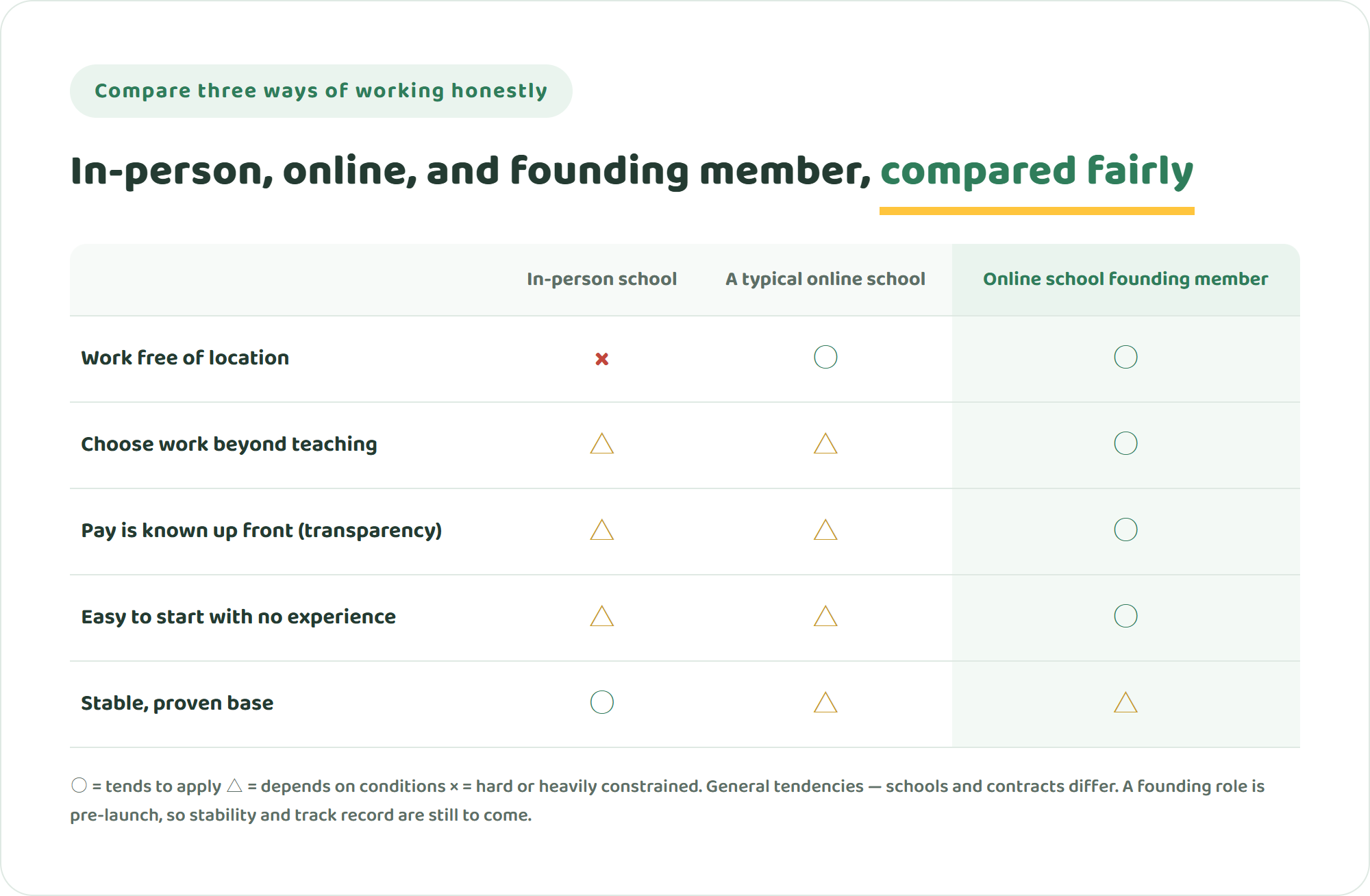
As the table makes plain, the founding-member role is not a cure-all. Precisely because it is a pre-launch phase, the “stability and track record” of an established school are still to come. Even so, this way of working holds real appeal for anyone who wants to be involved across the usual role boundaries. First, it is fully remote — designed around the premise of “working while traveling the world,” free of a commute or a fixed location. Second, you can combine teaching with running the business: beyond lessons, you can choose your involvement from five working styles spanning marketing, web, partnerships, and HR — one person crossing between “teaching roles” and “building roles,” you might say. Third, we say plainly what the terms are — founding roles on this track begin as volunteer positions ahead of our September 2027 opening, and the detailed terms are shared later in the process. When pay in listings is so often opaque, having a yardstick up front is reassuring.
Above all, NGA stands for learning beyond test scores — no ranking of children by exam results. Our view of education, built around small-group dialogue that starts from “what do you think?”, is laid out in how we learn. What we ask of applicants is roughly English at CEFR B2+ and an appetite for building from zero. We look at that drive more than at a teaching license or a glossy résumé.

Preparing to apply for online jobs — three steps
Here is everything above, folded into a manageable three-step path.
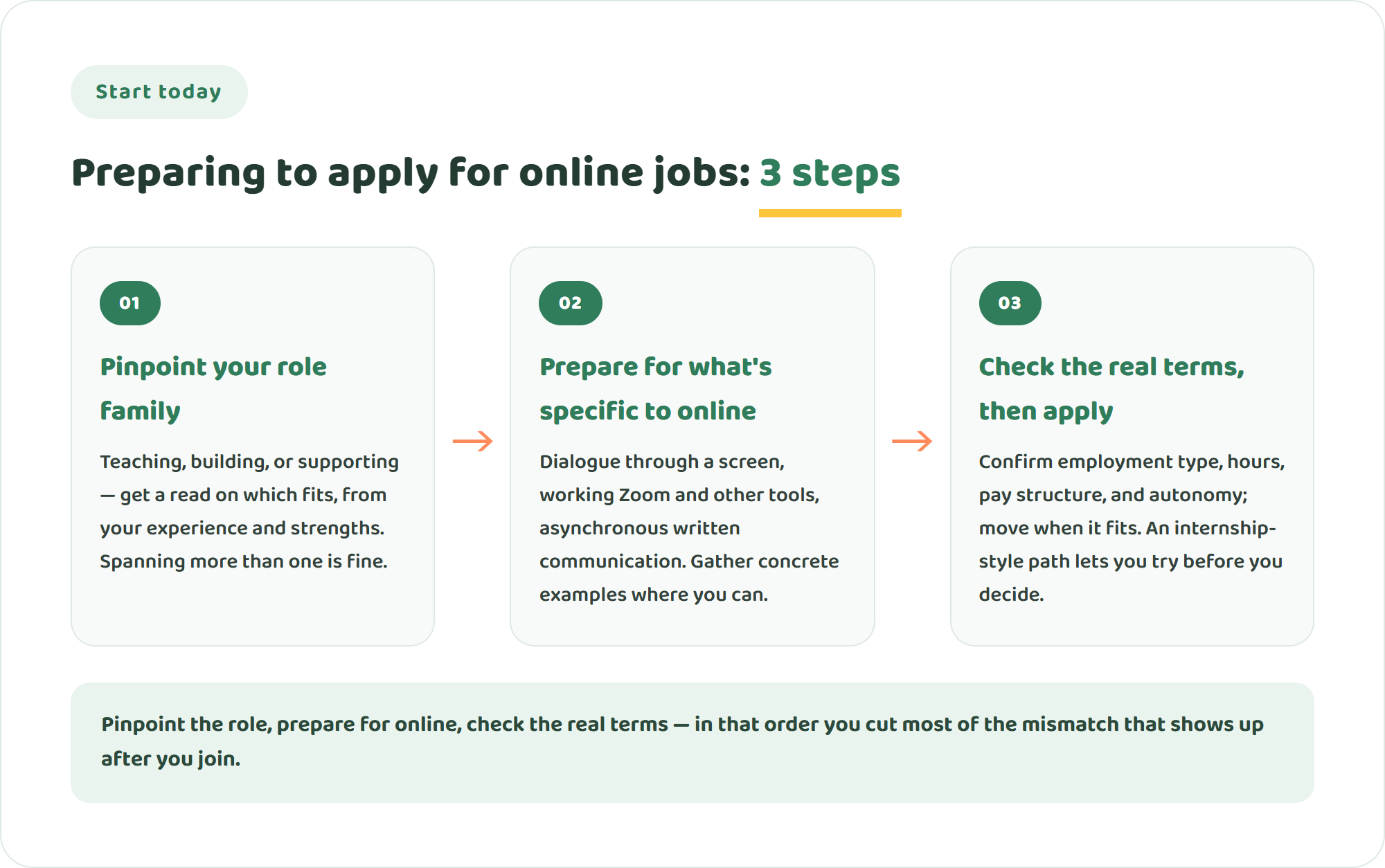
First, pinpoint your role family — teaching, building, or supporting — from your experience and strengths; spanning more than one is fine. Second, prepare for what is specific to online: dialogue through a screen, working the tools, asynchronous written communication, gathered into concrete examples where you can. Third, check the real terms, then apply. Confirm employment type, hours, pay structure, and autonomy, and move when something feels like a fit. NGA’s selection runs from document screening to a group interview, an internship at NIJIN Academy, and a final presentation (applications are via a Google Form). Being able to “try before you decide” through the internship — rather than leaping in blind — is, I think, a reassuring design for anyone stepping into online education for the first time.
Frequently asked questions
I have no teaching experience. Can I still apply for online school jobs?
Yes. Online-school work is not only teaching — there are many roles that never stand in front of a lesson: operations, planning, admin, customer success. NGA’s founding members, too, can choose involvement beyond teaching, in marketing, web, partnerships, and HR. There are plenty of role families where your existing professional experience and expertise carry over directly.
I’m not that confident in my English. Can I still apply?
We assume roughly CEFR B2+, but we are not looking for native-level perfection. What matters is the willingness to use English to work with children and peers around the world, and to keep growing it. We look at your room to grow and your drive more than your current level. You can confirm the exact expectations during selection.
You open in September 2027. Is there any point applying now?
Yes. It is precisely because it is pre-launch that founding members help design the substance of the learning and the way it is run. The lead-up is built so you can gain experience through the NIJIN Academy internship and more. If you are drawn to “joining the side that builds” rather than “entering a finished organisation,” now is arguably the moment.
Can you really teach children remotely?
NGA is an online international school built around small-group dialogue. Because it is dialogue that draws out each child’s thinking — not one-way lecturing to a large class — deep engagement is possible even remotely. Being able to teach, or help run a school, fully remotely and unbound by location can be a real option for anyone who wants to rethink the shape of their work.
Online school jobs reach well beyond “teaching.”
If you searched “online school jobs,” your reasons are probably more than one: you don’t want to be tied to a place; you want to work in education; you want to find somewhere your skills count. The work that answers those wishes is wider than you might think — not only teaching, but building roles, supporting roles, and the newer role that combines teaching with running the business. What matters is not being tossed around by job titles, but reading the field against “what do I actually want to do?” Pinpoint the role, prepare for online, check the real terms, and apply — each step moves you toward a choice you won’t regret. The steering wheel of your career has always been in your own hands.
Working at an International School — More Articles
- international school teacher salary
- how to become an international school teacher
- career change from teaching
- career change from teaching in your 30s and 40s
- how much do teachers earn?
- how to become an IB teacher
- jobs for moving abroad
- bilingual remote jobs
- international school teaching jobs
- international school staff jobs
- remote jobs that use English
- digital nomad teaching jobs
- career change from tutoring
- life after leaving teaching
- a second career for teachers
- high-paying jobs that use English
- careers with a teaching license
- private school teacher career change
Bring both the drive to teach and the drive to build into your next way of working.