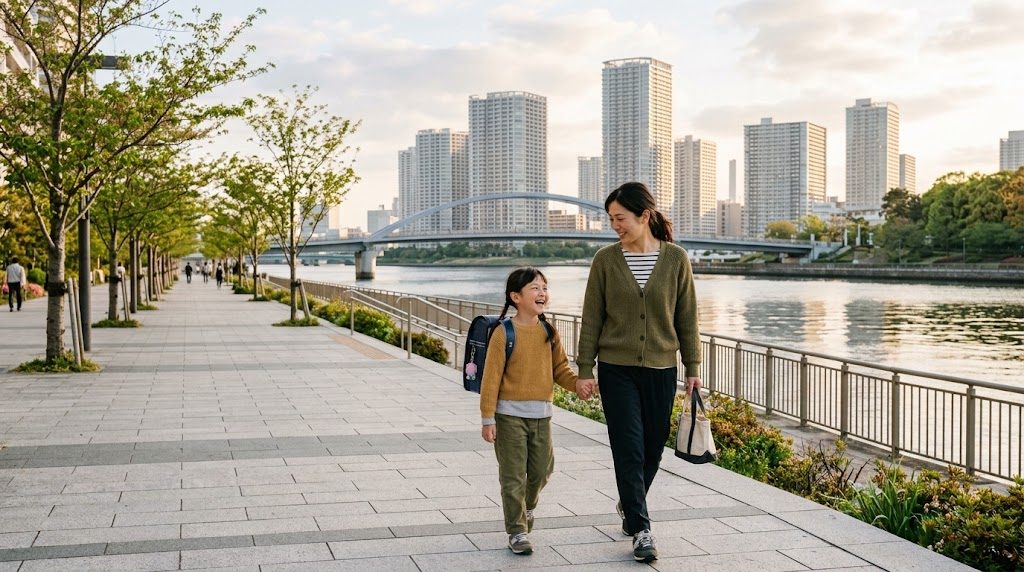
If you have just moved into a tower apartment in Toyosu, Shinonome or Ariake — or you are weighing up a move there — one question tends to surface fast: where exactly are the international schools in Koto Ward, and what do they actually cost? Koto is one of Tokyo’s fastest-growing family districts, with waterfront redevelopment drawing in both Japanese and foreign households, yet clear information about its schools is surprisingly hard to find. This guide sets out every international school genuinely located in Koto Ward — five that run all the way from early years to high school, plus the preschools serving the bay area — with real fee figures, curricula, and an honest look at how to choose. It also covers an eighth option worth knowing about if fees or the daily commute turn out to be the real obstacle.
Quick Answer: Your Options in Koto Ward
If you only read one section, read this. Below are the schools covered in this guide, plus the online option — so you can see every route side by side before the details.
- K. International School Tokyo (KIST) — Ages: K1 (age 3) to Grade 12 (age 17), co-educational / Annual tuition: ¥3,020,000 (K1–K3), ¥2,850,000 (G1–G9), ¥2,970,000 (G10–G12) for August…
- Tokyo YMCA International School (TYIS) — Ages: K5 to Grade 12, co-educational / Annual tuition: ¥2,148,000 plus a ¥198,000 maintenance fee, so about ¥2,346,000 a year at…
- UIA International School of Tokyo — Ages: 3 to 18 (EY1/K1 to Grade 12), co-educational / Annual tuition: approximately ¥1,369,000 at K1 rising to ¥2,217,000 at Grade 12 for…
- India International School in Japan (IISJ), Tokyo Campus — Ages: Kindergarten (Montessori) to Grade 12, co-educational / Annual tuition: ¥600,000 (Kindergarten to Grade 9) and ¥1,200,000 (Grades 10–12) for…
- Tokyo Bay International School (TBIS) — Ages: 2 (preschool) through high school, co-educational / Annual tuition: not published online — the school does not disclose its fees publicly, so…
- Global Leap International School, Toyosu — Ages: 2 to 5 (preschool) / Annual tuition: contact the school directly — varies by class and hours
- Kids Duo International (KDI) Shinonome — Ages: roughly 2 to 6 / Annual tuition: announced at the school’s information session — contact the school…
- NIJIN GLOBAL ACADEMY (online) — Ages 6–18 / opening September 2027, currently taking opening-update registrations / fees around one-fifth of a typical campus international school / Japanese-language support. An option when commute or fees are the wall.
New to this? Start with What is an international school? Types, fees, admission and how to choose for the full picture.
International schools in Koto Ward: the landscape and what they cost
Start with a geographical fact that shapes everything else. Koto Ward is not a district where large international schools line the waterfront. Toyosu, Shinonome and Ariake are new neighbourhoods built on reclaimed land, so what you find there is mostly early-years provision: bilingual preschools and English after-school programmes. The schools that carry children from kindergarten through to Grade 12 sit on the inland, older side of the ward — Kiyosumi-Shirakawa, Toyocho, Kiba, Sengoku and Kameido. For most bay-area families, that means the school run heads away from the water, not along it.
What makes Koto genuinely unusual is the spread in fees. Across the ward’s five through-schools, annual tuition runs from roughly ¥600,000 to ¥3,020,000 — a fivefold gap that you simply will not find in Minato or Shibuya, where about ¥3 million is the entry point. At the upper end sits K. International School Tokyo, an IB World School with fees around ¥2.85–3.02 million a year. At the lower end sits the India International School in Japan, at about ¥600,000 for kindergarten through Grade 9. In other words, Koto is one of the few Tokyo wards where a genuine international education remains reachable on a mid-range budget. Do read every figure as tuition only, though: entrance fees, facility levies and bus charges sit on top, and it is the total that determines whether you can keep going year after year. Our guide to international school tuition costs breaks down where the money actually goes.
Please note: all fees below are publicly available information as of July 2026. Always confirm the current figures directly with each school.
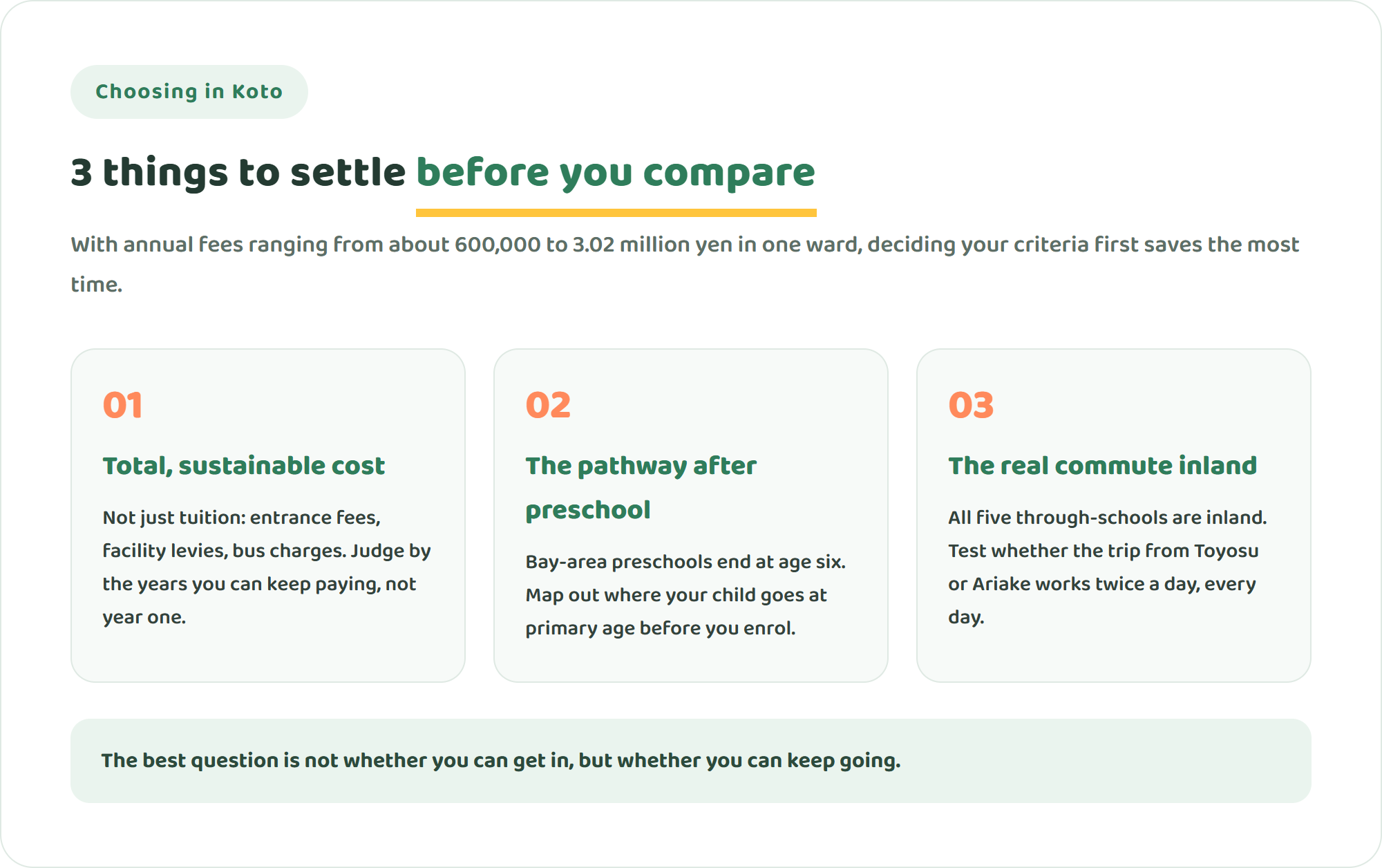
Every international school in Koto Ward: five through-schools plus the bay-area preschools
Rather than padding the list to a round number, here is what actually exists. Five schools in Koto Ward take children from the early years through to high school, and the waterfront adds preschool options for the under-sixes. The curricula and price points differ enormously, so read these with your own child’s age, budget and temperament in mind rather than by reputation alone.
1. K. International School Tokyo (KIST)
Founded in 1997 and located in Shirakawa, roughly thirty seconds from Kiyosumi-Shirakawa Station, KIST is the ward’s academic heavyweight. It runs a continuous IB pathway from K1 through Grade 12, and its 2025 graduating class averaged 42.0 out of 45 on the IB Diploma against a world average of 30.6 (figures as published by KIST, 2025). Admission is genuinely selective: the school screens for academic motivation, behaviour and English proficiency in stages, and states plainly that not every applicant progresses past screening.
- Curriculum: IB — PYP (K1–G5), the school’s own LSP (G6–G8), IGCSE (G9–G10), IB Diploma (G11–G12)
- Ages: K1 (age 3) to Grade 12 (age 17), co-educational
- Annual tuition: ¥3,020,000 (K1–K3), ¥2,850,000 (G1–G9), ¥2,970,000 (G10–G12) for August 2026–June 2027, plus a ¥200,000 annual facility maintenance fee. One-off costs include a ¥300,000 enrolment fee and a ¥700,000 facility expansion fee.
- Best suited to: families near Kiyosumi-Shirakawa or Monzen-Nakacho who want one uninterrupted IB pathway to university
2. Tokyo YMCA International School (TYIS)
Based in Toyocho, TYIS teaches a North American curriculum accredited by the Western Association of Schools and Colleges, and pairs it with a substantial Japanese-language programme — a combination that matters if you want your child to keep both languages alive. A high school division opened from the 2025–2026 year, completing the pathway from K5 to Grade 12. The school runs a bus service, which makes it one of the more practical inland choices for bay-area families.
- Curriculum: North American, WASC-accredited, with Japanese-language instruction
- Ages: K5 to Grade 12, co-educational
- Annual tuition: ¥2,148,000 plus a ¥198,000 maintenance fee, so about ¥2,346,000 a year at every grade level (2026–2027, as published by the school). Middle and high school add a ¥110,000 trip fee. First-year families also pay a ¥275,000 entrance fee and a ¥220,000 school development fee.
- Best suited to: families who want English-medium learning without letting Japanese slide, in one school from age five to eighteen
3. UIA International School of Tokyo
Established in 2010 and named for Unite, Inspire and Achieve, UIA is a Cambridge International School with its main campus in Kiba (EY1 to Grade 10) and a second campus in Fuyuki, near Monzen-Nakacho, for Grades 11 and 12. Students follow Cambridge Primary and Lower Secondary, then IGCSE and AS/A Levels. Fees sit noticeably below the top tier, which makes UIA the ward’s most accessible route to a full British-style qualification.
- Curriculum: Cambridge International — Primary, Lower Secondary, IGCSE, AS and A Level
- Ages: 3 to 18 (EY1/K1 to Grade 12), co-educational
- Annual tuition: approximately ¥1,369,000 at K1 rising to ¥2,217,000 at Grade 12 for 2026–2027 (published fee data), plus one-off registration and building maintenance fees of ¥77,000 each
- Best suited to: families in Kiba or Monzen-Nakacho wanting a British-style pathway through to A Levels at a mid-range cost
4. India International School in Japan (IISJ), Tokyo Campus
Located in Sengoku and founded in 2004, IISJ is the oldest school in Japan serving the Indian diaspora and is designated an international school by Japan’s Ministry of Education. It teaches the Indian CBSE curriculum, with an IB Diploma option available in Grades 11 and 12, and has a strong reputation in mathematics and the sciences. Its fees are the headline: about ¥600,000 a year through Grade 9 puts a full English-medium education within reach of budgets that would be shut out almost everywhere else in central Tokyo.
- Curriculum: CBSE (India), with an IB Diploma option in Grades 11–12
- Ages: Kindergarten (Montessori) to Grade 12, co-educational
- Annual tuition: ¥600,000 (Kindergarten to Grade 9) and ¥1,200,000 (Grades 10–12) for 2026–2027, plus a ¥20,000 registration fee and textbook costs
- Best suited to: families who want a sustainable, maths-and-science-strong English education all the way to Grade 12
5. Tokyo Bay International School (TBIS)
In Kameido, within walking distance of the station, TBIS combines Cambridge International accreditation with Montessori practice and takes children from age two through the high school years. Its stated mission is world-class education at affordable tuition, and its programme leans into robotics, drones and coding alongside languages, sport and character education. It is the smallest and least widely documented of the ward’s five, which makes a visit especially worthwhile.
- Curriculum: Cambridge International with Montessori early years, plus robotics and coding
- Ages: 2 (preschool) through high school, co-educational
- Annual tuition: not published online — the school does not disclose its fees publicly, so contact it directly to confirm
- Best suited to: families in the Kameido or Ojima area wanting a small setting with a technology and inquiry focus
6. Global Leap International School, Toyosu
A three-minute walk from Toyosu Station inside Toyosu Sail Park, Global Leap opened in April 2026 and is the newest arrival on the waterfront. It is backed by Kikagaku, a company working in AI and machine-learning education, and builds its programme around inquiry-based learning and STEAM for the AI era. For bay-area families, it is the rare option you can genuinely walk to.
- Curriculum: inquiry-based early-years learning with a STEAM emphasis, on an international framework
- Ages: 2 to 5 (preschool)
- Annual tuition: contact the school directly — varies by class and hours
- Best suited to: Toyosu and Shinonome families wanting a gentle, walkable start in English before primary school
7. Kids Duo International (KDI) Shinonome
KDI Shinonome is a bilingual kindergarten built on a Japanese base with heavy English immersion layered on top — a deliberate design for families who want strong English without loosening their child’s grip on Japanese. It takes children from the two-year-old class through to the final kindergarten year, with experience-led programmes such as its Learning Stations and movement classes, and runs a bus service across parts of Koto and Chuo wards.
- Curriculum: Japanese-based bilingual early-years education with English immersion (unlicensed childcare facility)
- Ages: roughly 2 to 6
- Annual tuition: announced at the school’s information session — contact the school directly
- Best suited to: families who want their child’s Japanese foundation protected while English grows alongside it
Beyond these, the ward keeps adding English-language after-school and early-years provision — Kids Duo at Ariake Garden, the Tokyo YMCA International Kids Garden in Toyocho, and Smile Club International School across Koto and Chuo among them. But once your child reaches primary age, the realistic list narrows to the five through-schools above. If none fits, the neighbouring wards are the natural next step: Minato and Chuo to the west, Chiyoda further in, and Edogawa to the east all add options within a reasonable commute.
International schools in Koto Ward compared: fees, area and age range at a glance
The same seven schools, set side by side by location, age range, curriculum and published annual tuition. Figures are tuition only — entrance fees, facility levies and bus charges sit on top — and schools that do not publish fees are marked honestly as such.
| School | Area / nearest station | Ages (stage) | Curriculum | Annual tuition guide |
|---|---|---|---|---|
| K. International School Tokyo (KIST) | Shirakawa, Koto / Kiyosumi-Shirakawa Stn | K1 (age 3) to Grade 12 (age 17) | IB — PYP, LSP, IGCSE, IB Diploma | ¥2,850,000–3,020,000 |
| Tokyo YMCA International School (TYIS) | Toyocho, Koto (bus service available) | K5 (age 5) to Grade 12 | North American, WASC-accredited, with Japanese | about ¥2,346,000 (tuition plus maintenance fee) |
| UIA International School of Tokyo | Kiba, Koto (main) / Fuyuki for Grades 11–12 | Age 3 (EY1) to 18 (Grade 12) | Cambridge International — Primary, IGCSE, AS/A Level | ¥1,369,000 (K1) to ¥2,217,000 (Grade 12) |
| India International School in Japan (IISJ) | Sengoku, Koto | Kindergarten (Montessori) to Grade 12 | CBSE (India), IB Diploma option in Grades 11–12 | ¥600,000 (K–G9) / ¥1,200,000 (G10–12) |
| Tokyo Bay International School (TBIS) | Kameido, Koto / walking distance from the station | Age 2 (preschool) through high school | Cambridge International with Montessori, robotics and coding | Not published — contact the school |
| Global Leap International School, Toyosu | Toyosu, Koto / 3 minutes from Toyosu Stn | Ages 2–5 (preschool) | Inquiry-based early years with a STEAM emphasis | Contact the school (varies by class and hours) |
| Kids Duo International (KDI) Shinonome | Shinonome, Koto (bus service available) | Roughly ages 2–6 | Japanese-based bilingual early years with English immersion | Announced at the information session |
How to work out which one fits your family
Listing schools is the easy part; choosing is harder. It helps to think of Koto in three groups: the five through-schools, the bay-area preschools, and a third category many families overlook entirely — online international schools with no commute at all. The table below sets out how each group tends to perform on the criteria that actually decide whether a school works for a family over years, not months.
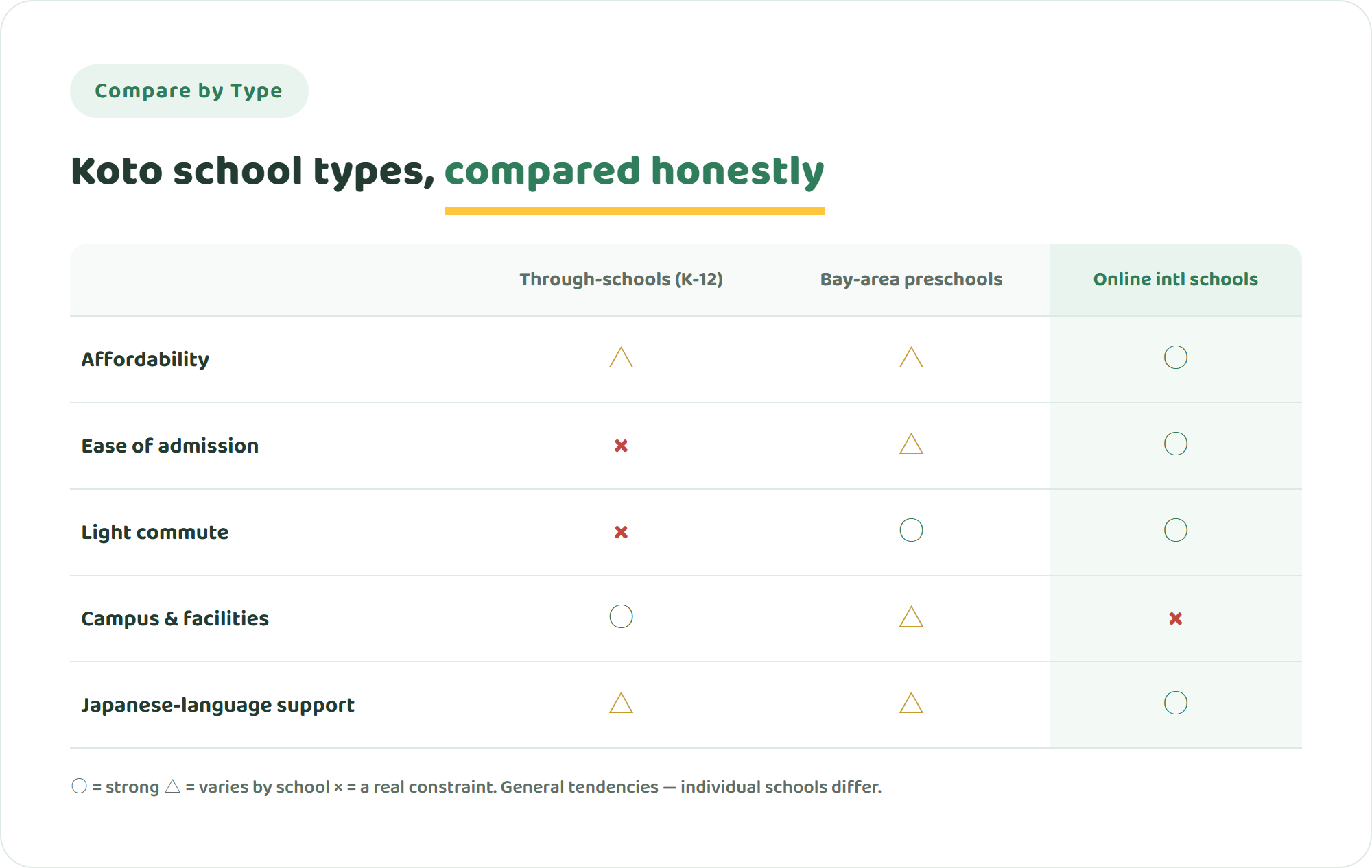
Koto’s through-schools have a real advantage in that you can genuinely choose by budget — few Tokyo wards offer that. The trade-off is selectivity: the most sought-after places screen closely for English and academic motivation, and a place is never guaranteed. The waterfront preschools are wonderfully low-friction while your child is small, but they end, and the question of what happens at primary age arrives faster than most parents expect. And then there is the commute itself. Ask honestly whether a five-year-old can make the trip from Ariake to Kiba or Sengoku twice a day, in July heat and February dark, for years. If the fees are the sticking point rather than the school, it is worth reading whether international school is simply too expensive before you rule anything out.
See how learning works online →
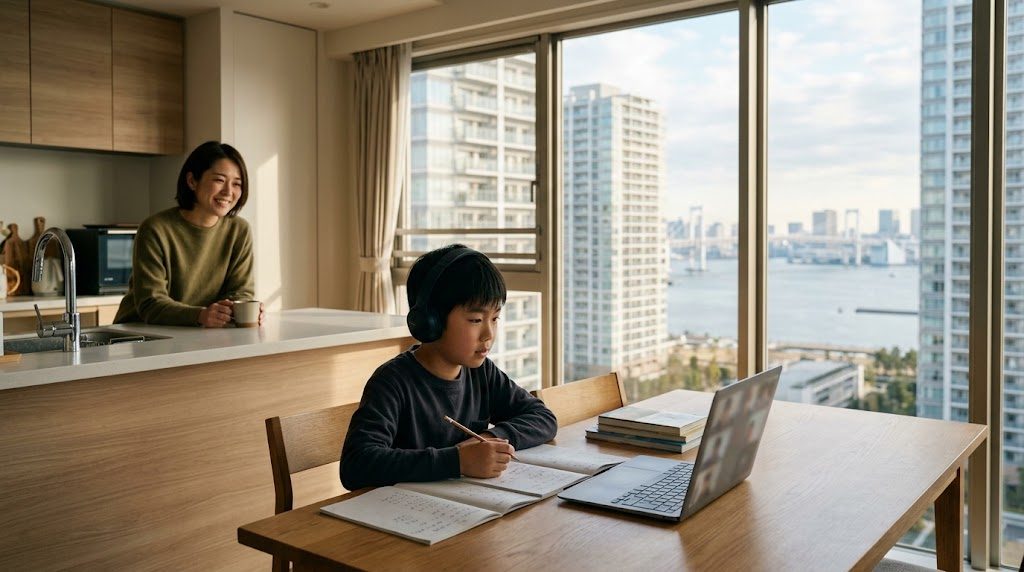
When fees or the commute are the real barrier: an eighth option
Koto is a good place to raise children — the convenience of the waterfront alongside the calm of the older neighbourhoods. Even so, the constraints are real: five through-schools in the whole ward, fees reaching around ¥3 million a year at the top end, and a daily journey inland from the bay for most families who live there. If you find yourself thinking that you want an international education for your child but cannot see the burden lasting a decade, there is an eighth option that does not assume a commute at all: an online international school.
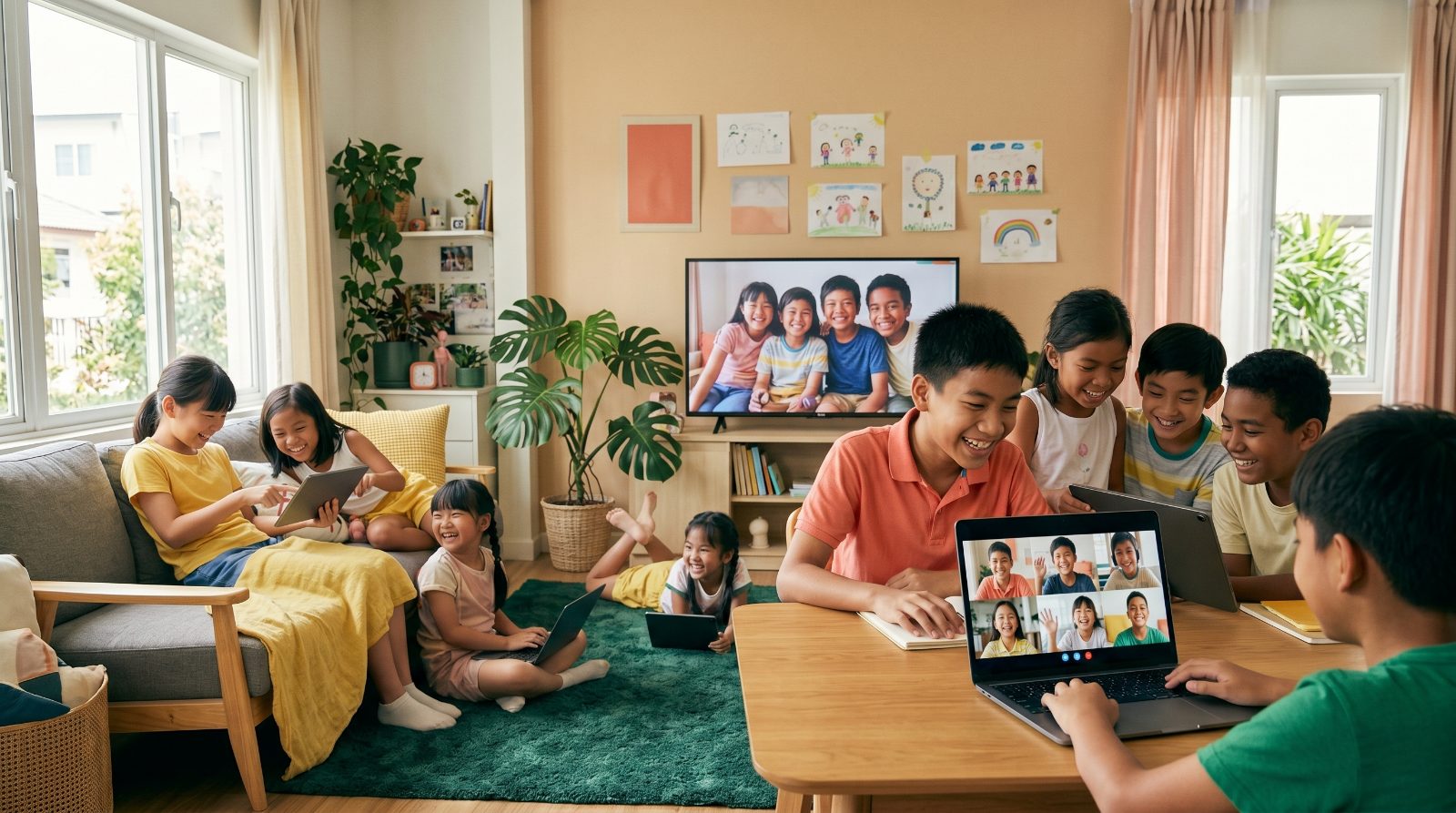
NIJIN GLOBAL ACADEMY (NGA) is an online international school opening in September 2027. It is run by NIJIN Inc., the company behind NIJIN Academy, an alternative school in Japan with more than 1,000 enrolled students. NGA is built on the idea of stepping away from ranking children by test scores, with small-group, dialogue-centred learning aimed at helping students come to like themselves and the world around them. It is open to children aged 6 to 18 across Asia and Oceania, wherever they live, and it is designed so that Japanese remains a support while English is introduced gradually. We are working towards tuition at roughly one-fifth of a bricks-and-mortar international school.
In fairness, we should say plainly that NGA has not opened yet and has no track record to show you. Nor can an online school replicate a playground, a science lab or a sports field. But if the barriers you are facing are cost and commute rather than conviction, learning that connects your child to the world from your own home is worth putting on the list.
Frequently asked questions
Q. From what age can my child start at an international school in Koto Ward?
A. The waterfront preschools — KDI Shinonome and Global Leap in Toyosu — take children from the two-year-old class. Among the through-schools, Tokyo Bay International School accepts children from age two, KIST from K1 at age three, and Tokyo YMCA International School from K5 at age five. Narrowing the list by your child’s current age is the quickest first filter.
Q. Can we commute from Toyosu or Ariake, and what about Japanese-language support?
A. All five through-schools are inland — Kiyosumi-Shirakawa, Toyocho, Kiba, Sengoku and Kameido — so expect a train or bus journey from the bay. Tokyo YMCA International School runs a bus service and teaches Japanese alongside its North American curriculum, which suits families who do not want Japanese to fade. If your child will need Japanese for their future in Japan, ask each school directly how many hours a week it actually teaches, and at what level. It is the detail families most often regret skipping.
Q. Is it possible to transfer in mid-year?
A. Most schools do accept transfers, but places at the popular ones open up unpredictably, and conditions vary by grade and by term. KIST, for example, runs a multi-stage screening process that assesses English proficiency and academic motivation, and entrance tests or interviews are common elsewhere too. Contacting schools directly about a year before your intended start date is the safest approach.
Q. Which schools in Koto Ward are the most affordable?
A. Among the schools that publish their fees, India International School in Japan is the least expensive by a wide margin: about ¥600,000 a year from kindergarten through Grade 9, rising to ¥1,200,000 for Grades 10–12. UIA International School of Tokyo comes next, at roughly ¥1,369,000 to ¥2,217,000 depending on year group. In both cases registration and facility charges sit on top of tuition, so compare the totals rather than the headline number.
Q. What costs come on top of tuition?
A. It varies by school. KIST charges a ¥200,000 annual facility maintenance fee, plus one-off costs of ¥300,000 to enrol and ¥700,000 towards facility expansion. Tokyo YMCA International School adds ¥198,000 a year in maintenance, a ¥275,000 entrance fee and a ¥220,000 school development fee in the first year, and a ¥110,000 trip fee at middle and high school. UIA charges ¥77,000 each for registration and building maintenance; IISJ charges ¥20,000 to register, plus textbooks. Bus travel, where you use it, is extra again.
Q. Can my child follow the IB in Koto Ward?
A. Yes. K. International School Tokyo runs a continuous IB pathway from K1 to Grade 12 — PYP, its own LSP, IGCSE and then the Diploma — and its 2025 graduating class averaged 42.0 against a world average of 30.6 (figures as published by KIST, 2025). India International School in Japan also offers the IB Diploma as an option in Grades 11 and 12 alongside its CBSE programme.
Q. Our child is at a bay-area preschool. What happens at primary age?
A. Global Leap in Toyosu takes children to age five and KDI Shinonome to around six, so neither is a pathway on its own. Every school in the ward that takes primary-age children is inland — Kiyosumi-Shirakawa, Toyocho, Kiba, Sengoku and Kameido — which means a train or bus journey from the waterfront. If none of the five fits, families usually widen the search to Minato, Chuo, Chiyoda or Edogawa; an online school removes the commute question altogether.
The time you spend deciding is time spent caring
There is no single right answer to this. In a ward like Koto, where the price range is so wide, the useful question is rarely which school is best — it is which choice your family can sustain for years. Fees, the journey inland from the bay, your child’s temperament: every family weighs these differently. The fact that you are hesitating at all is evidence of how seriously you are taking your child’s future. Take your time, visit a few schools in person, and compare what you actually see. And if you would like to keep a no-commute option in view as well, we would be glad for you to hear from us when we open.
International Schools in Other Cities
- International Schools in Nagoya: All 8 Schools
- International Schools in Minato: Fees
- International Schools in Setagaya: All 14 Schools
- International Schools in Nakano, Tokyo
- International Schools in Tsukuba: Fees
- International Schools in Sendai: 7 Picks and Fees
- International Schools in Itabashi, Tokyo
- International Schools in Kanazawa
- International Schools in Karuizawa: All 4 Schools
- International Schools in Tokyo
- International Schools in Shibuya, Tokyo
- International Schools in Shinagawa, Tokyo
- International Schools in Meguro: All 8 Schools
- International Schools in Chofu and ASIJ Fees
- International Schools in Shinjuku: Fees