You have probably already had the conversation twice — once with your partner, once in your head at two in the morning. The local school is fine, but it isn’t right. Your child needs English, or needs a different pace, or needs to stop being measured by a single number. And then the doubt arrives: is it too late? Can you really transfer from a local school to an international school in the middle of Year 4, or Year 8, or Year 10?
Here is the honest answer up front. Mid-year and mid-stage transfers happen all the time. What changes is not whether it is possible, but what the school will require of your child at the point of entry — and that requirement rises with every year group. This guide is written for families across Asia — Singapore, Malaysia, Thailand, Hong Kong, Japan and beyond — including Japanese and other expatriate families weighing a move. It is not here to talk you into a transfer or out of one. It is here so you can see, year group by year group, what makes a transfer work and where it usually goes wrong.

How hard is it really to transfer to an international school?
Most international schools accept transfers throughout the year, not only in August or September. Children arriving mid-stage are completely normal in Singapore, Kuala Lumpur, Bangkok and every other hub city. But “we accept transfers” and “we can take your child” are two different statements, and families who conflate them often discover the real conditions after the campus tour, when there is no time left to prepare.
Places are counted by year group, not by school
Admissions are managed year group by year group. If a year is at capacity, enthusiasm does not create a seat. If a family repatriates or relocates mid-term, a seat appears in that year group and nowhere else. A large share of whether you get in is simply timing. At oversubscribed schools some year groups run waiting lists that take more than a year to clear, while the year below has space.
So the first question is not “would my child be accepted?” It is “how many places are open in that year group right now, and how many families are on the list?” Ask in numbers and you get numbers back.
The English requirement rises with every year group
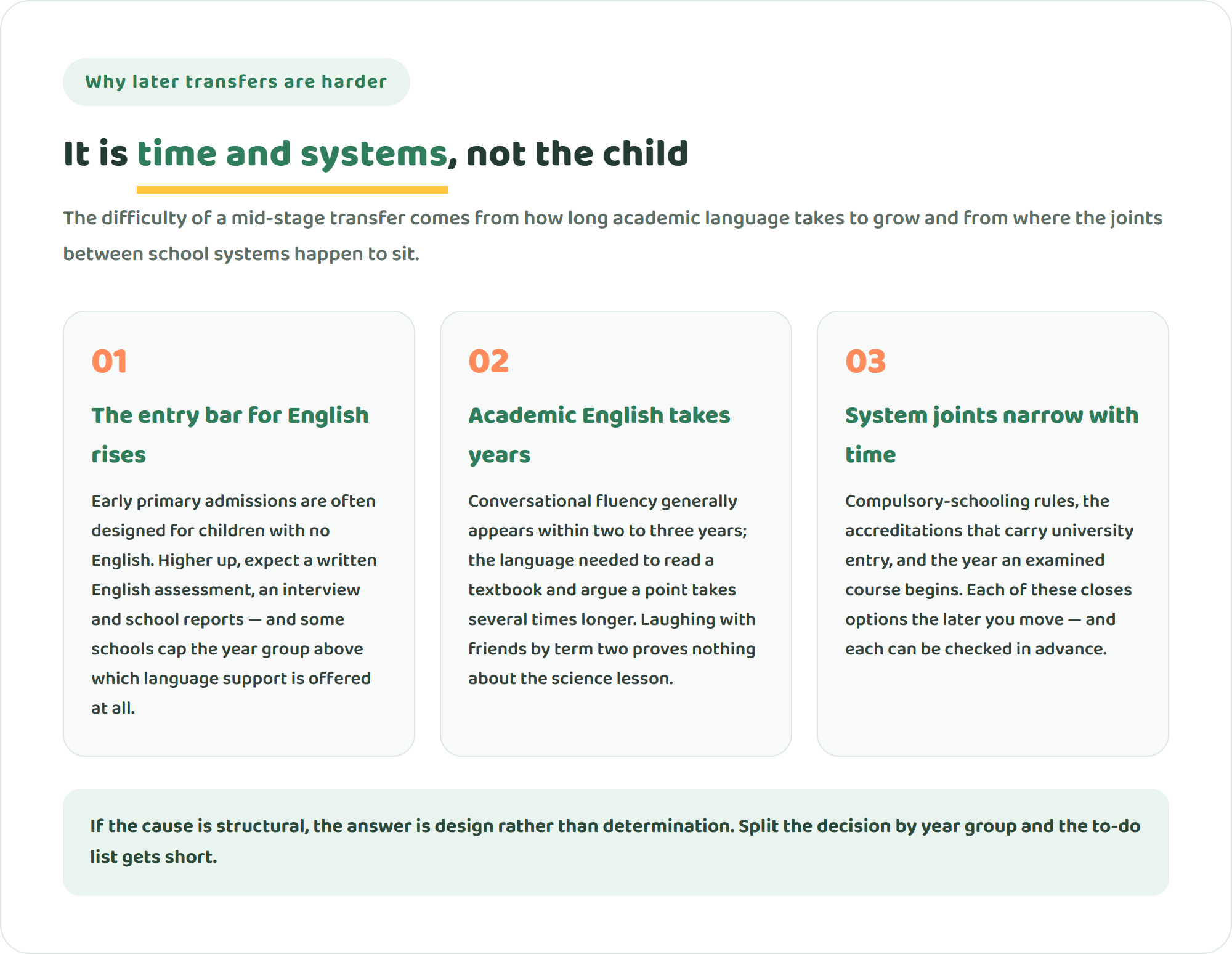
In the early primary years, many schools are built to take children with little or no English. As the years go up, admissions typically shift toward an English assessment covering reading and writing, an interview, school reports from the previous two or three years, and sometimes a standardised test. Many schools also cap the year group up to which they will admit a child who still needs English support, so that from a certain point upward the school effectively admits only children who can already learn in English. Practice varies enormously between schools, so treat this as a question to ask rather than a rule.
This is not gatekeeping for its own sake. The higher the year group, the more of the curriculum runs on language alone. That is the mechanism worth understanding before you decide.
Check what changes legally, before you withdraw
Depending on where you live, moving a child out of the national system can have consequences that have nothing to do with the school itself. In Japan, most international schools are not schools under Article 1 of the School Education Act, and the Ministry of Education states that enrolling a child who holds Japanese nationality in such a school does not constitute fulfilment of the legal obligation to enrol the child in compulsory schooling (MEXT, guidance on compulsory schooling and international schools). In Singapore, the Compulsory Education Act requires Singapore Citizens of primary school age and resident in Singapore to attend a national primary school unless an exemption is granted (Singapore MOE, exemption from compulsory education).
None of this makes a transfer impossible — exemptions and pathways exist, and rules differ by nationality and residency status. It simply means the authority to ask is your local education office, not the admissions team of the school you are applying to. Ask before you give notice, not after.
Why later transfers are harder: playground English is not classroom English
“Start early” is half-good advice. What is genuinely time-sensitive is not conversation. It is the English needed to read a textbook, defend an answer and write an argument.
Two different competences, two different timelines
In language education the distinction is often framed as BICS (basic interpersonal communicative skills) and CALP (cognitive academic language proficiency), introduced by Jim Cummins in 1979. Conversational fluency tends to appear within roughly two to three years of immersion; academic language takes several times longer (EBSCO Research Starters, “BICS/CALP”). Six months after a transfer your child may be laughing with friends at break. That is not evidence that they followed the science lesson.
When a child arrives changes how far they catch up
Reviewing a decade of English school data, Dr Ariel Lindorff and Professor Steve Strand at the University of Oxford report that learners using English as an additional language need on average about six years to reach the proficiency required to fully access an English-language curriculum. They also find that children who arrive in the first year of schooling catch up with their monolingual peers by the end of primary school, while those arriving after that generally do not, and that pupils arriving after Year 5 are likely to find it harder to close the gap by the time they sit their GCSEs (University of Oxford Department of Education, November 2025). That is state-school data from England rather than international-school data, so read it as an order of magnitude, not a verdict.
And note what “catching up” means there: matching native-speaking classmates. If your reason for transferring is a wider worldview, a different way of being assessed, or a school where your child is heard, native-level parity is not the target you are aiming at. The difficulty is real; what it means depends entirely on why you are moving. If you are still comparing systems, start with our guide on international versus local schooling. And if the worry underneath your question is what happens after the move, that is covered separately in when your child is struggling at international school.
Year by year: what makes a transfer work, and where it goes wrong
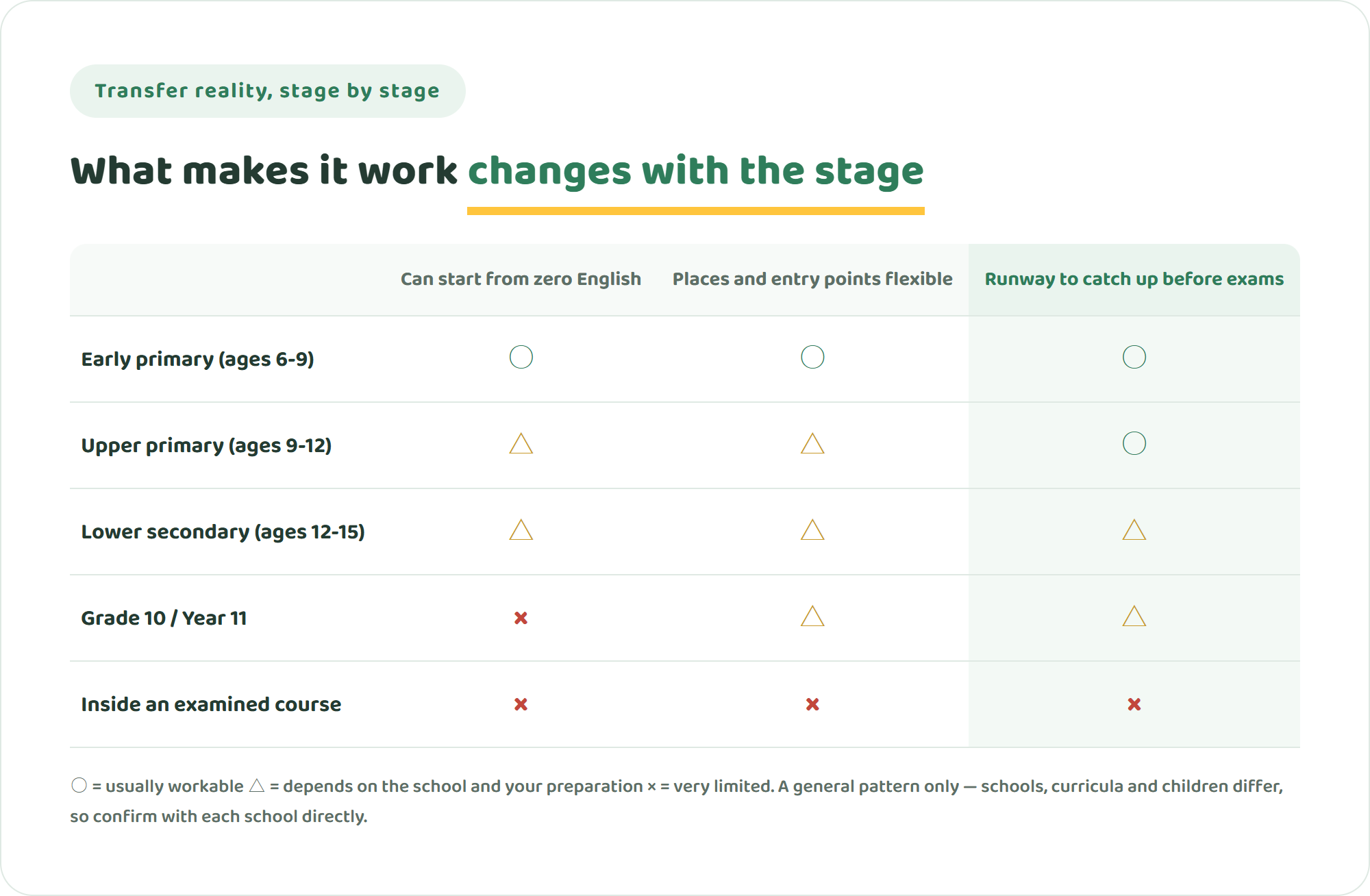
Transfer difficulty is not one line running from easy to impossible. The conditions swap around as the years go up. Find your row first.
Early primary (roughly ages 6 to 9)
The most forgiving window. Many schools are designed to admit children with no English at all, and support at this stage is usually generous. Language is absorbed through play and routine, so the academic load and the language load do not arrive together.
- What makes it work: very little, in terms of preparation. Use the time you would have spent on English coaching to choose the school carefully and decide your family’s language plan instead.
- Where it goes wrong: this is exactly the window in which home-language literacy is normally built. If nobody designs for it, the cost surfaces four or five years later. Our guide on international school and the home language covers what that plan looks like.
Upper primary (roughly ages 9 to 12)
Preparation starts to decide the outcome here, because textbook language turns abstract and the pictures and context that used to carry meaning disappear. The classic pattern at this stage is a child whose maths marks drop on word problems rather than on the arithmetic.
- What makes it work: abstract thinking already established in the home language; six to twelve months of deliberate reading and writing work in English before entry, run separately from school; and a school where language support sits inside the timetable rather than after hours.
- Where it goes wrong: speaking improves visibly while comprehension and grades lag. The real risk is not the gap — it is the child deciding, during that gap, that they are simply not clever.
Lower secondary (roughly ages 12 to 15)
Entirely possible, and one of the most common transfer points for families relocating within Asia. The catch is that you now have to solve the entry bar and the exit route at the same time.
- What makes it work: demonstrable basics across all four English skills at application; entering before the qualification years rather than inside them; and a willingness to consider placement a year below, which some schools will suggest and which is often the sounder choice.
- Where it goes wrong: the child leaves the local pathway to upper secondary, and returning later is not always straightforward — re-entry criteria for returnee admissions are often defined by years spent abroad and may not cover a child who attended an international school domestically. Rules differ sharply by country and by school, so verify with the specific schools you might return to.
Upper secondary (roughly ages 15 to 18)
The narrowest window, and the one that most needs a plan. The structural fact to start from is that the International Baccalaureate Diploma Programme is a two-year course for students aged 16 to 19 (International Baccalaureate, Diploma Programme). Transferring in once the DP has begun is generally very difficult, which makes the practical entry point Grade 10 or earlier. British-curriculum schools work the same way once IGCSE courses are under way.
- What makes it work: English strong enough to access lessons on day one, and entry before the examined course begins.
- Where it goes wrong: there is very little runway. Grades earned while academic English is still developing are the grades that go into a university application. “We got in, but the application window arrived before the results caught up” is the most common regret at this stage.
- Alternatives worth pricing: keeping the current school and running an international programme alongside it, an online international course, or a qualification route that leads to overseas universities without a full transfer.
Four things to do before you apply
If you have just concluded that you are late, read this part carefully. You cannot buy back years — but you can raise the condition your child is in on the day they walk through the door, and that is what admissions is actually assessing.
1. Build the English foundation as a separate project
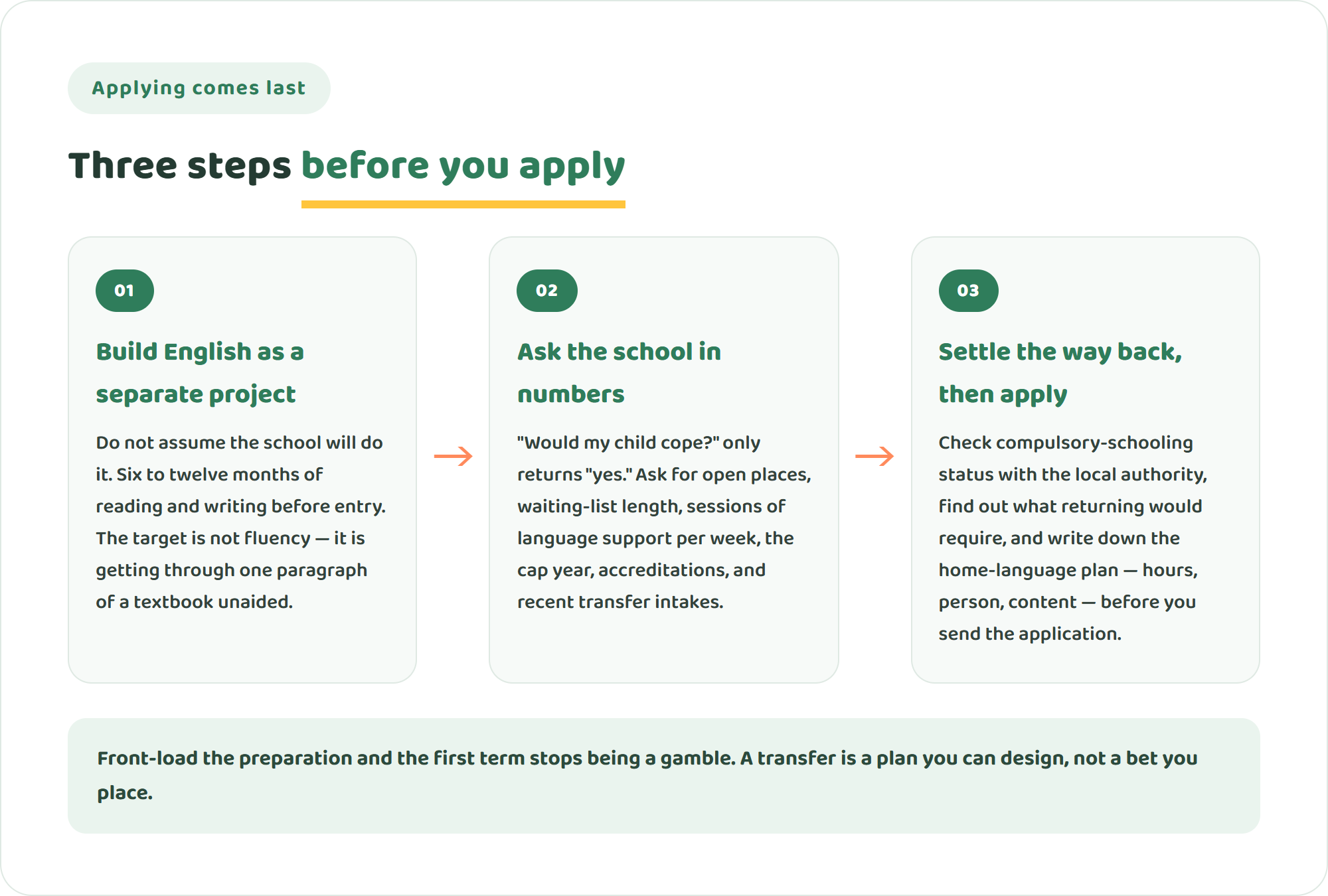
Do not assume the school will do it. Learning subjects in English and being taught English are different jobs, and a school does the first far better than the second. Six to twelve months of reading and writing work before entry changes the whole first term. The target is not fluency — it is being able to get through one paragraph of a textbook unaided.
2. Assemble what admissions will ask for
Expect school reports covering two to three years, an English assessment or interview, a parent meeting, and in some cases a teacher reference or standardised test results. Deadlines move with availability in the year group rather than with a national calendar. Some documents take weeks to obtain, so start collecting them the same day you make the first enquiry.
3. Settle the legal and administrative side first
When and how you leave the current school, whether the transfer affects compulsory-schooling status where you live, and what would be required if you ever came back. As above, the office that can answer this is the local education authority, not the school. Getting this wrong is the single most expensive kind of mistake, because it is discovered late.
4. Decide the home-language plan at the same time
This is the item every family postpones. Once English starts moving, home-language reading and writing quietly becomes the thing you will do later. But if neither language is carrying abstract thought, both stall. Decide now how many hours a week, with whom, and doing what. For more on how families keep two languages growing at once, see our guide on how to choose an international school, which covers what to look for in a school’s language model.
See how learning works online →
Nine questions to ask the admissions office
“Would my child cope?” only ever returns “yes.” Ask in numbers and proper nouns instead. These nine are the ones that matter specifically for a transfer.
- How many places are open in that year group right now, and how many families are on the waiting list?
- Do you admit between terms? When did you last take a mid-year transfer into this year group?
- Up to which year group do you accept a child who still needs English support?
- Who delivers that support, how many sessions a week, for how long, and is there an additional fee?
- How many transfer students have joined in the last three years, and into which year groups?
- How is the home language handled — as a first language, as a foreign language, or not at all?
- Which curriculum do you follow, and which bodies accredit you?
- Where did last year’s graduates go, and what route do students take if they apply to universities in their home country?
- Have students moved back into a national system from here? What documentation did they receive?
The ninth is the awkward one, and it is the most informative. A school that can discuss the way out is a school you can talk to once you are in.

A third option — a way to try it without betting the whole year
What makes transferring so heavy is the structure, not the paperwork. You cannot know whether it fits until you do it, and to do it you have to commit everything at once — leave the current school, sometimes move house, pay the fees, and hope. Change that structure and the decision becomes much lighter.
NIJIN GLOBAL ACADEMY (NGA), opening in September 2027, is being built with that in mind. Because it is online, it does not require a commute or a relocation, which makes it workable for families mid-posting, mid-year, or unsure where they will be living next. It is an international school that does not rank children by test scores, and small-group dialogue is the centre of the learning rather than an extra. In a room where every student is expected to speak, a newly arrived child does not disappear into the back row — which is precisely what happens to transfer students in large classes. The language design assumes children move into English gradually with the support of their home language.
NGA is run by NIJIN Inc. in Japan, whose alternative school NIJIN Academy has more than 900 students enrolled. It is for children aged 6 to 18 across Asia and Oceania, and the fee target is roughly one-fifth of a typical face-to-face international school. Honestly: an online school is not the same experience as a campus with a playing field, and since we have not opened yet, there is no track record to show you. Comparing it alongside your current school, rather than instead of it, is a perfectly reasonable way to use it.
Frequently asked questions
Can my child transfer from a local school to an international school in secondary?
Yes, and many do. The two conditions that matter are being able to demonstrate the basics of all four English skills at application, and entering before the examined qualification years rather than inside them. Plan the exit route at the same time, because leaving the national pathway can affect how your child re-enters it later.
Is it too late to transfer at 16 or 17?
It is the hardest window, but not automatically closed. The IB Diploma Programme is a two-year course for students aged 16 to 19, so joining after it has started is generally impractical, and British-curriculum schools are similarly constrained once IGCSE courses have begun. If the timing does not work, compare alternatives — running an international programme alongside the current school, or an online route — before assuming a full transfer is the only option.
Can we go back to the local school if it does not work out?
Families do go back. But placement, paperwork and eligibility vary by country, authority and school, and in some systems time at an international school does not count toward compulsory schooling. If returning is a realistic possibility, confirm the rules with your local education authority before you withdraw, not after.
Can we transfer mid-year?
Often, yes. Most schools admit between terms, but whether you actually get in depends on a place existing in that year group. Seats do open unpredictably when families relocate or repatriate, so ask to be added to the list even if the answer today is no.
Will a school take a child with no English at all?
In the early primary years, many will — it is a normal starting point. Further up, English is assessed at entry and some schools cap the year group above which they will not admit a child who still needs language support. Ask that question directly and early; the answer varies far more between schools than most families expect. If you want a broader framework for comparing schools first, see how to choose an international school.
Deciding it is too late may itself be too early
Transferring later is genuinely harder. The entry bar rises, the runway shortens, and the systems get less forgiving the closer you get to a qualification year. But notice what none of that was about: it was never about whether your child is capable. It was about how long language takes to grow, and where the joints between systems happen to sit.
Both of those things can be looked up, asked about, and planned around. Nine questions to the admissions office. Six months of English groundwork started before the application. A home-language plan written down rather than assumed. And a conversation about the way back, held before you give notice rather than after. That is the difference between a gamble and a plan.
NIJIN GLOBAL ACADEMY opens in September 2027. We send occasional updates on how the online learning model works, what a mid-year start looks like, and how to join the first cohort.
Honest Answers to Your Worries — related reading
- Will My Child Lose Their Mother Tongue?
- The Honest Pros and Cons of International School
- Disadvantages of Bilingualism in Childhood: Myths vs Research
- Who Regrets International School — and Who Doesn’t
- International School Special Needs: What to Look For
- International School vs Local School: How to Decide
- Does International School Hurt Your Child’s Home Language?
- When Your Child Is Struggling at International School
- Do International Schools Make Children Fluent in English?
- Is International School Worth It? What Happens to Graduates
- Should I Send My Child to International School?
- Disadvantages of Early English Education: What Research Says
- What Happens to International School Graduates