“Online learning looks like the right fit for our child. But can you actually earn an accredited diploma online?” It is the question almost every parent runs into the moment they start looking seriously at international qualifications online. The lessons may look wonderful and the community may feel right, but if a university later says “we don’t recognise that qualification,” there is no going back. When years of your child’s life are on the line, that caution is entirely reasonable.
This guide lays out six international qualifications online — credentials and completion routes a student can realistically work toward without attending a physical campus. We cover globally portable qualifications, the national routes open to families based in Japan, and the language tests and portfolios that serve as proof of ability. For each one we’re honest about what it can do and what to watch for, then give you a comparison map of the international qualifications online that families actually use, and three steps to decide. Systems change and requirements differ by school and country, so treat this as your overview and confirm details with each awarding body’s official information.

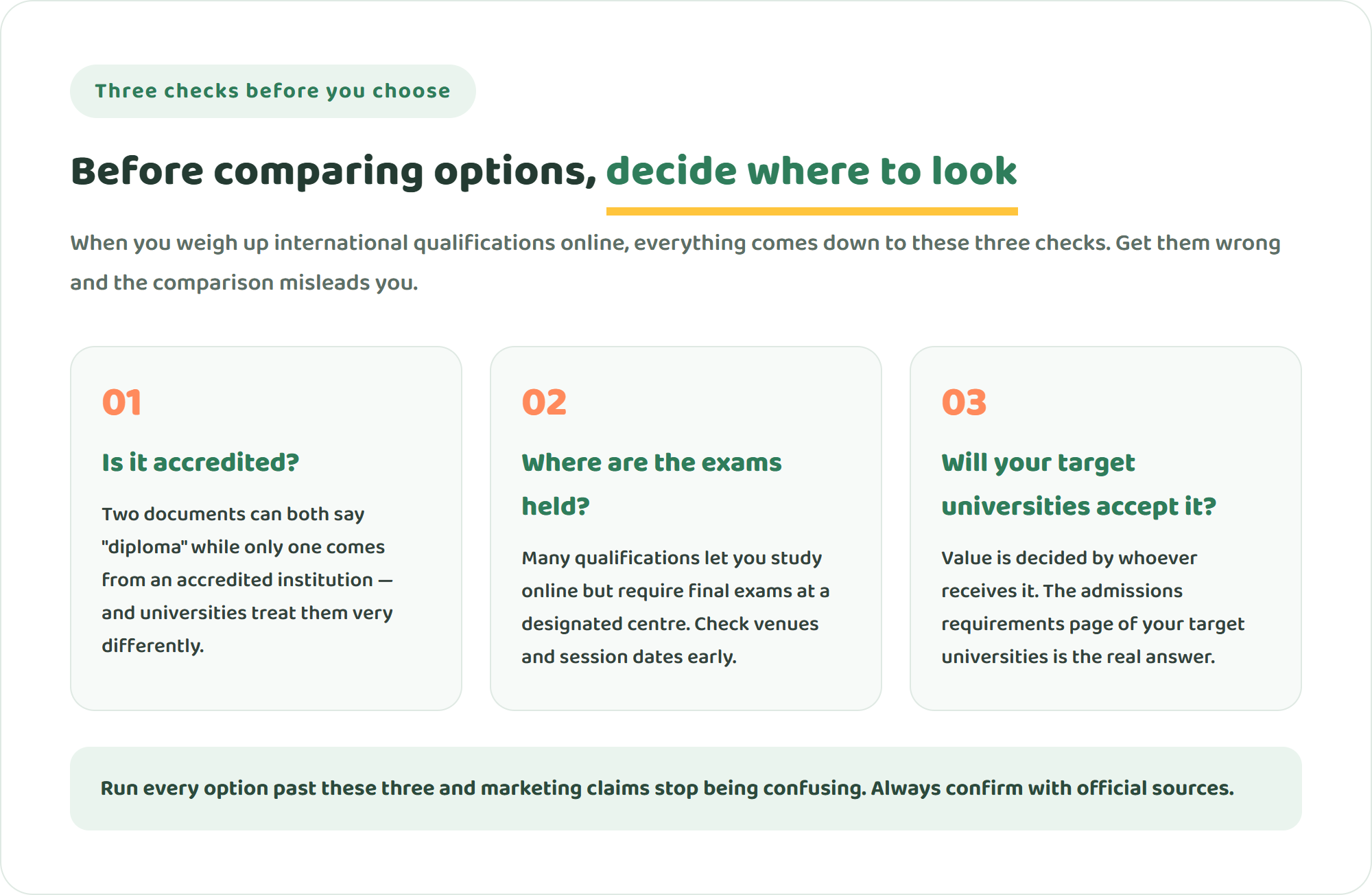
Three things to check before you choose any online qualification
Before the options themselves, settle where to look. Get this wrong and even the most careful comparison leads you astray.
First, is it accredited? Two documents can both say “diploma” while only one comes from an institution recognised by a proper accrediting body — and what they’re worth downstream is nothing alike. Second, where do the exams take place? Plenty of qualifications let you study entirely online but require you to sit final exams at a designated centre. Third, will universities in your target country accept it? A qualification’s value isn’t intrinsic; it’s decided by whoever receives it. The admissions requirements page of the universities you’re aiming at is where the real answer lives.
With those in hand, let’s look at the options. The six below are genuinely different in kind. Read them not as “which is best” but as “which one meets the exit our family is heading for.”
Six international qualifications you can work toward online
Learning without a campus does not mean learning without a destination. Here are six common routes, with the upsides and the caveats both on the table.
1. Cambridge International (IGCSE / AS & A Level)
These qualifications come from a department of the University of Cambridge. They are taught in more than 160 countries and over 10,000 schools, and recognised by more than 500 universities in the United States alone. Because students enter subject by subject, from IGCSE up through AS & A Level, a child can start from their strengths. The point you must not miss: you can study online, but exams are normally sat at an authorised exam centre. This is not a route you can complete entirely from home. Which subjects run, and when, varies by centre — check yours early.
2. The International Baccalaureate (IB Diploma)
The Diploma Programme, for students aged roughly 16 to 19, is referenced widely by universities around the world: a dense two years combining inquiry, an extended essay and activity beyond the classroom. The caveat is firm — the IB can only be offered by an authorised IB World School. IB World Schools that teach online do exist, but the number is limited. If you see a programme advertised as “get your IB online,” verify authorisation on the IB’s own official school listings, with your own eyes, before you commit.
3. An accredited online high school diploma
In the United States and elsewhere, schools deliver the full high school course online and issue a diploma at the end. Many are designed so a student reaches graduation without ever attending in person, and browsing a list of online international schools usually reveals more range than parents expect. The dividing line is accreditation. An accredited diploma and an unaccredited one are treated very differently by universities and employers, however similar the certificates look. Find out which body granted recognition and when, and cross-check that body’s own published list. Grounding yourself in what an international school is makes the judgement far easier.
4. Japan’s correspondence high school diploma
For families based in Japan, this route grants the Japanese high school diploma itself with far less on-campus time than a full-time school. Because it is the same recognised graduation, it connects directly to Japanese university admissions, and some schools accept students living overseas. It is not fully screen-based, though: schooling sessions (face-to-face instruction) and credit examinations are required, and how often and where they happen varies widely — from a few concentrated days a year to a few visits a month. Confirm directly with the school before applying.
5. Japan’s high-school equivalency examination
Also for Japan-based families: this national examination, run by the Ministry of Education, grants eligibility to sit entrance exams for universities, junior colleges and vocational schools. It opens a path for students who never enrolled in high school or left partway, and passes accumulate subject by subject. Be precise about what it is, though: passing is not the same as graduating from high school. It certifies equivalent academic ability; it does not make high school your final attainment. Whether overseas universities accept it varies institution by institution.
6. Language and skills certifications, plus a portfolio
IELTS, TOEFL and the Cambridge English exams are referenced by universities worldwide as evidence of English proficiency — but none is a graduation qualification on its own. They work alongside options one to five as proof that backs up what a student can actually do. Worth building in parallel is the portfolio: what your child investigated, what they made, and who it reached. That record carries weight in overseas applications and in Japan’s comprehensive selection admissions alike. Even families who keep a local school and add international learning after hours — a “double-school” arrangement — can accumulate this proof steadily.

The comparison map: reading the options side by side
Options this different become far easier to judge once they sit on the same scale. Here are four of them across four questions.
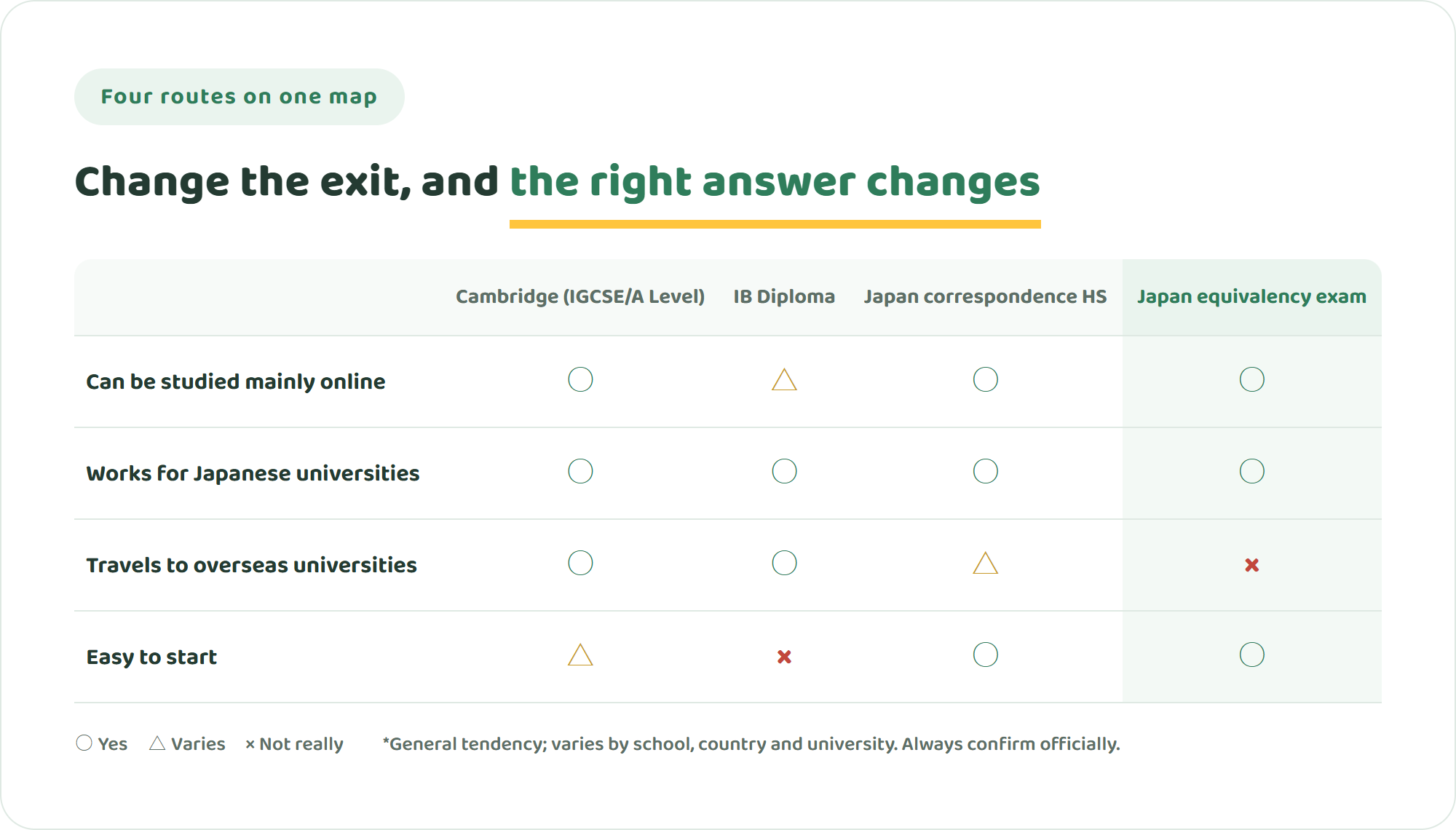
Laid out this way, one thing becomes obvious. “Can it be studied online” and “which country’s universities will take it” are two separate questions. If overseas universities are the target, portable qualifications like Cambridge or the IB tend to serve you better; if Japanese universities are the main arena, a correspondence high school or the equivalency exam is the more direct road. On ease of starting, the IB is steepest because authorised schools are few, while Cambridge and the equivalency exam open subject by subject. Change the exit and you change the right answer. Looking at where international school graduates go makes those forks easier to feel.
How to decide, in three steps
So how do you actually choose? Getting the order right is the shortest path there is.
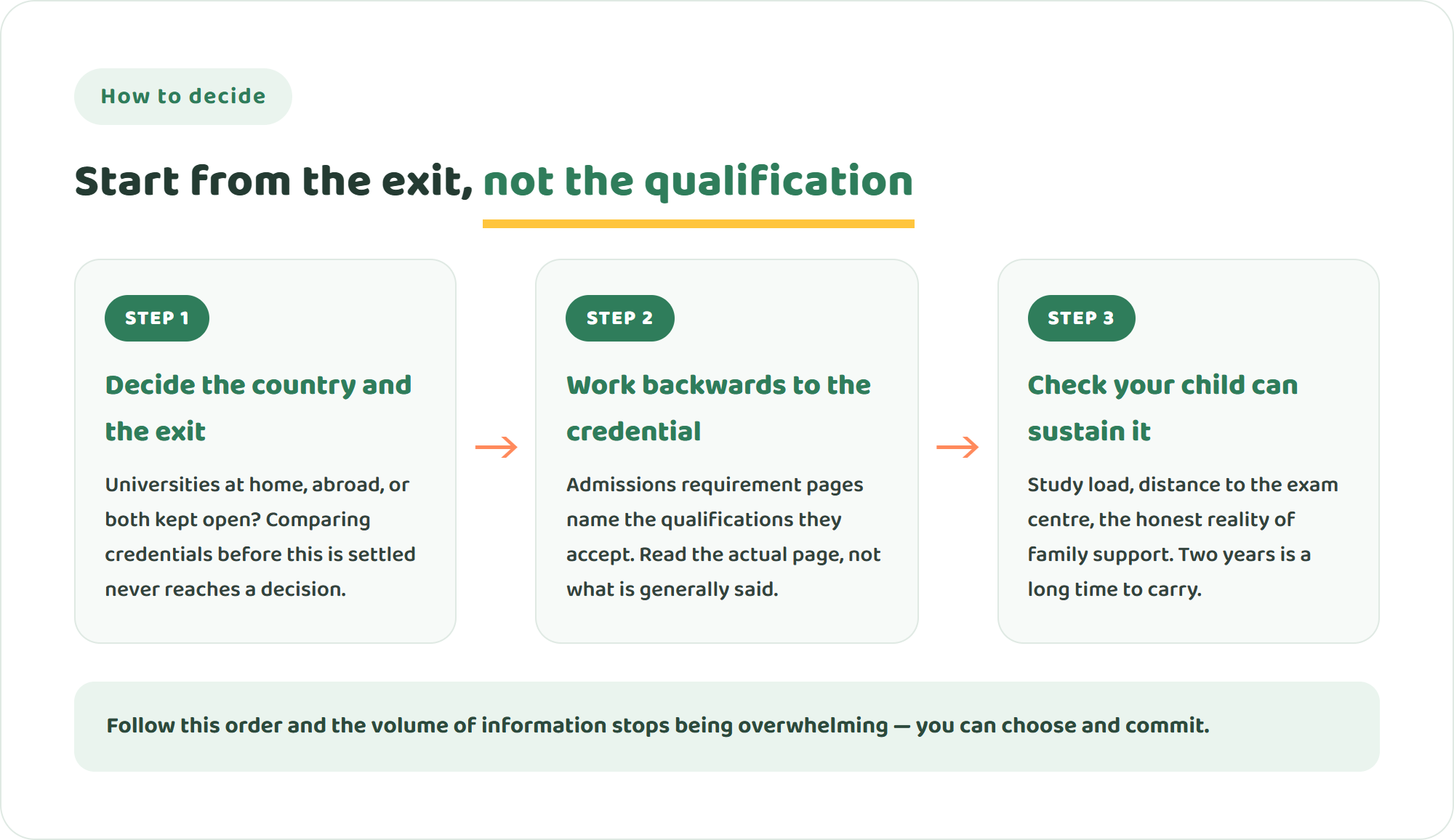
First, STEP 1 — decide the country and the exit you want. Universities at home, abroad, or a plan that keeps both open? Comparing qualifications before this is settled produces endless deliberation and no decision. Then STEP 2 — work backwards to the qualification that exit requires. Admissions requirement pages name the credentials they accept, specifically; read the actual page rather than what is “generally said.” Finally, STEP 3 — check your child can sustain it as they learn now. Study load, distance to the exam centre, the honest reality of family support. Only once you’ve looked at all three are you ready to decide.
See how learning works at NGA →
Where NGA sits among these
Here is where our NIJIN GLOBAL ACADEMY (NGA) stands. NGA is an online international school beyond the exam race, opening in September 2027, operated by NIJIN Inc. We also run NIJIN Academy, one of Japan’s largest alternative schools, where over 900 children are already learning, and in 2025 our founder, Tatsuro Hoshino, received the Grand Prix at JCI JAPAN TOYP 2025, which carries the Prime Minister’s Encouragement Award. On tuition, we’re aiming for roughly one-fifth of an on-campus international school.
On qualifications, we’ll be straight with you. We are not yet at a stage where we can state definitively which credential NGA will offer. We are working toward building our curriculum around the Cambridge pathway, but we won’t overstate what isn’t settled — we’ll share each decision as it is made. What we can say with confidence is that a qualification is only one of the exits. Making things through projects, sharpening thinking in small-group dialogue, and keeping a portfolio of what was built: that substance is what opens the next door.
Frequently asked questions
Can I earn a diploma entirely online, without ever visiting an exam venue?
It depends on the qualification. Cambridge International exams are normally sat at an authorised exam centre, and Japan’s correspondence high schools require face-to-face sessions and credit examinations. Some accredited online high schools, on the other hand, are designed so a student can reach graduation online throughout. Treat “you can study online” and “you can sit the exams online” as two separate claims, and confirm each with the awarding body.
Is an unaccredited online diploma worth anything?
It may still represent real learning, but don’t assume universities or employers will treat it as they treat an accredited one. Accreditation is precisely the mechanism by which an outside body vouches for a school’s standards, and admissions offices lean on it heavily. If a school’s accreditation status is unclear on its own website, or you cannot find the school on the accrediting body’s published list, ask directly before enrolling.
My child is still in middle school. When should we start thinking about qualifications?
Having even a rough sense of the exit during the middle school years widens your options considerably. Qualifications like the IB and Cambridge build over two-year cycles, so knowing the direction by the start of high school makes everything easier to arrange. That said, nothing needs locking in now. What pays off most at this stage is time spent with English and experience digging deep into genuine interests — a foundation that serves every one of these routes.
A qualification is one exit. The road can still widen.
Choosing to learn online is not choosing to give up on the future. Several international qualifications online are genuinely within reach without a campus, and formal national routes exist alongside them. What matters is not picking the most famous credential but working back from where your child wants to go, and choosing a form they can sustain. And more than the certificate itself, what they thought about and built over those years is what opens the next door.
NIJIN GLOBAL ACADEMY opens in September 2027. We’ll share how our learning works — the whole world as the textbook — along with updates on qualifications and pathways and first-cohort enrolment news, as each is decided. Learning differently doesn’t narrow your child’s options; done well, it widens them. Take that first step from here.
Get opening updates by email →
More on choosing an international education
- When Your Child Does Not Want to Go to School——How to respond, and 5 real options
- How Much Household Income Do You Need for an International School?——Budgeting so it lasts
- What Is the International Baccalaureate?——IB vs Cambridge, honestly compared
- Starting International School in the Elementary Years——What changes, and what it costs
- How Much Does an International Preschool Cost in Japan?——Fees, subsidies, and the step after kindergarten
- Minerva Virtual Academy Fees for Families in Asia——Paid upfront, taught on UK hours
- American Online Schools for International Students——5 compared on tuition, time zones and eligibility
- Stanford OHS vs Laurel Springs——Live seminars or self-paced, read from Asia
- Alpha School vs Sora vs Primer——Which new school model a family in Asia can use
- Can You Raise a Bilingual Child Without Speaking English?——What parents can realistically do at home