If you have been searching for a second career for teachers, you are probably not looking for a way to disown the classroom. Maybe retirement is in sight and you are thinking about what comes after. Maybe you are in your forties or fifties, wondering how many more years you can sustain this pace. Maybe you are younger and simply want to test your teaching skill somewhere else. Different situations, one shared question: does what I have built inside a school count for anything outside one? And behind that question, for most teachers, sits a line they have heard somewhere — that teaching does not transfer.
This article neither swallows that line nor waves it away. First, an honest look at the reality of a second career after teaching — why the picture is different depending on whether you move near retirement or mid-career, and where the “teaching doesn’t transfer” idea actually comes from. Then the heart of the piece: translating teaching experience into the vocabulary employers use, which is useful whatever path you take, with or without us. Finally, a place where the experience counts without translation at all — a founding role at the online international school we open in September 2027, offered as an option, not a pitch.

The reality of a second career for teachers
Start by separating two very different situations. A second career begun around retirement and one begun mid-career require completely different preparation. Near retirement, staying adjacent to education — re-employment schemes, part-time or supply teaching, tutoring, curriculum work — is a realistic set of options. Mid-career, with twenty or more working years ahead, you are redesigning income and role, not just filling a schedule. Neither is better. Deciding which situation you are actually in, before you look at a single job listing, saves months.
So why do people say teaching does not transfer? Not because the skill is missing. The reason is plainer: the work has never been translated into language that reads outside a school. Write “homeroom teacher,” “year lead,” or “pastoral coordinator” on a résumé and someone who has never worked in a school learns almost nothing about what you actually did. On top of that, schools rarely talk about outcomes in numbers, so teachers get little practice saying “I moved this many people this far, over this long.” Put those two together and a genuinely capable person becomes invisible to the market. The problem is visibility, not ability.
One point of accuracy on the institutional side. In Japan, some prefectural and municipal boards of education run special selection routes aimed at people with prior teaching or private-sector experience, and other countries have their own re-entry and alternative-certification schemes. But the names, eligibility rules, and requirements differ by authority and are revised from year to year. Nothing here should be read as a definite statement about your case — always check the current official guidelines published by the relevant education authority.
Translating teaching experience into three job functions
This is the core of the article. The first move in a second career is not browsing vacancies — it is renaming the work you have carried in the words used outside a school. Write out a year of your work, then ask of each item: what is this job called elsewhere? That single exercise brings the outline of what you own into focus.
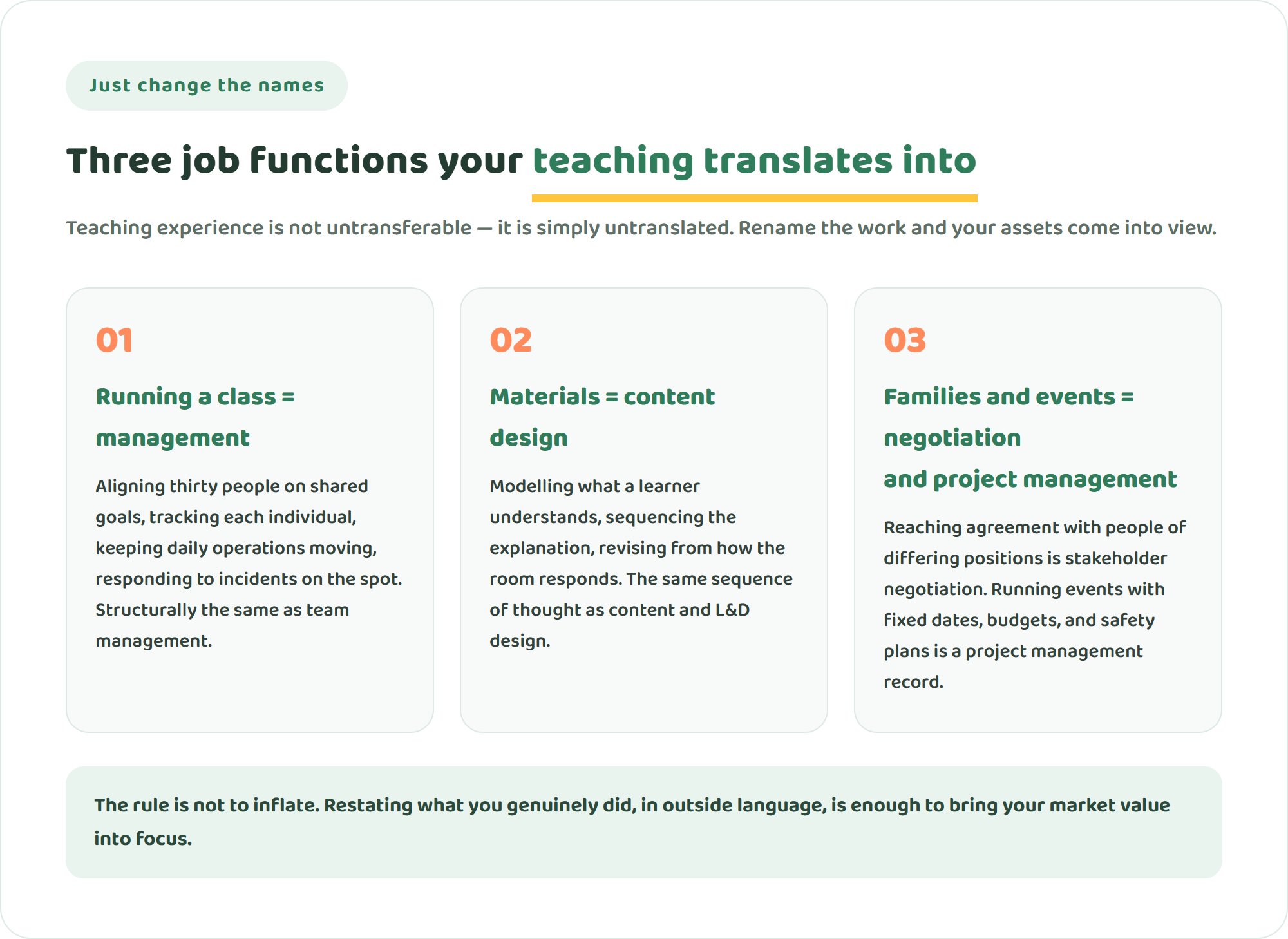
Running a class is management. You align a group of thirty on shared goals, track each individual’s state, keep daily operations moving, and respond to incidents on the spot. Structurally, that is what team management and floor operations look like anywhere — arguably harder, because your team members are children. Developing materials is content design. You model what a learner already understands, sequence the explanation, then revise based on how the room responds. Corporate content producers, e-learning designers, and L&D specialists follow the same sequence of thought.
And parent communication is stakeholder negotiation; running school events is project management. The ability to reach agreement with people of different positions and values, in emotionally charged moments, is scarce in sales and HR alike. If you have run something like a residential trip year after year — an immovable deadline, many stakeholders, a budget, and a safety plan — that is a project management track record. The rule here is: do not inflate. Restating what you genuinely did, in outside language, is enough.
See NIJIN GLOBAL ACADEMY’s founding-member roles →
Where the experience counts as-is: a founding role
Even after translating, most destinations still involve porting educational experience into another industry’s context. That is a worthwhile path. But there is another kind of place — one where the experience counts without translation, because teaching and building the business are held by the same person. That is exactly how the founding-member roles at NIJIN GLOBAL ACADEMY (NGA), recruiting now ahead of a September 2027 opening, are designed.
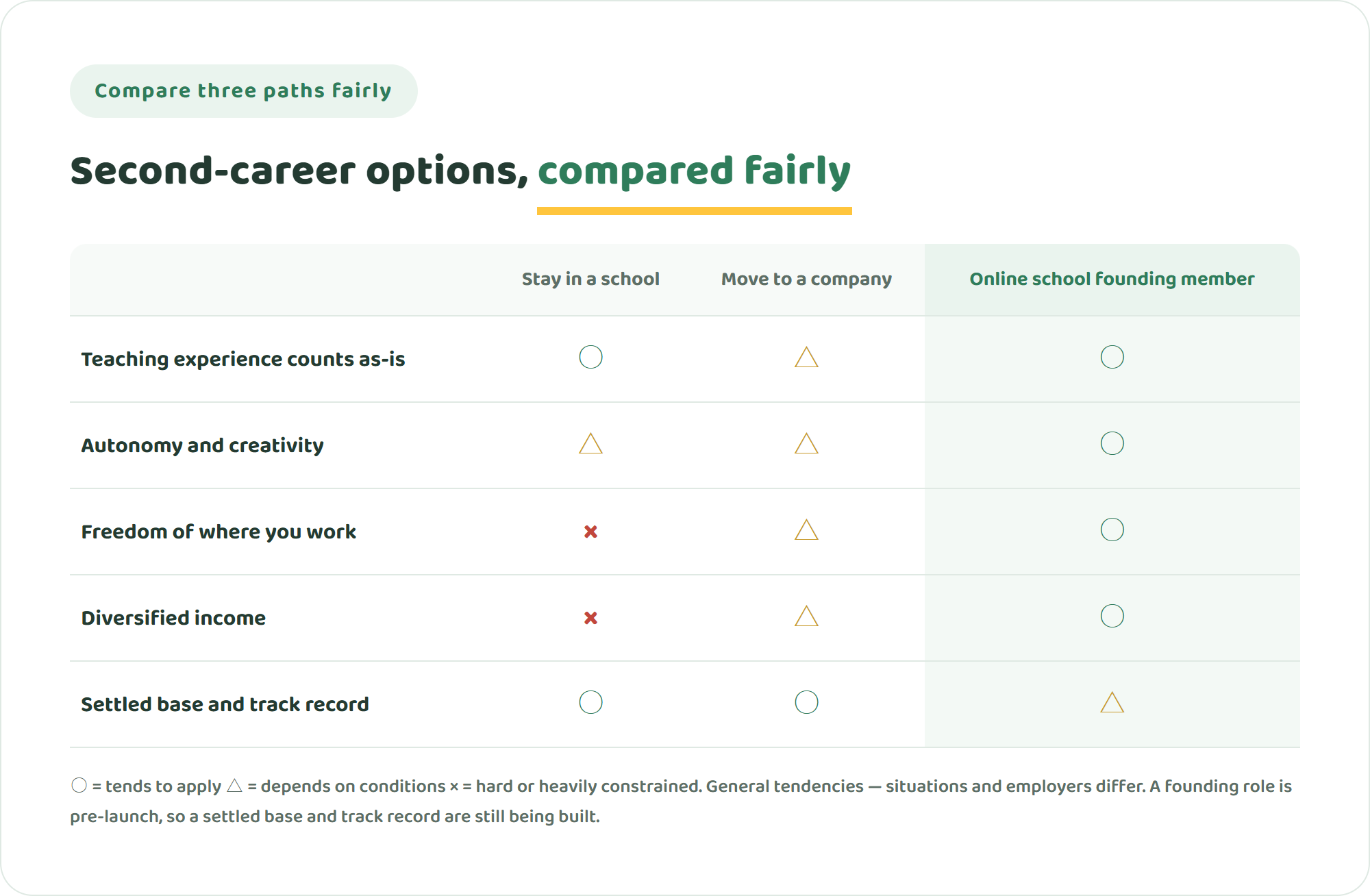
As the table shows, the founding route does not win on every axis. The settled foundation an established school or company offers is, for a pre-launch team, still ahead of us. What it does offer suits an experienced teacher. First, you combine teaching with running the business: alongside lessons you can choose your involvement from five working styles spanning marketing, web, partnerships, and HR — and the operational instinct you built running classes and events transfers directly. Second, it is fully remote, designed around “working while traveling the world,” with no commute and no fixed posting. If you have been thinking about leaving teaching mainly to take back your own time and place, that is a structural change, not a cosmetic one.
Third, we say plainly what the terms are. On the international track, founding roles begin as volunteer positions ahead of the September 2027 opening, and the detailed terms are shared later in the process. For a sense of how international-school economics compare, our international school tuition database gives you a yardstick. Fourth, continuity: NIJIN Inc., which runs NGA, spans a group of eleven companies, so continuing your career inside the group is an option. The sharpest risk in a second career is depending on one employer and finding nothing after it — a multi-business environment is itself a hedge. And if what you want is to deepen your expertise and climb another step rather than step down, a founding phase is where experience compounds fastest.あわせて、インターナショナルスクールの学費はなぜ高いのか(相場の内訳と、対面の約1/5に下げる方法)で、費用の構造そのものを分解しています。
What we ask is roughly English at CEFR B2+ and an appetite for building from zero. What we stand for is learning beyond test scores — no ranking children by exam results — set out in how we learn. The longer you have stood in front of real children, the more surely you know that scores do not measure everything. That conviction is the asset we most need.

Three steps to start your second career
Here is a manageable three-step way to turn the worry into movement.
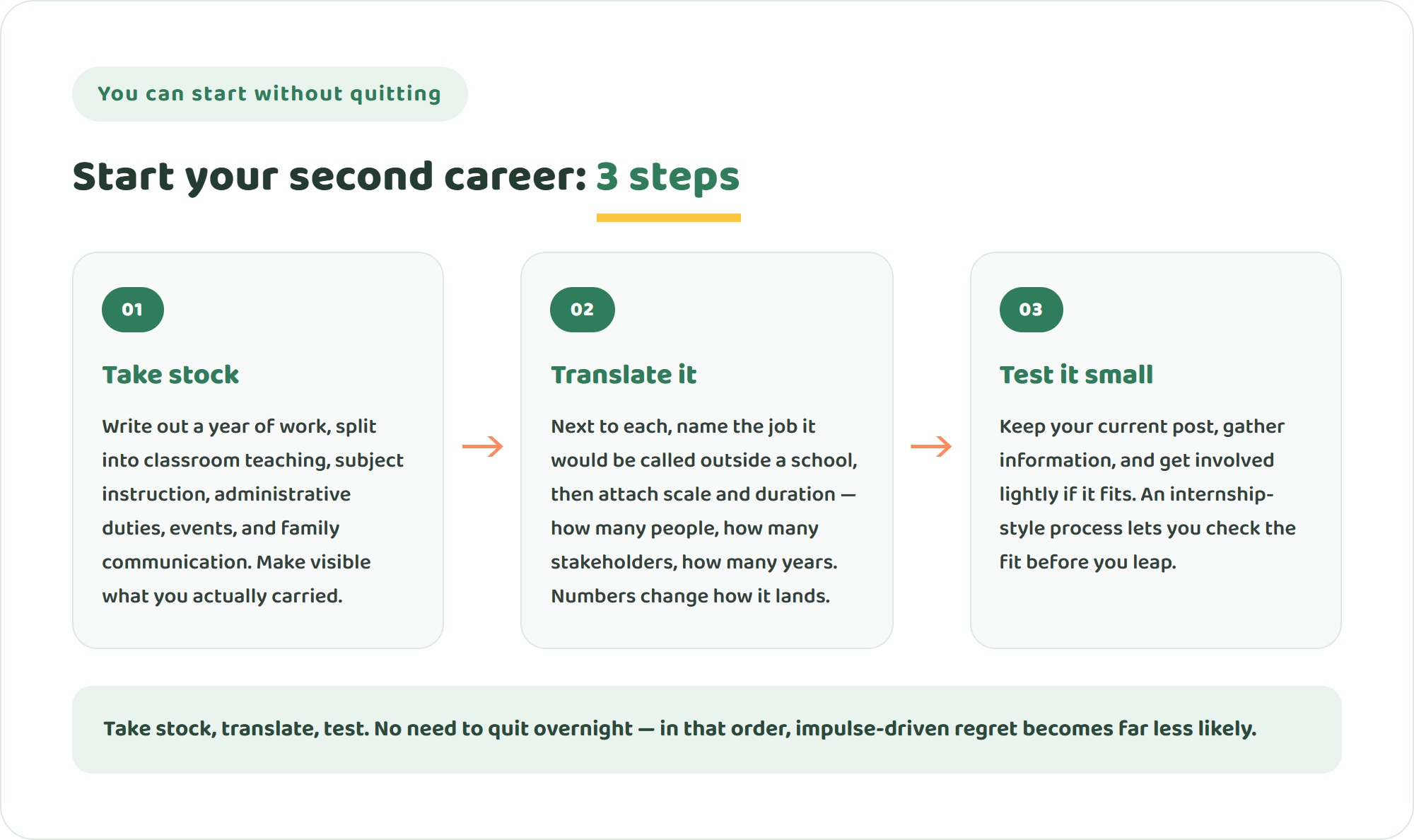
First, take stock. Write out a year of work, split into classroom teaching, subject instruction, administrative duties, events, and parent communication. Second, translate. Next to each, name the job it would be called outside a school, and where you can, attach scale and duration — how many people, how many stakeholders, how many years. Numbers change how it lands. Third, test small. Keep your current post, gather information, and get involved lightly if it fits. NGA’s selection runs from document screening to a group interview, an internship at NIJIN Academy, and a final presentation (applications via a Google Form).
Frequently asked questions
Is it too late to start a second career in my forties or fifties?
No. The longer you stood in a classroom, the more experience there is to translate. What changes is the preparation: decide first whether you are moving around retirement or mid-career. NGA looks less at age than at whether you enjoy building from zero.
Can anyone use a special selection route for former teachers?
We cannot state that definitely. Some education authorities do run selection routes aimed at people with teaching or private-sector experience, but names, eligibility, and requirements vary by authority and change from year to year. Always confirm against the current official guidelines published by the authority itself.
I have no experience outside schools. Is teaching alone enough?
What NGA asks for is people who can build from zero. The management built running a class, the design skill built making materials, and the negotiation built talking with families all come into their own in a founding phase. We value the drive to build a school together over a licence or a polished background.
You open in September 2027. Is there any point applying now?
Yes. It is precisely because it is pre-launch that founding members shape the substance of the learning itself, and the lead-up is built so you can gain experience through the NIJIN Academy internship. If joining the side that builds appeals more than entering a finished organisation, now is arguably the moment.
The years you have put in still count in the next place.
“Teaching doesn’t transfer” is not true. What is true is that teaching has not yet been translated. Holding thirty people together for a year, rebuilding materials around what a child could actually follow, reaching agreement with a parent whose feelings were running high — all of that has a name in the wider world. You simply had not been told the names; the capability was always yours. A second career is not discarding who you were to become someone else. It is putting what you have accumulated to work in a wider place. Take stock, translate, test small — step by step, without ever letting go of the joy of teaching.
Working at an International School — More Articles
- international school teacher salary
- how to become an international school teacher
- career change from teaching
- career change from teaching in your 30s and 40s
- how much do teachers earn?
- how to become an IB teacher
- jobs for moving abroad
- teach abroad without relocating
- thinking of quitting teaching
- career change from tutoring
- life after leaving teaching
- private school teacher career change
- junior high school teacher salary in Japan
- high school teacher salary in Japan
- school principal salary in Japan
- how the Japanese teacher pay scale works
- teacher bonuses in Japan
- private school teacher salary in Japan
Turn your passion for teaching into your next way of working.
Related reading for teachers
- How much do teachers earn——public, private and online compared
- Qualifications to teach English: TESOL, CELTA and more
- Private school teacher career change——four things that are different, and what to do next
- Careers with a teaching license——remote, part-time and beyond the classroom