If you have searched for international schools in Okinawa prefecture, you have probably noticed that no two lists agree. One site says seven schools, another says nine, and a business directory claims eighty-two. The gap exists because many of those listings count English conversation classes and workplace daycares. This guide covers only the schools whose existence we could verify through official websites, municipal information, and international-school databases — organised by region: the south (Naha and Nanjo), the centre (Chatan, Yomitan, Nakagusuku, Ginowan, Uruma), and the north and outer islands. You will find published annual fees, a straight answer about whether the on-base DoDEA schools are open to you, and an honest look at the fact that nothing full-time exists north of Nago or on Ishigaki and Miyako. By the end, you should know exactly which options sit inside your own daily radius.
Quick Answer: Your Options in Okinawa
If you only read one section, read this. Below are the areas where schools can be confirmed, with their school names, plus the online option — so you can see every route side by side before the details.
- South — Okinawa International School (OIS) — Tsubogawa, Naha City / Okinawa International Academy — Naha and Uruma / Hybrid Mom Okinawa International School — Naha City
- Central — Okinawa AMICUS International — Enobi, Uruma City / Da Vinci International School — Uezu, Uruma City / New Life Academy — Noborimata, Nakagusuku Village and 3 more (6 in total)
- Can you use the on-base DoDEA schools? — 13 schools
- International education that is not an international school — Okinawa Shogaku High School
- NIJIN GLOBAL ACADEMY (online) — Ages 6–18 / opening September 2027, currently taking opening-update registrations / fees around one-fifth of a typical campus international school / Japanese-language support. An option when distance or fees are the wall.
International schools in Okinawa prefecture: the landscape and what they cost
Here is the short version. Okinawa prefecture has roughly ten international schools that we could verify from official sources as of July 2026. For a prefecture of about 1.45 million people, that is not a small number — in fact, the density of choice is unusually high compared with similarly sized prefectures elsewhere in Japan.
Two forces explain that. The first is the long American presence. English-medium education took root here in the civilian community from the 1950s: Okinawa Christian School International in Yomitan was founded in 1957, making it one of the older international schools anywhere in Japan. The second is recent internationalisation. According to a survey by the Ryugin Research Institute, the number of foreign residents in Okinawa reached a record 33,516 as of the end of December 2025 — 2.3 per cent of the prefecture’s population. The Okinawa Institute of Science and Technology (OIST) in Onna village draws researchers from around the world, and their families’ search for schooling has pushed demand upward.
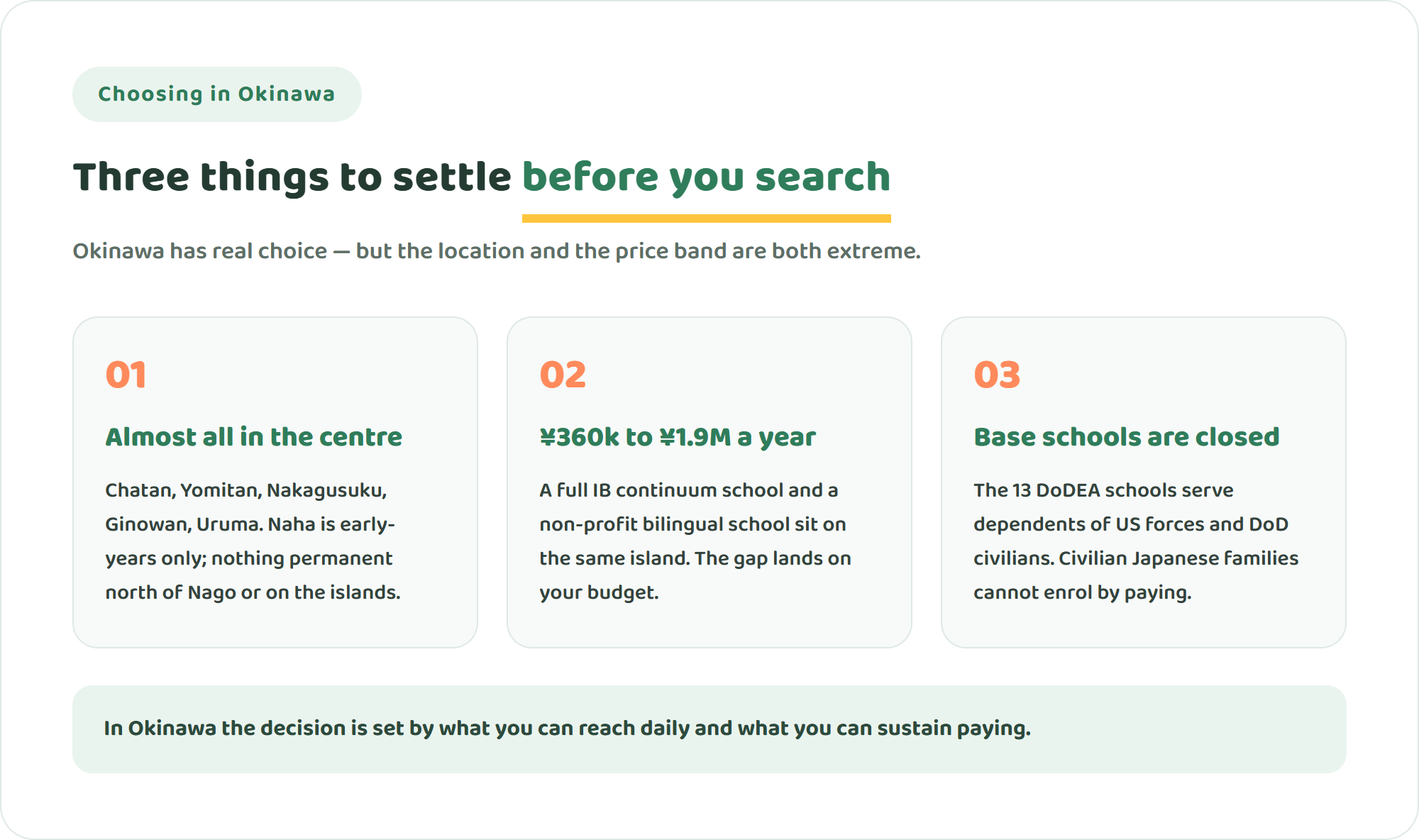
Fees span a very wide band, which is the defining feature of Okinawa. The three schools listed on the International Schools Database charge between roughly ¥636,000 and ¥1,913,000 a year for 2025/26, with an average near ¥1,155,000. Include the smaller schools and preschools that database does not cover, and the bottom of the range starts around ¥360,000. Broadly:
- ¥1.5M–1.9M a year — the full IB continuum school (upper grades at Okinawa International School, Nanjo)
- ¥1.0M–1.3M a year — American-system K–12 schools (OCSI in Yomitan, Da Vinci in Uruma)
- ¥0.8M–0.95M a year — English immersion inside a Japanese-accredited school (AMICUS in Uruma) and Christian schools (ZCAI in Chatan, New Life Academy in Nakagusuku)
- Around ¥360,000 a year — the non-profit bilingual school (AmerAsian School in Okinawa, Ginowan)
In other words, Okinawa can offer an international education for somewhere between a third and a half of what the same thing costs in Tokyo or Yokohama, where ¥2–3 million a year is normal. The catch is that the more affordable schools are small, and some have visa or enrolment-timing conditions. If you want to understand what sits inside a tuition figure before you compare, see our breakdown of international school costs; if you are still deciding whether this type of school suits your family at all, start with what an international school actually is.
One more thing to internalise: the distribution is lopsided. Almost every school sits in the central belt of the main island — Chatan, Yomitan, Nakagusuku, Ginowan, Uruma. Naha has an early-years campus and several preschools, but no full-time international school that a primary-age child can attend daily. North of Nago, and on Ishigaki, Miyako and the other islands, there is no permanent international school at all. Choosing a school in Okinawa comes down to one question: can you reach the central belt every single day?
Every international school in Okinawa prefecture, by region
What follows are the schools we could confirm through official sites and international-school databases. If you want to compare Okinawa against the rest of the country, our index of international schools across all 47 prefectures puts them side by side.
South: Naha City and Nanjo City
The stretch from the prefectural capital down to Nanjo is home to the only school in Okinawa with the complete IB continuum.
- Okinawa International School (OIS) — Tsubogawa, Naha City / Fusato, Tamagusuku, Nanjo City. Opened in 2003 as an English preschool in Naha, OIS is now the first and only school in Okinawa authorised for all three IB programmes — PYP (2011), MYP (2016) and DP (2020). The Naha campus handles preschool and kindergarten; the Nanjo campus runs grades 1 through 12. At high school level there is an International Liberal Arts track alongside the IB Diploma, and because the upper school is registered as Okinawa Kokusai Gakuin within the Japanese system, students can graduate with both a Japanese high school diploma and the IB Diploma. Classes are team-taught by international and Japanese faculty in a genuinely bilingual environment. Fees rise steeply with grade: the International Schools Database lists 2025/26 annual tuition at about ¥1,169,500 for age 2, ¥1,306,800 for kindergarten, ¥1,636,000 for grades 1–5 and ¥1,912,900 for grades 6–12, plus a one-off ¥15,000 assessment fee and ¥200,000 entrance fee, and an annual ¥100,000 capital fee.
- Okinawa International Academy — Naha and Uruma. A bilingual nursery combining English-medium childcare with developmental support. Not a full-time school, but a route into an English environment before school age. Fees on enquiry.
- Hybrid Mom Okinawa International School — Naha City. An English preschool for infants and toddlers, operated under Japan’s employer-led childcare framework. Fees on enquiry.
The takeaway for the south is blunt: if you want English-medium schooling from primary age upward, OIS Nanjo is effectively the only option. It is a 30–40 minute drive from central Naha, so check the school bus catchment carefully. Everything else in the south serves pre-school children.
Central: Chatan, Yomitan, Nakagusuku, Ginowan and Uruma
This is where Okinawa’s international schools live. Within a radius of roughly 20 kilometres you will find a long-established American K–12 school, an English-immersion school licensed inside the Japanese system, and a mothers-founded non-profit bilingual school — a spread that few prefectures can match.
- Okinawa Christian School International (OCSI) — Zakimi, Yomitan Village. Founded in 1957 and dual-accredited by WASC and ACSI, OCSI runs an American curriculum from pre-K to grade 12. Its published SY25-26 schedule sets tuition at ¥1,000,000 a year for elementary (K–5), ¥1,040,000 for middle school (6–8) and ¥1,080,000 for high school (9–12), plus an annual ¥100,000 facility fee, ¥50,000 materials fee and ¥20,000 technology fee — so budget roughly ¥1.15M–1.25M a year. First-year costs add a ¥50,000 application fee, ¥50,000 interview and testing fee, a ¥240,000 enrolment fee (¥120,000 for siblings) and, where required, a ¥140,000 ESL fee. Families who pay ten months of tuition by 10 August receive a two per cent discount.
- Okinawa AMICUS International — Enobi, Uruma City. Opened in 2011, AMICUS is a Japanese-accredited private school operating under MEXT’s special education designation, which lets it deliver its own curriculum across kindergarten, elementary and junior high. Most subjects are taught in English, with Japanese language and part of social studies taught in Japanese — and because it is a recognised school, attendance satisfies Japan’s compulsory education requirement. The official fee list shows monthly tuition of ¥43,000 (kindergarten), ¥54,800 (elementary) and ¥59,800 (junior high), plus annual materials fees (¥93,000 / ¥103,000), a ¥120,000 facility fee and a ¥15,000 welfare fee — roughly ¥750,000–950,000 a year. The ¥250,000 entrance fee is waived for students continuing from AMICUS kindergarten to elementary or elementary to junior high. The campus is about five minutes from the Okinawa-Kita expressway exit.
- Da Vinci International School — Uezu, Uruma City. A US-accredited programme running from early years through the upper grades, offered in English or fully bilingual form (with Japanese or Spanish). Distinctive features include a ratio of up to eight students per teacher and in-house psychological support. Published figures start above ¥1.3 million a year, but the total depends on the track — confirm directly.
- Zion Christian Academy International (ZCAI) — Kuwae, Chatan Town. An ACSI member school using the American Abeka curriculum from kindergarten to secondary level, with a multicultural student body and uniforms. One aggregator puts annual fees near ¥820,000; the school publishes current fee schedules as downloadable documents in English and Japanese.
- New Life Academy — Noborimata, Nakagusuku Village. A private international Christian school operating since 1995, from preschool through grade 12, about five kilometres from Camp Foster. Annual fees are reported at around ¥840,000. Note that the school states children without a family or independent visa are not eligible, so Japanese families should ask before applying.
- World Mission Christian School — Nakagusuku Village. A Christian school taking children from age one through high school age. Fees on enquiry.
- Santa Monica Okinawa International School (SMIS) — Hamagawa, Chatan Town. A WASC-accredited, secular English preschool and kindergarten with provision into the upper grades. It accepts infants from just a few weeks old, which is why working families gravitate to it. Fees on enquiry.
- Busy Bee School — Chatan Town. A bilingual setting for children from 18 months to elementary age, reported from around ¥54,000 a month — one of the more reachable price points on the island. Fees on enquiry.
- AmerAsian School in Okinawa (AASO) — Shimashi, Ginowan City. Founded in 1998 by five Japanese mothers raising AmerAsian children and now a certified non-profit, AASO uses a double immersion model: maths, science and social studies are taught in both Japanese and English, while each language arts course runs in its own language. It serves pre-K (age 4) through grade 9 with no more than fifteen children per class, and Ginowan’s Board of Education recognises attendance as equivalent to public school, so students can earn a Japanese junior high diploma. Information published by OIST lists a ¥15,300 registration fee and ¥363,000 a year at every level — the most affordable route in the prefecture, though the school is small, so ask about availability.
The strength of the central belt is that you actually get to choose a price point. Very few prefectures put a ¥1.9M IB school and a ¥360,000 non-profit inside the same commuting radius. The flip side is that Okinawa is not uniformly cheap — the gap between schools lands directly on your household budget.
North and the outer islands: Nago, Onna, Ishigaki, Miyako
This part has to be said plainly. As of July 2026, there is no permanent international school north of Nago City, nor on Ishigaki, Miyako or the other outer islands.
Nago has a small Montessori-and-English preschool, some of which qualifies under the city’s fee-waiver scheme, and the Nago International Exchange Hall hosts parent-and-child English circles. Ishigaki has several children’s English classes. None of these are full-time schools; they sit in the after-school category. Onna village is home to OIST, but researchers’ children generally commute to OCSI, AMICUS or another central-belt school.
So for families in the north or on the islands, a full-time international school means one of three things: a long daily commute to the centre, relocating the family, or a form of learning that does not require a commute at all. If relocation is on your table, price the whole picture — housing, a car, and the fee band above — before you commit.
Can you use the on-base DoDEA schools?
Okinawa hosts 13 schools run by the US Department of Defense Education Activity on installations such as Kadena Air Base and Camp Foster, including Kubasaki High School and Kadena High School, three middle schools and six elementary schools. The instruction is fully American and tuition-free for eligible families.
Eligibility, however, is limited to dependents of active-duty service members and Department of Defense civilian employees. Enrolment is zoned by on-base housing and requires proof of active-duty status and a housing agreement; questions about eligibility under the Status of Forces Agreement go to the DoDEA Pacific coordinator. These are not schools a civilian Japanese family can pay to attend. If you moved to Okinawa hoping the base schools would be an option, this is the point to let that idea go.
International education that is not an international school
There is one more distinctly Okinawan path. Okinawa Shogaku High School in Naha is an IB World School: its International Cultural Science course runs a Dual IB Diploma Programme in Japanese and English, and graduates leave with both a Japanese high school diploma and the IB Diploma. The cohort is around 25 students, and applicants need English at roughly EIKEN Pre-1 level by the first term of year two — so it presupposes preparation from junior high. But it is a realistic way to earn an international qualification while attending a Japanese school.
Fees, curricula and admission conditions above reflect information published as of July 2026. Amounts are revised often, so always confirm with each school directly. And be sceptical of pages claiming Okinawa has dozens of international schools: those counts come from business directories that include language schools and workplace nurseries.
Comparing the paths, so you can see which fits
Families in Okinawa tend to arrive at three questions. Should we stretch to the IB school? Is an immersion school inside the Japanese system enough? And what do we do if we simply do not live within reach? Put them on the same table.
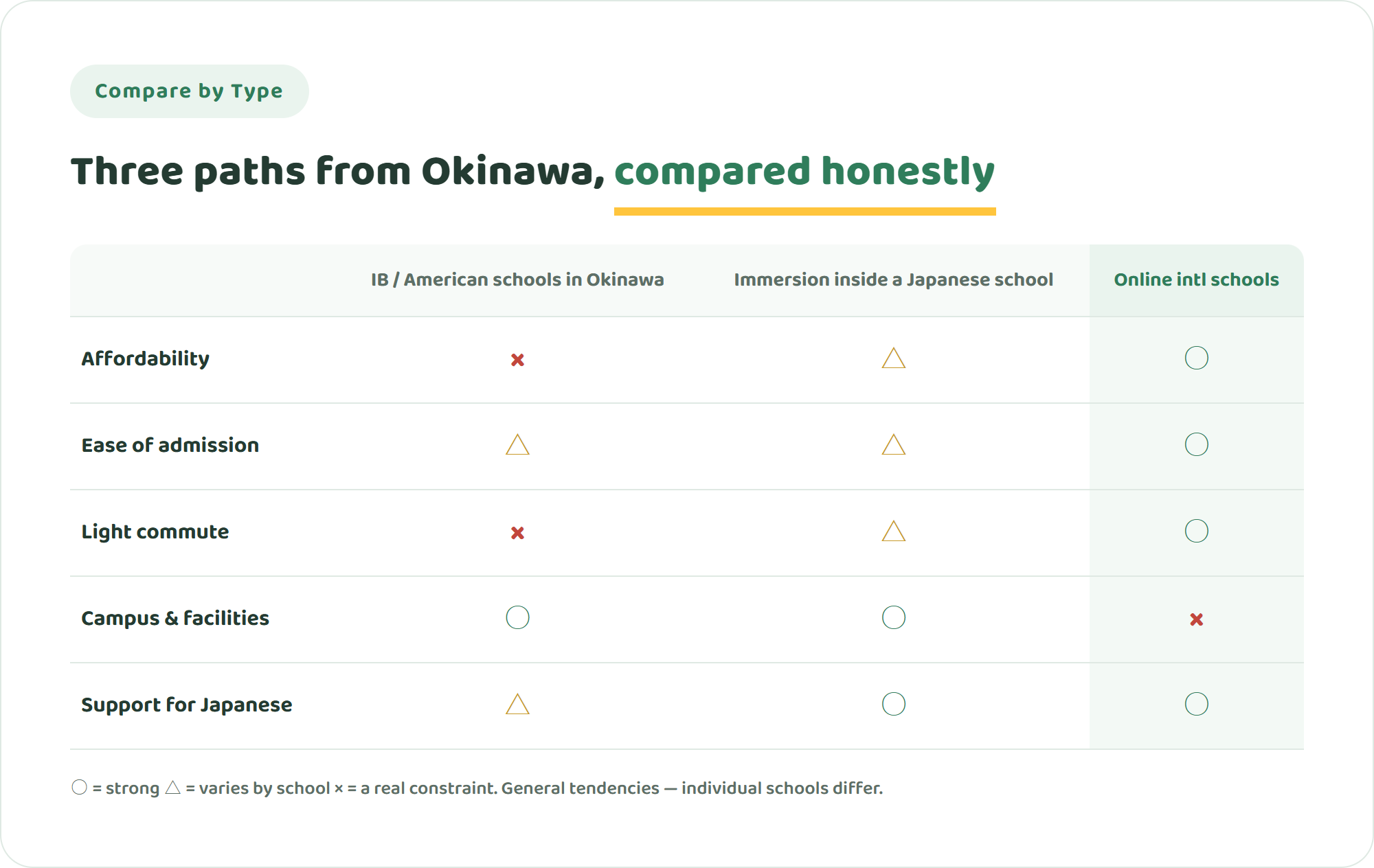
A full IB continuum school like OIS gives you one unbroken road to universities abroad. But at ¥1.5–1.9 million a year across twelve years, the total climbs past ¥20 million. The American-system schools in Yomitan and Chatan and the Christian schools in Nakagusuku sit at half to two-thirds of that. Schools plugged into the Japanese system — AMICUS and AASO — let you build English without letting Japanese literacy slide.
And do not underestimate the commute. The central-belt schools look close together on a map, but anyone who has driven Route 58 or Route 330 at 7:40 in the morning knows better. Picture an hour each way, twice a day, for twelve years, and ask whether the family routine survives it. Choose the education you can sustain, not merely the school that admits you.
If committing your whole education budget to one campus feels frightening, there is a middle path: keep your child in the local Japanese school and add international learning around it — see how learning is structured online. You keep the friendships, the school lunches and the club activities, and add English and a wider world on top.
See how learning works online →
When nothing is within reach — the online option
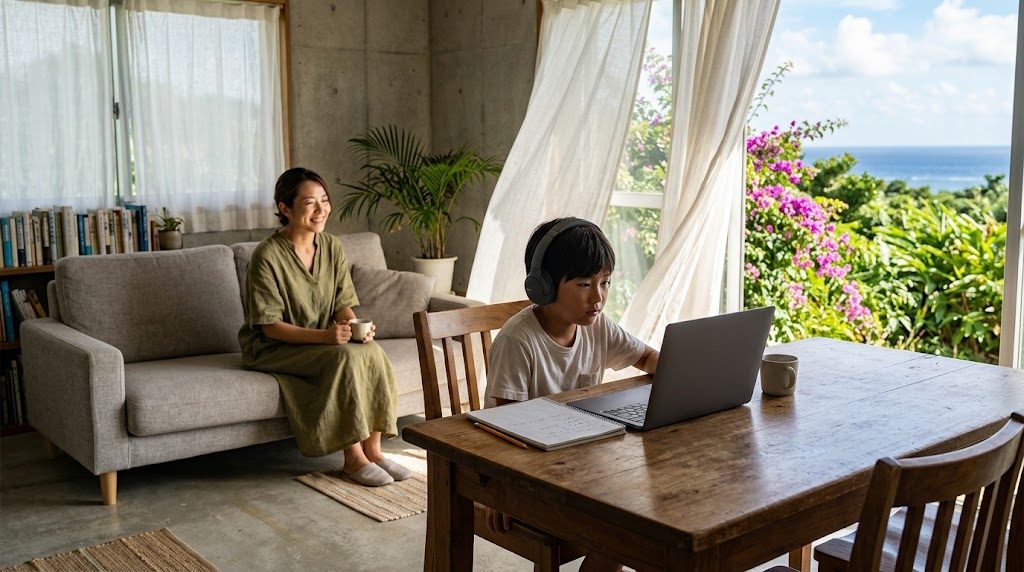
The most common wall families hit in Okinawa is this: they find a school they like, and then realise they cannot get there every day. From Nago to Chatan, from Ishigaki to the main island, from Miyako to Naha — a stretch of ocean is not something family effort can solve. Even inside the central belt, we have watched families give up after a few years, worn down by traffic and the driving.
That is why we would ask you to consider learning that does not depend on a commute. NIJIN GLOBAL ACADEMY (NGA) is an online international school opening in September 2027, operated by NIJIN Inc. in Japan. Our alternative school in Japan, NIJIN Academy, already has more than 1,000 students enrolled.
What we care about is refusing to rank children by test scores, and keeping classes small and conversation-led. Our promise is simple: that children come to like themselves and the world. We serve ages 6 to 18 across Asia and Oceania, and location makes no difference — Ishigaki, Miyako, Naha or Nago, the terms are the same. We are aiming for tuition around one-fifth of a campus-based international school. And rather than switching everything to English overnight, the design assumes Japanese as a support and lets children move into English gradually. Neither language has to be sacrificed — and that design was built with families in places like Okinawa’s islands in mind.
Two honest caveats. NGA has not opened yet, so we have no graduate outcomes to show you. And because we are online, we cannot offer the schoolyard, the sports field, or the detour home with friends in the way a campus can. If those matter most, a central-belt school is the better fit. But if it turns “we can’t get there, so we’re giving up” into “we can keep going without getting there,” we think it is worth a look.
Frequently asked questions
Q. Can we reach a school from anywhere in Okinawa prefecture?
No. Full-time international schools are concentrated in the central belt — Chatan, Yomitan, Nakagusuku, Ginowan and Uruma — plus Nanjo City in the south. Commuting daily from north of Nago, or from Ishigaki or Miyako, is not realistic. Decide first how many minutes each way your family can sustain for twelve years, then look only inside that circle. School bus routes vary enormously between schools, so ask about them at the enquiry stage.
Q. Could we use a base school, or a school outside the prefecture?
The 13 DoDEA schools on the bases are for dependents of active-duty US military personnel and Department of Defense civilians; a civilian Japanese family cannot enrol by paying tuition. Commuting to another prefecture is also off the table — Okinawa is separated by sea. Choosing a mainland school in practice means a boarding place or moving the family, and some families adopt boarding only from junior high or high school age.
Q. Do children need English to enter, and is there Japanese support?
Most preschools and kindergartens accept children with no English at all. Transfers from the upper primary grades usually involve an English assessment, and some schools — OCSI, for instance — charge a separate ESL fee. If you want to protect your child’s Japanese literacy, schools with proper Japanese-language subjects are the safer bet: AMICUS as a Japanese-accredited school, or AASO with its double immersion model. Families worried specifically about a child’s Japanese may also want to look at Tomodachi Japan, our sister service offering online Japanese lessons for children.
Growing up in Okinawa does not mean being far from the world
There may be moments when you think the mainland would have given you more choices. But Okinawa has a school that has been teaching children in English since 1957, a school that built an English-immersion environment inside the Japanese system, and a bilingual school that mothers founded with their own hands. Very few prefectures hold a ¥1.9 million IB school and a ¥360,000 non-profit on the same island.
What does not change is that almost all of it sits in the centre of the main island. For families raising children in Nago, on Ishigaki, on Miyako, that map can feel unkind. So put all three options on one table — a central-belt school, relocating, and learning online — and choose the one your family can actually sustain. Being surrounded by ocean is not the same as being far from the world. If your child ends up liking themselves and liking the world, whichever road you took was the right one.
International School Guides for Other Prefectures
- International Schools in Kumamoto Prefecture
- International Schools in Kagoshima Prefecture
- International Schools in Nagasaki Prefecture
- International Schools in Hokkaido Prefecture
- International Schools in Kanagawa Prefecture
- International Schools in Aichi Prefecture
- International Schools in Hyogo Prefecture
- International Schools in Saga Prefecture
- International Schools in Saitama: All 34 Listed
- International Schools in Shiga Prefecture
- International Schools in Shimane Prefecture
- International Schools in Shizuoka Prefecture
- International Schools in Tochigi Prefecture
- International Schools in Tokushima Prefecture
- Browse all 47 prefectures of Japan