A new country every few years. Where the next posting will land, you don’t yet know. For expat and transfer families who move across borders, nothing weighs on you quite like the question of your child’s school. Just as they finally settle into a local school, the next assignment comes through — the goodbyes, the language barrier, the learning that keeps getting cut off partway. “Is my child’s education actually building on itself, or starting over each time?” If you’ve felt that worry, you are far from alone.
This piece is written for families whose child crosses borders and changes schools again and again. We’ll look at the options through one lens that matters most when you move: learning that can continue. A local school, an on-campus international school, homeschooling, and a third road — an online high school for expat families. We’ll compare these four honestly, on the factors that truly count for a globally mobile family, and lay out how to choose the one that fits yours. Not to declare a single right answer, but to give you what you need to choose with confidence.

Three school-choice worries of expat and globally mobile families
Choosing a school when you move often carries difficulties that families who stay put never face. They tend to fall into three.
The first is broken continuity. A new country means a new education system and curriculum. What your child learned in the last country doesn’t line up with the assumptions of the next, and everything they built starts over. The second is the burden of re-adapting. A new language, new friends, a new culture — learned from scratch, every single move. It wears a child down, and there are stretches where study is simply out of reach. The third is that credentials don’t travel. Because systems differ from country to country, grades and completion records may not carry over, and planning for high-school completion or university admission becomes hard to see clearly.
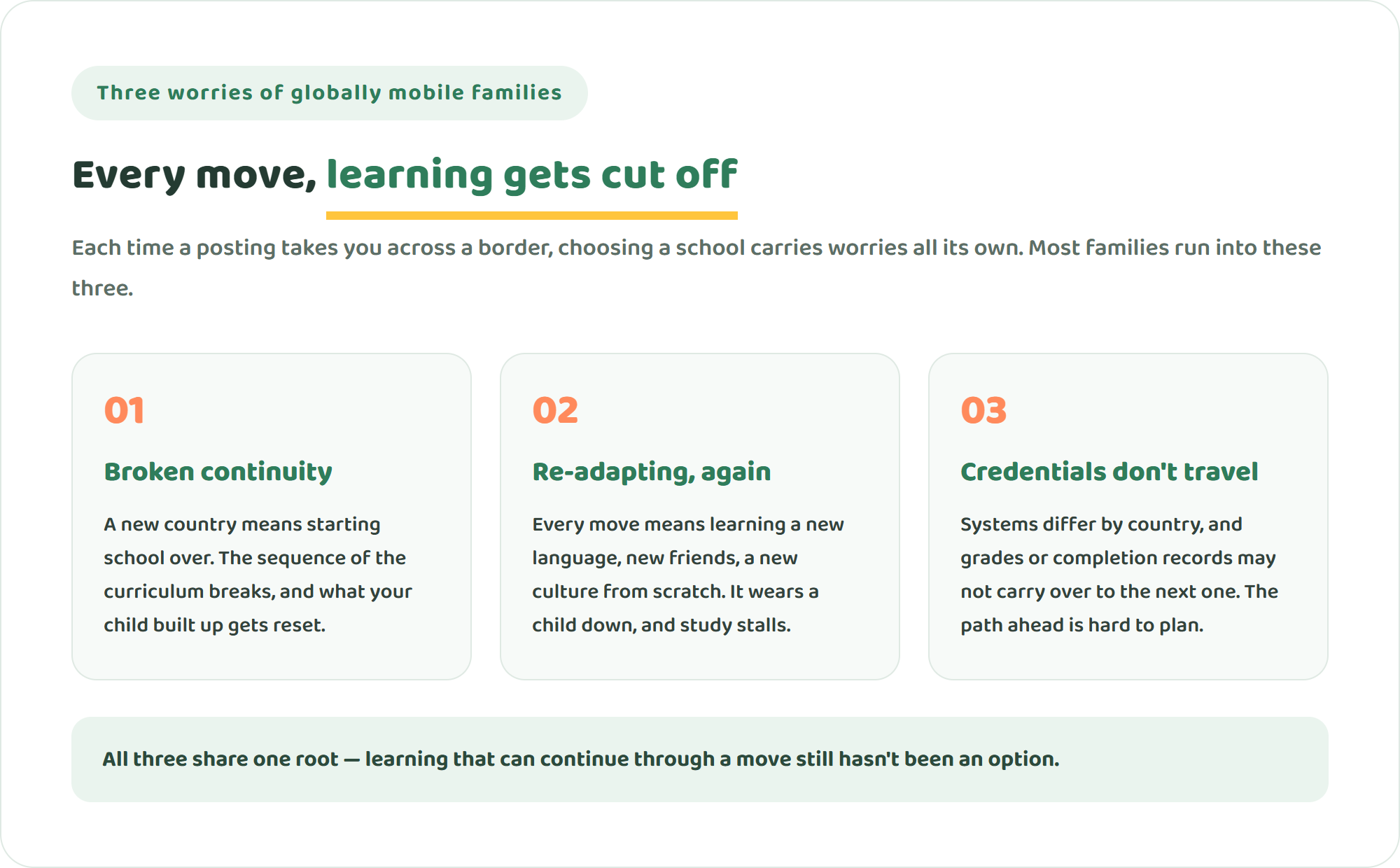
These three share one root: learning that can continue through a move still hasn’t been on the table. Put the other way around — secure that one thing, and the school worries of an expat life ease considerably. So which way of learning comes closest to it?
A local school, on-campus international, homeschooling, online — an honest comparison
A mobile family has four broad options, each with its strengths and its difficulties. Keeping in mind what an international school is, let’s look at them flatly.
A local school immerses your child fully in the country’s language and culture — its real appeal. But each new country means starting over, with neither language nor system carrying on. An on-campus international school lets your child learn a globally shared curriculum such as the IB or Cambridge (IGCSE), and if a sister school exists in the next country the transition can be smoother. On the other hand, tuition runs high, and a related campus won’t always be waiting at your next posting. Homeschooling has continuity as its greatest strength — the materials travel wherever you move — yet connection with peers of the same age tends to thin out. And an online international school works wherever you live, carrying the same school and the same peers with you across every move.
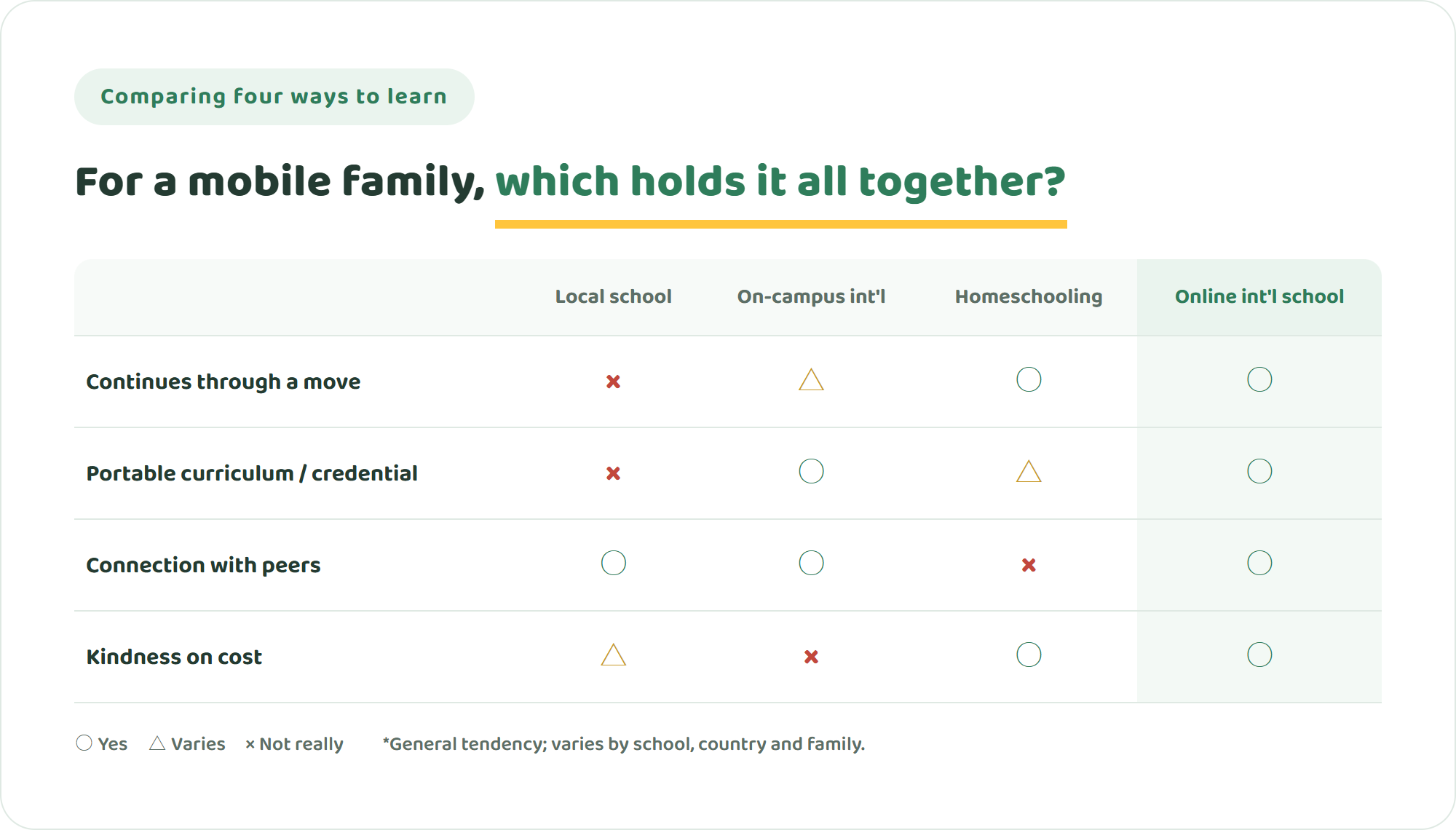
Laid out as a table, the fork for a mobile family becomes clear. On “continues through a move,” a local school — bound to its country — is inevitably weak. On affordability, an on-campus international school tends to be the costliest. Holding on to a globally shared education and a connection with peers, from home, without letting go of either when you move — that ease of holding it all together is what an online international school offers. It’s no cure-all, but it answers, in one form, the three worries a mobile family carries.
See how online learning works →
Why an online high school suits families who move often
Why does online learning pair so well with expat and transfer life? Because it speaks directly to continuity — the root of the whole problem. When the school lives inside the screen, your address can change while the school you attend does not. The curriculum, the teachers, the peers learning alongside your child all carry on across the move. That draining ordeal of starting over each time you cross a border — you can spare your child from it.
What’s more, the peers at an online international school are themselves scattered across the world, and many are growing up moving between countries just as your child is. An environment where a child can feel “I’m not the only one who moves” is, in itself, a source of steadiness. On cost, too, it tends to be easier to keep down than a commuting on-campus school, and you can more often avoid paying a fresh, hefty enrolment fee with every posting — see also whether online international schools are affordable. Recognised pathways such as the IGCSE, the IB, and diplomas you can work toward online are, in general terms, steadily taking shape — so you can now choose with an eye on where international school graduates go.

How to choose for your family — in three steps
So how do you actually choose? Here are three steps to help a mobile family choose without regret.
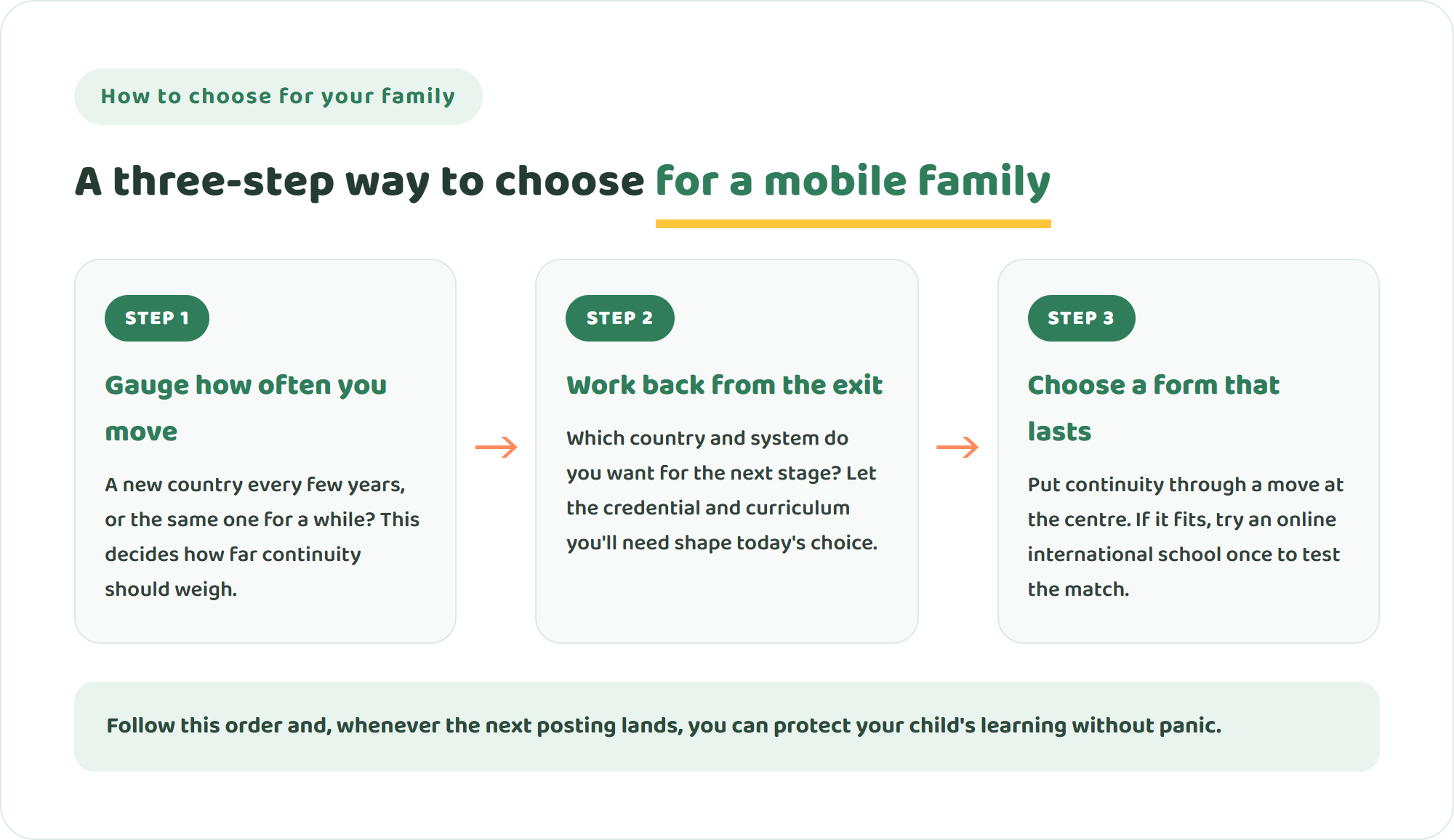
First, STEP 1 — gauge how often you move. A new country every few years, or the same one for a while? This decides how far continuity should weigh. The more you move, the more a place-independent way of learning is worth. Next, STEP 2 — work back from the exit. Picture which country and which system you want for the next stage, and the credential and curriculum you’ll need come into view. Settle the exit, and the entrance you should choose now settles too. Then, STEP 3 — choose a form that lasts. Narrow the candidates around continuity that won’t break when you move, and if one looks right, test the actual fit through a trial session at an online international school. If it doesn’t fit, there’s no need to force it.
Where NGA sits among these
With all of that in mind, here is where our NIJIN GLOBAL ACADEMY (NGA) sits. NGA is an online international school beyond the exam race, opening in September 2027, operated by NIJIN Inc. NIJIN Academy, which we run in Japan, already has over 1000 children learning with us. Being able to learn wherever you live is a strength that feels made precisely for globally mobile families.
What we aim for is learning built on coming to love yourself and the world. Rather than ranking children by test scores, we learn through small-group dialogue alongside peers around the world. When you move, the peers and teachers on the other side of the screen don’t change. On tuition, we’re aiming for around one-fifth of an on-campus international school — within reach. As for graduation credentials and the specifics of pathways, we’ll share details in stages as we approach opening; we won’t overstate what isn’t yet settled. Compare it fairly with the other options, and choose it when it feels right for your child.
Frequently asked questions
If a posting changes our country every few years, can my child stay at the same online high school?
Yes — that’s the single greatest strength of learning online. Because the school lives inside the screen, your address and country can change while the school, curriculum and peers do not. You avoid transferring and re-adapting from scratch with every border. Time zones are the one thing to check, though many online international schools accommodate the gap with recordings and follow-up support.
If we repatriate to our home country, is the learning wasted?
It isn’t wasted. The English your child builds online, and the experience of dialogue with peers around the world, are assets in any country they return to. That said, some paths — like needing a specific national high-school credential — call for checking the system side. That’s exactly why working back from the exit, as in STEP 2, matters. When in doubt, you can raise it with us through our opening updates.
Can a child still unsure of their English choose an online international school?
Yes. Among beyond-the-exam-race online international schools, some are designed around home-language support so a child can meet English little by little. Choose a place that treats English as “something to grow into” rather than “an entry requirement,” and even a child meeting international learning for the first time through a posting can take that first step with confidence.
Even in a life of constant moving, learning can continue.
A life across borders can be a great gift to a child. But for learning to break each time is a real waste. The third road of learning online holds out an option families never had before: that you need not let go of learning, or of peers, just because you move. What matters isn’t the best option in the abstract, but choosing — with conviction — the one that fits your family right now.
NIJIN GLOBAL ACADEMY opens in September 2027. We’ll share how our learning works — place-independent, with small-group dialogue that connects to the world — along with first-cohort enrolment news, straight to your inbox. Whenever the next posting lands, your child’s learning is something you can protect, together. Take that first step from here.
Get opening updates by email →
More on choosing an international education
- How to Choose an International School——7 questions to ask before you enrol
- 6 International Qualifications You Can Earn Online——An honest guide
- When Your Child Does Not Want to Go to School——How to respond, and 5 real options
- How Much Household Income Do You Need for an International School?——Budgeting so it lasts
- What Is the International Baccalaureate?——IB vs Cambridge, honestly compared
- Starting International School in the Elementary Years——What changes, and what it costs
- How Much Does an International Preschool Cost in Japan?——Fees, subsidies, and the step after kindergarten
- Can You Raise a Bilingual Child Without Speaking English?——What parents can realistically do at home
- School Refusal? An Online International School Can Reopen Learning——A route back into learning
- How Do You Nurture the Skills Standardized Tests Cannot Measure?——Beyond exam scores