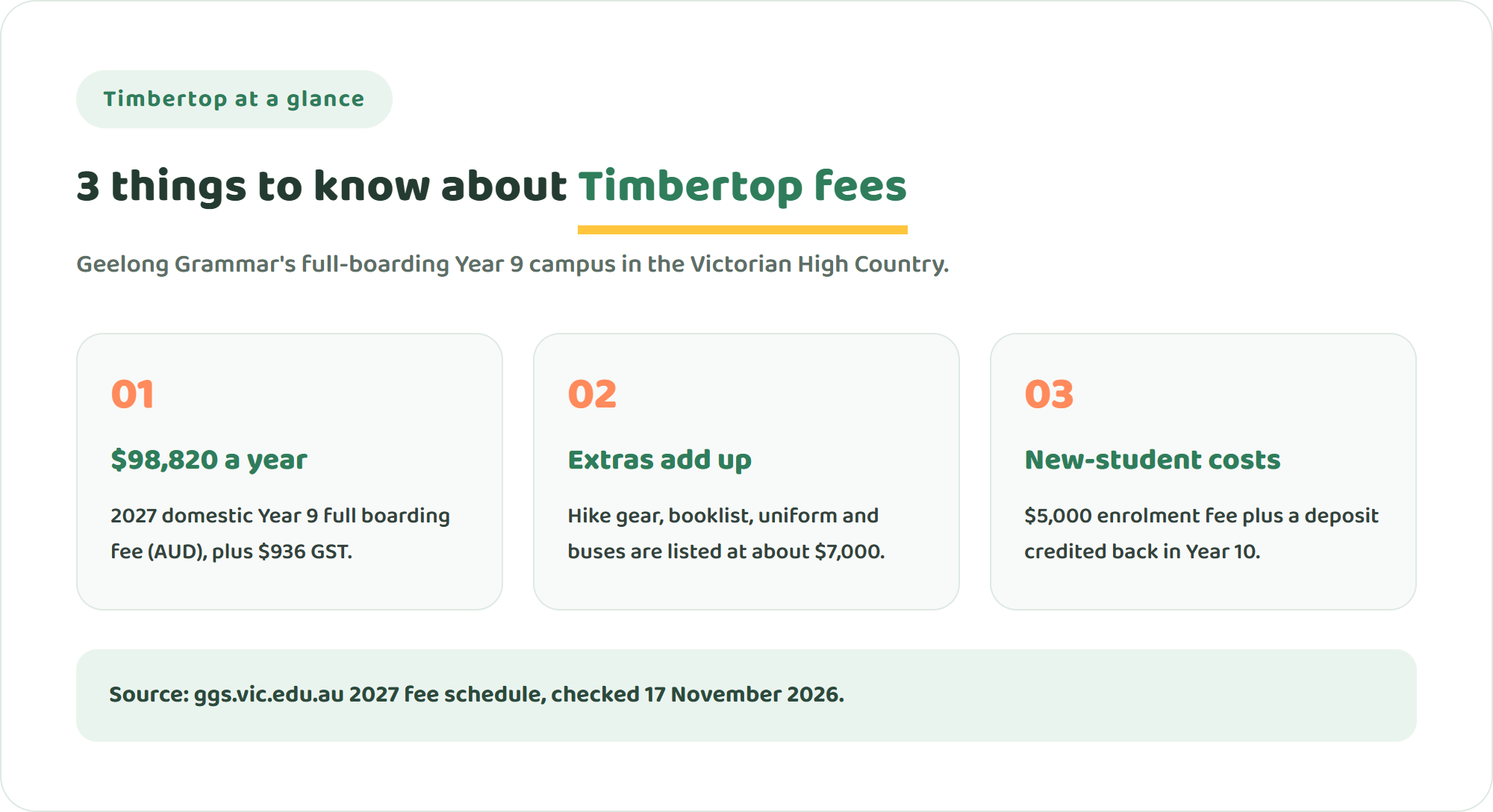
Timbertop fees for 2027 are the Geelong Grammar School Year 9 full boarding fee: $98,820 a year ($24,705 a term) plus $936 GST for Australian citizens and permanent residents, and $119,600 a year ($29,900 a term) plus $936 GST for overseas students on a student visa (AUD), according to the school’s official 2027 fee schedules, effective 1 January 2027 (checked 17 November 2026). There is no separate “Timbertop fee” on top of school fees — the Timbertop line is the Year 9 fee — but there are entry fees, a refundable-by-credit deposit for new students and a list of indicative extras that the headline figure does not include.
If you searched “Timbertop fees”, “Timbertop school fees” or “Timbertop Geelong Grammar cost”, you probably already know the headline number. What is harder to find is the total: what the boarding fee covers, what families pay on top (hike gear alone is listed at about $4,000), how the Senior School Transition Deposit works, how day families can spread the Year 9 jump, and when a new student has to apply. This page brings those official numbers together with the arithmetic shown, describes what a Timbertop week actually looks like, and sets out the honest concerns and the alternatives, including a very different option, NIJIN GLOBAL ACADEMY (NGA), an online school that opens in September 2027.
The short answer: who Timbertop suits — and who it doesn’t
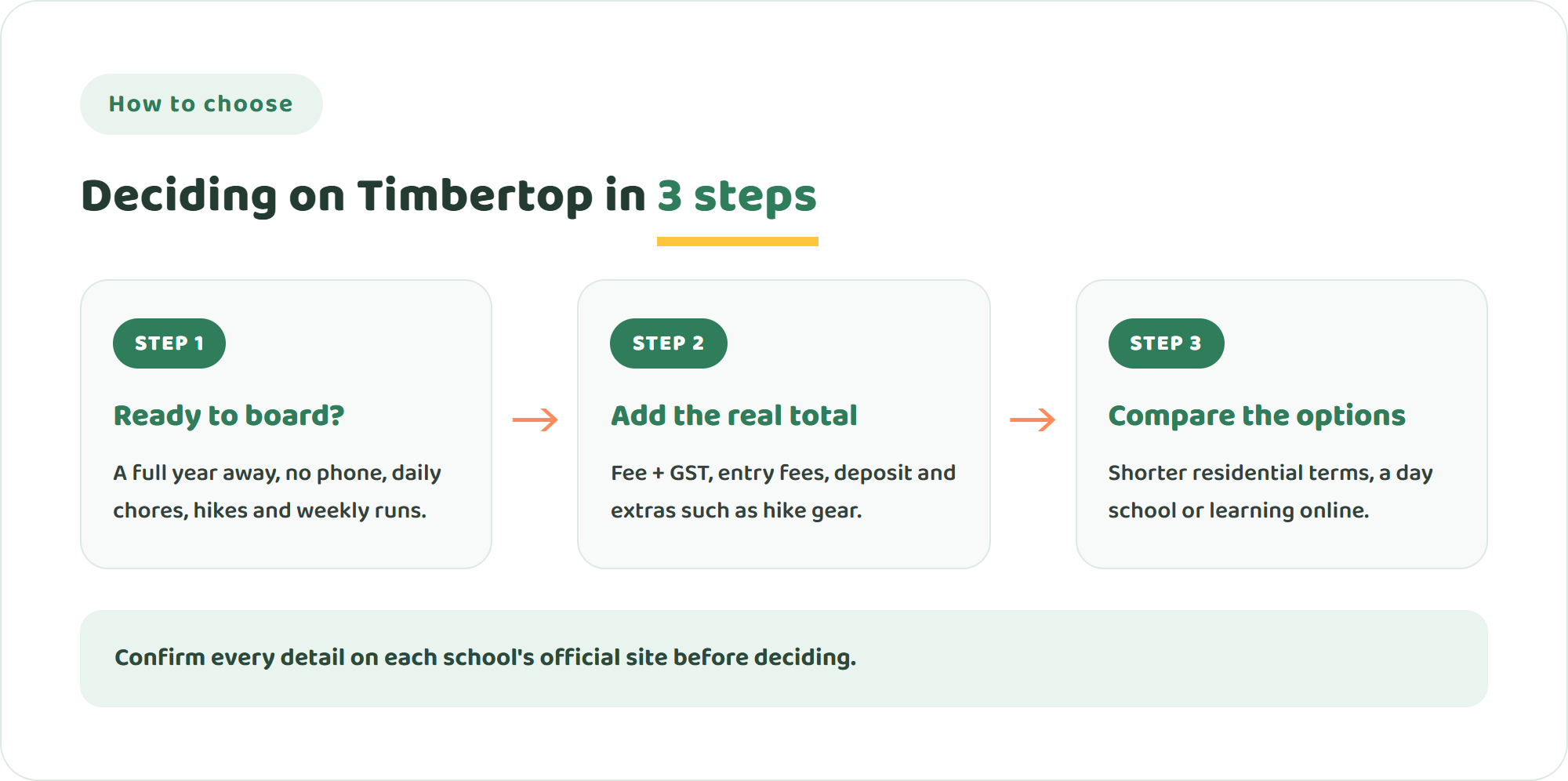
- Suits a 14–15-year-old who is ready to live away from home for a full school year, enjoys (or is willing to learn to enjoy) long hikes, running and physical work, and can cope without a phone or screens.
- Suits families who plan to continue at Geelong Grammar into Years 10–12 at Corio. The school weighs “intention to continue to Senior School” when it makes Year 9 offers, and its deposit rules reward it.
- Suits families who can budget around $100,000 for one year (domestic) plus several thousand dollars of extras, or who qualify for the day-family spreading scheme or a scholarship.
- May not suit a child who is anxious about separation, who has health needs that are hard to manage three hours from Melbourne, or who dislikes outdoor exertion — every student runs, hikes and does rostered chores.
- May not suit families who want weekly contact by phone or messaging. Mobile phones, the internet and social media are excluded at Timbertop.
- May not suit families wanting only a “taste” of residential outdoor education. Programmes at MLC (Marshmead) and Wesley College (Clunes) run for about eight weeks rather than a whole year.

What Timbertop is
Timbertop is Geelong Grammar School’s Year 9 campus. The school describes it as nestled in a secluded valley in the foothills of the Victorian Alps, three hours’ drive from Melbourne, on over 325 hectares of bush and farming land in the Victorian High Country, near Mansfield and Mt Buller. It was established in 1953 and celebrated 70 years in 2023. It is a co-educational, full boarding campus: the school’s Life at Timbertop page describes a community of around 250 students living in sixteen Units (eight for boys and eight for girls), each with up to fifteen fellow students.
Students come from Geelong Grammar’s own Middle School at Corio (and, from 2027 and 2028, from the Toorak Campus Years 7 and 8) plus new students who join the school in Year 9. The fee schedule states that full boarding is integral to the Timbertop experience and that all students at Timbertop board, returning home during mid-term exeats and holidays. There is no day-student option at Timbertop.
| Item | Timbertop (official information) |
|---|---|
| School | Geelong Grammar School (independent, Anglican, co-educational; CRICOS 00143G) |
| Year level | Year 9 only, for the full academic year |
| Students | Around 250; 16 Units (8 boys, 8 girls) of up to about 15 students |
| Location | Foothills of Mt Timbertop, Victorian High Country; about three hours from Melbourne |
| Opened | 1953 |
| Boarding | Full boarding for every student; home for exeats and holidays |
| Academic week | Friday to Tuesday; the weekend is Wednesday and Thursday |
| 2027 fee (domestic) | $98,820 a year ($24,705 a term) + $936 GST |
| After Timbertop | Years 10–12 at the Senior School, Corio Campus (VCE or IB Diploma) |
Timbertop fees for 2027 (official), and what they include
Geelong Grammar publishes one fee line for Timbertop in its Domestic Students Fee Schedule 2027 and its Overseas Students Fee Schedule 2027, both linked from the official Fees & Business Notices page. Fees are paid in four termly instalments. The 2027 schedule is the newest one published; the school notes it is subject to annual review.
| 2027 fee item (AUD) | Domestic student | Overseas student (subclass 500 visa) |
|---|---|---|
| Timbertop full boarding, Year 9 — per term | $24,705 | $29,900 |
| Timbertop full boarding, Year 9 — per year | $98,820 | $119,600 |
| GST shown on the schedule (per year) | $936 | $936 |
| Application fee (non-refundable) | $350 | $500 |
| Enrolment fee once a place is accepted (non-refundable) | $5,000 (Year 9 rate) | $5,500 |
| Senior School Transition Deposit (new Timbertop students) | One full term of Year 10 boarding fees ($24,705 at 2027 rates) | One full term of Year 10 boarding fees ($29,900 at 2027 overseas rates) |
Note that the Year 9 enrolment fee for domestic students ($5,000) is double the $2,500 charged for other Prep–Year 12 entry points. “Domestic” includes Australian citizens and permanent residents living overseas.
What the Timbertop fee includes
The schedule lists these inclusions: tuition and study skill support; compulsory external tests and exams; the Timbertop yearbook; timetabled sport and activities; canoeing and cross-country skiing; Unit outings; furnished accommodation (a single bed in a shared dorm, with personal storage and shared bathrooms) and meals seven days a week (breakfast, lunch, dinner and supper); buses for official sport, activity and academic purposes; 24/7 access to the Timbertop Health Centre; laundry; and a technology levy.
What it does not include: the official list of indicative extras
Appendix A of the 2027 domestic schedule lists “indicative course related costs” for Timbertop that “may be incurred and charged separately” depending on your child’s activities:
| Timbertop extra (2027, indicative) | Per term | Per year |
|---|---|---|
| Hike gear | — | $4,000 |
| Booklist / bookroom items (through Campion) | — | $1,500 |
| Uniform (less if pre-loved; excludes chosen sport or optional items) | — | $800 |
| Bus — exeat / end of term | $180 | — |
| Chemist and medical charges (optional) | $250 | — |
| Postage, tuck (optional) | $200 | — |
| Skiing (other than cross-country) | — | $500–$1,300 |
| Hobbies | — | $10–$450 |
| Bogong trip | — | $250 |
| Duke of Edinburgh Scheme | — | $200 |
| Visual arts kit | — | $180 |
| Birthday cake | — | $30 |
| Vocal / music lessons (per instrument; optional) | From $579 | — |
Notebook computers are not on the Timbertop extras list, which fits a campus where computers and the internet are excluded from student life. A laptop package is listed for students entering Year 10 at the Senior School instead.
Total cost examples (official numbers, our arithmetic)
These examples only use figures from the 2027 schedules. Extras are indicative, so treat them as a planning range, not a quote.
- Core extras most families should expect: hike gear $4,000 + booklist $1,500 + uniform $800 + exeat/end-of-term buses 4 × $180 = $7,020.
- Every listed extra at the top of its range, excluding music: $30 + $250 + $1,500 + $720 + $1,000 (medical, 4 terms) + $200 + $800 (postage/tuck, 4 terms) + $4,000 + $450 + $1,300 + $800 + $180 = $11,230. Add one instrument for four terms from 4 × $579 = $2,316.
- New domestic student joining in Year 9: $98,820 + $936 GST + $350 application + $5,000 enrolment + $7,020 core extras = $112,126 for the year. The $24,705 Transition Deposit is also paid in Year 9 (cash out of about $136,831 in total) but is credited to the Year 10 Term 3 statement if the student continues.
- New overseas student joining in Year 9: $119,600 + $936 GST + $500 application + $5,500 enrolment = $126,536 before extras, plus a deposit of one Year 10 overseas boarding term ($29,900). Overseas families also need the compulsory health cover listed in the overseas schedule.
- Existing day family at Corio: the Year 8 day fee is $48,180; Timbertop is $98,820, a jump of $50,640. If the school approves the spreading scheme, that difference is paid in equal parts over Years 8, 9 and 10 — on 2027 figures roughly $16,880 a year (our division; the school sets the actual amounts).
For the full Year 7–12 picture, including day and boarding routes through Corio, see our Geelong Grammar School fees guide, which totals every year from Year 7 to Year 12 using the same 2027 schedules.
Timbertop vs a regular Year 9 at a city campus or day school
The biggest cost question for most families is not “what does Timbertop cost?” but “what does it cost compared with a normal Year 9?” Because every Geelong Grammar Year 9 is at Timbertop, there is no Corio day option to compare with inside the school. The useful comparisons are the school’s own fees on either side of Year 9, and a Year 9 at a Melbourne day school.
| Year 9 option | 2027 fee (domestic, AUD) | Living arrangement | What is different |
|---|---|---|---|
| Timbertop (GGS Year 9) | $98,820 + $936 GST | Full boarding, whole year | Hikes, weekly runs, chores, no phones or internet, Wed–Thu weekend |
| GGS Year 8 day student at Corio (the year before) | $48,180 | Lives at home | Normal school week; Saturday sport compulsory from Year 7 |
| GGS Years 10–12 day boarding at Corio (the year after) | $58,320 | Lives at home | Day boarding in the Senior School |
| Melbourne independent day school, Year 9 | See each school’s official schedule | Lives at home | Usually camps or a shorter outdoor programme rather than a full year away |
In other words, a day family pays about twice the Year 8 fee for the Timbertop year, because the price includes a full year of boarding, meals, supervision and an outdoor programme. Compared with full boarding elsewhere at Geelong Grammar, Timbertop costs the same as Years 10–12 full boarding ($98,820). If you are weighing a Melbourne day school instead, our pages on Melbourne Grammar School fees and Scotch College Melbourne fees set out their official schedules, and our overview of international schools in Melbourne covers IB options in the city.
What a week at Timbertop looks like: hikes, runs, chores and school
Timbertop is still a school: the curriculum page describes a full Year 9 academic programme with English, Mathematics, Science, History, Outdoor Education Studies and Positive Education as core subjects, plus five semester-unit electives chosen from French, Japanese, Chinese, Music, Geography, History, Visual Arts, Health and Physical Education, and Agriculture and Land Management. The academic week runs Friday to Tuesday, and the weekend falls on Wednesday and Thursday, which the school says avoids busy tourist periods in the High Country.
The school’s Daily Routine at Timbertop page sets out a typical day:
- 6:55am — rostered students prepare and serve breakfast (“slushies”); 7:20am breakfast for all students and staff.
- 8:15am — Unit inspection; 8:30am lessons begin; recess at 10:45am.
- 1:00pm — lunch preparation and clean-up on a roster; lunch at 1:20pm; Chapel at 2:30pm.
- 3:00pm — the long run on Sundays, or more classes; cross-country (“crossie”) run on Saturdays.
- 6:00pm — dinner; 6:50pm prep (quiet study) in the Unit.
- 8:20pm — Unit jobs, then supper; 8:50pm thirty minutes of silent reading; 9:20pm lights out.
Runs. All students and staff run cross-country every week on bush tracks. Distances build through the year to the 33-kilometre Timbertop Marathon at the end of the year.
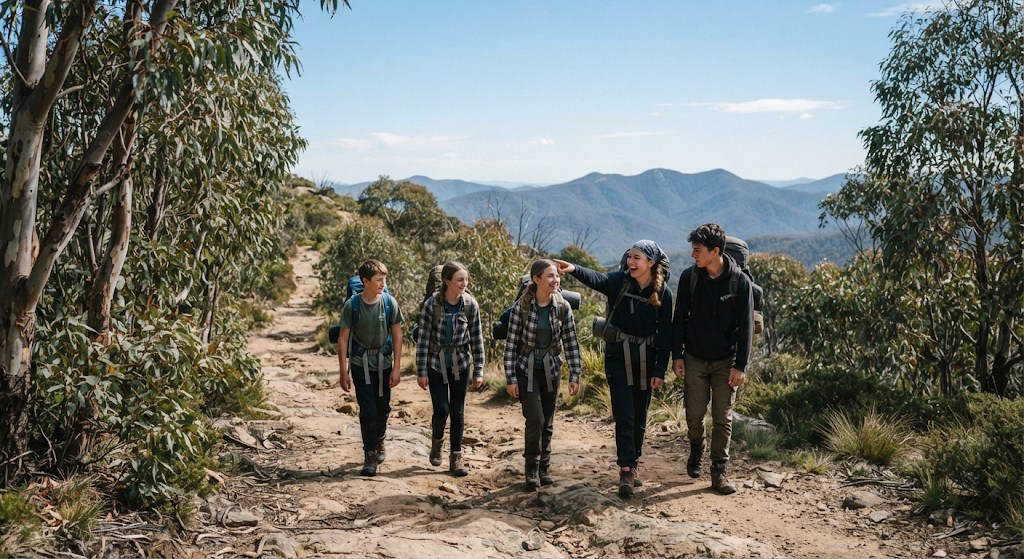
Hikes. According to the Timbertop Outdoor Education page, Term 1 starts with skills training and a hike up Mt Timbertop, then a series of two-and-a-half-day hikes, a Three Day Hike and a solo experience. Term 2 includes a four-day Unit hike past the Crosscut Saw, an overnight solo and a Rogaine. In Term 3 each Unit makes an overnight winter expedition to Mt Stirling for cross-country skiing, and the term ends with a four-day backcountry expedition on the Bogong High Plains, including snow camping. Term 4 builds to a Four Day Hike and a Six Day Hike on which students plan their own route and logistics.
Chores. Students are responsible for their own living spaces. A “Service Wheel” rotates jobs weekly within each Unit; students take turns preparing, serving and cleaning up meals; and chopping wood for the slow-combustion heaters and hot water boilers is a daily routine. In Term 2, many weekends go to community service with local Mansfield families — wood chopping and stacking, gardening, fencing and cleaning.
Weekends and exeats. Weekend activities include hiking, canoeing, skiing, rafting and camping. Students go home for one exeat each term; in 2027 these are 26 February–1 March, 15–18 May, 14–17 August and 30 October–2 November, according to the official 2027 term dates. New students arrive on Friday 29 January 2027, Corio students on Saturday 30 January, and the programme starts on Sunday 31 January; the year ends on Friday 3 December.
It is a sharp contrast with learning from home. If you are curious what the opposite end of the spectrum looks like, our page on how an online international school works walks through a typical day of live online classes.
Entry points: when to apply for Timbertop
There are two ways into Timbertop.
- Already at Geelong Grammar: students in Year 8 at the school move up to Timbertop and do not need to apply. The main entry points before that are Year 7 or Year 8 at the Corio Campus, and Year 7 (from 2027) or Year 8 (from 2028) at the Toorak Campus. The Entry into Timbertop page notes that Middle School enrolment does not by itself guarantee a Timbertop place.
- Joining as a new student in Year 9: places are available each year, but applications exceed places, so not every applicant receives an offer. The school asks for Year 7 and Year 8 reports and NAPLAN results, a Pre-Enrolment Questionnaire and a personal interview for parents and child with the Admissions Manager or a delegate. Students whose first language is not English must pass an approved English language proficiency test.
Offers are based on a weighted assessment of suitability to board and capacity to thrive in a demanding boarding environment, whether the school can make reasonable adjustments, intention to continue to the Senior School, academic progress (including comments on attitude, behaviour and effort), interests and activities, the needs of the existing Year 8 cohort, siblings and family association, and date of application — which alone does not guarantee a place.
Timing. The Timbertop entry page does not publish a closing date, so a specific Year 9 application deadline is not published on the official site. Geelong Grammar says it accepts applications at any time and that interviews typically take place one to two years before entry, so families aiming for Year 9 in 2028 or 2029 should apply early. For existing day families, the deadline that matters most is financial: applications for the Timbertop fee-spreading scheme must reach the Admissions Office before 1 August in Year 7.
Scholarships and bursaries for Timbertop families
Geelong Grammar’s Scholarships page lists Academic, General Excellence (including Rural and Regional), Music, Sports, Choral and Boarding scholarships for 2028 entry (Visual Arts is not open for 2028 entry). Scholarships are awarded one year ahead: applications for major scholarships open on Monday 2 November 2026 and close on Monday 1 February 2027, the examination is on Saturday 20 February 2027, interviews run from April to June 2027, and outcomes are sent by June 2027. Sports scholarship expressions of interest close on Wednesday 21 July 2027.
Scholarships can cover tuition and boarding fees “in part or in full”, and boarding scholarships are offered for entry in Years 7 to 11 — a range that includes Year 9. The school says it supports over two hundred students through scholarships each year and offers an additional one hundred bursaries and concessional support to existing families who need financial help. The value of individual scholarships and the number available for Year 9 entry are not published on the official site. Ask Admissions directly whether a Timbertop-entry scholarship is available in the category you are considering.
Other official ways to reduce the cost: the day-family spreading scheme described above; sibling discounts of 20% for the third and subsequent child when all are boarders, or 15% when not all are boarders (applied to the youngest); and the Transition Deposit, which is waived where a sibling of the new student already attends the Senior School.
Accreditation, diploma and what comes after Timbertop
Timbertop does not award a qualification of its own; it is Year 9 of Geelong Grammar School, a registered Victorian independent school that also enrols international students (CRICOS 00143G). After Timbertop, students return to the Senior School at Corio for Years 10–12, where they choose between the Victorian Certificate of Education (VCE) and the International Baccalaureate Diploma. The school’s Year 9 curriculum is designed, in its own words, to prepare students for the Senior School on their return to Corio.
This is why the Senior School Transition Deposit exists. It equals one full term of Year 10 boarding fees, is charged with the Year 9 Term 1 fees (or spread across the year), is credited to the Year 10 Term 3 statement if the student continues, and is forfeited if the student does not move on to the Senior School — including if the student does not complete the Timbertop year. Families considering Timbertop as a one-year experience before moving elsewhere should factor that in.
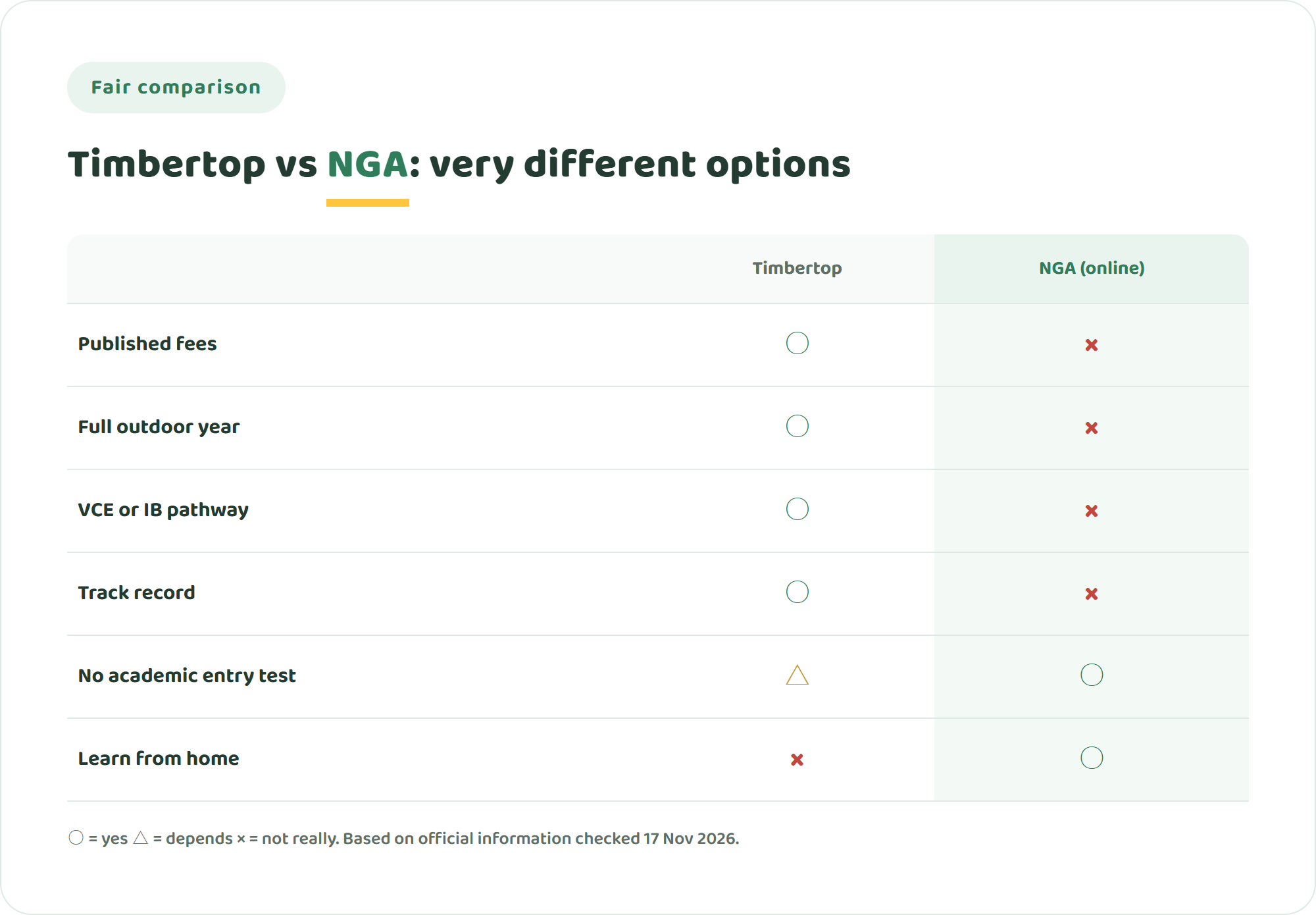
Timbertop vs NIJIN GLOBAL ACADEMY vs two other Year 9 options (official data)
The fairest comparison for Timbertop is other Year 9 residential programmes. Two well-known Melbourne examples are MLC’s Marshmead campus and Wesley College’s Clunes programme. We add NIJIN GLOBAL ACADEMY because it is a fundamentally different choice — learning online from home — and we are the school behind this site.
| Timbertop (Geelong Grammar) | NIJIN GLOBAL ACADEMY | MLC Marshmead | Wesley College at Clunes | |
|---|---|---|---|---|
| School type | Independent Anglican co-ed school; residential Year 9 campus | Online international school (operated by NIJIN Inc., Japan) | Residential campus of Methodist Ladies’ College, Melbourne (girls) | Residential programme of Wesley College, Melbourne |
| Grades / ages | Year 9 (whole year) | Ages 6–18 | Year 9 (one term) | Year 9 (part of one term) |
| Length away from home | Full academic year, home for exeats and holidays | None — learn from home | About eight weeks; a city-based Melbourne Term is offered instead | Eight weeks |
| Fees (2027) | $98,820 + $936 GST (domestic); $119,600 + $936 GST (overseas) | Not yet published; no enrolment, facility or uniform fees, materials included | See official site | See official site |
| Curriculum | Full Year 9 programme + outdoor education; VCE or IB in Years 10–12 | Live small-group classes in English with a bilingual mentor; optional Cambridge IGCSE / A-Level pathway | Sustainability, resilience, outdoor education and community | IB Middle Years Programme, with learning in local businesses |
| Live classes & time zone | In person, Victoria | Timetable built for Asia and Oceania daytime | In person, East Gippsland | In person, Clunes (Victorian goldfields) |
| Accreditation / diploma | Registered school; VCE or IB Diploma after Year 9 | Not yet accredited; no graduates yet (opens 2027) | Part of MLC; see official site | Part of Wesley College; see official site |
| Admission | Reports, NAPLAN, questionnaire, interview; places limited | No academic entrance exam and no English requirement | For MLC Year 9 students | For Wesley Year 9 students |
| Start dates | New students arrive 29 January 2027 | Opening September 2027 (planned); free trial classes monthly | See official site | See official site |
Sources: Geelong Grammar School 2027 domestic and overseas fee schedules, Fees & Business Notices, Entry into Timbertop, Year 9 at Timbertop, Life at Timbertop, Daily Routine, Outdoor Education, Scholarships and 2027 term dates pages; MLC Middle School page; Wesley College Clunes page (our direct fetch was blocked, so its description is taken from the official page as shown in search results). All checked 17 November 2026.
Reviews and common concerns, answered honestly
“Will my child be homesick?”
Homesickness is a common worry for any boarding year, and the programme is built around living closely with a Unit of up to fifteen peers. The school describes a pastoral support structure and a 24/7 Health Centre, and students go home for an exeat roughly halfway through each term. The honest question is whether your child is ready for a full year of this; the school itself weighs “suitability to board” when it makes offers to new students.
“How do we stay in touch without a phone?”
The official Timbertop page says television, mobile phones, social media, the internet and computers are excluded, and that students use the time for reading, writing letters, creative work and conversation. A detailed policy on phone calls home is not published on the official site — ask the campus how and when families can speak with their child, especially in the first weeks.
“Is it too physically demanding?”
The programme is genuinely demanding: weekly runs that build to a 33-kilometre marathon, multi-day hikes up to six days, snow camping and daily chores such as chopping wood. The school says it considers whether it can make reasonable adjustments when assessing applicants, so discuss any health condition or disability early.
“Is the cost worth it?”
For a day family, Timbertop roughly doubles the Year 8 fee for one year, and the extras list adds several thousand dollars more. What the money buys is a full year of boarding, meals, supervision, a 325-hectare campus and an outdoor programme that is hard to replicate. Whether that is worth it depends on your child and your budget; the spreading scheme, scholarships and bursaries can change the numbers. Our explainer on online vs in-person school costs shows where the money goes in each model.
“What if it doesn’t work out?”
Under the 2027 business notices, the Year 9 enrolment fee is non-refundable and the Transition Deposit is forfeited if a new student does not complete the Timbertop year or does not continue to the Senior School. Read the school’s terms on notice and withdrawal before accepting a place.
Alternatives to Timbertop worth comparing
1. A shorter residential Year 9 programme. MLC’s Marshmead (about eight weeks in East Gippsland, with a Melbourne Term as the alternative) and Wesley College’s Clunes programme (eight weeks, IB Middle Years Programme) give a taste of living away from home without a whole year. Fees for these are folded into each school’s own schedule — see their official sites.
2. A Melbourne day school with camps. Most independent day schools run outdoor camps and expeditions without a full year of boarding. Compare their official fee schedules with ours on Melbourne Grammar and Scotch College Melbourne.
3. NIJIN GLOBAL ACADEMY (online). NGA is an online international school for ages 6–18, focused on Asia and Oceania, opening in September 2027 (planned), with free monthly trial classes from September 2026 and pre-opening trial classes in April–May 2027. Students learn subjects in English in small live groups of about eight, with a bilingual (English–Japanese) mentor, CEFR-based English levels and social co-creation projects with companies and governments. There is no academic entrance exam and no English requirement, and NGA can run alongside a local school. Tuition is not yet published; the school says it will be far more affordable than a typical international school, with no enrolment, facility or uniform fees and materials included. Be clear about the limits: NGA is not yet accredited, has no graduates or track record, offers nothing like a year in the bush, and its live timetable is built for Asia and Oceania daytime, so families in the Americas or Europe should check class times against local time.
Choosing between Geelong Grammar and a Melbourne day school? See Geelong Grammar vs Melbourne Grammar for the six-year cost side by side.
FAQ
How much does Timbertop cost per year?
For 2027, the Timbertop Year 9 full boarding fee is $98,820 a year ($24,705 a term) plus $936 GST for domestic students, and $119,600 a year ($29,900 a term) plus $936 GST for overseas students (official fee schedules, checked 17 November 2026). Indicative extras such as hike gear ($4,000), booklist ($1,500), uniform ($800) and buses are charged separately.
Is there a separate Timbertop fee on top of Geelong Grammar fees?
No. The Timbertop fee is the Year 9 fee at Geelong Grammar. New Year 9 students also pay a $350 application fee, a $5,000 enrolment fee (domestic) and a Senior School Transition Deposit equal to one term of Year 10 boarding, which is credited back in Year 10 if they continue.
Do all Geelong Grammar Year 9 students go to Timbertop?
Geelong Grammar’s Year 9 is delivered at Timbertop: current Year 8 students move up without applying, all Timbertop students board, and there is no Year 9 day option. New students can also apply to join in Year 9, but places are limited.
Can international students attend Timbertop?
Yes. The overseas fee schedule includes a Timbertop line for students on a subclass 500 student visa, and students whose first language is not English must pass an approved English language proficiency test.
What are the alternatives to Timbertop?
Shorter residential Year 9 programmes such as MLC Marshmead or Wesley College at Clunes, a Melbourne day school with camps, or a different model altogether such as NIJIN GLOBAL ACADEMY, an online school opening in September 2027.
A year in the mountains is a big decision — take it one step at a time
Timbertop is one of the most distinctive school years in Australia, and the fee reflects a full year of boarding, care and a long-running outdoor programme. It also asks a lot of a 14-year-old and of the family budget. Start with your child: are they ready to board for a year, without a phone, and to hike, run and chop wood? Then add the entry fees, deposit and extras to the headline fee, and compare it honestly with shorter programmes, a day school or learning from home. Whatever you choose, we hope these official numbers make the conversation easier.
Tuition and admissions details were checked on the official websites on 17 November 2026. Schools revise fees every year — always confirm on the official site before applying.