If you are moving to Kyoto — for a research post, a university appointment, a company transfer, or simply because your family fell in love with the city — one of the first questions is where your children will go to school. Here is the honest answer up front: Kyoto Prefecture has six international schools that take students beyond kindergarten age — four in Kyoto City and two in the south of the prefecture. Five teach in English; one teaches in French. Add roughly ten English-medium preschools clustered in central Kyoto, plus two Japanese schools running English-language international tracks in Uji and Kyotanabe, and you have the full picture. Annual tuition ranges from about JPY 820,000 to JPY 1.95 million depending on the curriculum.
This guide maps every option in Kyoto Prefecture by area, with a fee comparison table, nearest stations, age ranges, admission requirements and transfer timing — and it answers the question search engines never quite answer: whether Kyoto’s international schools have a hensachi (Japanese academic ranking score). No school is being sold to you here. The goal is that by the end, you can make the call yourself.
Quick Answer: Your Options in Kyoto
If you only read one section, read this. Below are the areas where schools can be confirmed, with their school names, plus the online option — so you can see every route side by side before the details.
- Kyoto City (Kamigyo-ku, Shimogyo-ku, Fushimi-ku, Nakagyo-ku) — Kyoto International School (KIS) / Lycée Français International de Kyoto / AIC International School Kyoto, Elementary and 2 more (5 in total)
- Southern Kyoto and the Keihanna science city (Kizugawa, Kyotanabe, Uji) — Doshisha International School, Kyoto (DISK) / KIU Academy (Kyoto International University Academy)
- Japanese schools with English-language international tracks — Ritsumeikan Uji Junior and Senior High School (Uji)
- NIJIN GLOBAL ACADEMY (online) — Ages 6–18 / opening September 2027, currently taking opening-update registrations / fees around one-fifth of a typical campus international school / Japanese-language support. An option when distance or fees are the wall.
International schools in Kyoto: the landscape and what they cost
Kyoto is unusual among Japanese prefectures. It is a global tourism destination and, at the same time, one of the country’s densest concentrations of universities and research institutes — Kyoto University, Kyoto Institute of Technology, Doshisha, Ritsumeikan and the Keihanna science city cluster in the south. The prefecture’s foreign resident population grew from roughly 54,000 in 2016 to about 91,000 in 2025, a 1.68-fold increase in a decade (Kyoto Prefectural Government). In Sakyo-ku alone, more than 9,000 of about 150,000 residents are foreign nationals — largely researchers, visiting faculty, graduate students and their families.
That produces a distinctive mix of demand: families here for two or three years on a research contract sitting alongside long-settled international and returnee families. What it has not produced is a large school market. Kyoto has nowhere near the school density of Tokyo, Osaka or Kobe. Past age six, the choice narrows to six schools: Kyoto International School (KIS) in Kamigyo-ku, Lycée Français International de Kyoto in Shimogyo-ku, AIC International School Kyoto Elementary near Kyoto Station, Chandra Sekhar Academy in Fushimi-ku, Doshisha International School Kyoto (DISK) in Kizugawa, and KIU Academy in Kyotanabe. If you want the fundamentals first — what an international school actually is, and how it differs from an accredited Japanese school — see what is an international school.
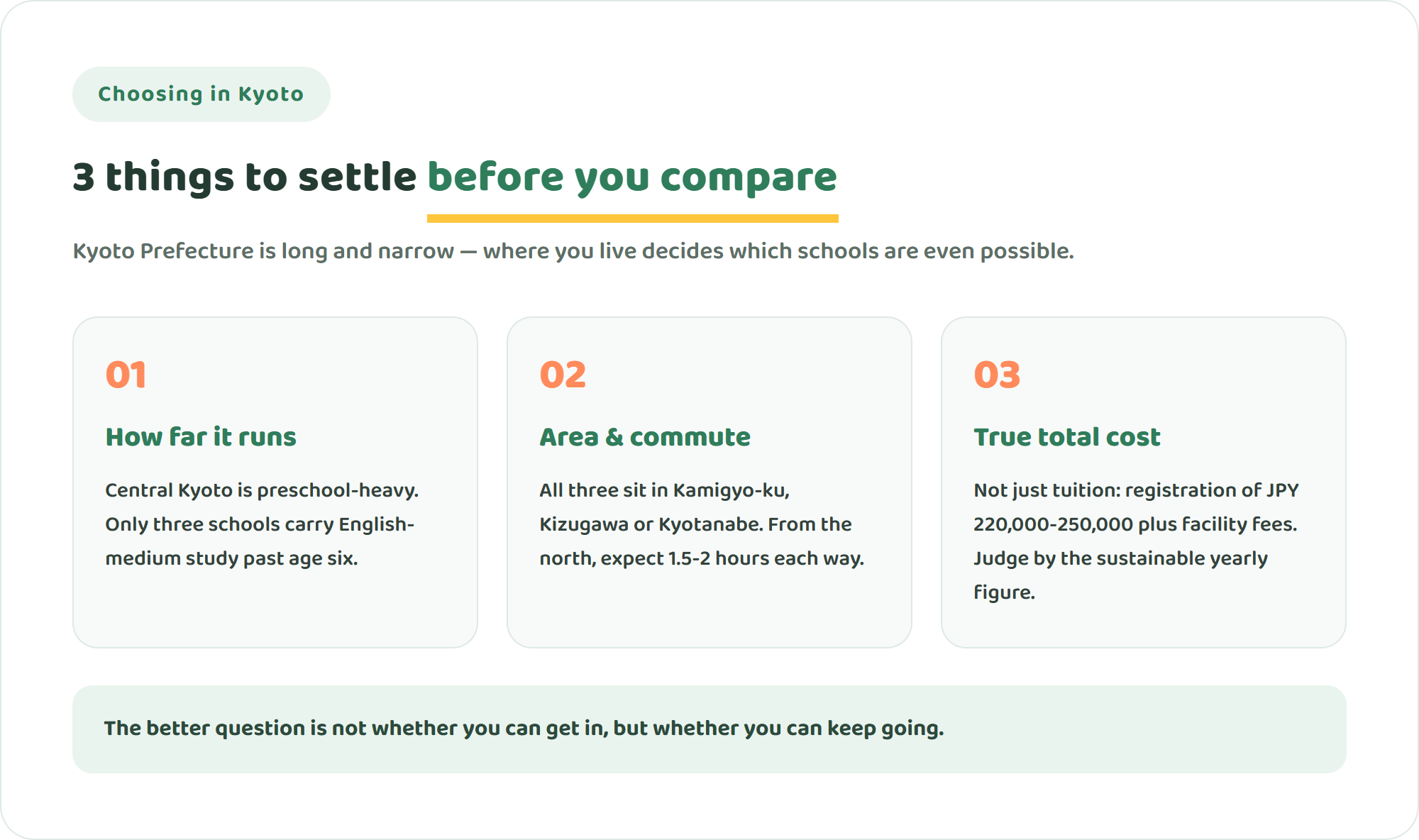
Budget roughly JPY 1.45–1.95 million per year at the English-medium schools, plus one-time registration fees of JPY 220,000–250,000 and application fees of JPY 20,000–31,500. The French curriculum school is markedly cheaper at about JPY 820,000–1.23 million. The Japanese schools with international tracks sit at roughly JPY 980,000–1.68 million a year. To understand how international school costs are actually structured — and where the hidden line items sit — see our breakdown of international school tuition. Note: figures reflect information published as of July 2026; always confirm current fees directly with each school.
The accreditations you will see in Kyoto, decoded
The acronyms trailing school names are genuinely confusing. Here are only the ones that appear in Kyoto.
- IB (International Baccalaureate) — three separate programmes: PYP (ages 3–12), MYP (11–16) and DP (16–19). A school authorised for all three is an IB Continuum School; in Kyoto only KIS qualifies.
- WASC — a US school accreditation body, usually held by schools running an American-style curriculum.
- ACSI — an international association accrediting Christian schools.
- COBIS — an accrediting body for British-style international schools.
- AEFE — the network of schools delivering the French national curriculum abroad (580 schools across 139 countries).
- CBSE — India’s Central Board of Secondary Education curriculum.
These matter beyond prestige. Completing a 12-year programme at a school accredited by a recognised international body is what makes a graduate eligible to apply to Japanese universities. If you are considering a school without such accreditation, verify university entrance eligibility before you enrol, not after.
Kyoto international school fees at a glance (2026)
The whole picture on one screen. Annual figures are published estimates; facility fees, materials and bus costs may sit outside them. Registration fees are one-time, first-year costs — keep them separate from the annual number when you budget.
| School | Location | Ages | Language & curriculum | Annual fees (approx.) |
|---|---|---|---|---|
| Kyoto International School (KIS) | Kamigyo-ku, Kyoto City | 3–18 | English, IB (PYP/MYP/DP) | JPY 1.56M–1.95M |
| Lycée Français International de Kyoto | Shimogyo-ku, Kyoto City | 3–18 | French, French national curriculum (AEFE) | JPY 823K–1.23M |
| AIC International School Kyoto Elementary | Shimogyo-ku, Kyoto City | 3–12 | English-led plus Japanese, IB PYP | On enquiry |
| Chandra Sekhar Academy, Kyoto | Fushimi-ku, Kyoto City | Primary (expanding) | English, Indian CBSE | On enquiry |
| Doshisha International School, Kyoto (DISK) | Kizugawa | 6–18 | English, IB PYP-based, G1–G12 | JPY 1.55M–1.70M |
| KIU Academy | Kyotanabe | 6–18 | English & Japanese, American-based (WASC/ACSI) | From JPY 1.45M |
| Ritsumeikan Uji, IB high school course | Uji | Secondary | Japanese/English, IB DP (accredited JP school) | JPY 1.68M |
| Doshisha International Junior & Senior High | Kyotanabe | Secondary | Japanese/English, returnee-focused (accredited JP school) | JPY 980K–1.08M |
Based on published 2025–2026 figures. Amounts vary by grade, entry year and fee revisions — sources are cited school by school below.
Every international school in Kyoto Prefecture, by area
Kyoto Prefecture runs roughly 140 km from the Sea of Japan coast down to the Nara border. Where you live determines which schools are genuinely reachable far more than in a compact city. Read the sections below with your commute in mind.
Kyoto City (Kamigyo-ku, Shimogyo-ku, Fushimi-ku, Nakagyo-ku)
1. Kyoto International School (KIS)
Founded in 1957, KIS is the oldest international school in Kyoto and the only IB Continuum School in the region — authorised for the Primary Years, Middle Years and Diploma Programmes. It operates two campuses in Kamigyo-ku: Juraku Campus for ages 3 to 12 and Taiken Campus for the secondary years. The school opened its first Grade 11 class in August 2025 and completes Grade 12 in 2026, so a full K-12 pathway is now in place. It also holds WASC and COBIS accreditation, and the academic year starts in August.
- Curriculum — International Baccalaureate PYP / MYP / DP, taught in English
- Ages — 3 to 18 (K1–G12), Kamigyo-ku, Kyoto City (two campuses)
- Access — 317 Kitawaraji-cho, Kamigyo-ku. Kyoto City Bus routes 9, 12 and 50 stop at Horikawa-Nakadachiuri, directly outside (school access page)
- Annual fees — approx. JPY 1,556,800 (K1–G5) and JPY 1,951,000 (G6–G10), including a JPY 190,000 building and facilities fee; application JPY 31,500, registration JPY 220,000 (2026/27 published figures, confirm with the school)
- Best for — families based in central Kyoto who want a continuous IB pathway, including short-term academic postings
2. Lycée Français International de Kyoto
In Shimogyo-ku, this school delivers the French national curriculum in full, from maternelle through to terminale — ages 3 to 18 — under homologation from the French Ministry of Education as part of the AEFE network of 580 schools in 139 countries. It enrols around 270 students of 23 nationalities, roughly 70% of them international, with an average class size of 12. Teaching is primarily in French, but there is a reception programme for children who do not yet speak it, plus language classes in Japanese, English, German, Spanish, Chinese and Latin. Graduates take the French Baccalauréat and the Brevet, both reported at 100% pass rates. It is the only school in Kyoto Prefecture offering an international education in a language other than English, and it appears on Kyoto City’s own list of international schools in the city (Kyoto City FAQ).
- Curriculum — French national curriculum (AEFE homologated), taught in French
- Ages — 3 to 18; 411 Motoshinmei-cho, Shimogyo-ku, Kyoto City
- Annual fees — approx. JPY 823,200 (maternelle), JPY 843,780 (primaire), JPY 926,100–946,680 (collège), JPY 1,058,310–1,229,350 (lycée), plus a JPY 150,000 family application fee. The school year runs September to June (10 months) (official 2025/26 fees, confirm current rates)
- Best for — francophone families, families moving between France and Japan, and anyone for whom English-medium fees in Kyoto are out of reach
3. AIC International School Kyoto, Elementary
Opened in April 2022 within walking distance of Kyoto Station, this school was formally authorised as an IB PYP school in October 2025, in only its third year of operation (ReseMom report). Japanese is taught five times a week while other subjects are delivered in English; the maths programme is Singapore Math, and STEAM learning is a stated priority. It currently serves ages 3 to 12, and a middle school section is planned for 2028, which makes the onward pathway easier to plan than it was a year ago. Of all the schools in the prefecture, this one has the best public-transport access.
- Curriculum — IB PYP authorised; English-led with Japanese five times weekly, Singapore Math
- Ages — 3 to 12 (middle school planned for 2028); 145 Hishiya-cho, Shimogyo-ku, Kyoto City
- Access — 1 minute from the Shichijo-Horikawa bus stop, about 10 minutes’ walk from Kyoto Station, about 15 minutes from Gojo Station on the Karasuma subway line (campus page)
- Annual fees — not published; enquire directly or request the admissions pack
- Best for — families who need a genuinely commutable city school and want English and Japanese developed together through the primary years
4. Chandra Sekhar Academy International School, Kyoto
Established in April 2018, this was the first school in the Kansai region to deliver India’s CBSE curriculum. It sits in Mukaijima, Fushimi-ku, and teaches in English. Indian-system mathematics and science teaching is its draw, and it serves Indian families in the region alongside others specifically interested in that curriculum. It began with a primary wing and states an intention to add grades progressively. The school describes its aim as providing English-medium education at an affordable rate, though no fee figures are published.
- Curriculum — Indian CBSE, taught in English
- Ages — primary wing, expanding; Mukaijima Seminar House 3F, 104-1 Takaba-cho, Mukaijima, Fushimi-ku, Kyoto City
- Access — about 15 minutes’ walk from Mukaijima Station on the Kintetsu Kyoto Line
- Annual fees — not published; enquire directly
- Best for — families drawn to the Indian curriculum, or living in the Fushimi / Uji corridor
5. English-medium preschools in central Kyoto
Kyoto City has a healthy cluster of English-immersion preschools, mostly for ages one to six. Some run full-day English programmes, others blend Japanese and English. Crucially, none of them continue past age six — you will be choosing a primary school again at that point, so plan the transition early.
- Kyoto International Preschool — Nakagyo-ku
- Kinder Kids International School, Kyoto — Nishinokyo, Nakagyo-ku; full-English environment for ages 1–5
- Sakura International School Kyoto (Kansai International Academy) — bilingual, inquiry-based English childcare
- Kirara International Kindergarten — deliberately develops both English and Japanese
- Little Gems Kyoto (Nakagyo-ku, ages 1.5–6), Zoo-phonics Academy Kyoto (Nakagyo-ku), Marian International School (Nakagyo-ku), Venetia International School (Sakyo-ku) and others
Preschool costs vary enormously with hours and days attended, so treat fees as enquiry-only rather than assuming a published rate applies to your schedule. One thing worth knowing: for children aged three to five, Japan’s free early childhood education and care scheme may cover part of the cost — up to JPY 37,000 a month for unlicensed childcare facilities, subject to a municipal assessment of childcare need. Whether a given preschool qualifies depends on how it is registered, so ask the school and your local ward office.
Southern Kyoto and the Keihanna science city (Kizugawa, Kyotanabe, Uji)
Southern Kyoto Prefecture, anchored by the Kansai Science City, is where the larger campuses are. It is also within reach of Nara City and north-eastern Osaka, and tends to offer more space and better bus links than central Kyoto.
6. Doshisha International School, Kyoto (DISK)
Located in Kizugawa, DISK runs Grades 1 through 12 and became, in 2014, the first international school in Japan authorised to offer the IB Primary Years Programme. It shares a campus with Doshisha International Academy Elementary School (DIAES), a Japanese-accredited school teaching roughly 45% in Japanese and 55% in English under a special curriculum exemption. Having an English-medium international school and a mother-tongue-based bilingual Japanese school on one site is genuinely rare in Japan.
- Curriculum — English-medium, IB PYP authorised; a 12-year pathway (confirm current secondary authorisations with the school)
- Ages — 6 to 18 (G1–G12); 7-31-1 Kizugawadai, Kizugawa, Kyoto Prefecture
- Access — direct bus, about 10 minutes from Shin-Hosono Station (Kintetsu Kyoto Line) or Hosono Station (JR Gakkentoshi Line); about 20 minutes by direct bus from Gakken Nara-Tomigaoka (Kintetsu Keihanna Line); about 15 minutes on foot from Yamadagawa Station (campus access page)
- Annual fees — approx. JPY 1,550,000 (G6–8) and JPY 1,700,000 (G9–12), plus a JPY 150,000 educational enrichment fee; entrance test JPY 20,000, registration JPY 250,000 (published figures)
- Best for — families who want strong English without giving up on Japanese, living around Kizugawa, Nara or Kyotanabe
7. KIU Academy (Kyoto International University Academy)
In Kyotanabe, KIU Academy offers a Grades 1–12 bilingual programme built on an American curriculum with awareness of the Japanese course of study, taught in both English and Japanese. It is accredited by WASC and by ACSI, and positions itself for students heading either overseas or into the Japanese system.
- Curriculum — American-based bilingual (English and Japanese), WASC and ACSI accredited
- Ages — 6 to 18 (G1–G12); 1-1 Kusauchi-Ichinotsubo, Kyotanabe, Kyoto Prefecture
- Access — nearest stations are Shin-Tanabe (Kintetsu Kyoto Line) and Kyotanabe (JR Gakkentoshi Line), both within walking distance; confirm school bus availability directly
- Annual fees — from approx. JPY 1,453,000 (2026/27 published figures), application fee JPY 25,000; confirm current rates
- Best for — families wanting both languages developed seriously, in the Kyotanabe / Uji / Nara corridor
Japanese schools with English-language international tracks
If a Japanese graduation certificate matters to you — for university admission in Japan, or simply for continuity — two accredited Japanese schools in Kyoto Prefecture are worth knowing.
- Ritsumeikan Uji Junior and Senior High School (Uji) — in 2009 it became the first accredited Japanese school in the Kansai region authorised for the IB Diploma Programme. The high school IB course cost approx. JPY 1,679,000 per year in 2025 (tuition JPY 638,000 + facilities JPY 291,000 + IB course fee JPY 750,000); fees were revised from 2026, so check current figures.
- Doshisha International Junior and Senior High School (Kyotanabe) — more than half the student body are returnees, and it is the only school in Kyoto with A1 designation from the Japan Overseas Educational Services. First-year costs are around JPY 1,080,000, then roughly JPY 980,000 per year.
Central and northern Kyoto (Kameoka, Nantan, Ayabe, Fukuchiyama, Maizuru)
To be straightforward: we could not identify any permanent international school serving primary-age children or older in central or northern Kyoto Prefecture as of July 2026, having cross-checked prefectural private school listings, school websites, international school databases and Kyoto City’s own published information. There are English after-school programmes in towns such as Nagaokakyo, but these are supplementary rather than full-time schooling. From Fukuchiyama or Maizuru, a one-way trip into Kyoto City is around two hours — not a realistic daily commute.
If you live in southern Kyoto, however, Osaka is genuinely reachable. International schools in Osaka are far more numerous, and some families commute from Kyoto Station by rapid service. You can also compare the wider picture through our guide to international schools across all 47 prefectures.
Do Kyoto’s international schools have a hensachi ranking?
Many Japanese families search for the hensachi — the standardised deviation score used to rank Japanese schools — of Kyoto’s international schools, and find nothing. Here is why: international schools do not have a hensachi, and structurally cannot have one.
A hensachi expresses a student’s relative position within the pool of people who sat the same mock examination. In Japanese junior high and high school admissions, tens of thousands of mock-test results are matched against actual admissions outcomes, and from that a school’s approximate hensachi is inferred. Kyoto’s international schools sit entirely outside that machinery: their applicants do not sit Japanese mock exams, and their admissions results are not aggregated by any test provider. Selection is based on English proficiency, interviews and school records, so no reference population exists and no number can be produced. If you do see a hensachi figure in search results, it is most likely for an accredited Japanese school such as Doshisha International or Ritsumeikan Uji — not for an international school.
So what should you look at instead? Five things actually discriminate between schools in Kyoto.
- English entry requirements. The bar rises with each grade. Whether a school offers EAL (English as an Additional Language) support is, in practice, the real measure of how accessible it is.
- IB outcomes. The Diploma is scored out of 45. Some schools publish average scores and pass rates — the most objective academic evidence available. In Kyoto, the DP is offered by KIS and by Ritsumeikan Uji (an accredited Japanese school).
- Accreditation. IB, WASC, ACSI, COBIS and AEFE tell you whether external scrutiny exists — and they bear directly on Japanese university entrance eligibility.
- Where graduates go. Which universities, in which countries. This is where a school’s substance shows most plainly. Newer schools have thin records, which is itself worth knowing.
- Class size and nationality mix. Lycée Français International de Kyoto publishes an average of 12 per class across 23 nationalities, for example. Smaller numbers mean more adult attention per child.
Put plainly: choosing an international school means giving up the single yardstick of the hensachi. That is unsettling. It is also a decision to stop measuring your child by a score.
Admission requirements, transfer timing and the selection process
Because Kyoto has so few schools, the biggest variable is simply whether a place exists in the year you need it. Starting early pays.
When the school year begins. International-curriculum schools generally start in August or September, not April. KIS begins in August; Lycée Français International de Kyoto runs a ten-month year from September to June. Moving from a Japanese school therefore creates a gap or an overlap of a few months — plan backwards from that. Some schools open applications six to twelve months ahead.
Mid-year transfer. Most schools accept it, on two conditions: a vacancy in that grade, and English (plus academic) ability appropriate to the year group. In Kyoto, entry at preschool age rarely requires English at all, but from the middle primary years onward English entry requirements become common. If your child’s English is not yet there, narrow your list to schools with EAL or bridging support.
The usual selection sequence.
- 1. Enquiry and a school visit or information session — Kyoto has few schools and limited visit slots, so make contact early.
- 2. Application documents — school reports, proof of enrolment, sometimes references or an essay.
- 3. Written assessment — usually English and mathematics; for younger children, an observed play session instead.
- 4. Interviews with the child and the parents — expect questions about your educational philosophy and how you will support English at home.
- 5. Decision and enrolment — registration deadlines can be short, so check payment timelines in advance.
Four questions to ask on every school visit. What does a year actually cost beyond tuition (facilities, materials, bus, trips, IB exam fees)? How many Japanese lessons per week? What specifically happens for a child whose English is behind? And where have graduates gone? None of these are reliably answered in a brochure.
One legal note. Most international schools in Japan are not ichijo-ko — schools recognised under Article 1 of the School Education Act. For a child holding Japanese nationality, attending one may therefore not be treated as satisfying compulsory education requirements. Practice varies by municipality, so confirm with your local board of education before you enrol.
Choosing the one that fits your family
Grouping the options by type makes the decision clearer. In Kyoto, the city-versus-south divide is effectively a divide between different schools altogether, so start with geography and work inward.
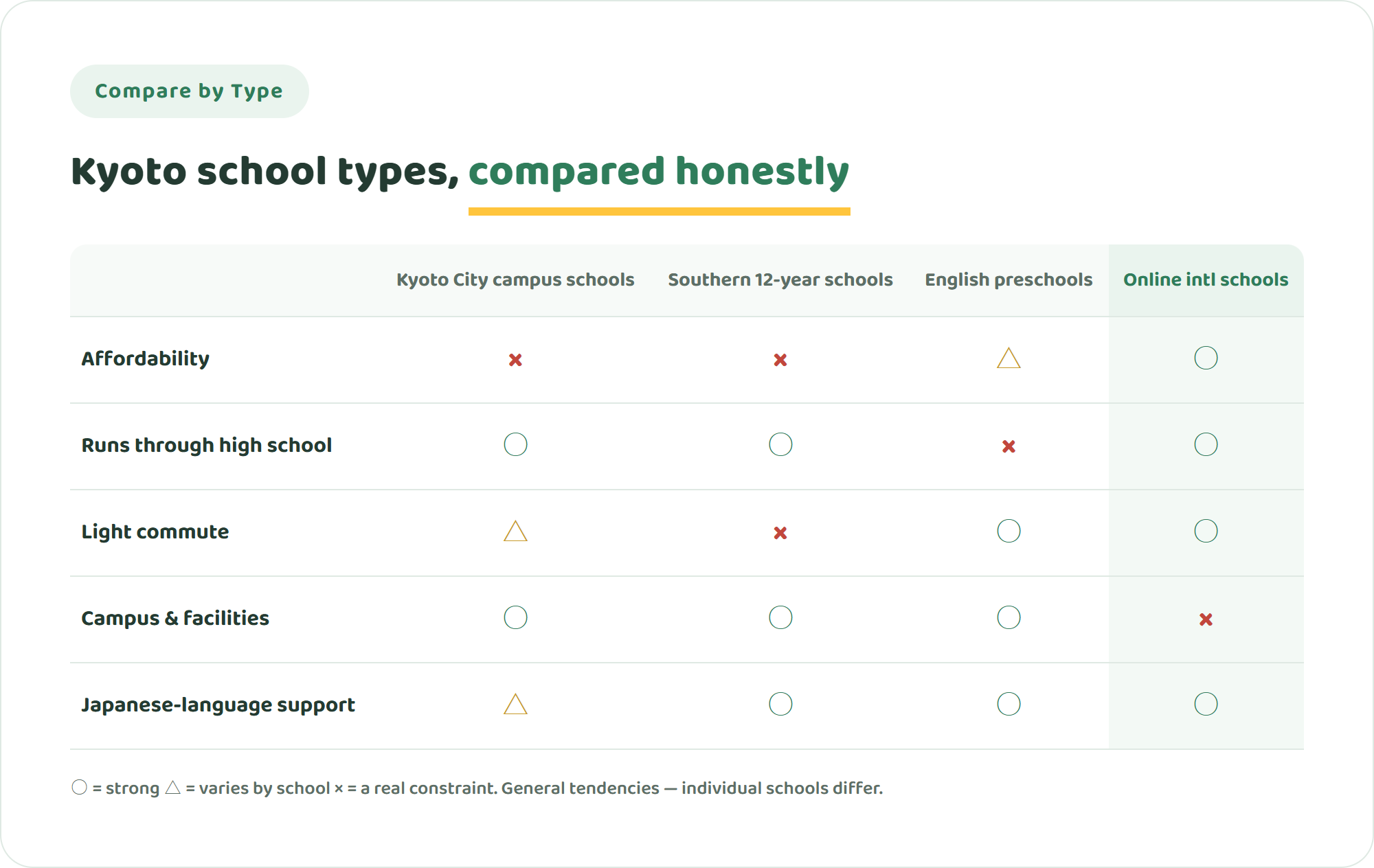
A physical campus and full daily immersion are real strengths of the commuting schools — but in Kyoto Prefecture there are only six of them past kindergarten, and the English-medium ones climb toward JPY 1.5–1.95 million a year. Affordability, a light commute, and continuity no matter where in the prefecture you live are the strengths of online schooling. The question worth asking is not can we get in? but can we keep this going for a decade? Weigh commute time, household budget and your child’s temperament together. You can see how learning works online → if you want to understand the model in detail.
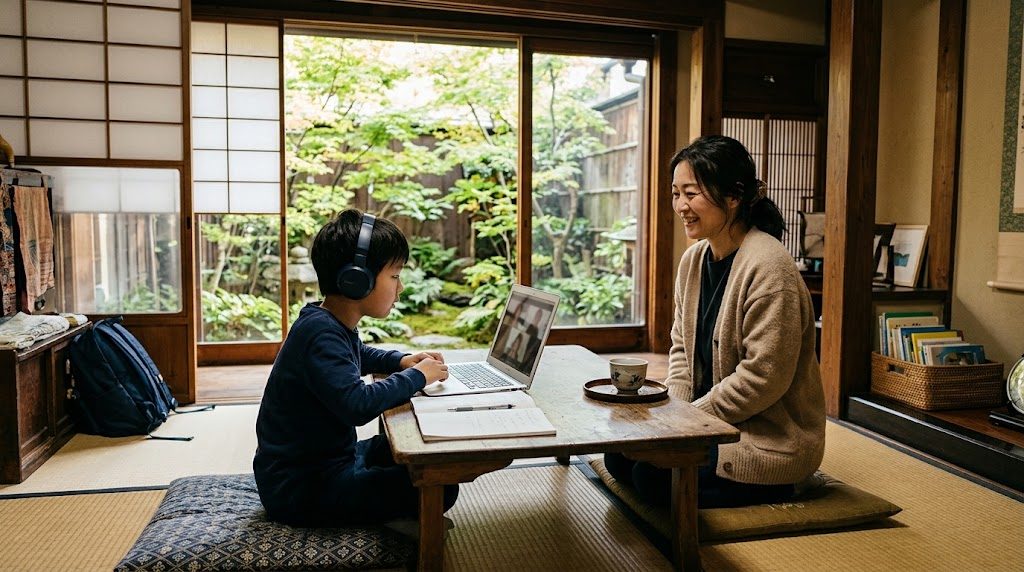
When nothing is within reach — the online option
Perhaps you have read this far and concluded that a daily commute into central Kyoto is impossible, that northern Kyoto has nothing at all, or that JPY 1.5 million a year is simply not sustainable for the number of years involved. Commuting schools are not the only path. NIJIN GLOBAL ACADEMY (NGA) is an online international school opening in September 2027, operated by NIJIN Inc. in Japan. Its sister alternative school in Japan, NIJIN Academy, already has more than 1,000 students enrolled.
NGA is built around learning that does not rank children by test scores, small dialogue-centred classes, and a mission we take literally — helping children come to like themselves and the world. Tuition is designed to be about one-fifth of a typical campus international school. It serves ages 6 to 18 across Asia and Oceania, which means central Kyoto, Uji, Kizugawa, Fukuchiyama or Maizuru make no difference. Because it assumes Japanese-language support underneath, children can move into English gradually rather than all at once.
In fairness: NGA has not opened yet, so there is no track record to point to, and it will never replicate a school field, a science lab or a corridor full of classmates. But for families in Kyoto Prefecture with few reachable schools — or none — it is an option worth putting on the same table as the others.
Frequently asked questions
Can we reach an international school from anywhere in Kyoto Prefecture?
Not really. The six schools serving primary age and above sit in Kamigyo-ku, Shimogyo-ku and Fushimi-ku in Kyoto City, plus Kizugawa and Kyotanabe in the south. From Kameoka, Nantan, Ayabe, Fukuchiyama or Maizuru, expect 1.5 to 2 hours each way. If you live along the subway or JR lines in Kyoto City, KIS and AIC International School Kyoto are workable; if you are in the Keihanna area, DISK and KIU Academy are the natural candidates. Test the route on a weekday morning before you commit.
Can we commute to schools in Osaka or Nara instead?
Yes, and many families do. Southern Kyoto — Uji, Joyo, Kizugawa, Kyotanabe — shares a daily catchment with Nara City and north-eastern Osaka. Kyoto Station to central Osaka is under 30 minutes by rapid service, and Osaka has considerably more schools. See international schools in Osaka for the options. That said, once a one-way commute passes about 90 minutes, it starts to cost your child sleep and your family its evenings.
What about Japanese-language support?
Entry with no English is usually fine at preschool age; from mid-primary onwards some schools apply English-language entry requirements. Kyoto has a real advantage here: Doshisha International School, KIU Academy and AIC International School Kyoto all develop Japanese alongside English deliberately, rather than treating it as an add-on. If your child attends a fully English-medium school, Japanese literacy often needs separate attention — our sister service Tomodachi Japan (online Japanese for children, also run by NIJIN) is one way to cover that gap.
What costs sit outside the tuition figure?
Beyond annual tuition there are first-year-only costs — registration of JPY 220,000–250,000 in Kyoto and an application fee of JPY 20,000–31,500 — and recurring facility or enrichment fees of JPY 150,000–190,000. Then materials, uniform or required devices, school bus, trips and residential programmes, and IB Diploma examination fees if applicable. Assume JPY 200,000–400,000 a year on top of the published figure and your planning will hold up. Our tuition breakdown goes through the structure line by line.
Do Kyoto preschools qualify for Japan’s free early childhood education scheme?
It depends on the facility. For children aged three to five, unlicensed childcare facilities are covered up to JPY 37,000 a month, provided the municipality certifies a childcare need. International preschools fall on either side of that line depending on how they are registered, so ask the school whether it is a qualifying facility and check the certification requirements with your ward office. Some municipalities also run their own additional subsidies.
Can an international school graduate apply to Japanese universities?
Yes. Completing a 12-year programme at a school accredited by a recognised international body (the IB Organization, WASC, ACSI and others) confers eligibility to apply to Japanese universities, as does holding an IB Diploma. In Kyoto, KIS, DISK and KIU Academy all hold international accreditation, and Lycée Français International de Kyoto leads to the French Baccalauréat. Requirements and documentation vary by university, so check the admissions guidelines of your target institutions once a shortlist forms. If you are considering a school without international accreditation, verify this point early.
Growing up in Kyoto, on your family’s terms
Kyoto Prefecture offers a small but genuinely varied set of choices: a full IB continuum in the old city, a French national curriculum school, a newly IB-authorised elementary school by Kyoto Station, an Indian CBSE school in Fushimi, bilingual 12-year schools in the science city to the south, English preschools in between, and accredited Japanese schools with international tracks. Because the list is short, there is no reason to rush toward the best-known name. In a world without a hensachi to rank them, line up the total cost, the daily journey and your child’s temperament, and choose the place where your child can most be themselves while learning. We hope this guide made that decision a little clearer.
NIJIN GLOBAL ACADEMY opens in September 2027. We will share how the learning works — no ranking by test scores, reachable fees, small classes connected to the world — and news about our founding cohort by email.
International School Guides for Other Prefectures
- International Schools in Hyogo Prefecture
- International Schools in Mie Prefecture
- International Schools in Shiga Prefecture
- International Schools in Nara Prefecture
- International Schools in Hokkaido Prefecture
- International Schools in Kanagawa Prefecture
- International Schools in Aichi Prefecture
- International Schools in Miyagi Prefecture
- International Schools in Miyazaki Prefecture
- International Schools in Nagano Prefecture
- International Schools in Nagasaki Prefecture
- International Schools in Niigata Prefecture
- International Schools in Oita Prefecture
- International Schools in Okayama Prefecture
- Browse all 47 prefectures of Japan