
You probably didn’t start worrying because of a report card. It was smaller than that. Homework that used to take thirty minutes now takes two hours. A shrug when you ask about the day. A teacher comment — “would benefit from participating more confidently” — that you read three times without knowing what it meant. And somewhere underneath, the question you haven’t said out loud: is my child struggling at international school because of the language, or because something else is wrong?
Here is the honest answer up front. Falling behind at an English-medium school is common, and in most cases it is not a sign that your child can’t learn. It is a sign that academic English hasn’t caught up with the pace of the classroom yet. Those two things look almost identical from the outside, and confusing them is expensive — in tutoring fees, in wasted terms, and above all in what your child comes to believe about themselves. This guide is for families across Asia — Singapore, Malaysia, Japan, Thailand, Hong Kong, the Philippines and beyond — and it is built to help you tell the difference and decide what to do next.
If your child is struggling at international school, you are not the exception
Let’s not soften it. In a school where every subject runs in English, some children stall — often somewhere between six months and two years after starting. The pattern is recognisable: they chat happily with friends, but reading, writing and comprehension lag behind. Parents describe it as a child who “sounds fine but isn’t following.”
What makes this dangerous is not the gap itself. It is the loop the gap starts. Content isn’t fully understood, so assignments come back incomplete, so grades drop, so confidence falls, so the child stops volunteering answers — which removes the last visible signal a teacher had. Within two or three terms, a language delay has been quietly rewritten as an ability problem, by everyone including the child. Naming the cause correctly is the single highest-leverage thing a parent can do.
It is usually the language, not the learner
This is not wishful thinking. Analysis of English school data by Professor Steve Strand found that proficiency in English accounts for up to 22% of the variability in academic achievement, compared with 3–4% explained by characteristics such as gender, free school meal status and ethnicity (summarised by The Bell Foundation, “What is EAL in education?”). In an English-medium classroom, how far a child’s English has developed explains far more about their results than almost anything else about them. That is true across every model of international school, whatever curriculum it follows.
That is genuinely good news, because language responds to time and design. Effort alone does not fix it — and “try harder” is the least effective instruction you can give a child whose problem is that they are decoding every sentence twice.
Why children fall behind — five structural reasons
Struggle has patterns. Once you can name the pattern, you know who to ask and what to ask for.
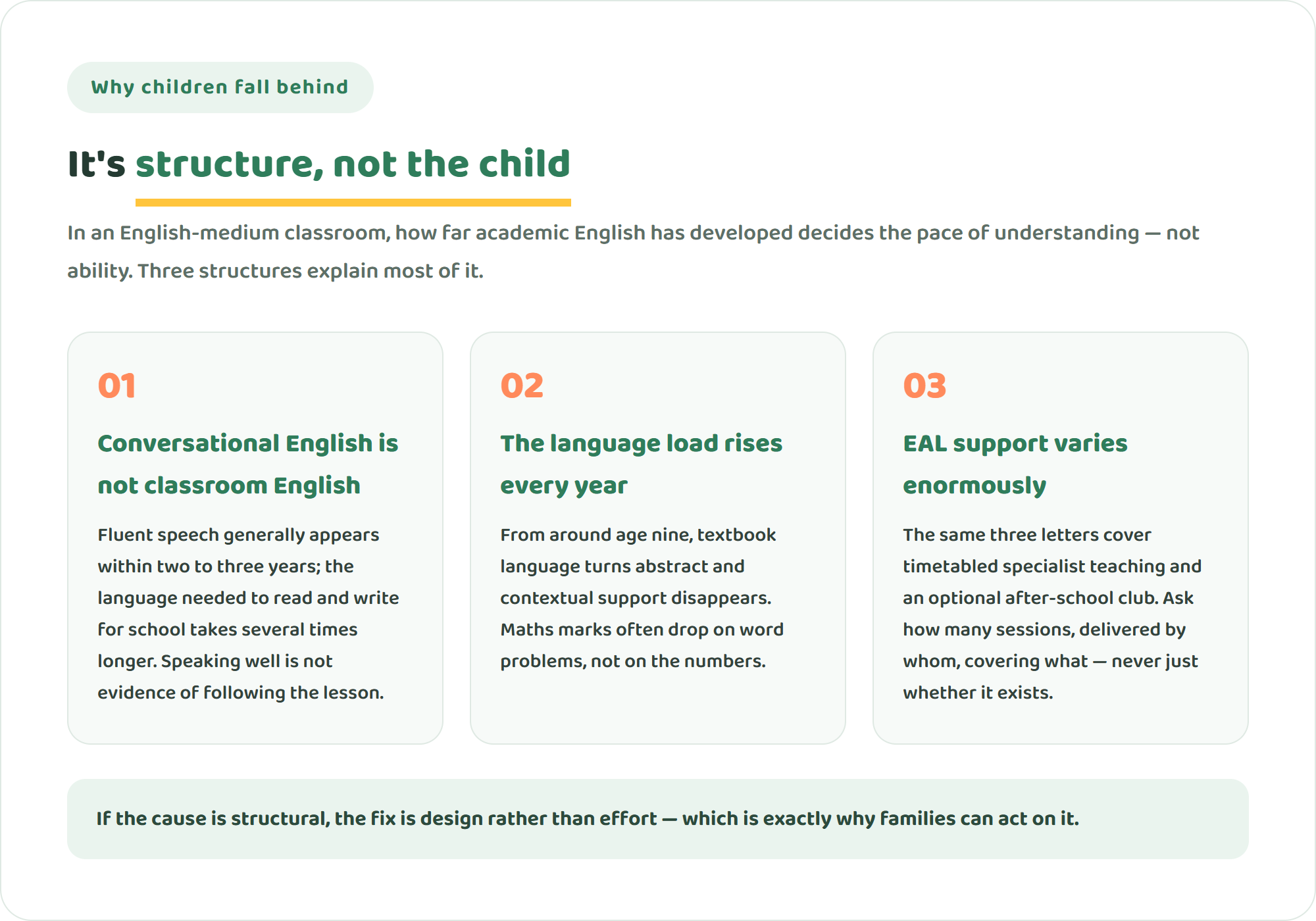
1. Conversational English and classroom English are different languages
This is the misunderstanding at the root of almost everything else. Generally, the fluency a child uses at lunch and the language they need to read a textbook, justify an answer or write an argument are treated as separate competences. In language education the distinction is often framed using the terms BICS (basic interpersonal communicative skills) and CALP (cognitive academic language proficiency), introduced by Jim Cummins in 1979: conversational fluency tends to appear within roughly two to three years of immersion, while academic language takes several times longer (EBSCO Research Starters, “BICS/CALP”).
Which is why “but she speaks English perfectly” is the most misleading evidence in the room. Speaking well and thinking in English on paper develop on completely different timelines, and only one of them is visible at the dinner table.
2. The language load rises every year
In the early years, pictures, objects and gesture carry a lot of the meaning. From around age nine, textbook language turns abstract — evidence, hypothesis, compare, therefore — and that contextual support disappears almost overnight. This is also why maths and science scores can drop in a child who is good at maths: the difficulty has moved into the word problems.
There are figures for how long the catch-up takes. Reviewing a decade of English school data, Dr Ariel Lindorff and Professor Steve Strand at the University of Oxford report that learners using English as an additional language need on average about six years to reach the proficiency required to fully access an English-language curriculum, and that children who arrive later in their schooling are markedly less likely to catch up — those arriving after the reception year generally do not close the gap by the end of primary school (University of Oxford Department of Education, November 2025). That data comes from state schools in England rather than international schools, so treat it as an order of magnitude, not a promise. But it should reset one expectation: if your child hasn’t caught up in two years, nothing has gone wrong.
3. EAL and ESL support varies enormously between schools
Support for students learning in an additional language is usually labelled EAL or ESL. The trap is that “yes, we have an EAL programme” tells you almost nothing. Specialist teaching timetabled into the school day and an optional after-school club are both described with the same three letters, and they produce very different outcomes. Group size, the specialism of the person delivering it, which lessons a child is withdrawn from, and how the school decides a student no longer needs support — all of it differs school by school. Ask about the design, never the existence. There is a question list further down.
4. Curriculum transitions leave real gaps
Families who move country, or move between a national system and an international one, often discover the problem was never English at all. Curricula sequence topics differently — British, American, IB and national systems all introduce concepts in different years. A child can arrive having simply never been taught the unit everyone else covered last year. If the struggle began within a year of transferring, check the content gap before you conclude anything about language. Our guide on international vs local school: how to actually decide covers how these systems differ.
5. In a large class, the quiet child disappears
This isn’t a criticism of schools; it is arithmetic. In a class of twenty-five, a child who is still nervous about speaking English can get through the entire day without ever having to reveal that they didn’t follow. Nothing surfaces until reports are issued. The more considerate and self-contained your child is, the later you will find out. That happens in any school, but a second language makes the hiding place much deeper. The broader trade-offs are laid out in our honest pros and cons of international school.
Ten signs you can spot at home
You don’t have to wait for a report card. Struggle shows up in behaviour long before it shows up in grades. One or two of these is normal childhood weather. Several of them, running for two to three weeks, is your signal to act.
Signs in schoolwork
1. Homework takes far longer than it used to. Same volume, double the time, usually means reading is consuming the effort.
2. They avoid showing you their work. Hiding is about shame, not laziness — and scolding only makes the hiding better.
3. They can’t explain the lesson even in your home language. If the content isn’t there in either language, it never went in.
4. Maths or science marks drop for a child who is good at maths. Look at where the marks were lost: word problems point to language, not numeracy.
Signs in mood and daily rhythm
5. Mornings get slower; stomach aches appear. Strain that a child can’t put into words comes out through the body and the clock.
6. They stop talking about school. When “how was your day?” gets nothing but “fine” for weeks, there is less they can comfortably say.
7. They visibly brighten at weekends and after holidays. That contrast is information about what school currently costs them.
Signs in school life
8. They no longer mention who they spend break with. Language gaps often hit friendships before they hit grades.
9. They dread presentations, group work or reading aloud. Avoiding public use of English means classroom confidence has already eroded.
10. Reports repeatedly say they should “participate more confidently.” It reads like encouragement. It is usually a report that your child cannot yet take part in lessons linguistically.
Use these to describe, not to diagnose. The goal is a concrete record — when, in which subject, doing what — that you can put in front of a teacher.
What to do, in order
The sequence matters. Gather information, then move the school, then decide what home does. Families who jump straight to tutors or transfers usually spend more and learn less.
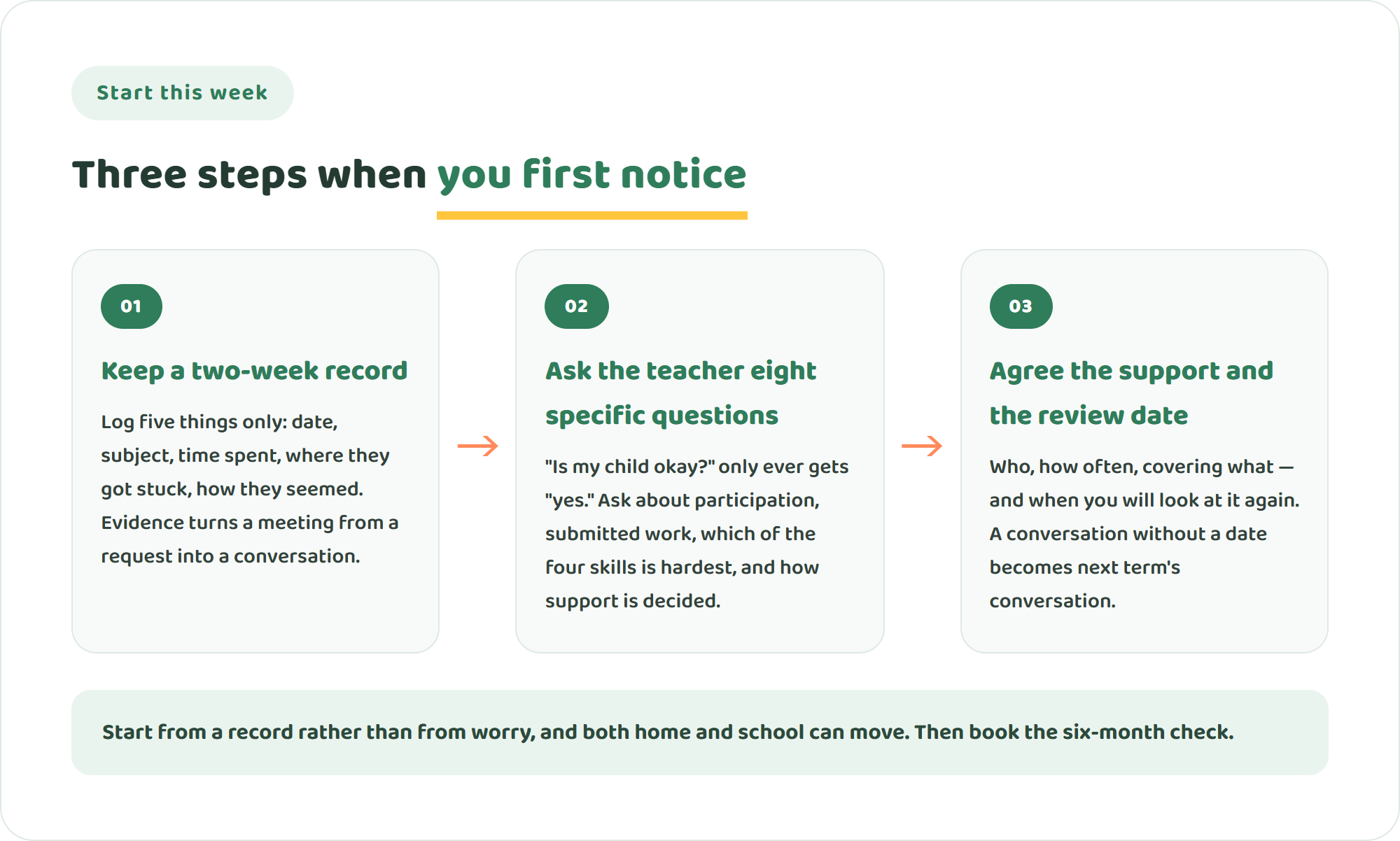
Step 1: Keep a two-week record at home
A notes app is enough. Log five things only: date, subject, how long the homework took, where they got stuck, and how they seemed. “Stuck twenty minutes on a word problem in maths.” “Read aloud fine.” Two weeks of that shows you whether the difficulty sits in a subject, in reading, or in writing. Walking into a meeting with two weeks of evidence changes what the school can do for you.
Step 2: Ask the class teacher these eight questions
“Is my child doing okay?” almost always gets “yes, they’re settling in.” Be specific instead.
1. When you call on them, can they answer? Do they ever volunteer?
2. Is work handed in on time — and does it show they understood the instructions?
3. Of reading, writing, listening and speaking, which is hardest for them right now?
4. In terms of stage rather than ranking, where are they relative to the year group?
5. Do they qualify for EAL or ESL support, and how is that decision made?
6. If they receive it: how many sessions a week, delivered by whom, covering what, and which lessons do they miss?
7. If you had to name one or two things we should do at home, what would they be?
8. When shall we review this together?
Never skip the eighth. A conversation without a review date tends to become next term’s conversation.
Step 3: Ask for the support menu by name
Schools have provisions they don’t advertise to parents who haven’t asked. Typically: EAL or ESL withdrawal and in-class support; a learning support department; a school counsellor; and accommodations such as extra time, reduced task volume, or permission to use a dictionary or translation tool. Ask also about the school’s policy on year placement, so it isn’t a surprise later. The phrasing that works is “which of these does my child qualify for?” rather than “do you offer anything?”
Step 4: Decide what home actually does
Your job is not to teach the syllabus. It is to reduce the load and send your child into class already holding some of the meaning. Four things do most of the work.
Pre-teach the concepts in your home language. Talk about photosynthesis, fractions or the Industrial Revolution at home first. Meeting an idea for the first time in English is far harder than recognising an idea you already have. Stop finishing the homework for them. Record where they stopped instead — that is the data the school needs, and completed work erases it. Protect sleep and empty time. A full day in a second language is genuinely tiring; dropping one activity can raise grades more than adding a tutor. Name what went right, specifically. Not “good job” but “you asked the teacher a question today.” Classroom confidence is what decides whether a hand goes up tomorrow.
What to say to your child instead of “try harder”
Children who are falling behind almost always know it, and many perform being fine at home. Adding “concentrate” or “make more effort” to that only confirms the story they are already telling themselves — that they are the problem.
Put the cause outside them, explicitly: “This isn’t about how smart you are. Your English is still growing, and that takes years for everyone.” That is factually true, and a child who knows it stands differently in a classroom. Change your questions too — “how was school?” is unanswerable, whereas “which lesson was the most confusing today?” or “was there anything the teacher said that you couldn’t catch?” assumes that not understanding is normal, and gets you real answers. One more thing: don’t say “maybe this school was a mistake” in front of them. Children hear it as being the mistake.
Step 5: If it still isn’t working
If you have had support in place for six to twelve months and nothing has shifted, it is reasonable to change the environment rather than the child. The options are wider than “transfer or endure”: a conversation about year placement, a school with stronger learning support, a return to a national or local school, running two systems in parallel, or moving part of the learning online. Leaving is not failing. If you are weighing that decision, our guide to choosing between international and local schooling sets out the trade-offs honestly.
Language problem, learning gap, or something else? How to think about it
This is the part to handle carefully. Diagnosis belongs to professionals, and nothing in this article can tell you what is happening with your child. What you can do is work out who to talk to.
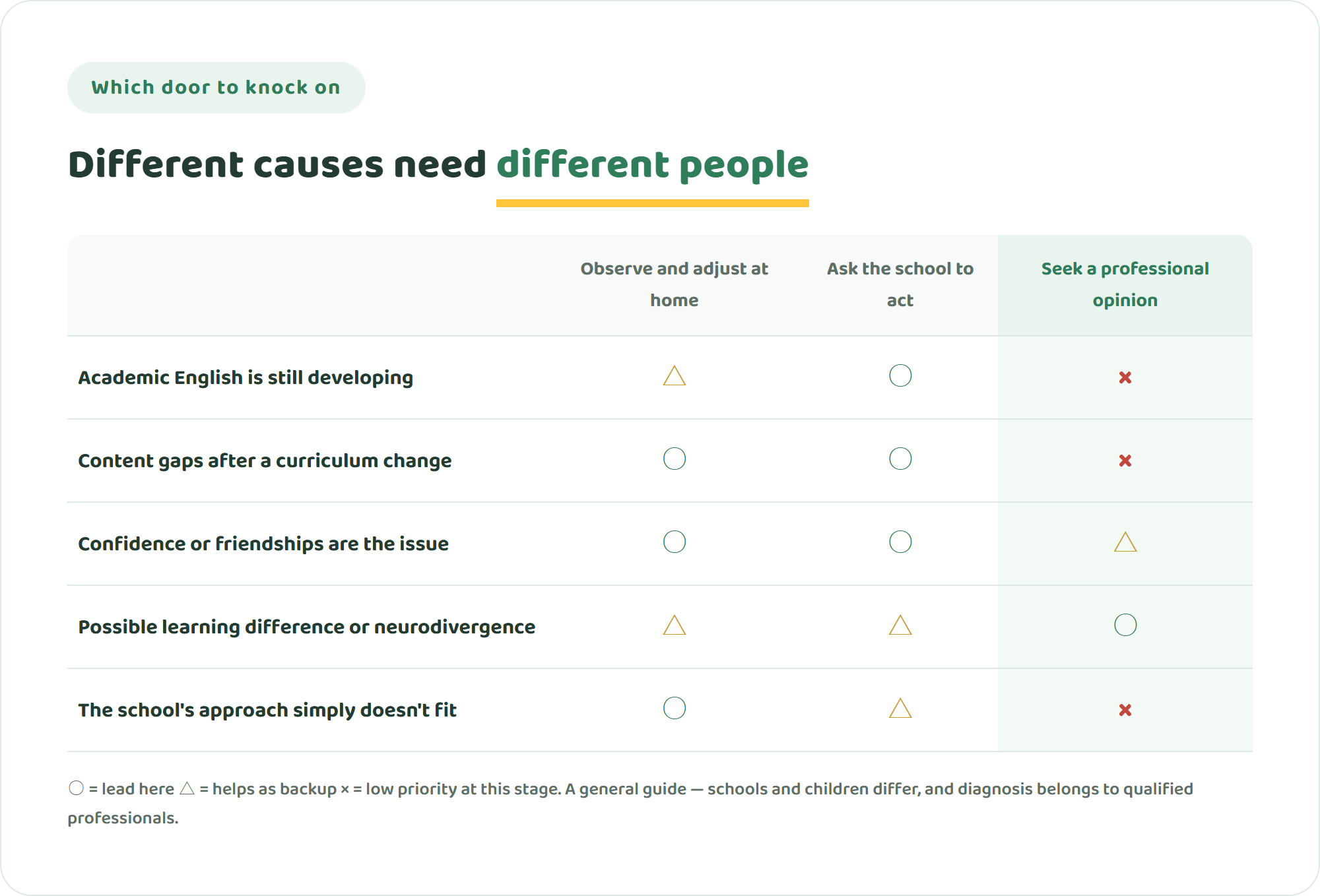
The Bell Foundation, which publishes EAL guidance for UK schools, is explicit on both sides of this. “Learning EAL is not the same as having a SEND” — that is, learning in an additional language is not itself a special educational need — and at the same time, “there is no single test that schools can administer to learners using EAL that will reliably indicate the presence of a SEND,” because most assessments were designed for fluent English speakers and carry cultural and content bias (The Bell Foundation, EAL and SEND guidance). So both quick conclusions are wrong: “he’s behind, so something must be wrong with him,” and equally “it’s just English, so we’ll wait.”
One practical signal is worth knowing. Ask whether the same difficulty appears in your home language. If instructions don’t stick in either language, if the same line gets reread in a book in your own language, if starting to write is hard in both — then language exposure alone is a thin explanation. If everything is smooth in the home language, academic English is the more likely story. This helps you choose a door; it is not a diagnosis. Speak to the school counsellor, the learning support lead, or a qualified professional locally if you have concerns.
When the home language is quietly part of the problem
There is a version of this that catches many international-school families. The child is behind in English at school — and also isn’t reading and writing at age level in the family’s own language. Neither language is carrying abstract thought yet, so the cause becomes almost impossible to see. Checking whether concepts exist in the home language is often the fastest way to untangle it, because a concept held in one language transfers to the other. If that describes your family, start with our companion guide on international school and the home language.

A third option — small enough that no one disappears
If, reading all this, you found yourself wishing for a school with real support, small groups and no ranking by test score, that instinct is well aimed. The reason falling behind lasts so long is rarely ability. It is how long it takes for anyone to notice.
NIJIN GLOBAL ACADEMY (NGA), opening in September 2027, is being designed around exactly that problem. It is an online international school that does not rank children by test scores, built on small-group dialogue that starts from “what do you think?” In a room where you are expected to speak, a child cannot quietly not understand for a whole term. That isn’t pressure — it means difficulties surface in weeks rather than in reports. Mentors stay with each student, and the language design assumes children ease into English with the support of their home language rather than being dropped into it.
NGA is operated by NIJIN Inc.; its alternative school in Japan already serves more than 900 children. It is open to 6- to 18-year-olds across Asia and Oceania, with tuition designed to be around one-fifth of a typical campus international school. Honestly: online is not a physical campus, and as a pre-launch school our track record is still ahead of us. Plenty of families will want to look at it alongside the school their child is already in, not instead of it.
Frequently asked questions
Is my child struggling at international school only because of English?
Language is usually the largest factor, but rarely the only one. Content gaps from a curriculum change, friendships, teaching style, and in some cases an underlying learning difference can all be part of it. The first sorting question is whether the same difficulty shows up in your home language.
How long does it take to catch up?
No one can promise a number for an individual child. As a reference point, analysis of English school data suggests learners using English as an additional language need about six years on average to reach the proficiency needed to fully access the curriculum, with later arrivals taking longer. Not catching up within one or two years is ordinary, not alarming.
Should we move our child down a year?
It depends. Repeating a year can rebuild foundations, but it also affects friendships and self-image, and school policies differ widely. Ask the teacher and learning support lead specifically what would change — content, support, groupings — before deciding.
Should we hire a tutor?
Check what the school provides first; many families pay privately for something already available in the timetable. If you do go external, be clear whether you are buying subject catch-up or academic English development. They are different jobs and rarely the same person.
Would changing schools mean we gave up?
No. Staying in an environment that isn’t working costs more than moving. A fair test is whether six to twelve months of actual support produced any change. If it didn’t, changing the setting is a design decision, not a defeat.
Should I be considering a learning difficulty or neurodivergence?
Not on the basis of school impressions alone. Learning in an additional language is not itself a special educational need, and there is no single test that reliably separates the two for EAL learners. If you have concerns, raise them with the school counsellor or learning support lead and seek a qualified assessment locally.
What if my child is behind in both languages?
That is worth taking seriously, but the useful question is whether either language can currently carry abstract thinking. Depth in one language supports the other; thin exposure to both is what causes trouble. Deliberately growing the home language is usually the faster route back.
The school keeps telling us to “wait and see.” What now?
Bring your two-week record and ask to agree what will be checked and by when. Adding a date turns a reassurance into a plan. If nothing moves, the learning support lead or head of year is a legitimate second door.
Falling behind says nothing about who your child is.
If a report card has cost you sleep, that is love, not overreaction. But what is happening in that classroom is not the limit of your child’s mind. It is a child being measured, in every subject, through a tool they are still learning to hold. Tools get easier to hold. It takes longer than anyone tells you at enrolment, and it happens.
You don’t need a perfect plan. Two weeks of notes, eight specific questions, a review date six months out — and, more than any of it, an adult who names the cause out loud before your child decides they are simply the kind of person who can’t do school. Children can carry a difficulty. What they struggle to carry is a wrong explanation of it.
NIJIN GLOBAL ACADEMY opens in September 2027. We’ll share how small-group learning catches difficulties early, and send first-intake news by email.
Honest Answers to Your Worries — related reading
- Will My Child Lose Their Mother Tongue?
- The Honest Pros and Cons of International School
- Disadvantages of Bilingualism in Childhood: Myths vs Research
- Who Regrets International School — and Who Doesn’t
- International School Special Needs: What to Look For
- International School vs Local School: How to Decide
- Does International School Hurt Your Child’s Home Language?
- Do International Schools Make Children Fluent in English?
- Is International School Worth It? What Happens to Graduates
- Should I Send My Child to International School?
- Transfer From a Local School to an International School
- Disadvantages of Early English Education: What Research Says
- What Happens to International School Graduates