Searching for an online school in Canada turns up two very different things under the same name. One is the online learning that each province runs for its own residents. The other is a group of private online high schools in Ontario that accept students from anywhere in the world and grant credits toward the Ontario Secondary School Diploma (OSSD). Which one you need depends on two questions: do you live in Canada, and which diploma do you need?
This guide answers both, with fees taken only from official school and government websites, checked in October 2026. Fees are in Canadian dollars (CAD); where we give a US dollar figure, we use the 9 October 2026 rate (C$1 ≈ US$0.70).
Online school in Canada: provincial programmes vs private schools
Canada has no national ministry of education; schooling is run by each province. That is why “online school Canada” covers two separate systems.
Provincial online learning is for residents. British Columbia’s official page describes online learning for students who are “ordinarily resident in B.C.” Alberta lists public online schools that serve students in the province. If you live in Canada, this is where to start.
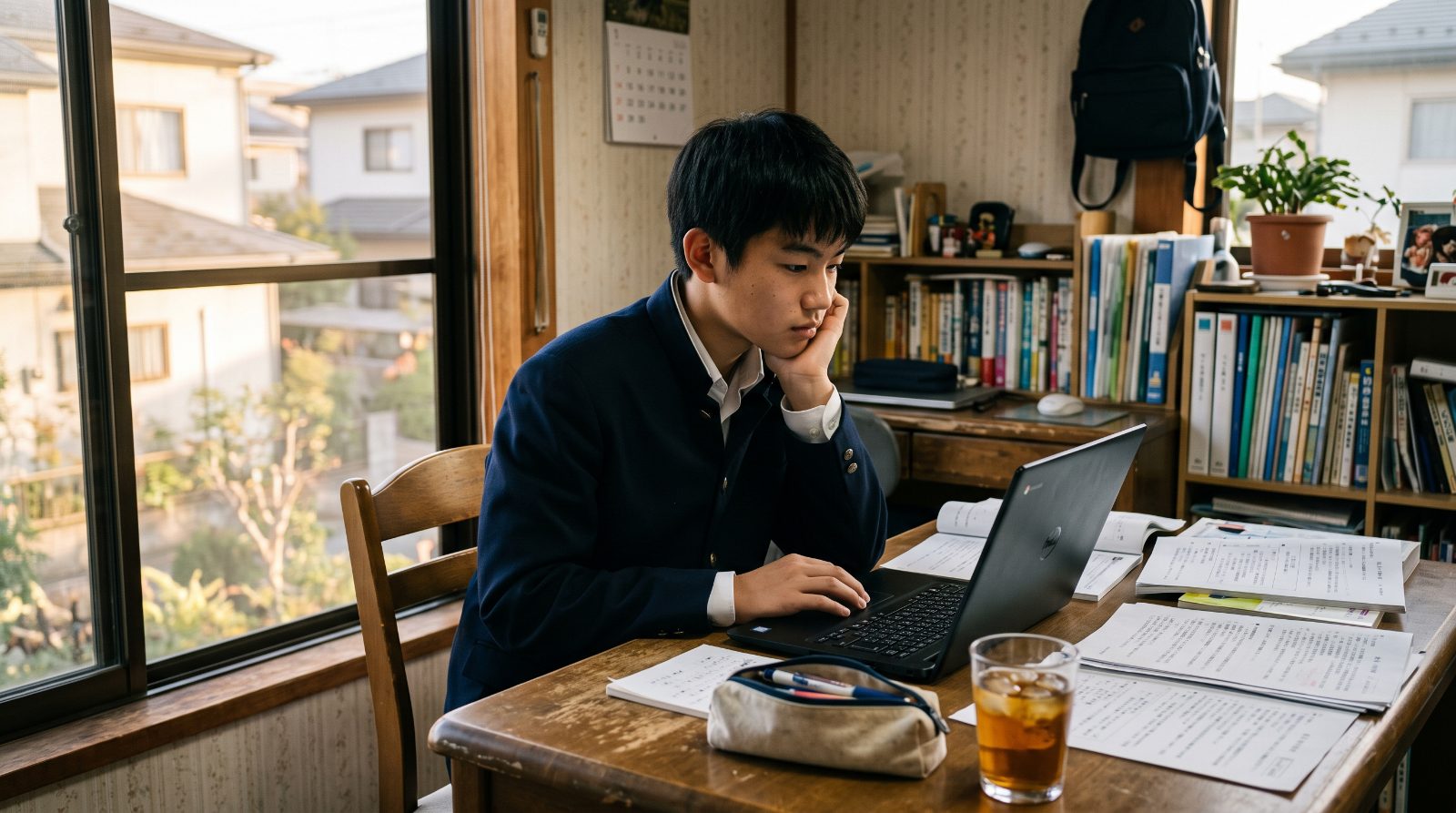
Private online high schools inspected by Ontario are open to international students. You can stay in Japan, Singapore or anywhere else and earn OSSD credits, paying per course. Each school publishes its Ministry-assigned school number (BSID).
In between sits the Independent Learning Centre (ILC), run by Ontario’s public broadcaster TVO. Most Ontario residents pay $40 a course. ILC’s global site lists $500 a course (the page shows “$” without naming the currency), and applicants must be at least 14 (students already at an Ontario high school register through their guidance counsellor).
If you live in Canada: start with your province
For families moving to Canada, the first step is the local public school and your province’s online learning options. Fees for residents are not set out on the provincial pages we checked, and neither BC nor Alberta spells out online fees or eligibility from outside the province on the pages we checked, and arrangements differ by school district, so contact the district once you have an address.
For many expat families, online school works best as a tool around the local school rather than a replacement for it: catching up on credits lost in a move, or adding a course the local school does not offer. Australia and New Zealand split things in a similar way; see our guides to online school in Australia and online school in New Zealand.
From abroad: Ontario private online high schools and the OSSD
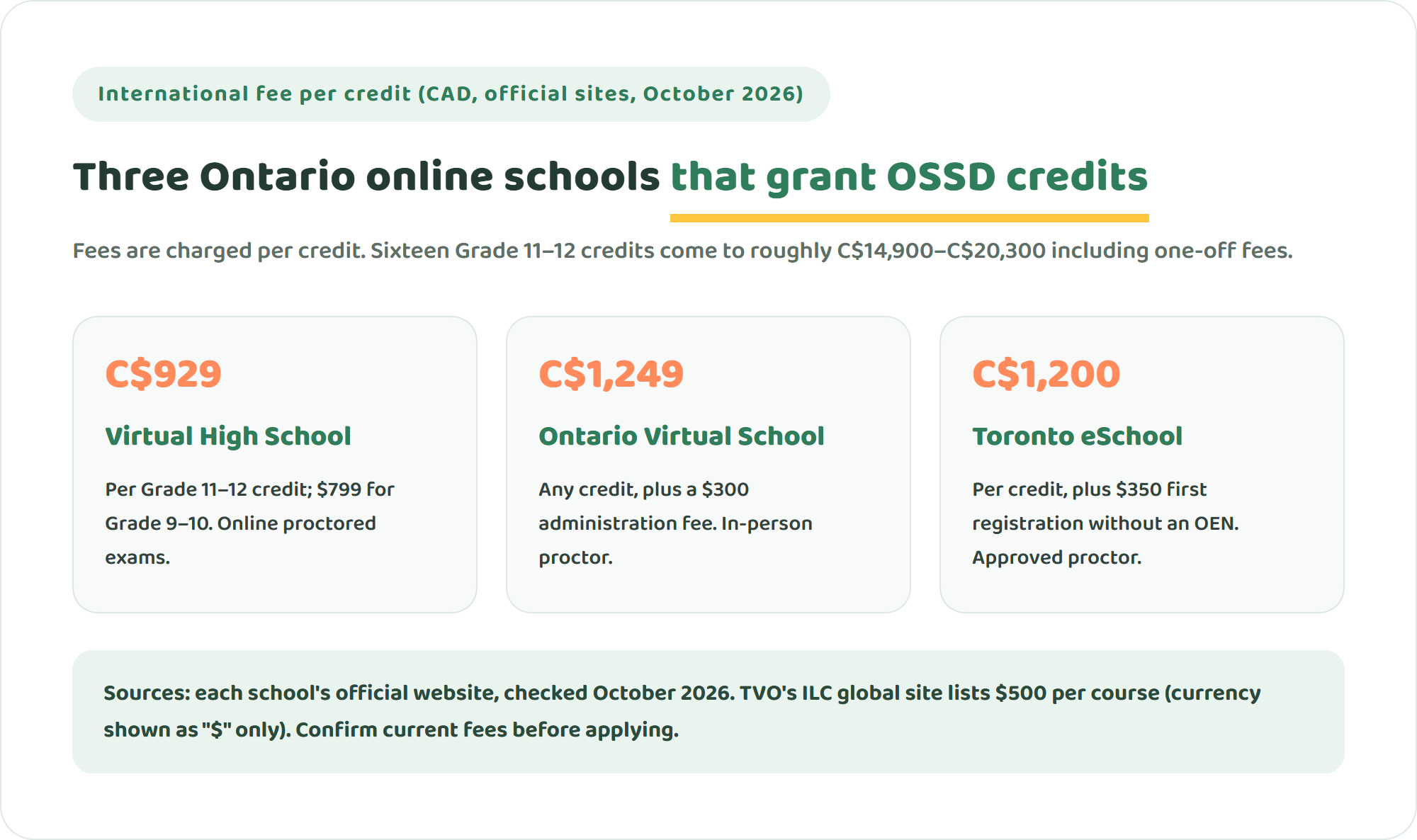
If you do not live in Canada, an Ontario private online high school is the realistic route to Canadian credits. Here are the international fees for the three schools we checked on their official sites.
Virtual High School (VHS)
An Ontario private online school (BSID 665681). International fees are $929 per Grade 11–12 credit (about US$650), $799 per Grade 9–10 credit and $629 per half credit. Canadian citizens and permanent residents pay $629, $499 and $329, so the international premium is $300 a course. Fast-track marking adds $175. VHS states that no study permit is needed and that all graduation requirements can be met from any country. Final exams use third-party online proctoring with a webcam and photo ID, at no extra charge.
Ontario Virtual School (OVS)
BSID 665804. International students without a study permit pay $1,249 per credit for any course, plus a $300 administration fee. Final exams are written in person in front of an approved proctor whom the student arranges and pays.
Toronto eSchool
BSID 886520. International students without a study permit pay $1,200 per credit and $699 per half credit. International students without an Ontario Education Number (OEN) pay a one-time $350 registration fee. Exams are written in front of an approved proctor rather than at home.
Because all three charge per credit, the total depends on your plan. As an illustration, 16 Grade 11–12 credits for a final two-year plan would cost $929 × 16 = $14,864 at VHS, $1,200 × 16 + $350 = $19,550 at Toronto eSchool, and $1,249 × 16 + $300 = $20,284 at OVS (counting the administration fee once). Treat these as rough guides, not quotes.
What the OSSD actually requires
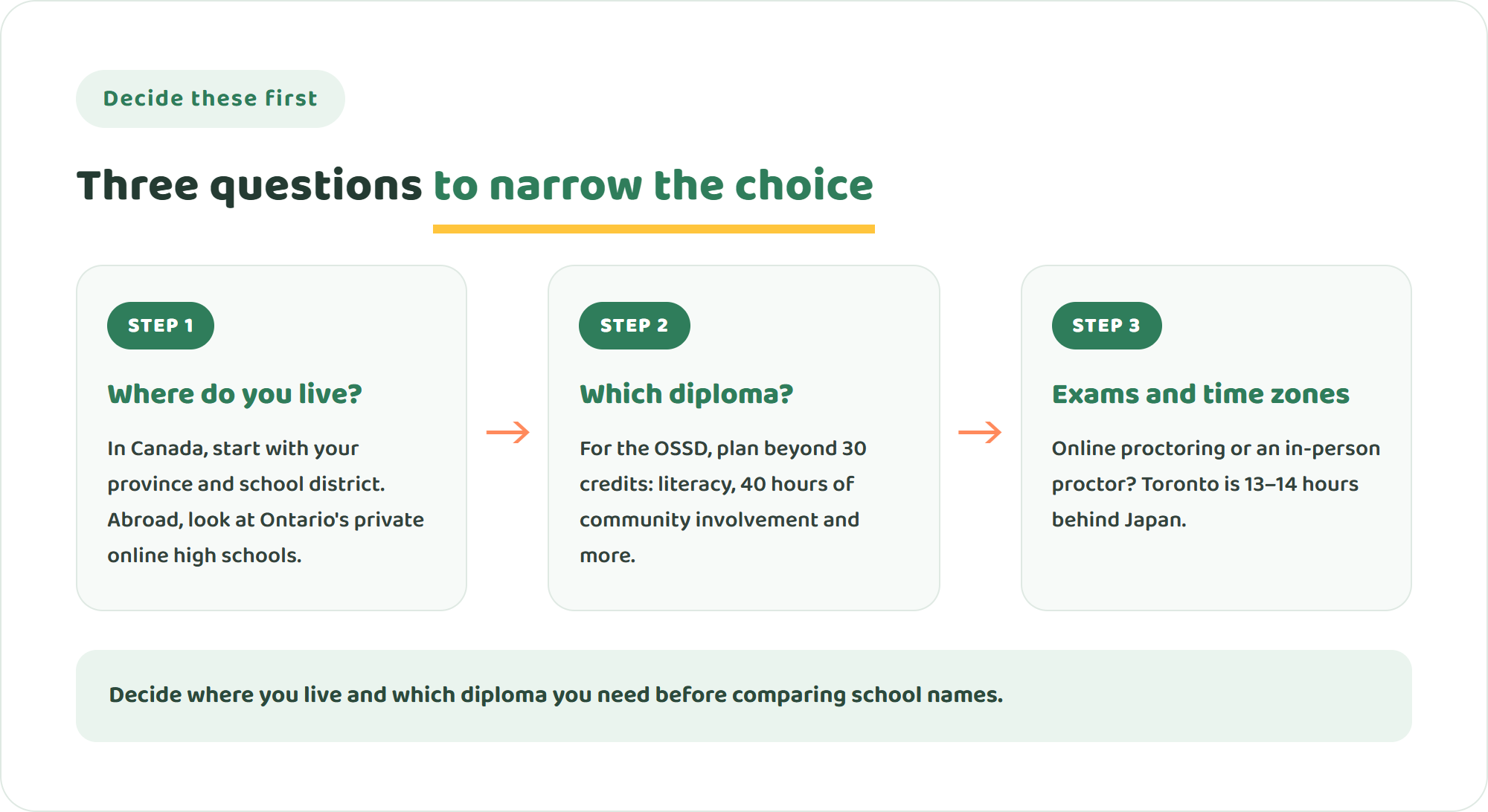
The Ontario Ministry of Education’s graduation page (updated September 2026) sets out 30 credits. Students who entered Grade 9 in September 2024 or later need 17 compulsory and 13 optional credits; earlier students need 18 compulsory and 12 optional. On top of the credits:
- Literacy requirement: usually the Ontario Secondary School Literacy Test (OSSLT). VHS says students outside Ontario can meet it through the online literacy course OLC4O instead.
- Two online learning credits, with an opt-out process. Students at an online school usually meet this along the way.
- 40 hours of community involvement. None of the three schools explains on its site how international students meet this, so ask before you apply.
- Financial literacy: an added requirement for students who entered Grade 9 in 2024 or later.
One more thing none of the schools publishes: how many credits you must earn with them before they will grant the diploma, and how they treat credits from other schools. Ask both questions in writing. If you are also weighing US options, compare them with our list of affordable accredited online high schools and our guide to checking an online school’s accreditation.
It is also worth noticing what these schools are built for. They are mostly self-paced: students work through course material and submit assignments, with little scheduled live discussion. If the way your child learns matters as much as the credits, compare it with NGA’s approach to learning.
Canadian online schools, provincial programmes and NGA side by side
Here is how provincial online learning, Ontario private online high schools and NIJIN GLOBAL ACADEMY (NGA) compare. We have left NGA’s crosses in.
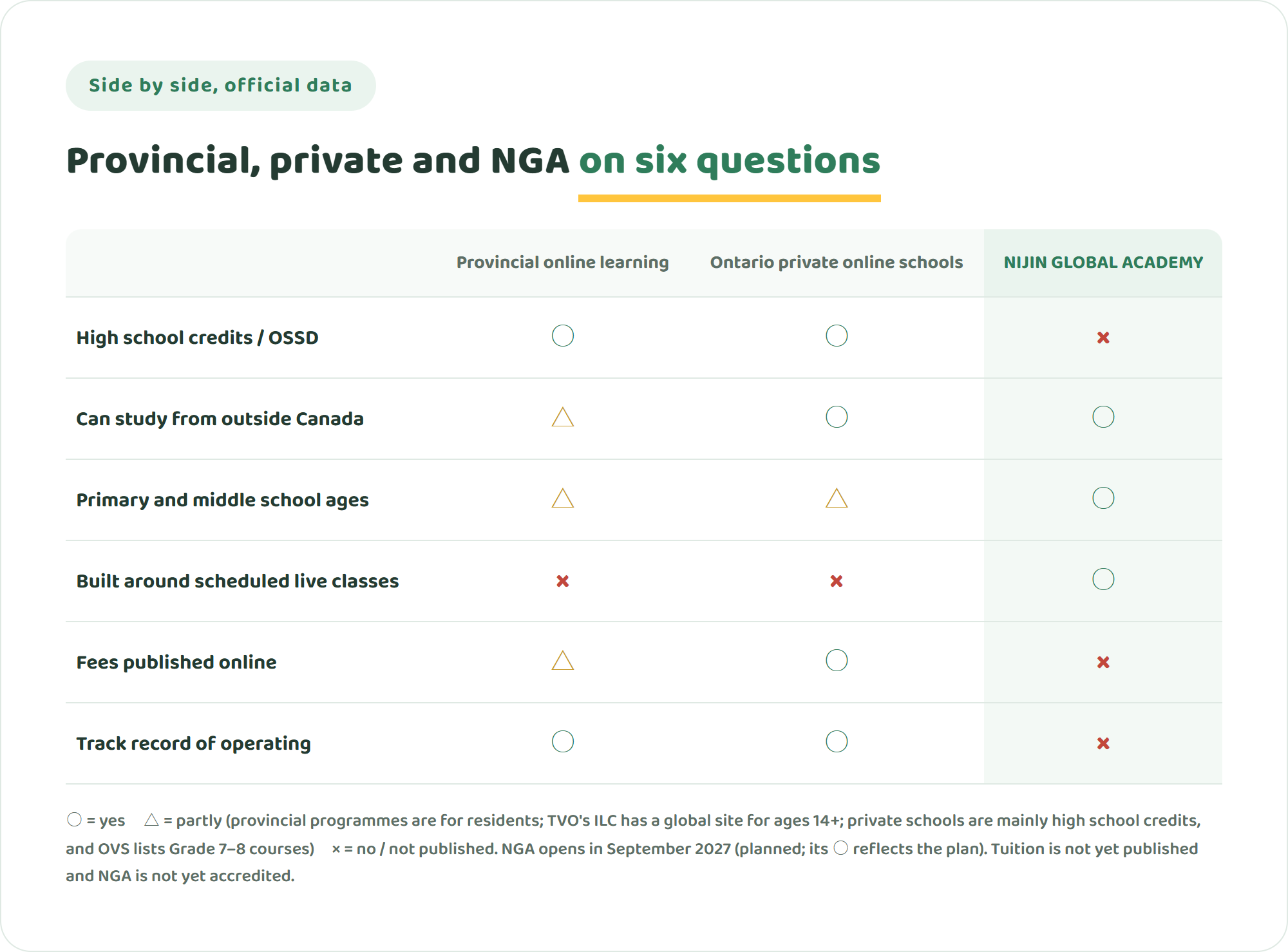
The conclusion is simple: if you need a Canadian high school diploma, choose an Ontario private online school or ILC. NGA has not opened yet and cannot issue a diploma such as the OSSD. On the other hand, the options open to students abroad are mainly high school credit courses (OVS also lists Grade 7–8 courses), and ILC requires students to be 14 or older, so younger children living outside Canada need a different plan.
Practical points for families outside Canada
Time zones
Toronto is 13 hours behind Japan during daylight saving time and 14 hours behind the rest of the year; Vancouver is further behind still (British Columbia has announced changes to its clock rules, so check the current offset officially). Self-paced courses make this manageable, but teacher meetings and proctored exams may need to fit Canadian daytime.
Exam arrangements differ
VHS uses online proctoring; OVS and Toronto eSchool require an approved proctor in person. If you live abroad, whether you can find a suitable proctor may decide which school works for you.
Check university entry rules early
If your child may apply to universities outside Canada, check how each one treats the OSSD before choosing courses. Entry requirements vary by country and by university, and they shape which credits are worth taking.
Where NIJIN GLOBAL ACADEMY fits
NIJIN GLOBAL ACADEMY (NGA) is an online international school for ages 6–18 focused on Asia and Oceania, opening in September 2027 (planned). It is operated by NIJIN Inc., which runs learning programmes in Japan, including NIJIN Academy for children who do not attend school, and has supported more than 1,000 children. Its model is live classes in small groups of about eight, subjects taught in English with support from a bilingual English–Japanese mentor, and admission that is not based on test-score rankings.
The honest limits: NGA is not yet open, not yet accredited and has no graduates, and tuition has not been published. It is not a substitute for the OSSD. Its timetable is built around Asia–Oceania daytime, so live classes may fall in the evening or early morning for families living in Canada. Where it may help is earlier: for a family in Asia that wants a child to build the habit of thinking and speaking in English through the primary and middle school years, before aiming at a diploma such as the OSSD in high school.
FAQ
Can international students take online school in Canada?
Yes, through Ontario’s private online high schools. VHS, Ontario Virtual School and Toronto eSchool all accept international students without a study permit, and TVO’s ILC has a global site. Provincial programmes in BC and Alberta are designed for residents.
How much does an OSSD online cost for international students?
Fees are per credit: $799–$929 at VHS, $1,200 at Toronto eSchool and $1,249 at OVS (CAD, October 2026). Sixteen Grade 11–12 credits come to roughly $14,900–$20,300 including registration or administration fees.
Is there an online school in Canada for elementary students?
Provincial programmes serve younger students who live in the province. Of the options open to students abroad, most are high school credit courses, though OVS also lists Grade 7–8 courses, and ILC requires students to be 14 or older.
Is online school in Canada accredited?
For the OSSD, the key check is not US-style accreditation but that the school is a private school inspected by the Ontario Ministry of Education, with a BSID that appears on the Ministry’s list of private schools. All three schools above publish theirs.
Choose by where you live and the diploma you need
Online school in Canada looks confusing until you answer two questions. Living in Canada? Start with your province. Studying from abroad and aiming for the OSSD? Start with Ontario’s private online high schools. Either way, confirm the exam arrangements and the community involvement requirement with the school before you apply.
For families who want the years before a high school diploma to be spent thinking and speaking in English, NIJIN GLOBAL ACADEMY is preparing to open in September 2027 (planned), with trial classes in April–May 2027. We will email the timetable and curriculum once they are fixed.
No need to pick a school this week. Start by talking as a family about where your child might want to be in the year they finish high school. That answer is the most reliable map for choosing an online school in Canada.