The notice arrives in autumn: your local ward or city office sends the pre-enrolment health check for children starting elementary school next spring. You open the envelope, it lands that your child really is about to start school — and your hand stops. The local public elementary school is the obvious path. But the English your child has been building since preschool would fall away, and you find yourself wondering whether starting international school from elementary school is something your family could actually do.
This article is written for the moment you’re in. Rather than answering “yes you can” or “no you can’t,” it takes the three worries that stop most families — compulsory education rules, starting with no English, and whether the money lasts — and separates what is known from what genuinely depends on your situation. Then it lays out the ways to attend, because full-time enrolment is not the only one. The aim is that you finish with a list of things to confirm, not a decision you were pushed into.
What changes when you start international school from elementary school
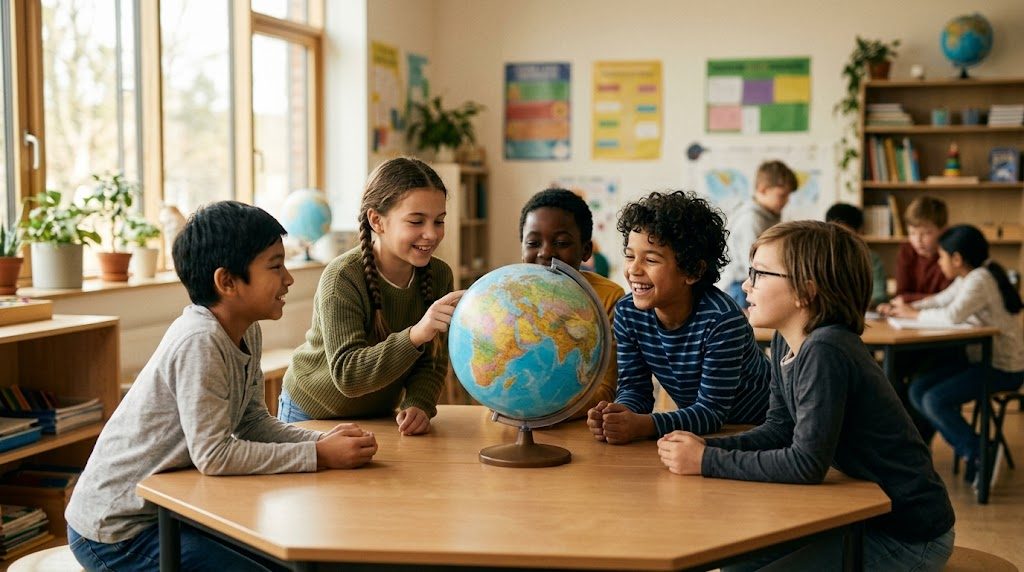
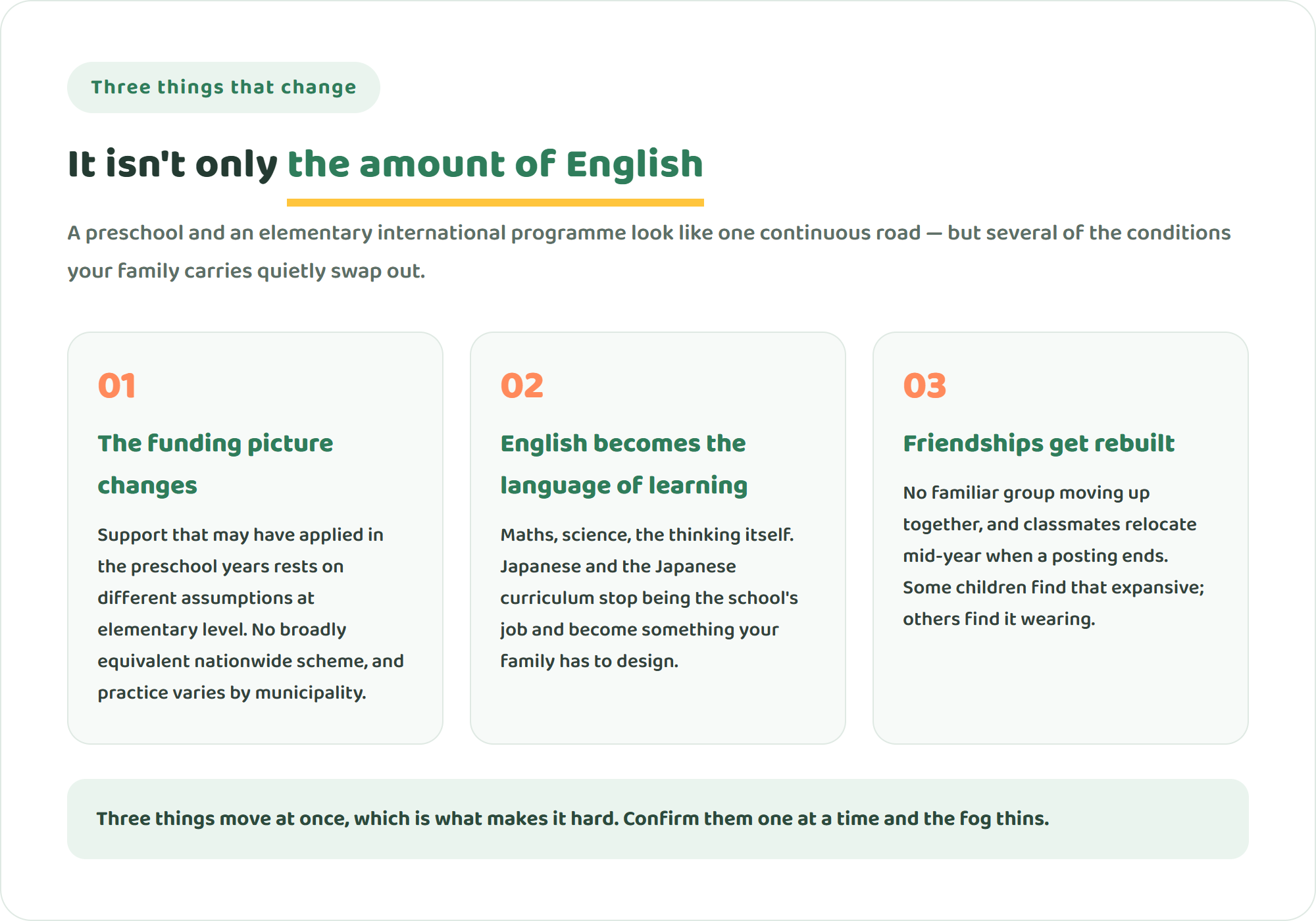
A preschool and an elementary programme can look like one continuous road, but several of the underlying conditions swap out. First, the money changes shape. In the preschool years, depending on how the facility is classified and how your municipality applies the rules, some families qualify for public childcare support. At elementary level, no broadly equivalent nationwide scheme is generally available. Because implementation varies by municipality, confirm your own case at your local office — our overview of subsidies and ways to save is a starting point, not a substitute for that call.
Second, the language of learning becomes English. This is not “more English lessons.” Maths, science and social studies — the thinking itself — happen in English. At the same time, Japanese and the Japanese curriculum stop being something the school automatically handles and become something your family has to design. When will kanji be built up, and by whom? When does your child meet Japanese history and geography? Families who postpone this question are the ones who struggle a few years later.
Third, the social world gets rebuilt. There is no group of familiar faces moving up together from the same kindergarten. Classmates relocate mid-year when a parent’s posting ends, so arrivals and departures turn over quickly. Some children find that expansive; others find it wearing. If you want the landscape first, what an international school actually is makes the rest of this easier to weigh.
Compulsory education when you start international school from elementary school
This is the most common question we get. Here is the accurate short version. Most international schools in Japan are not classified as schools under Japan’s School Education Act — they are not what is called an Article 1 school. As a result, when a child attends one, how the parental compulsory-education obligation is treated cannot be assumed to work the same way as it does for a public elementary school. How the school register is handled, what has to be filed with the local school, how attendance is recorded — practice differs between municipalities and between schools.
So this article will not give you a legal conclusion. Confirm your own situation with your municipal board of education before anything else. You can raise it years ahead of enrolment, and the arrival of the pre-enrolment health check is a natural moment to ask. Leaving this vague while you tour campuses is how families end up exhausted later. It belongs first in the sequence, not last.
What if your child speaks no English at all?
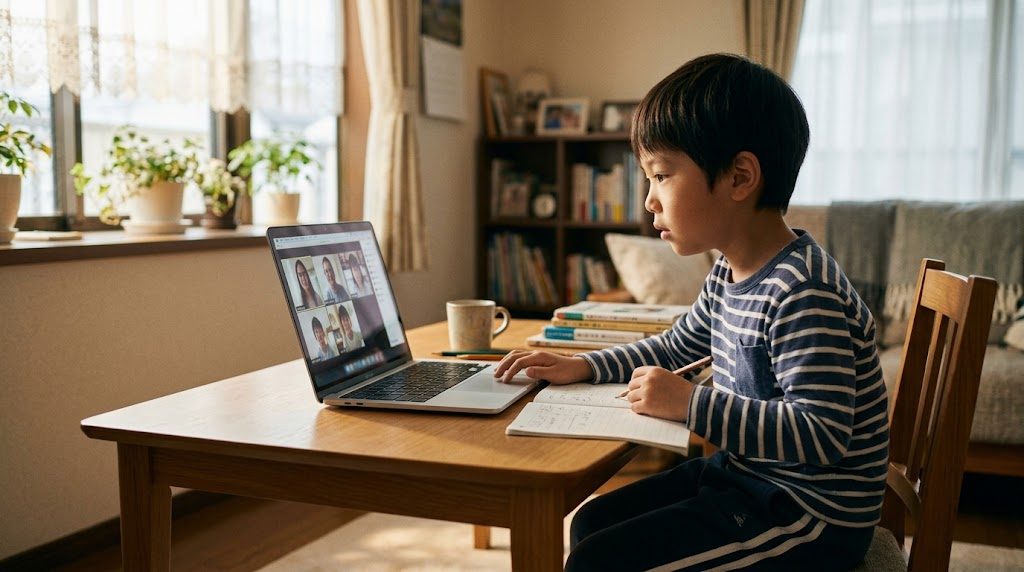
The honest answer is that it depends entirely on the school. Some run substantial support for children who don’t speak English at home, usually called EAL or ESL. Others expect a working level of English at admission. The same two words on the gate can mean very different things. At an open day, don’t stop at “yes, we have EAL.” Ask how many specialists there are, how many hours a week, how long before a child typically joins the mainstream class, and who notices when a child stalls.
On age: it is generally observed that the earlier a child enters, the lighter the language load feels. But that is not purely good news. When English dominates during the years a child is building literacy and abstract thinking in their first language, Japanese can grow more slowly than parents expect — and in some cases neither language settles fully as the language of learning. This is not an argument against international school; it is something you can plan around. Read how families raise a bilingual child without losing the mother tongue alongside it, because the families who cope best are the ones who budget for first-language support from the start rather than discovering the need in year four.
What international school from elementary school costs, and whether you can keep paying it
The range is wide. Our own compilation puts annual fees at roughly 1.0 to 3.45 million yen, with the main schools clustering around 2.0 to 3.45 million yen a year. On top of that sit entrance fees, facility fees, bus fees, materials, trips and, at some schools, a donation. Figures are revised annually, so treat each school’s official site as the primary source. Our breakdown of tuition and the costs around it explains what the headline number leaves out, and how fees compare across Asia is useful if relocation is on the table.
There is one structural point every family considering the elementary years should hear. The nine years of elementary and junior high are when public support is thinnest for a family outside the Article 1 school system. There is an entry point of sorts in the preschool years, and at high school age some schools — depending on how they are licensed — come back within reach of public support. The nine years in between land squarely on the household. Which means the question is not “can we pay for year one?” but can we pay for nine years running? What support might exist is summarised in subsidies and savings, but eligibility changes by municipality and by year, so verify it officially.
See how learning works at NGA →
There is more than one way to attend
If you have read this far thinking it may not be feasible, here is the part most families miss. Starting international school from elementary school is not a single yes-or-no about full-time enrolment. There are broadly three ways in.
1. A full-time international school. The richest English environment, and an international curriculum built from the ground up. In exchange, it is the heaviest cost, and geography decides whether it is even possible. Japanese and the Japanese curriculum become your family’s design problem.
2. Public elementary school plus international learning alongside it. Your child stays at the local school and adds English-medium learning after hours or at weekends. The Japanese foundation stays intact while English hours accumulate, and the cost is easier to carry than full-time. The thing to watch is your child’s energy and how the week is spent — a tired child learns neither language well.
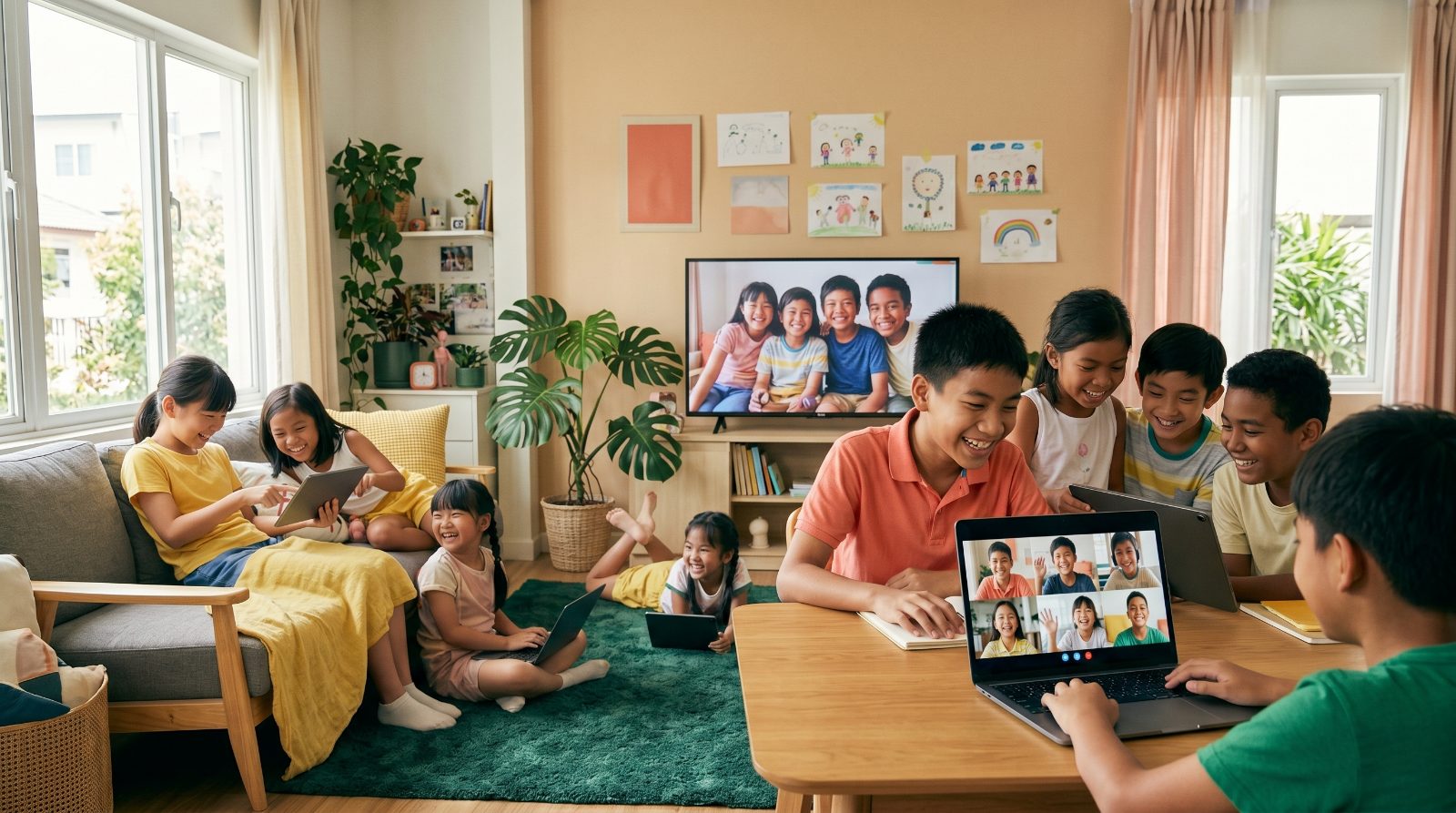
3. An online international school. International learning without being tied to where you live. Without a campus to maintain, fees tend to sit lower, and a child can adjust how they take part around temperament and health. The trade-offs are the density that only in-person brings, and the daily rhythm you have to build yourselves. See online international schools across Asia for who is out there, and whether online international schools are actually affordable for the numbers.
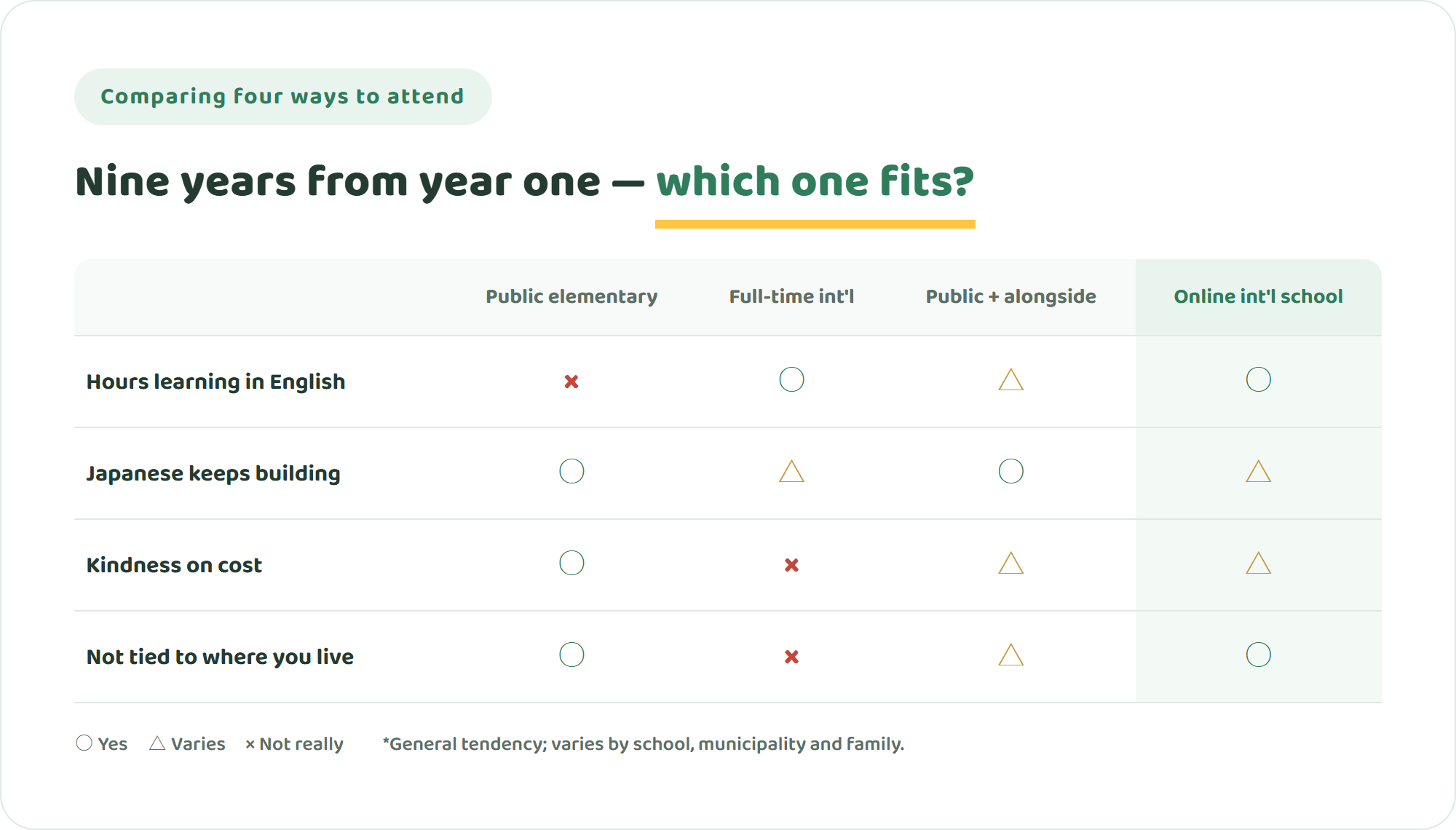
Laid out like this, the obvious truth surfaces: choosing one of these means giving something up. Maximise hours in English and you accept the cost and the geography. Protect the Japanese foundation and the public-plus-alongside route is the solid one. Refuse to be limited by where you live and online becomes the realistic answer. Rather than chasing all four rows, decide which single row your family will not compromise on. The choice gets dramatically easier after that.
Four things to confirm before you decide
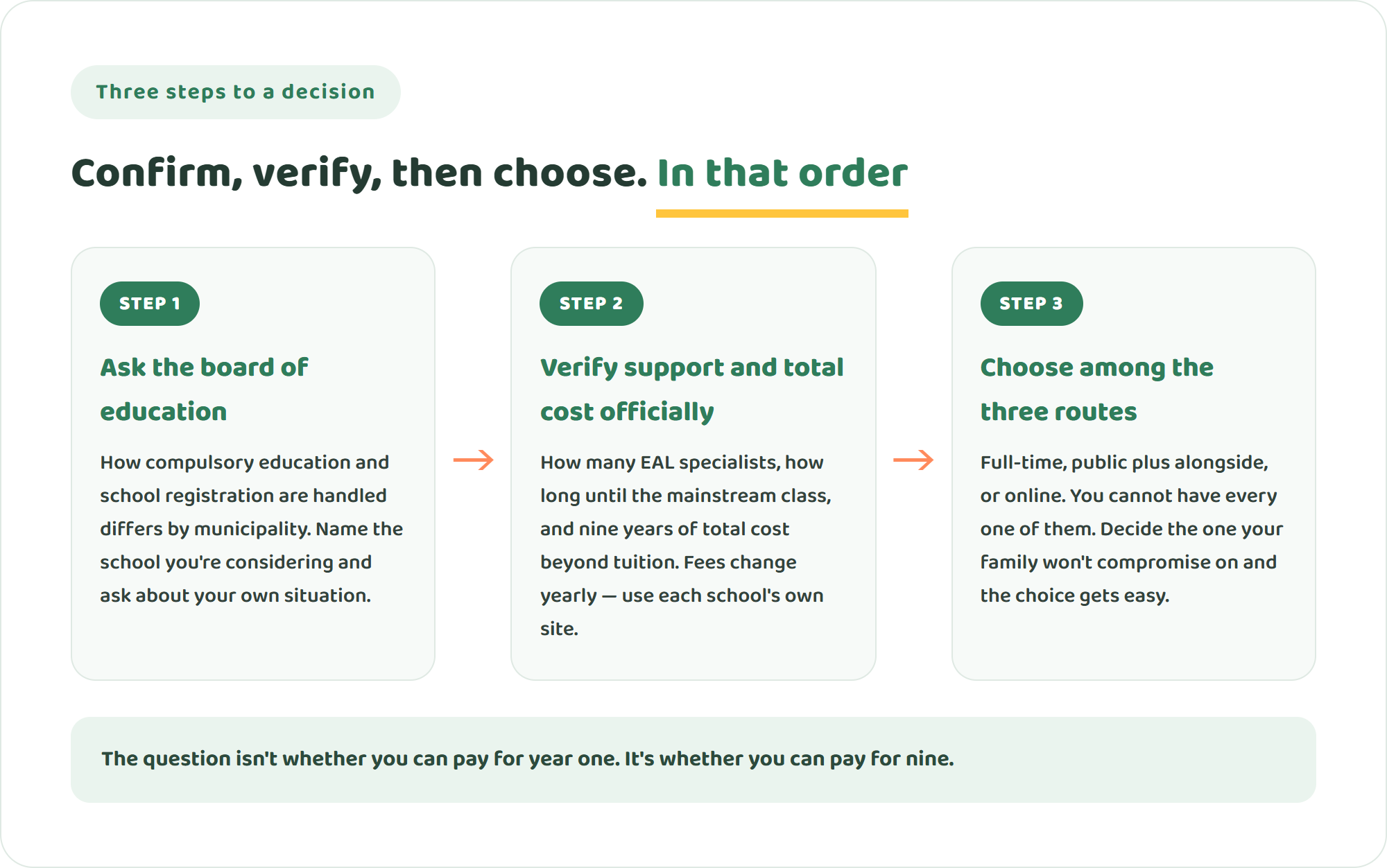
1. Have you asked the board of education yourself, in your own words?
Don’t decide from forum posts or another parent’s experience. Practice varies by municipality. Naming the specific school you’re considering gets you a specific answer instead of a general one.
2. Have you checked English support down to staffing and timeline?
“We have EAL” is not an answer. How many specialists, how many hours a week, and how long until a child typically joins the mainstream class? Only then can you compare schools honestly.
3. Have you written down your plan for Japanese?
Who, when, and with what. Left vague, it slides. Weekend Japanese classes, reading habits at home, structured support — deciding this during the elementary years changes how heavy the later years feel.
4. Have you put nine years of total cost on paper, with your partner?
Nine years, not year one — including everything beyond tuition and the likelihood of increases. Having to withdraw mid-way is the outcome that costs a child the most.
Where NGA fits, and where it doesn’t
If the third route caught your attention, here is where we stand. NIJIN GLOBAL ACADEMY (NGA) is an online international school beyond the exam race, opening in September 2027. We enrol ages 6 to 18 — the elementary years are the front door. NGA is operated by NIJIN Inc., and NIJIN Academy, one of Japan’s largest alternative schools, already has over 900 children enrolled.
What we hold above everything is psychological safety, and in practice that means each child chooses how many people they engage with, and how. Camera on or off, speaking aloud, writing in the chat, showing something they made — all of it counts as taking part. Two phrases sit underneath the whole design: come to love yourself and the world, and don’t blame people, fix the structure. The world itself is the material. And because none of it depends on a campus, families in regions with no international school within reach are not excluded.
In fairness, NGA is not right for every family. If what you want most is your child walking into a building every morning and spending physical, unmediated days with the same group of children, a full-time school within commuting distance fits better. If you need reliable coverage of the Japanese national curriculum at grade pace, public school plus something alongside is the more direct answer. Line us up fairly against the alternatives, and consider us only if it genuinely fits your child.
Frequently asked questions
Can a child stay enrolled at a public elementary school while attending an international school?
How enrolment and attendance are handled differs by municipality and by school. Some families do combine them, but filing requirements and attendance treatment are not uniform. Confirm with both your municipal board of education and the school your child would be registered at. If you are adding English-medium learning after hours or at weekends, enrolment usually stays as it is, and that arrangement is often the simplest place to start.
Our child speaks no English. Is starting from elementary school unrealistic?
Not necessarily. At schools with real support for children who don’t speak English at home, starting from zero is common. But the depth of that support varies enormously, so verify it school by school rather than assuming. Build the plan for maintaining your child’s first language at the same time, not afterwards.
Can a child move back to a public elementary school later?
Transfer rules and procedures vary by municipality and school. How the school register has been handled and how prior learning is assessed are both worth understanding in advance. Ask the board of education about the way back before you take the way in — knowing the door opens both directions is often what makes the decision possible.
You aren’t choosing a school. You’re choosing nine years of family life.
Starting international school from elementary school is hard to decide not because schools are hard to compare, but because three realities move at once: the compulsory-education rules, the language, and the money. Which also means that confirming them one at a time genuinely reduces the fog. Nothing has to be decided today. What can be done today is putting a date in the calendar to call the board of education.
NIJIN GLOBAL ACADEMY opens in September 2027, with trial classes running as a soft launch in spring 2027. We’ll send you news of our first cohort, how learning works when a child chooses the size and shape of their own participation, and how a classroom connected to the world is built. You don’t have to decide anything today. Just hold on to this: how your child learns has far more room in it than it looks.
Get opening updates by email →
More on choosing an international education
- How Much Does an International Preschool Cost in Japan?——Fees, subsidies, and the step after kindergarten
- Minerva Virtual Academy Fees for Families in Asia——Paid upfront, taught on UK hours
- American Online Schools for International Students——5 compared on tuition, time zones and eligibility
- Stanford OHS vs Laurel Springs——Live seminars or self-paced, read from Asia
- Alpha School vs Sora vs Primer——Which new school model a family in Asia can use
- Can You Raise a Bilingual Child Without Speaking English?——What parents can realistically do at home
- School Refusal? An Online International School Can Reopen Learning——A route back into learning
- How Do You Nurture the Skills Standardized Tests Cannot Measure?——Beyond exam scores
- The Best Age to Start Learning English for Kids——Too early? Too late?
- Online International Education in Asia and Oceania: 7 Options Compared——An honest comparison