If you are searching for remote teaching jobs in the Philippines, the first thing you want to know is whether they are real — whether a licensed teacher in Cebu, Davao or Quezon City can genuinely teach for an international school without leaving the country, and be treated as faculty rather than as a per-minute contractor. The short answer is yes, and the practical reason is a number: Philippine Standard Time is UTC+8 and Japan Standard Time is UTC+9. That is a one-hour gap. A Japanese school day starting at 08:30 JST begins at 07:30 for you. Almost no other overseas market can say that about a Japan-based school.
That single hour is why schools in Japan and East Asia can hire remote faculty from the Philippines without splitting anyone’s sleep. What follows is an honest look at what these roles actually are, what a school will ask you for, how to tell a real posting from a bad one, and where NIJIN GLOBAL ACADEMY — a fully online international school opening in September 2027 — fits in. Conditions differ by school, so treat everything here as a way to ask better questions, not as a promise.
| What you are looking at | A real remote faculty role | A posting worth walking away from |
|---|---|---|
| Pay | A stated basis, and a straight answer about when terms are settled — including when the honest answer is that the role starts unpaid | “Competitive” with no figure and no answer about when you will get one, or a figure far above market with no qualification asked |
| Money moving toward you | Always. You never pay the school, and it supplies or reimburses what it requires. Any unpaid or volunteer arrangement is stated plainly and bounded | A training fee, placement fee, equipment deposit or “processing” charge |
| Time zone | Named hours in a named zone (JST is PHT +1) | “Flexible” only, with graveyard shifts appearing later |
| Who you are talking to | A named school, a named legal entity, named people, a working website | A recruiter on chat only, no site, no entity, urgency about deciding today |
Sources: NIJIN GLOBAL ACADEMY careers pages; Philippine Standard Time (UTC+8) and Japan Standard Time (UTC+9). Terms vary by school and are confirmed individually — always ask.
That first row is the one to hold on to. Most online teaching listings never name a figure, and never say when they will. That second silence is the one that costs you evenings. See the founding member roles at NIJIN GLOBAL ACADEMY → — the answer there is plain rather than flattering: founding roles begin as volunteer positions while the school builds toward its 2027 opening, and detailed terms are shared later in the process. Knowing that before you invest your time is the whole point of the row above.
Why schools hire remote teachers from the Philippines
It is worth being clear about this, because the honest version is more useful than the flattering one.
The structural reasons
English is an official language of the Philippines and is widely used as a medium of instruction, so a Filipino teacher is not switching into a second working language when the class runs in English. The country also has a formal licensing system: under Republic Act 7836, the Philippine Teachers Professionalization Act of 1994, teaching is a regulated profession, and passing the Licensure Examination for Teachers (LET) administered by the Professional Regulation Commission makes you a Licensed Professional Teacher. That means a school abroad can verify a credential rather than guess at one. The Philippines also runs a K-12 basic education programme, so a teacher here is already working inside grade levels and learning standards that map onto what an international school expects, rather than translating between two unrelated systems. Add the one-hour offset from Japan and the case makes itself.
The reason people are cautious about
Cost is part of it, and pretending otherwise would be dishonest. But cost alone does not explain why a school would build its faculty this way, because a cheap teacher who leaves in three months is expensive. What a school is actually buying is a licensed, English-teaching professional who can stay — which is why the roles worth taking look like roles, not like piecework.

What a school will actually ask you for
Requirements vary, but the pattern is consistent across schools that take remote faculty seriously.
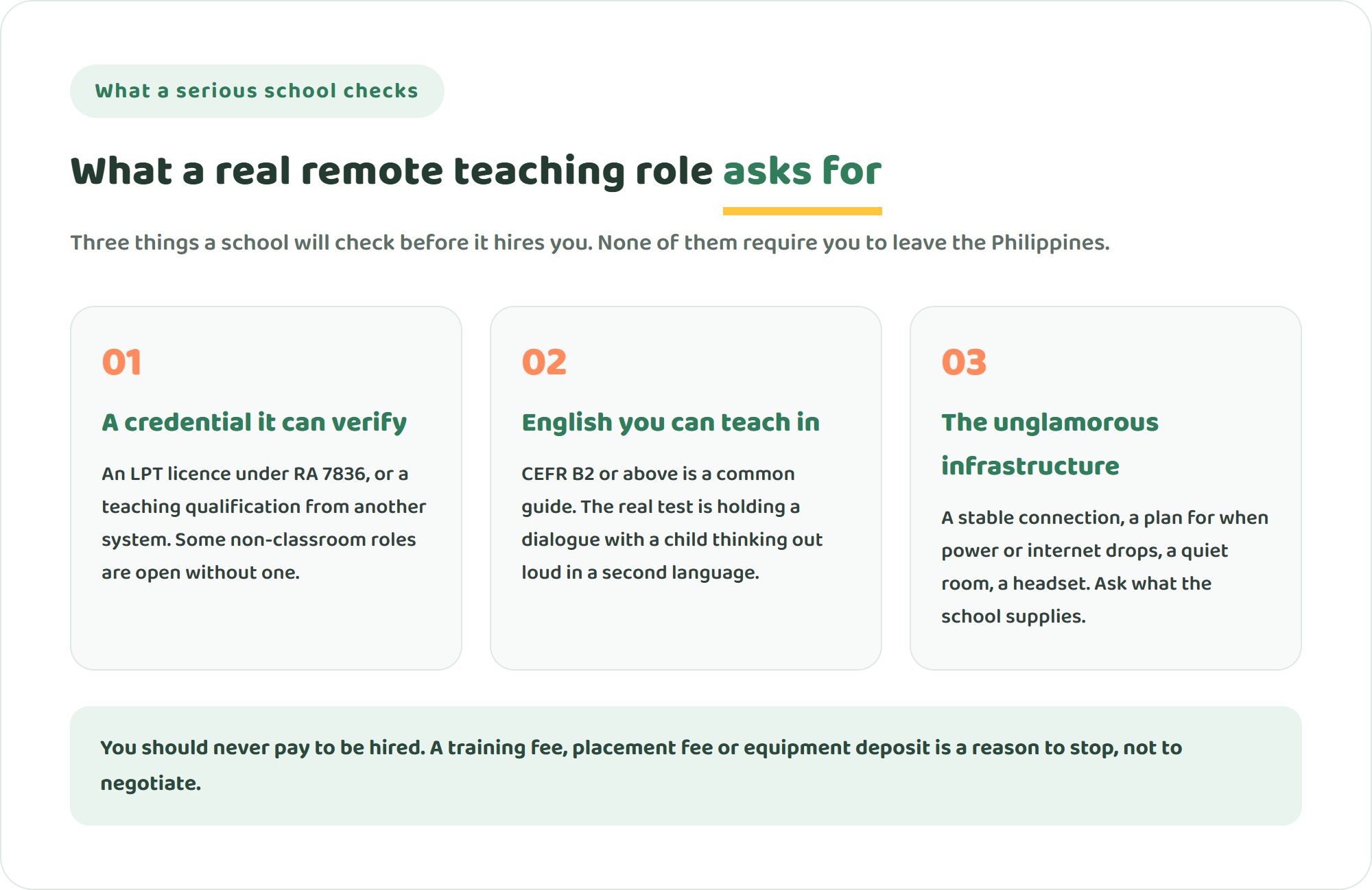
A credential, or a clear reason you do not need one
An LPT licence, or a teaching qualification from another system, is the usual starting point. Some roles — mentoring, language support, project work — are open without a classroom licence; if that describes you, our guide to teaching jobs without a licence is the better place to start.
English you can teach in, not English you can pass a test in
NGA uses CEFR B2 or above as a guide. The real test is different: can you hold a dialogue with an eleven-year-old who is thinking out loud in an imperfect second language, and keep them thinking? Schools that build around inquiry care far more about that than about an accent.
The unglamorous infrastructure
A stable connection, a plan for when power or internet drops, a quiet room, and a headset. Ask what the school supplies and what it expects you to provide — and remember that a real employer never asks you to pay for the privilege of being hired.
How to read a posting before you answer it
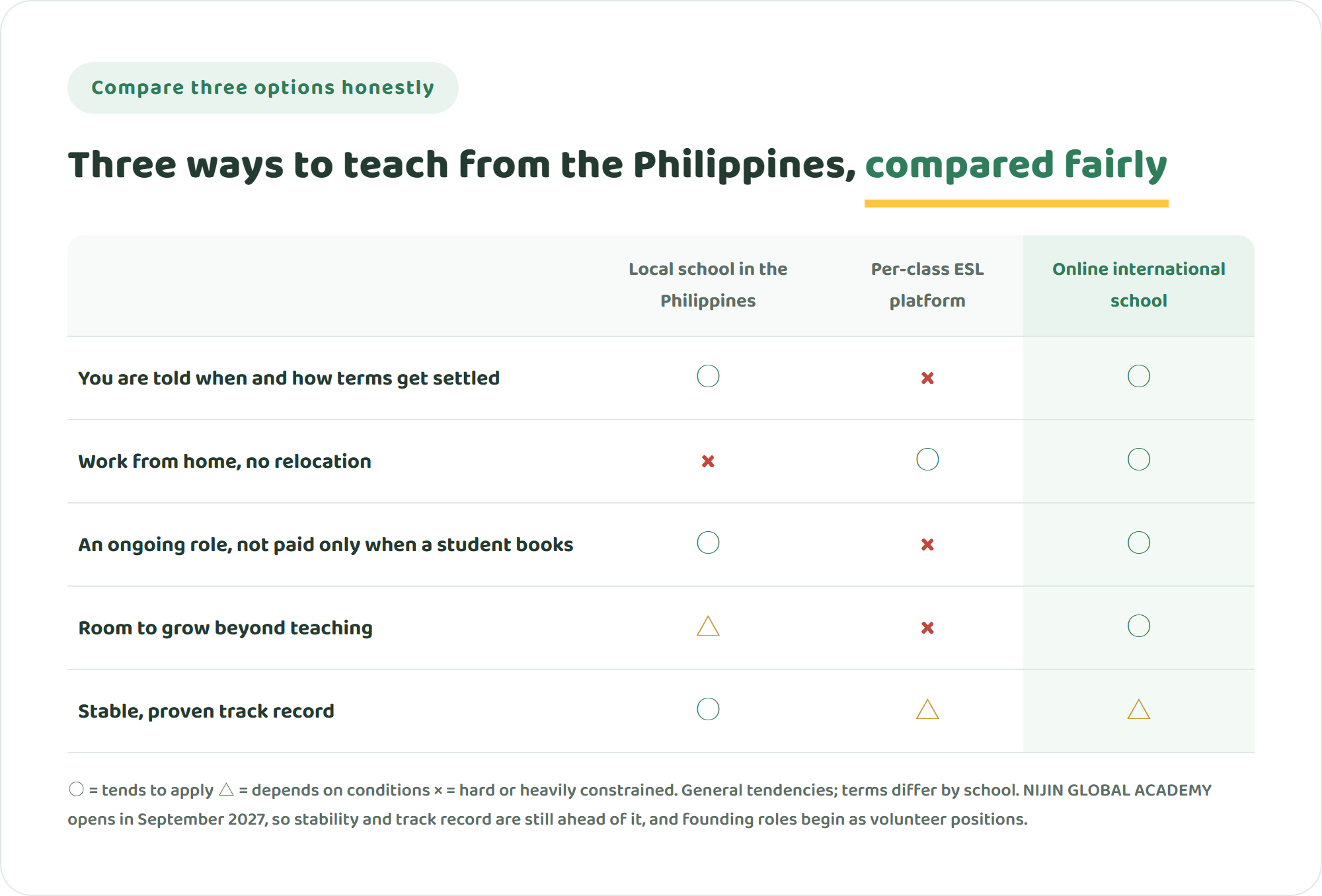
The remote teaching market has real employers and it has predators, and they use the same job boards. Three checks separate them.
Check the entity, not the advertisement
Find the school’s own website, its legal operating company, and the names of actual people. A school that exists is easy to verify in ten minutes; one that is not will resist every specific question.
Get the terms in writing before you teach
Pay basis, hours, currency, payment method, notice period, who supplies equipment. If a recruiter will not put these in a document, that is the answer.
Money should only ever move toward you
No training fee, no placement fee, no deposit for a laptop, no “processing” charge. This one rule removes most of the danger in the market.
Ask what happens when something goes wrong
This question tells you more than any brochure. What happens when your connection drops mid-lesson? When a child is upset and the lesson has to stop? When a parent raises a complaint? A school with real structures will answer immediately, because it has already lived through all three. A platform that treats you as interchangeable will answer with a policy about deductions. Listen for which one you are hearing, and ask who you would call — a named colleague, or a support ticket.
A school built to be staffed from anywhere
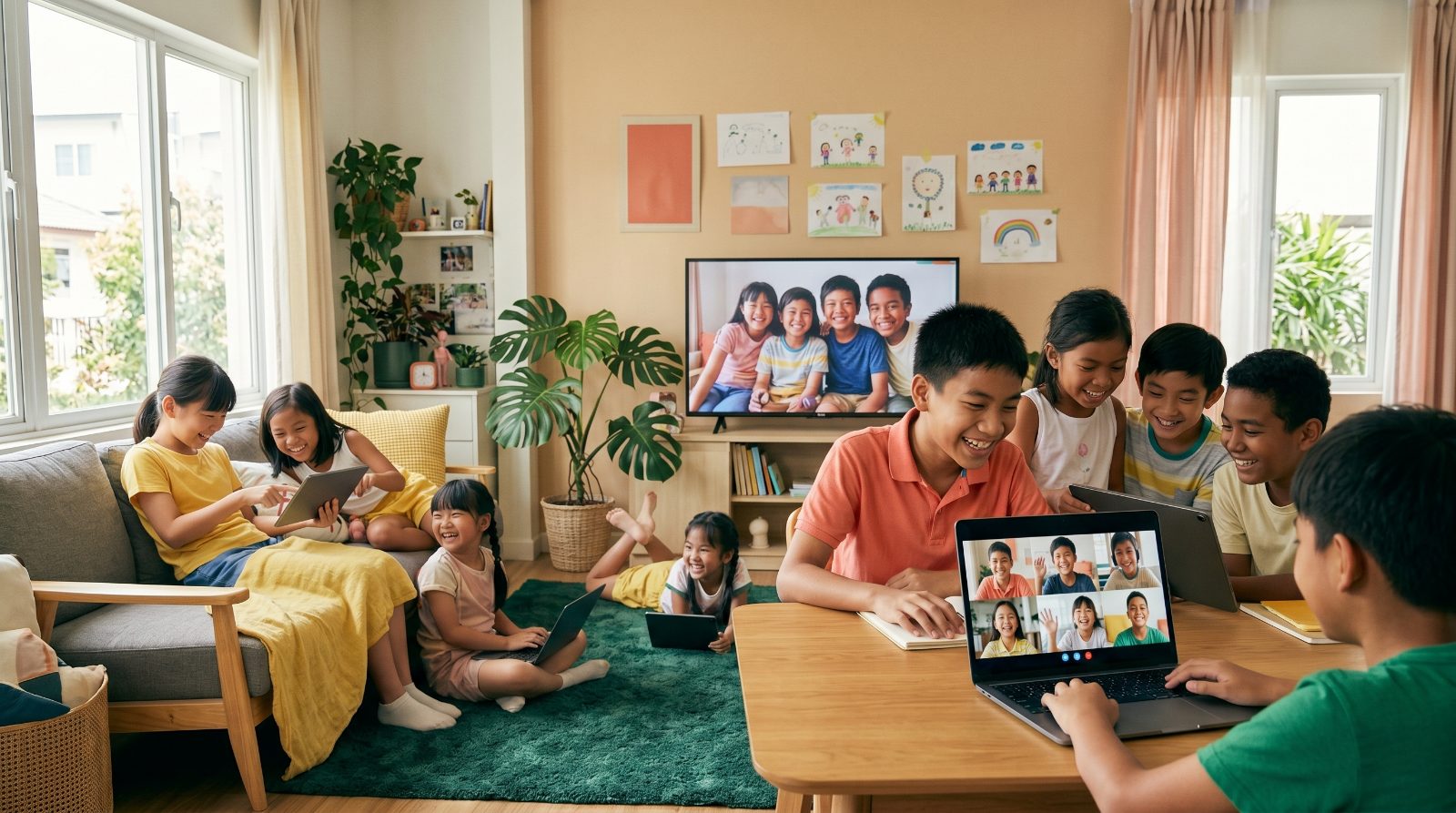
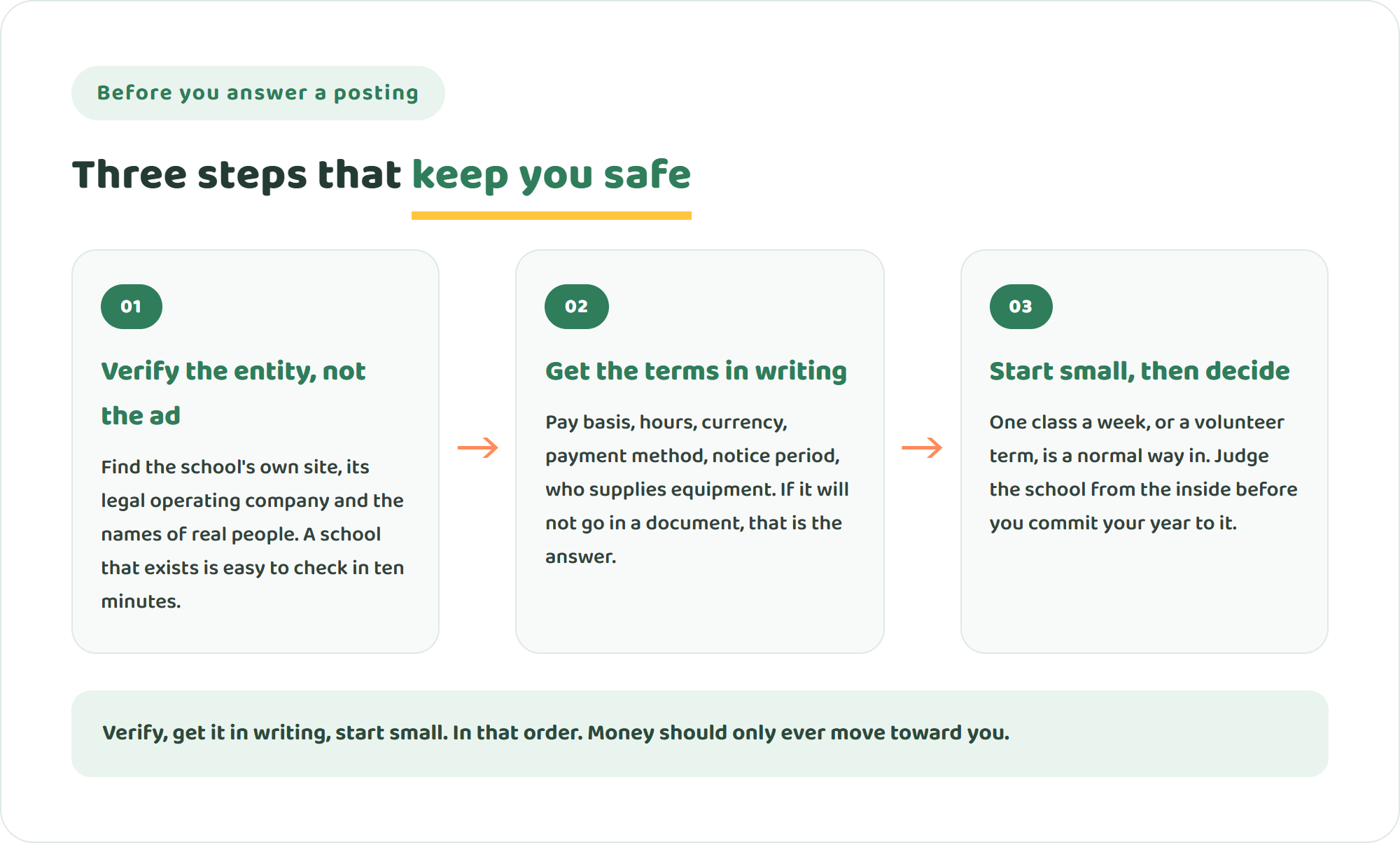
NIJIN GLOBAL ACADEMY is an online international school run by NIJIN Inc. in Japan, opening in September 2027. It is built around dialogue and inquiry in classes of eight, and it deliberately looks past exam-score ranking as the measure of a child. Because it is fully remote by design, it hires without visas, without relocation and without asking anyone to move — which is not a perk here, it is the operating model.
Three things follow from that, and they matter specifically if you are reading this from the Philippines.
- Your location does not set your terms. There is no campus to live near, so there is no premium for living near it. Teaching from home in the Philippines is the normal case, not an exception the school tolerates.
- A genuinely multinational faculty. NGA does not claim to be an all-native-speaker staff room and does not want to be. Children who will live and work internationally benefit from hearing English carried by adults from several countries — Filipino educators are a core part of that, not a fallback.
- More than one way in. Open founding roles include homeroom teacher, bilingual mentor and country PM, so you can enter through the door that matches what you already do well.
Two honest caveats. The school has not opened yet, so stability and track record are still ahead of it — anyone who tells you a pre-launch school is a safe bet is selling something. And founding roles begin as volunteer positions, with detailed terms shared later in the process as the school moves toward opening — so if what you need is paid work now, this is not it, and no amount of enthusiasm on our side changes that. Even one class a week is welcome, and starting as a volunteer is a normal way in — several people join to give back while living abroad, and decide about more from the inside. If you want the wider picture on what international schools pay, our international school teacher salary guide sets the context.
Frequently asked questions
Do I need to be a Licensed Professional Teacher to apply?
For classroom-facing roles a teaching qualification is the usual expectation, and an LPT licence under RA 7836 is recognised as one. Non-classroom founding roles are open more widely. If you are unsure which applies to you, say so in your application rather than screening yourself out.
What hours would I work from the Philippines?
The school runs on Japan Standard Time, one hour ahead of Philippine Standard Time, so a Japanese school day falls inside a normal Philippine working day — no night shifts, no sleeping through the afternoon. Exact schedules are agreed with the team rather than fixed in advance, and part-time patterns are genuinely available rather than theoretical.
Do I need a visa, or to move to Japan?
No. NGA is fully remote and hires people where they live. There is no visa process and no relocation cost, which is precisely why the school can build faculty across several countries.
The school opens in 2027 — is it too early to apply?
No. Founding members are being recruited now, and being early is the point: the curriculum, the culture and the systems are still being written, so what you build becomes part of the school rather than something you inherit.
Teaching where you already live
Most teachers who look up remote work abroad are not trying to escape teaching. They are trying to keep it while removing the part that costs the most — the moving, the visa, the distance from family. If that is you, the honest news is that the option exists, it is not a trick, and the main skill you need is the one you already have: the ability to hold a room of children in genuine thought. Whether you take it further with NGA or with a school we have never heard of, the checks in this article are yours to keep — verify the entity, get the terms in writing, refuse to pay anyone for a job, and start small enough that you can walk away. The rest is logistics, and logistics can be arranged.

Working at an International School — More Articles
- international school teacher salary
- how to become an international school teacher
- career change from teaching
- career change from teaching in your 30s and 40s
- how much do teachers earn?
- how to become an IB teacher
- jobs for moving abroad
- international school staff jobs
- high-paying jobs that use English
- elementary school teacher salary in Japan
- junior high school teacher salary in Japan
- high school teacher salary in Japan
- school principal salary in Japan
- how the Japanese teacher pay scale works
- teacher bonuses in Japan
- private school teacher salary in Japan
- online international school teacher salary
- online teaching jobs in Malaysia
Keep the teaching. Lose the relocation.
Sources
- Professional Regulation Commission, Professional Teachers (Board for Professional Teachers, LET): prc.gov.ph
- Republic Act No. 7836, Philippine Teachers Professionalization Act of 1994: prc.gov.ph
- NIJIN GLOBAL ACADEMY, founding member roles and application form: nijinglobal.academy
- NIJIN GLOBAL ACADEMY, international join-us page: founding roles begin as volunteer positions and detailed terms are shared later in the process