If your child has stopped going to school in Japan, one of the first practical questions is money: what does an online free school cost, and what do you get for the fee? A quick note on the word first: in Japan, a “free school” (furī sukūru) is a fee-charging alternative learning space for children who are not attending school. It is not “free of charge”. Many free schools now run entirely online, so a child can join from home anywhere in the country.
This guide answers the cost question with published figures only. We checked the official websites of seven online free schools for elementary and junior high students (NIJIN Academy, Class Japan Shochu Gakuen, SOZOW School, Shingaku, Muchu Kyoshitsu WOW!, SUPER SCHOOL and Gakken WILL Gakuen’s Metaverse Course) on 24 October 2026 and put their monthly fees, entry fees, format and attendance-credit terms into one table, then set them beside in-person free schools and international schools. No third-party price lists or reviews are used; where a website does not state something, we say so.
One disclosure before the table: NIJIN Academy is a sister business of NIJIN Inc., the company that runs this site. We state that up front and treat it by exactly the same rule as the other six schools, which is to use only what its official website says.

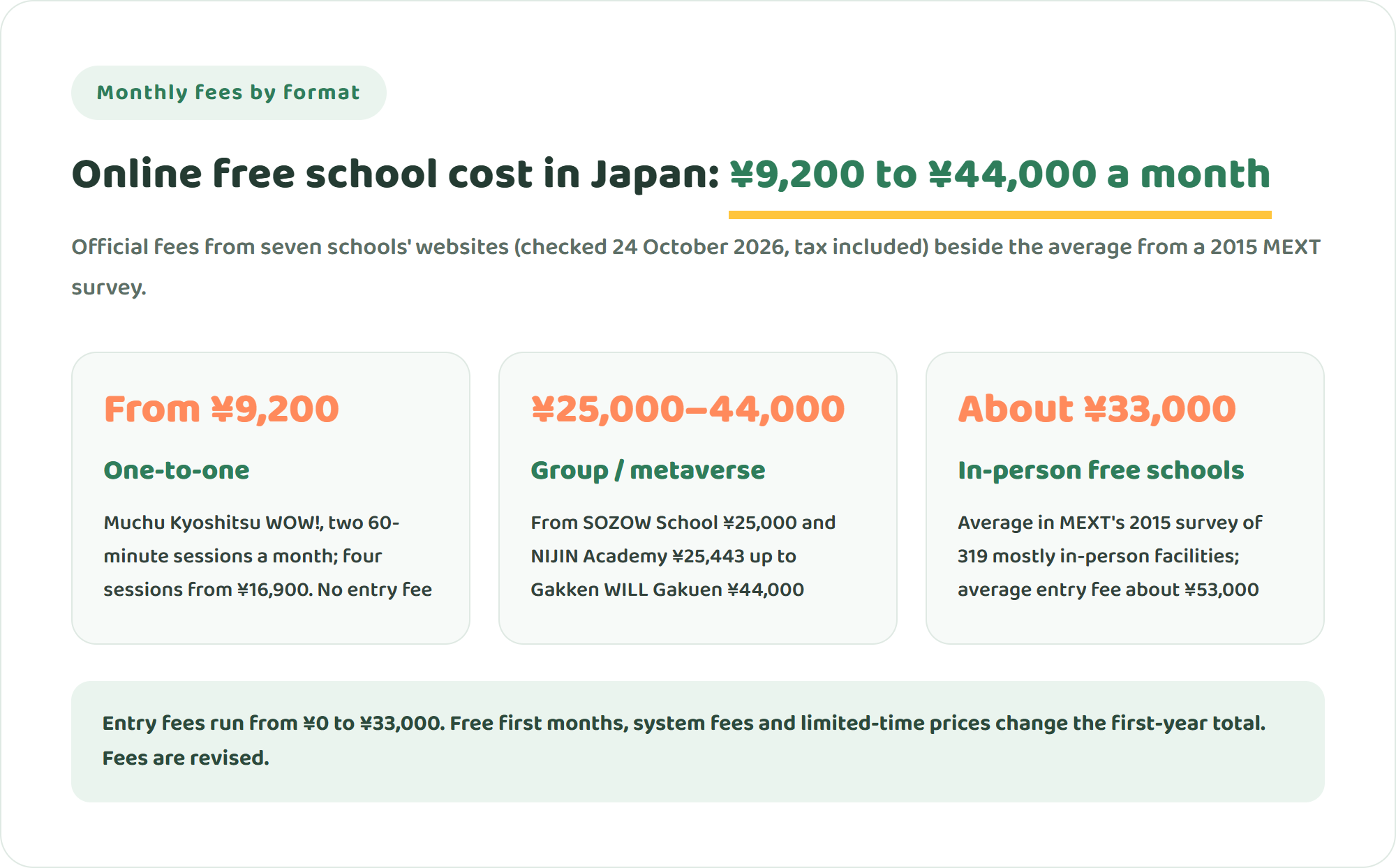
The short answer: ¥9,200 to ¥44,000 a month, with entry fees from ¥0 to ¥33,000
- Monthly fees: the cheapest option is the one-to-one format at Muchu Kyoshitsu WOW! (from ¥9,200 a month for two sessions). The highest is Gakken WILL Gakuen’s metaverse course at ¥44,000. Most group and metaverse-style schools fall between ¥25,000 and ¥38,500.
- Entry fees: from ¥0 (Muchu Kyoshitsu WOW!) to ¥33,000 (NIJIN Academy). Several schools run limited-time conditions such as a free first month or a waived set-up fee.
- Attendance credit: all seven mention it, but only three publish a recognition rate: NIJIN Academy (97%), Shingaku (95%) and Gakken WILL Gakuen (97.5%). At every school, the final decision belongs to the principal of the child’s home school.
- Versus in-person free schools: a 2015 Ministry of Education (MEXT) survey of mostly in-person facilities found an average monthly fee of about ¥33,000 and an average entry fee of about ¥53,000. Online monthly fees sit in the same band or slightly below; entry fees are clearly lower.
- Versus international schools: an in-person international school in Japan typically costs ¥2–4 million a year (roughly ¥200,000–300,000 a month). Online free schools are about an order of magnitude cheaper per month.
Two cautions. Ranking by monthly fee alone can mislead, because entry fees, system fees and free months change the first-year total. And a lower fee does not mean attendance credit is harder to get; the two are not linked in any simple way.
What does an online free school cost in Japan? Seven schools, official figures
The table shows what each school’s own pricing page and FAQ say, as of 24 October 2026. Amounts are in Japanese yen, tax included where the school states so. A “from” means the school itself writes the fee with a “from”.
| School (operator) | Grades | Monthly fee | Entry fee | Format | Attendance credit (as stated) |
|---|---|---|---|---|---|
| NIJIN Academy (NIJIN Inc., sister business of this site) | Grades 1–9 | Metaverse course ¥25,443 / Hybrid course from ¥41,943 | ¥33,000 (first month only) | Online classes in a metaverse campus (recordings available), plus optional in-person rooms at 52 locations from one day a week | 97% of families who requested credit received it (final decision by the home-school principal) |
| Class Japan Shochu Gakuen (run by Meiko Gijuku) | Not stated | ¥27,500 (single plan, first month free) | ¥11,000 | Video lessons and quizzes, with an online teacher tracking progress (no live classes mentioned) | “Aim for attendance credit”; a monthly learning report goes to the home school. No rate published |
| SOZOW School (SOZOW Inc.) | Grades 3–9 | ¥25,000 / ¥33,000 / ¥40,700 by course (the upper two add a ¥3,300 monthly system fee) | ¥30,800 | Daily weekday gatherings in a virtual campus, a learning app and live sessions; mentor meetings three times a month | Credit granted by schools nationwide; support service included. No rate published |
| Shingaku (Seiki Community Group) | Grades 4–9 | ¥38,500 (a “special” price of ¥35,200 is currently shown); “no other costs” | Not stated | Metaverse classroom open weekdays 9:30–18:30; subject study on the Surala app in the morning, project work in the afternoon; a weekly 60-minute one-to-one meeting | 95% recognition rate (April 2023 to February 2026) |
| Muchu Kyoshitsu WOW! (Wowfull Inc.) | Elementary to high school | From ¥9,200 (2 sessions) / from ¥16,900 (4 sessions), one-to-one, 60 minutes | ¥0 (no exit fee either) | One-to-one on Zoom, built around the child’s interests; the school describes itself as an “online tutor for children not attending school” | FAQ says only that attendance-credit support is available. No rate published |
| SUPER SCHOOL (NPO Coconova) | Grades 1–9 | ¥33,000 (first month free, second month ¥19,800) | ¥11,000 set-up fee (waived until end of October 2026) | One-to-one sessions twice a week at the core; group activities optional; no whole-class lessons | Credit has been granted; “the home-school principal decides”. No rate published |
| Gakken WILL Gakuen Metaverse Course (Gakken L-Staffing) | Grade 6 (elementary) / junior high | ¥44,000 (tuition) | ¥24,200 (first year only) | Log in to a metaverse campus up to five days a week, weekdays 10:00–15:00 | Students accepted from 588 schools in 13 prefectures; credit granted at 97.5% of public schools |
Source: each school’s official pricing page and FAQ, checked 24 October 2026. Fees change; confirm the current amount on the official site before you apply.
The “format” column matters as much as the price column. Muchu Kyoshitsu WOW! calls itself an online tutor rather than a school: you are buying one-to-one hours, not a daily place to be. Class Japan Shochu Gakuen is built on video lessons and an online teacher’s check-ins, with no live classes mentioned. NIJIN Academy, SOZOW School, Shingaku and Gakken WILL Gakuen all offer a metaverse or virtual campus a child can enter every weekday. SUPER SCHOOL has no whole-class lessons and runs on one-to-one activities. The label “online free school” covers all of these, and they are very different products.
Why the monthly fee is not the whole online free school cost
You can sort the table by monthly fee, but what you actually pay follows a different order. Four things are easy to miss.
1. Entry and set-up fees
Entry fees range from ¥0 to ¥33,000: nothing at Muchu Kyoshitsu WOW!, ¥11,000 at Class Japan Shochu Gakuen and SUPER SCHOOL, ¥24,200 at Gakken WILL Gakuen, ¥30,800 at SOZOW School and ¥33,000 at NIJIN Academy. Shingaku’s pricing page does not list an entry fee and says only that there are no other costs; third-party figures for it could not be confirmed, so we do not use them.
2. System fees outside the headline price
SOZOW School’s two upper courses add a ¥3,300 monthly system fee. Muchu Kyoshitsu WOW! adds a ¥1,500 system and operating fee on top of the ¥3,850 session price. NIJIN Academy’s ¥1,683 facility fee is already inside its ¥25,443, and Class Japan Shochu Gakuen and Shingaku both state that there are no additional charges.
3. Free months and limited-time prices
Class Japan Shochu Gakuen and SUPER SCHOOL both make the first month free, and SUPER SCHOOL drops the second month to ¥19,800. SUPER SCHOOL’s ¥11,000 set-up fee is waived until the end of October 2026, and Shingaku’s ¥35,200 is labelled a special price with no end date shown. NIJIN Academy offers a ¥47,520 annual-payment discount. These conditions change, so check the page in the month you apply.
4. One-to-one or group
The cheapest school, Muchu Kyoshitsu WOW!, is one teacher and one child for 60 minutes, two or four times a month. The most expensive, Gakken WILL Gakuen, is a metaverse campus open five weekdays from 10:00 to 15:00; NIJIN Academy offers more than 100 lessons a month, and Shingaku’s classroom is open 9:30–18:30 on weekdays. The price gap is really a gap in hours and in closeness to a teacher: a daily place to belong and one or two hours a week with a trusted adult are different purchases.
For a rough first-year figure, multiply the monthly fee by 12 and add the entry fee (ignoring free months, discounts and system fees): NIJIN Academy’s metaverse course comes to ¥338,316, Class Japan Shochu Gakuen ¥341,000, SOZOW School’s entry course ¥330,800, SUPER SCHOOL ¥407,000, Gakken WILL Gakuen ¥552,200, and Muchu Kyoshitsu WOW! ¥110,400 for two sessions a month or ¥202,800 for four. Shingaku’s ¥38,500 × 12 is ¥462,000, but we leave it out of the comparison because its entry fee cannot be confirmed.
How attendance credit is decided: the 2019 MEXT notice and the principal
Whether hours spent learning online count as attendance at the child’s home school matters as much as the price. The legal basis is a MEXT notice of 25 October 2019 on support for children not attending school, and specifically its Annex 2 on how home-based learning using ICT is recorded in the school register. In summary, the notice sets seven conditions:
- parents and the school maintain close cooperation;
- the learning is delivered through ICT (computers, the internet, remote-learning systems) or by post or fax;
- appropriate face-to-face guidance, such as home visits, takes place on a regular, continuing basis;
- the programme is planned around the child’s level of understanding (for private providers, judged with reference to MEXT’s draft guidelines on private facilities);
- the principal has a clear picture of the face-to-face guidance and the learning, through regular reports or meetings;
- in principle, the arrangement applies where the child cannot receive counselling or guidance at a public body or private facility outside school;
- the school judges the learning plan and content appropriate against its own curriculum.
The key point is that the notice allows a principal to record attendance; it does not require it. The decision belongs to the home-school principal, and a free school can only prepare the material the principal needs, such as a learning plan and monthly reports. No school can guarantee credit, and none of the seven claims to.
Three schools publish a rate; four describe support or track record
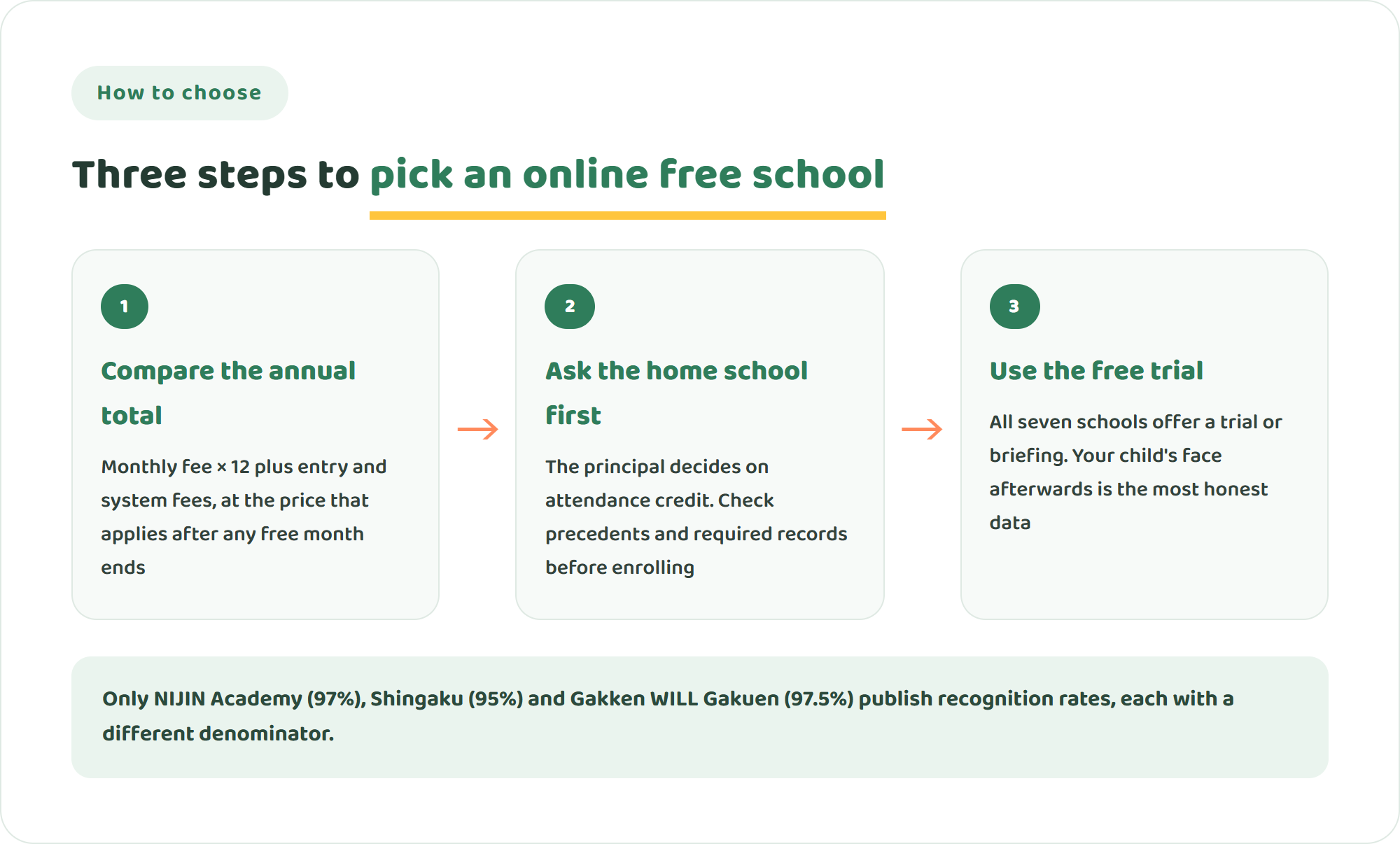
NIJIN Academy states that 97% of families who requested credit received it. Shingaku states a 95% recognition rate for April 2023 to February 2026. Gakken WILL Gakuen says it has accepted students from 588 schools in 13 prefectures and that 97.5% of public schools granted credit. The denominators differ (families who asked, the school’s own record, public schools it has worked with), so these three figures are not a league table.
The other four describe the process instead. At Class Japan Shochu Gakuen, parents take a learning report to the home school once a month and the principal decides; the school says its evaluation framework follows the MEXT notice. SOZOW School cites credit granted by schools across Japan and a support service that prepares reports for the school. SUPER SCHOOL notes that credit has been granted, provides activity records, and states plainly that the home-school principal decides. Muchu Kyoshitsu WOW!’s FAQ says only that support is available.
At a briefing, ask what the report to the home school looks like and who contacts the school. In parallel, ask your child’s homeroom teacher or vice-principal before enrolling whether online learning could be counted. That one conversation prevents most later disappointments.
How online fees compare with in-person free schools and international schools
For in-person free schools, the reference point is a MEXT survey published in August 2015 on private organisations serving compulsory-age children not attending school. Of 474 organisations contacted, 319 responded. The average monthly fee was about ¥33,000 (just under 40% charged ¥10,000–30,000 and just under 40% charged ¥30,000–50,000), and the average entry fee was about ¥53,000, although 123 organisations charged none. This is a ten-year-old survey of mostly in-person facilities, not an online benchmark. Against it, the online schools’ ¥25,000–44,000 monthly band is similar, and their ¥0–33,000 entry fees are below the in-person average.
In-person international schools are in a different league: typically ¥2–4 million a year (around ¥200,000–300,000 a month), roughly ¥1.5–4 million if you take the wider range, and sometimes more at well-known central Tokyo schools, with entrance fees that can run to several hundred thousand yen and annual facility charges on top. Our guide to international school tuition in Japan breaks those costs down.
If you are weighing an online international school as a route for a child who is not attending school, our article on online international schools for school refusal covers that option and the general free-school price picture, so this article stays focused on the per-school figures. For the wider landscape, see what an alternative school is in Japan.
Local subsidies: Tokyo pays up to ¥20,000 a month, for in-person facilities; online is “check first”
The Tokyo Metropolitan Government runs a free-school user support scheme. Parents living in Tokyo whose elementary or junior-high child is not attending school and uses a free school can receive up to ¥20,000 a month towards the usage fee (or the full fee if it is below ¥20,000). Entry fees, facility-maintenance charges and materials are excluded, and payment follows a report of actual use. For fiscal 2026, applications are accepted from 27 May 2026 to 12 February 2027, online or by post.
The catch is eligibility. Tokyo’s June 2024 announcement describes the target as private facilities that children attend in person for school-refusal support, and the press releases do not say whether online or home-based programmes qualify. Before counting on it, ask the school and the scheme’s office (run by Adecco, 03-6800-8763). On 24 October 2026 the scheme’s dedicated website was unreachable, so the conditions here come from the metropolitan government’s press releases.
Some Tokyo wards, including Minato and Shinagawa, add their own top-up of up to ¥20,000 a month, and other cities such as Kobe run similar schemes. Ask your local board of education.
Three steps to choose the right school for your child
Step 1: Compare the annual total
Multiply the monthly fee by 12, then add the entry fee and any system fees. Use the price that applies after any free month or special offer ends. If a sibling might join later, check for a sibling discount such as NIJIN Academy’s.
Step 2: Ask the home school about attendance credit before you enrol
Recognition rates are only a guide. The person who decides is your child’s principal, so ask whether the school has counted online learning before and what records it would want to see. Our comparison of free schools and distance-learning schools explains how the relationship with the home school differs between the two.
Step 3: Use the free trial and watch your child’s reaction
All seven schools offer a way in: a one-to-one free trial at Muchu Kyoshitsu WOW!, a trial week at SOZOW School, one to three trial days at Gakken WILL Gakuen, a briefing and Minecraft session at SUPER SCHOOL, a free first month at Class Japan Shochu Gakuen, a metaverse open day at NIJIN Academy, and a briefing session at Shingaku (its website does not say whether that is free). How your child looks after the session tells you more than any row in the table. If you are also considering learning at home, homeschooling in Japan versus online school sets out the trade-offs.
Where NIJIN GLOBAL ACADEMY fits
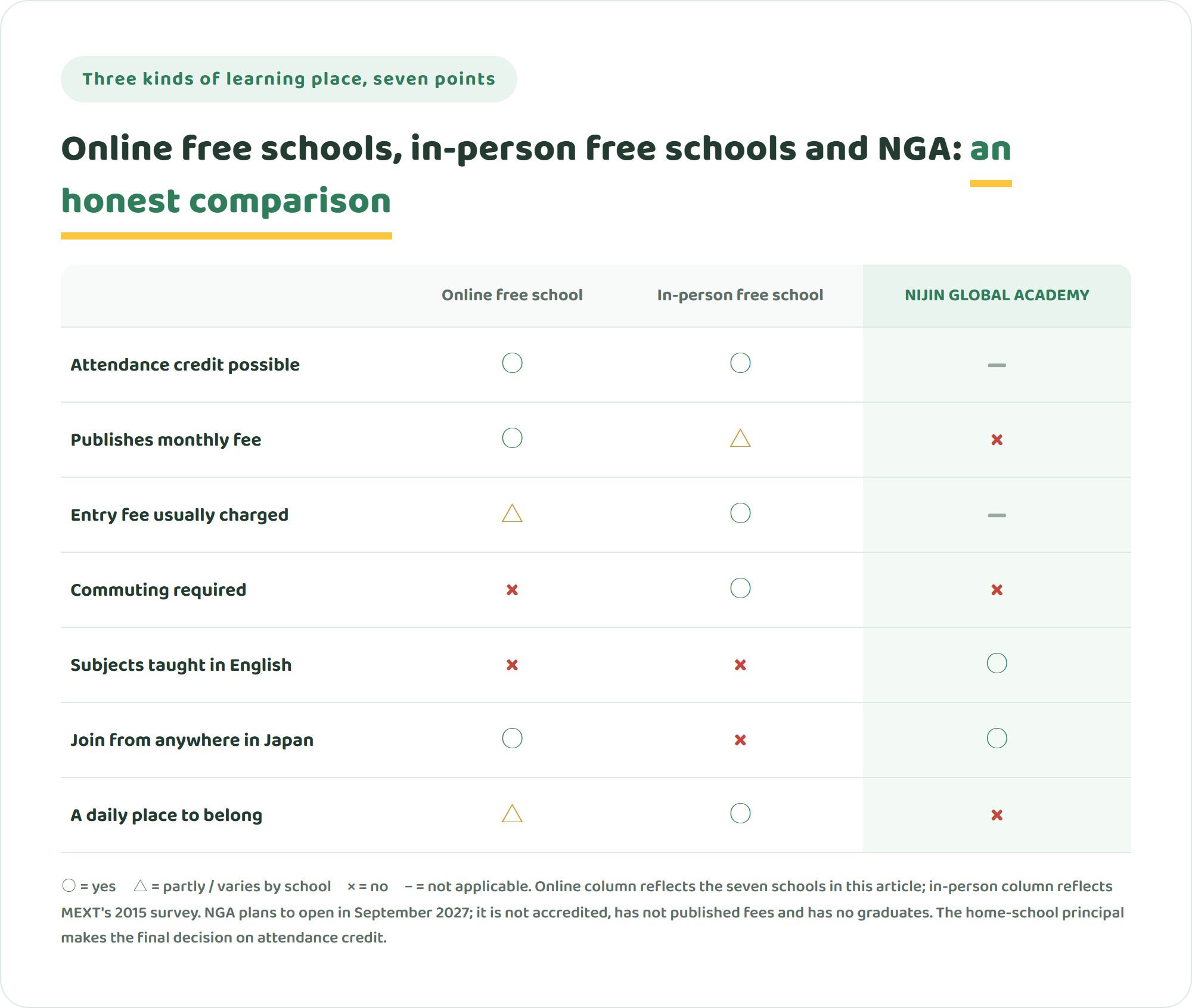
NIJIN GLOBAL ACADEMY (NGA) is an online international school for ages 6–18, planned to open in September 2027. It is run by NIJIN Inc., the company behind NIJIN Academy in the table above, where more than 1,000 children have studied. NGA builds on that experience by adding subjects taught in English: small live classes, supported by bilingual Japanese–English mentors, without ranking children by test scores. You can see how a class would run in our online school curriculum overview.
To be clear about where NGA stands: it has not opened, is not accredited, has not published fees and has no graduates, which is why it has no row in the table. For a child who needs a place to belong every day right now, the seven schools above are the options you can use today. NGA is a second track for families who want to add English-medium learning alongside the home school or a free school, not a replacement for them.
Frequently asked questions
What is the typical online free school cost in Japan?
Across the seven schools we checked, ¥9,200 to ¥44,000 a month, with entry fees from ¥0 to ¥33,000. Most group and metaverse-style schools charge ¥25,000–38,500 a month, about the same band as the ¥33,000 average in MEXT’s 2015 survey of mostly in-person free schools.
Which online free school is cheapest?
By monthly fee, Muchu Kyoshitsu WOW!’s two-session plan (from ¥9,200, no entry fee). It is a one-to-one format of two 60-minute sessions a month, so it is not a daily place to belong. Among schools a child can attend every weekday, SOZOW School’s entry course (¥25,000) and NIJIN Academy’s metaverse course (¥25,443) are the lowest band.
Does joining an online free school guarantee attendance credit?
No. The home-school principal decides, and the free school can only supply plans and reports. Even the schools that publish rates (97%, 95% and 97.5%) are not at 100%. Talk to the home school before enrolling.
Is NIJIN Academy connected to this website?
Yes. NIJIN Academy is a sister business of NIJIN Inc., which runs this site. In this article it is treated exactly like the other six schools, using only its official website.
Knowing the number makes the next step lighter
An online free school in Japan costs between ¥9,200 and ¥44,000 a month, with entry fees of ¥0 to ¥33,000. Written down, it is not the out-of-reach figure of an in-person international school; it is a sum an ordinary household can weigh. And the seven schools differ far more in shape than in price: one-to-one, a metaverse campus, video lessons, project-based learning. Which shape fits your child is something a trial session will show you more honestly than any table.
If you would also like to keep “learning in English, connected to the world” as a second option for a child who finds school hard, NIJIN GLOBAL ACADEMY expects to run trial classes in April–May 2027, ahead of its planned September 2027 opening.