“Will my child lose their mother tongue?” If you are raising a child across two languages — perhaps in Singapore, Malaysia, or the Philippines, or in an international school where English dominates the day — this quiet fear may have brought you here. Your child chatters away in English, but stumbles in the language you grew up with. Grandparents call and the conversation goes flat. You start to wonder whether, in gaining one language, your child is quietly letting go of another — and of a piece of home along with it.
This article meets that worry honestly. We will look at what people mean by a so-called “double-limited” or “semilingual” child, how the two terms differ, why the concern arises, and — most importantly — what you can actually do at home, by age and including reading and writing, to raise both the mother tongue and English so that neither is left half-formed. Not to frighten you, but so you can take the next step calmly. By the end, a vague dread should feel more like a clear plan.
Will my child lose their mother tongue? What “double-limited” really means
The terms “double-limited” and “semilingual” get used to describe a child who, growing up with two languages, seems not to reach an age-appropriate level in either one. Picture a ten-year-old who can chat easily but, in both languages, finds it harder than same-age peers to read a textbook or explain an idea in an orderly way. It is worth saying clearly at the outset: these are not precise clinical diagnoses. They are informal labels used by parents and educators, and in recent years many specialists have grown wary of “semilingual” in particular, precisely because it can wrongly brand a child or family as deficient.
In other words, there is no fixed condition called “double-limited” that a child either has or does not have. In most cases, what you are seeing is a temporary stage in a long developmental process — one that shifts a great deal depending on the environment and how you engage. That single fact tends to loosen the knot in a parent’s chest. For the background to the label itself, our companion piece on the truth about “semilingual” is worth reading alongside this.
“Double-limited” vs “semilingual” — and BICS vs CALP
Two clarifications help. First, “semilingual” is the older term, now often avoided because it can sound as though it is judging a child or family as lacking. “Double-limited” is the more neutral rephrasing — it names a state (neither language yet fully grown) rather than pinning a label on the person. The two point at roughly the same thing; the second is simply the kinder, more accurate way to say it.
Second, linguists separate everyday conversational language (BICS) — the language of the playground — from academic language (CALP), the language of reading, reasoning and school. What families usually worry about with “double-limited” is the CALP side: a child can sound fluent yet lack, in both languages, the deeper language needed to think and learn. That hidden gap is the real source of the fear. The next section explains why it opens up.
That said, the worry itself is not imaginary. Children raised in two languages at once do often show a slower-looking vocabulary curve in each language, for a time, compared with a monolingual peer. The task is not to panic, but to read it as a natural wobble in raising two languages — and to support it well.
Why it happens — depth of use, not volume of exposure
Understanding why a child can look “stuck between” two languages makes it far clearer what to do at home.
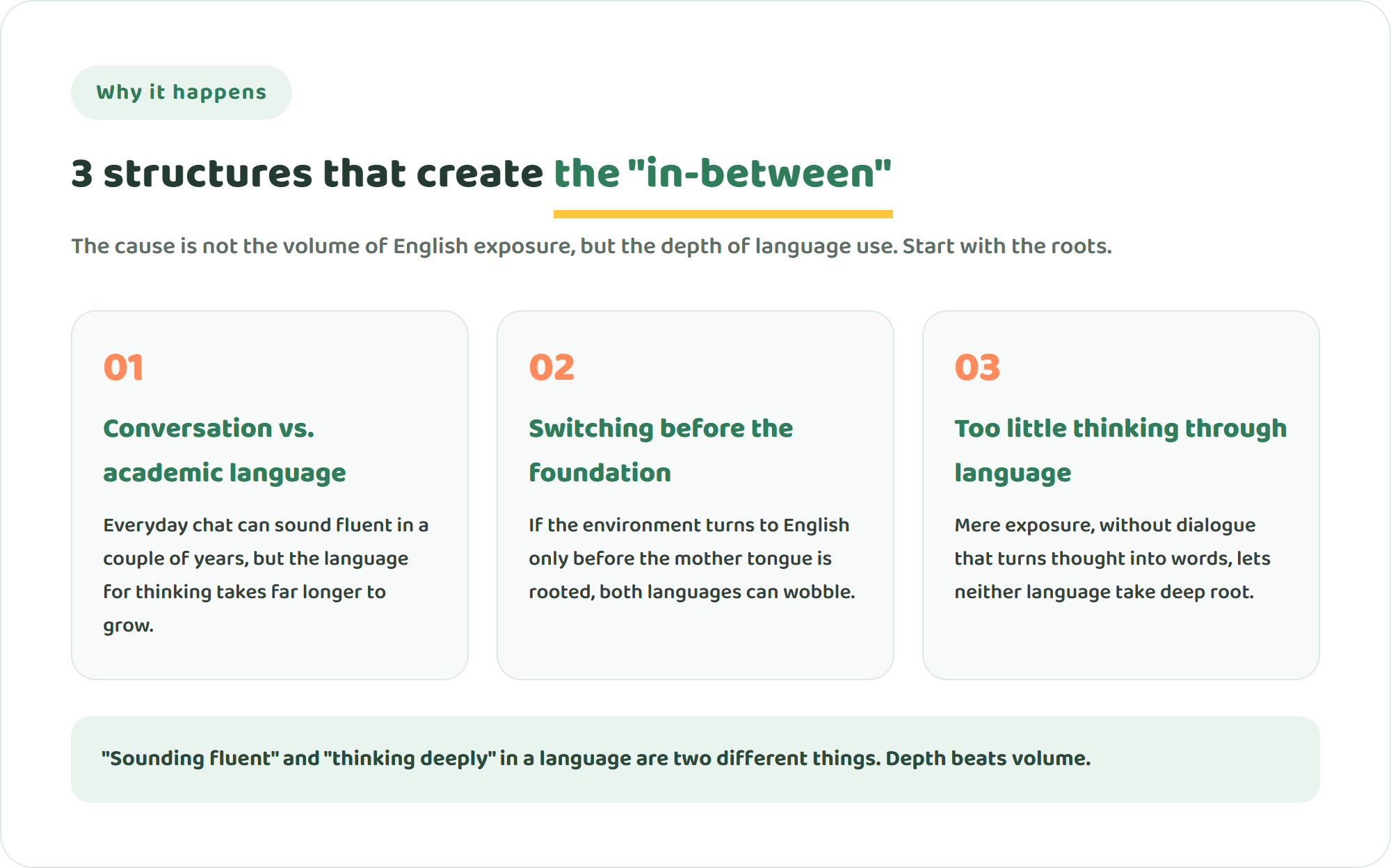
Educational linguists have long distinguished everyday conversational language (BICS) from the deeper academic language (CALP) we use to think and learn. The idea is widely credited to the Canadian researcher Jim Cummins: conversational fluency can appear within a couple of years, while the academic language needed for abstract thinking takes considerably longer to develop. It is a model, not a law — but a useful one. The key implication: sounding fluent and being able to think deeply in a language are two different things. A child chatting easily in English is not necessarily thriving underneath.
A second, related idea often raised is the “threshold hypothesis.” Held loosely, it suggests that when one language is developed to a solid foundation, it can support growth in the other language and in thinking itself. Conversely, when a child’s home language has not yet found firm ground and the environment switches abruptly to English only, the scaffolding for thought never quite settles — and both languages can look shaky. Where many families stumble is here: so anxious to maximise English exposure, they let the chances to think and converse deeply in the mother tongue thin out. Language is not built by showering a child with input. It grows through the depth of use — putting one’s own thoughts into words and being understood.
Concretely — when and how the risk rises
In everyday terms, the risk is generally said to rise in a few situations. These are tendencies, not certainties — no single one dooms a child.
One is when, before the mother tongue has taken root in the early years, the main language of daily life switches abruptly to another — a move abroad, say, or a child who speaks the home language yet spends most of the pre-school day in English. A second is when parents, meaning well, cut the home language back sharply “for the sake of English.” Switching to a language you are less fluent in tends to lower the quality of your deepest conversations, which is exactly what a child’s thinking leans on. A third is when a child can converse but has few chances, in either language, to read, write, explain reasons, and build arguments — the “using it to think” part. In short, it is less about how much exposure and more about which language a child uses, and how deeply.
Age and the sensitive period — the mother tongue in early childhood, academic language over years
A rough timeline is reassuring to keep in mind. The foundation of the mother tongue is generally laid in the early years (roughly ages 2 to 5), with literacy and academic language building through the school years after that. The academic language (CALP) needed to learn school subjects is often said to take several years — frequently cited as around five to seven — to develop after a child first meets that language. The numbers are a general sketch, and children vary widely; but holding the premise that “able to converse” is not the same as “already fine” helps you support without rushing. Reviews in child development (for example McCabe and colleagues, 2013) likewise conclude that keeping the mother tongue rich supports the second language, literacy, and school learning rather than holding them back.
What you can do at home — raising both languages by using them
This is the heart of the article, and it needs no expensive tutor or curriculum. Small shifts in daily interaction build the foundation of both languages. The principle: move both languages from “exposure” to “use.”
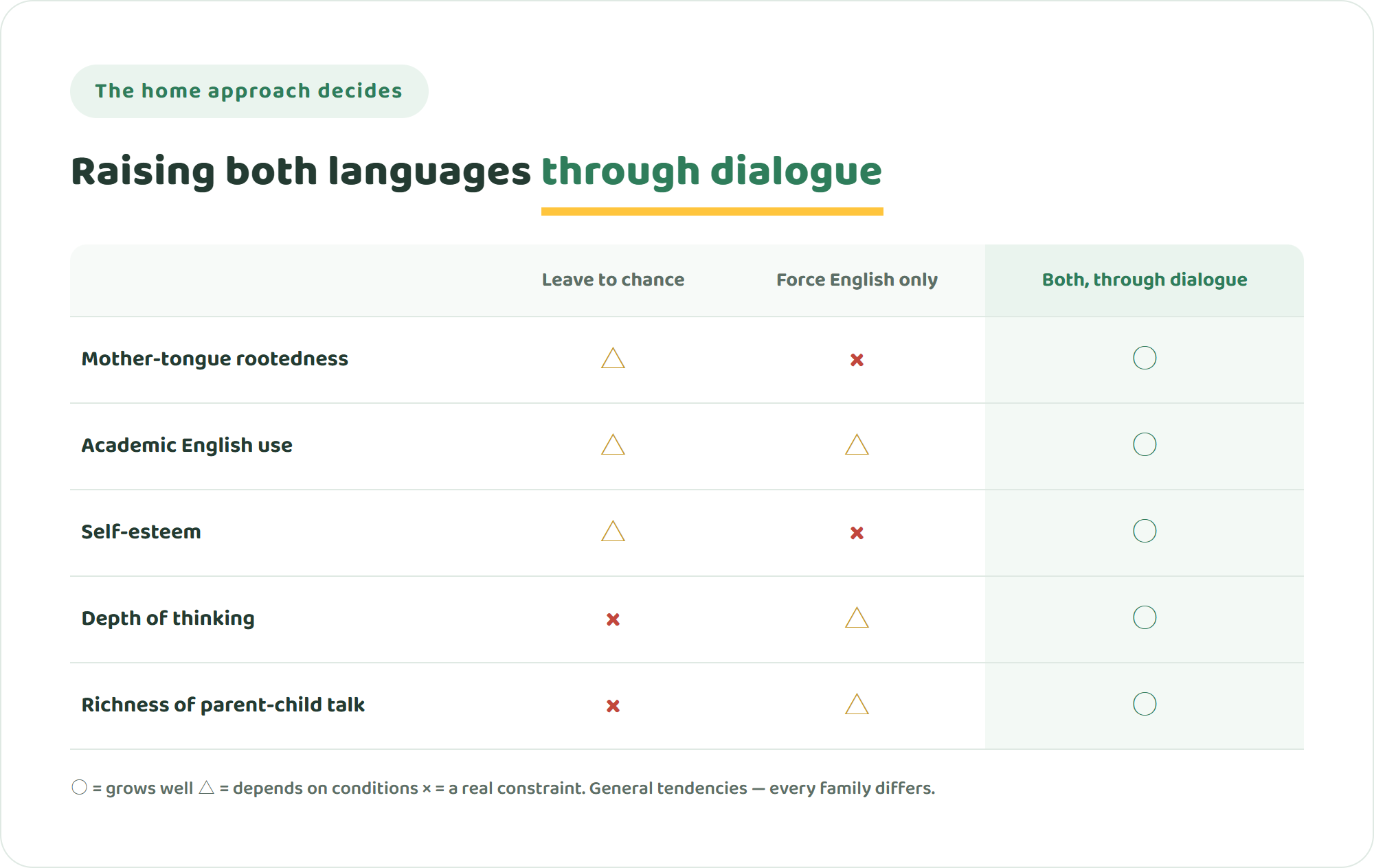
As the table suggests, neither leaving it to chance nor forcing English alone works as well as growing both languages through dialogue, with the mother tongue as the foundation — a balance that serves the home language, English use, and the child’s self-esteem alike. In practice, keep three things in mind.
First, use your home language proudly and richly. You do not need to fear that speaking your mother tongue at home will hold English back. On the contrary: engaging your child’s “why?” and “what do you think?” in the language you can go deepest in builds the scaffolding for thought — and that scaffolding quietly supports English learning too. Read aloud, ask your child to explain the day, reason things out together. Second, prize “being understood” over “being correct” in either language. Rather than correcting every grammar slip, respond with “you got it across” and “what an interesting idea.” The joy of being understood is what drives a child to keep using a language. Third, do not over-fear mixing (code-switching). Children raised bilingually naturally blend their languages, and this usually sorts itself out with time. An unhurried view of development is the greatest support of all.
By age — early childhood, primary years, adolescence
Even within “grow it through dialogue,” where you put the emphasis shifts a little with age. As a rough guide:
In the early years (before school), plentiful conversation in the mother tongue comes first — reading aloud, narrating daily life, putting feelings and reasons into words. The richness of the home language now becomes the foundation for both languages later; English is fine as simply “one of the fun things” a child dips into. In the primary years, add mother-tongue reading and writing on purpose: reading passages, writing a reaction or a reason, keeping a diary or writing letters — building the “use it to think” experience first in the stronger language, so academic English can later ride on that base. In adolescence, honour the child’s own interests and identity: give them places to talk and write deeply about what they love, and to argue in earnest with peers — in the mother tongue or in English — so language becomes a tool that is truly theirs.
Reading and writing are the foundation — don’t neglect mother-tongue literacy
The most overlooked lever is literacy — reading and writing. Conversation develops fairly readily on its own, but academic language deepens through reading and writing. Many specialists note that the ability to read and write in the mother tongue transfers to, and underpins, literacy and school achievement in the second language. At home: keep reading aloud in the mother tongue long past the toddler years, read books together and talk about them as your child grows, and build a short, regular writing habit (a diary, letters, reactions). Before rushing English literacy, give your child the experience of reading and writing deeply in the language they speak most deeply.
Designing the family’s languages — who speaks what, and how
Going a step further, designing your household’s language “rules” on purpose reduces second-guessing. Some families have each parent speak consistently in their strongest language; others use the mother tongue at home and the local language outside. The point is not perfection but consistency, and keeping deep conversation alive in whichever language you choose. A rule that makes talk stilted helps less than anchoring on the language you can be richest in. If cost or commute is what makes the school decision hard, it helps to look at your options when international school feels too expensive before setting your direction. And if your honest worry is “it’s the mother tongue, not English, that I’m anxious about” — especially for Japanese-heritage families in Asia — pairing in a place that grows the home language on purpose, such as the children’s online Japanese programme Tomodachi Japan, is a realistic move.
A third option — a school built around “using” language
Carry the ideas above — use rather than shower, honour the mother tongue’s foundation — into how you choose a school, and the options look different. If you first want to get your bearings on what these schools even are, see what an international school is, and for the honest trade-offs before you commit, the disadvantages of international school. With that in view, this is exactly the thinking behind NIJIN GLOBAL ACADEMY (NGA), which we are designing to open in September 2027.
NGA is an online international school that does not rank children by test scores. We build learning around small-group dialogue that starts from “what do you think?” — because we want language grown as a tool for thinking, not a substance to be absorbed. Rather than memorising fixed answers in English, children put their own ideas into words and exchange them with peers around the world; academic English develops alongside their thinking. At the same time, we respect the home language rather than replacing it — the aim is to raise both side by side, not to trade one for the other. NGA is operated by NIJIN Inc.; its alternative school in Japan already serves more than 1,000 children. Tuition is designed to be around one-fifth of a typical bricks-and-mortar international school, so families can keep going. It is not a fit for everyone — weigh it fairly against your other options, and consider it only if it feels right for your child.
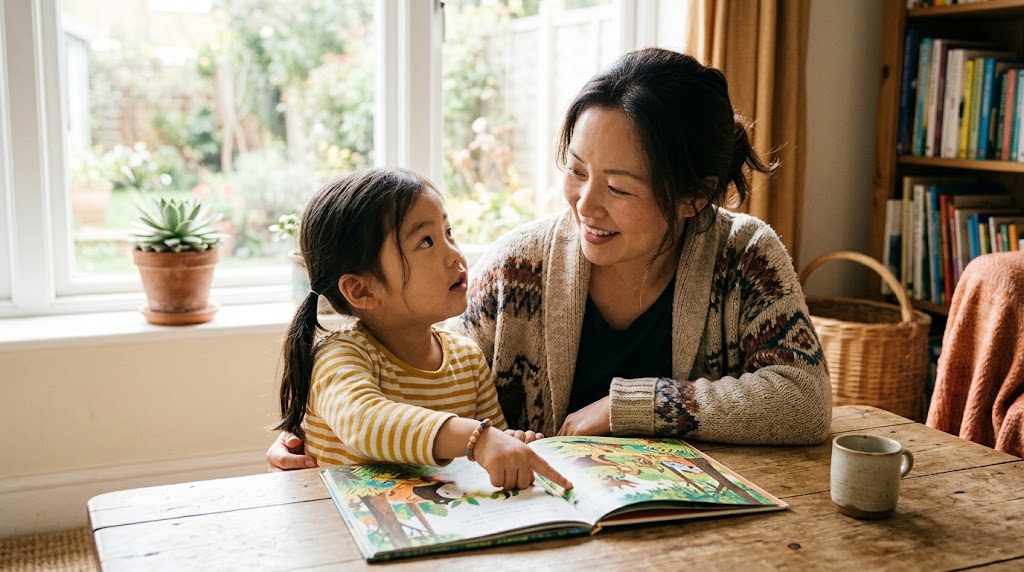
Three steps to start today
Finally, here is a gentle way to turn worry into action.
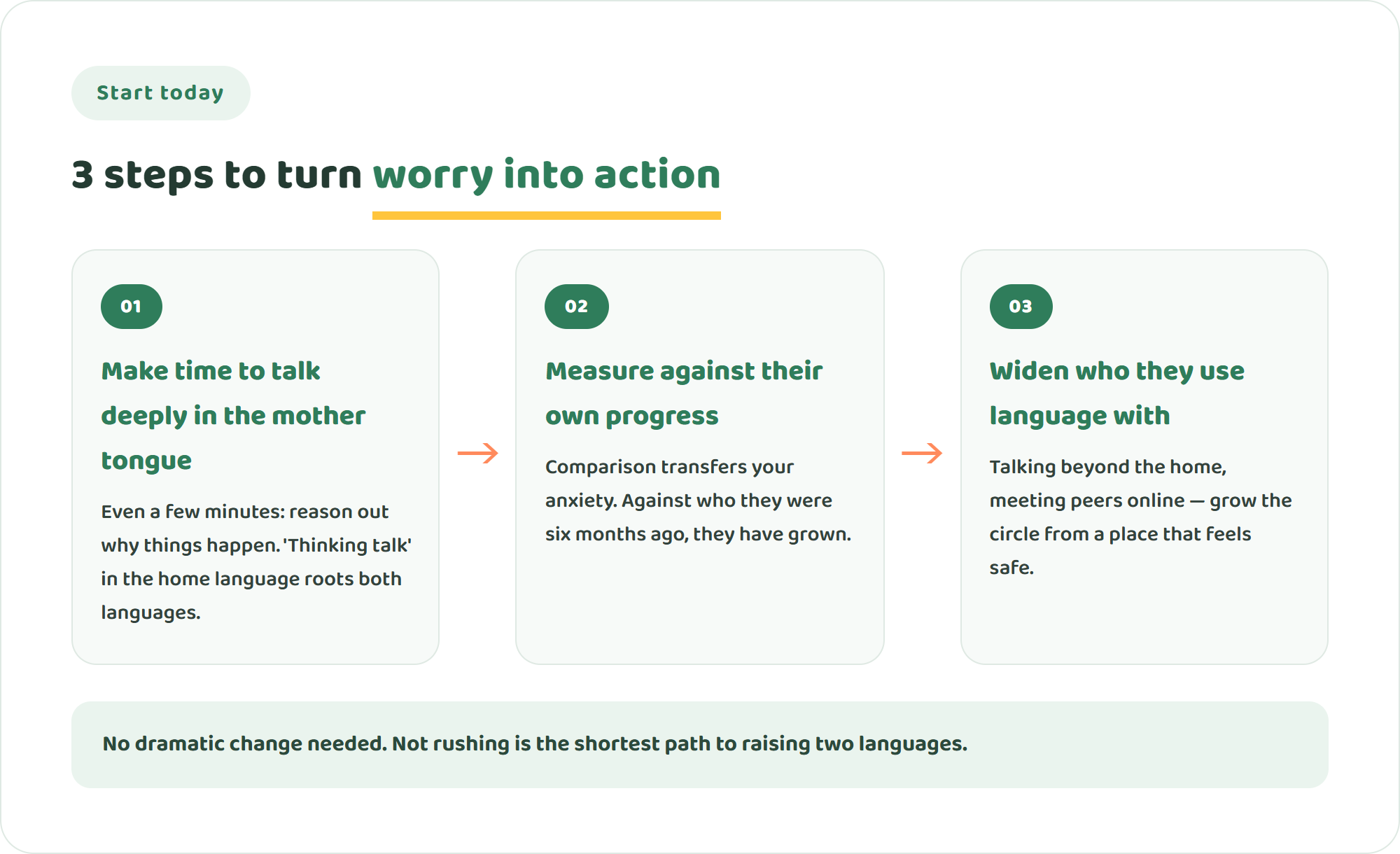
First, make time to talk deeply in your mother tongue. Even a few minutes a day — reasoning out why something happened, imagining how a story continues — grows the roots of both languages. Second, measure your child against their own progress, not others’. The more you compare (“her child already speaks English”), the more your anxiety transfers to your child. Against who they were six months ago, they have grown. Third, slowly widen the circle of people they use language with — in the mother tongue or in English, talking with people beyond the home, meeting peers online, starting from a place that feels safe. Language grows only when there is someone to use it with.
Frequently asked questions
If my child seems “double-limited,” is it permanent?
No. Being “double-limited” is not a fixed condition but, in most cases, a temporary stage in raising two languages. Honour the mother tongue’s foundation and increase the chances to think using both languages, and things generally sort themselves out over time. The key is not to cut off one language in a panic.
Is “double-limited” the same as a learning disability or special needs?
They are generally understood as different things. Being “double-limited” stems from the language environment — academic language that has not yet fully developed while two languages are being raised. A developmental or learning disability, by contrast, relates to an inborn difference in how the brain develops; the root cause is different. The surface difficulties can look similar (delayed language, trouble with schoolwork), and they are genuinely hard to tell apart by eye. If you are concerned, rather than self-diagnosing, a speech-language therapist or developmental specialist can help sort out what support, if any, is needed.
Is “semilingual” an offensive term?
It is not formally defined as a slur, but it is increasingly avoided because it can sound as though it is judging a child or family as “lacking.” That is exactly why the more neutral “double-limited,” or simply “a child in the middle of growing two languages,” has taken its place. Look at the child’s real progress rather than the label attached to them.
At what age should mother-tongue reading and writing begin?
Build on conversation first, then add literacy gradually from around the start of school. Keep reading aloud richly in the mother tongue; once your child is comfortable with print, move to reading short texts and writing (a diary, letters). Before rushing English literacy, let your child read, think, and write in the language they speak most deeply — that is what underpins academic language in both. Match the pace to their age and interest; there is no need to force it.
Will speaking only my home language slow down English?
Usually the opposite. The ability to think deeply in the mother tongue becomes the foundation for learning in the other language. Using your home language richly does not hold English back — it supports academic English from underneath. Use your mother tongue with confidence.
Is mixing languages a warning sign?
Most often, no. Code-switching is a natural part of a bilingual child working out how to use both languages. Rather than correcting it head-on, celebrating that the message got across tends to help both languages settle over time.
Can we start from no English at all?
Yes. Some test-score-free online international schools are designed so children ease into English with support in their home language. Choose a place that treats English not as an entry requirement but as something to grow by using, and even a beginner can start with confidence.
Turn the fear of “half-and-half” into the confidence to raise both.
A stretch when your child’s language looks slow is not a door closing on their potential. Rather than fearing the words “double-limited,” hold on to the one thing that matters — raising two languages by using them, with the mother tongue as the ground beneath — and your child’s language will, given time, put down deep roots. An unhurried view of development is the richest nourishment there is. The worry you feel today is only the flip side of how much your child’s words mean to you. As long as that love is there, you are going to be all right.
NIJIN GLOBAL ACADEMY opens in September 2027. We will share how our small-group, dialogue-based learning grows language by using it — while honouring the mother tongue — and send first-intake news early, by email. May the days spent caught between two languages become days of raising both. Let’s take that first step together.
Honest Answers to Your Worries — related reading
- The Honest Pros and Cons of International School
- Disadvantages of Bilingualism in Childhood: Myths vs Research
- Who Regrets International School — and Who Doesn’t
- International School Special Needs: What to Look For
- International School vs Local School: How to Decide
- Does International School Hurt Your Child’s Home Language?
- When Your Child Is Struggling at International School
- Do International Schools Make Children Fluent in English?
- Is International School Worth It? What Happens to Graduates
- Should I Send My Child to International School?
- Transfer From a Local School to an International School
- Disadvantages of Early English Education: What Research Says
- What Happens to International School Graduates