Open the homepage of almost any online international school and scroll to the bottom. There they are: a row of accreditation badges, three or four unfamiliar acronyms sitting together, quietly doing the work of reassuring you.
It is worth stopping there for a moment. The single word “accreditation” is covering four different things — accreditation of the school itself, authorisation to deliver a particular programme, approval as a venue where external exams are sat, and membership of an association. Only some of them affect the qualification your child eventually leaves with, and which ones matter changes depending on whether the school is British or American in design. This article works from the primary sources — the UK Department for Education’s two schemes, the US bodies behind Cognia, and the IB’s own published process — and ends with the five questions that turn a badge into a fact.

An accredited online international school: four different claims, one word
Start by sorting the badges. None of these categories is superior to the others. They certify different things, which is exactly why they affect the leaving qualification differently.
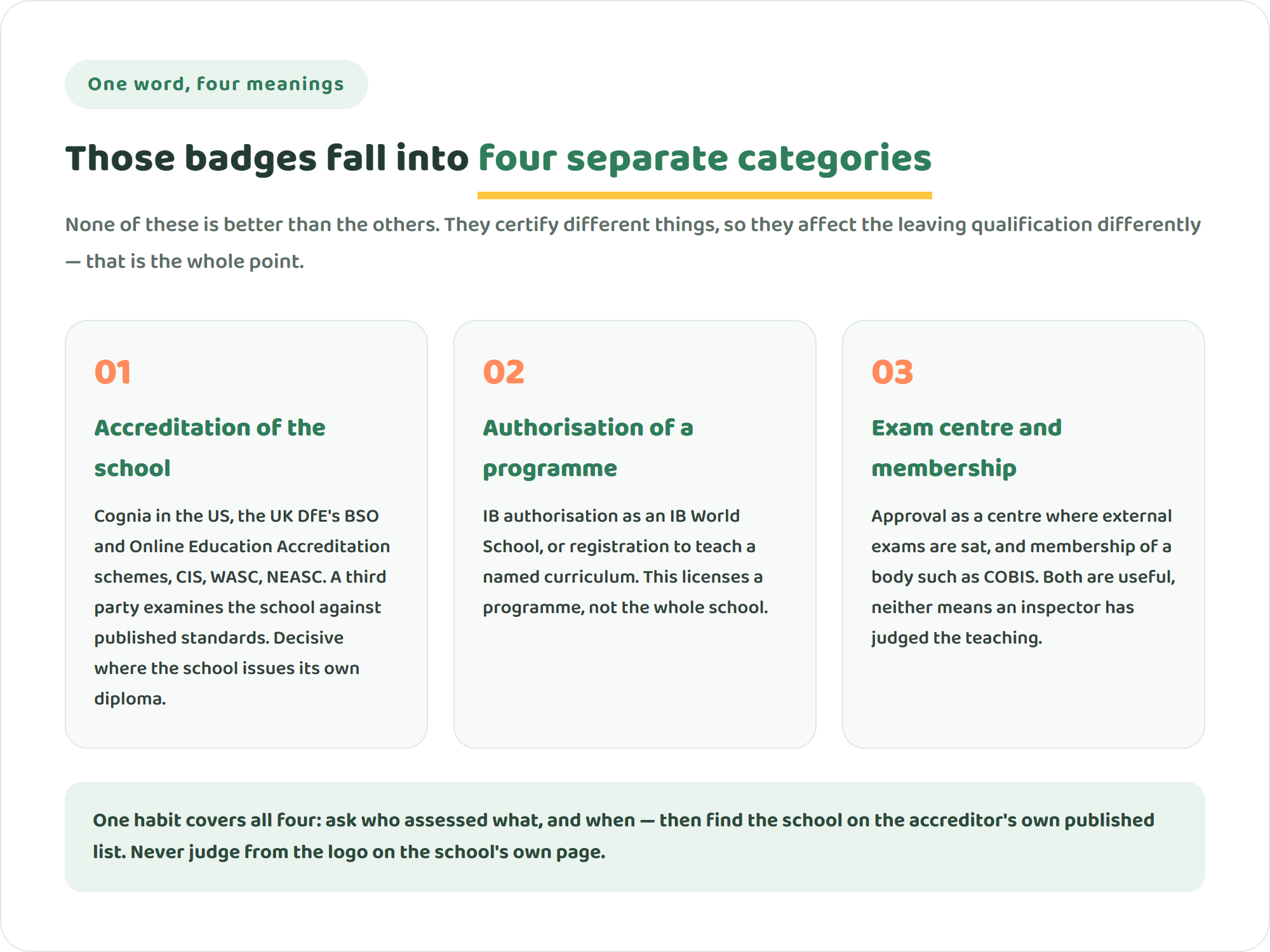
1. Accreditation of the school. A third party examines the school against published standards, usually including a visit. Cognia in the United States, the UK Department for Education’s British Schools Overseas and Online Education Accreditation schemes, and international bodies such as CIS, WASC and NEASC all sit here. Where a school issues its own leaving certificate, this is the category that matters most.
2. Authorisation of a programme. The International Baccalaureate’s authorisation is the clearest example. It does not evaluate the whole institution; it licenses a school to deliver a named programme.
3. Approval as an exam centre. Registration as a venue where IGCSE or A Level papers can actually be sat. Genuinely useful, but it says nothing about whether anyone has judged the teaching.
4. Membership of an association. Bodies such as COBIS, the Council of British International Schools. Most COBIS membership categories rest on either an external accreditation (BSO, CIS, or the OEAS scheme below) or COBIS’s own standards review. Across associations in general, though, some memberships involve no inspection at all. Being a member and having been inspected are not automatically the same thing.
British or American design changes which badge counts
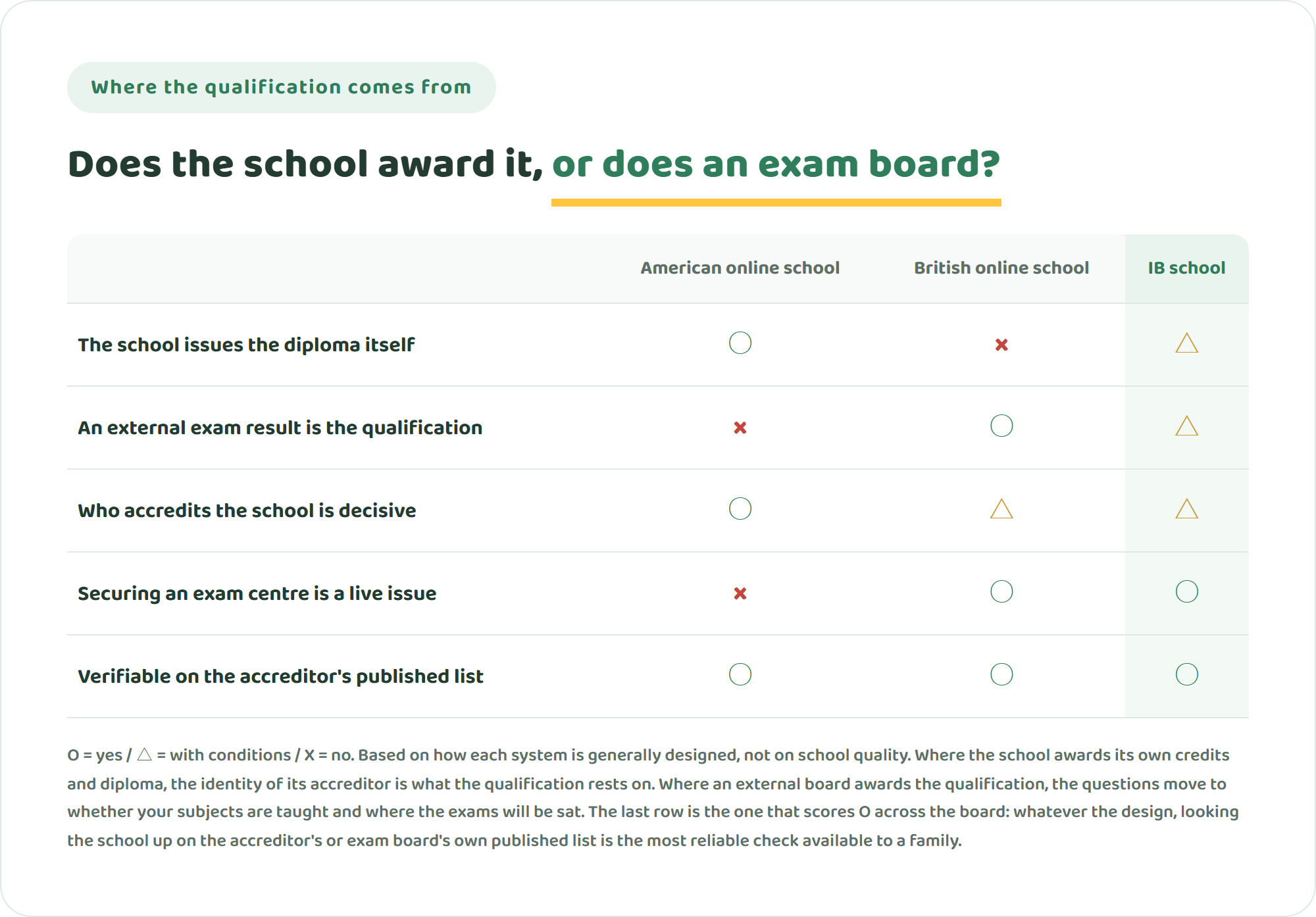
This is the heart of it. Who awards the qualification determines which accreditation carries weight.
American-style online schools award their own credits and issue a high school diploma in the school’s name. The credibility of the qualification therefore rests directly on the credibility of the school, which is why the identity of its accreditor is decisive. If you cannot verify the accreditor, you cannot verify the diploma.
British-style online schools prepare students for IGCSE and A Level, where an external board awards the grade. The school does not mark the work that becomes the qualification. Accreditation of the school still tells you something real about teaching and safeguarding, but it is not what the certificate rests on. Here the questions move to whether your subjects are actually taught, and where the exams will be sat.
The underlying difference between the two systems is set out in British vs American online international school, and the full range of qualifications available online is mapped in Where do online international school graduates actually go?
The UK runs a scheme built specifically for online schools
If you are looking at British providers, two Department for Education schemes are worth knowing by name.
British Schools Overseas (BSO)
A voluntary inspection scheme for British international schools abroad, established in 2010. Participating schools must evidence that they meet standards comparable to the independent school standards for England, and the national minimum standards for boarding where relevant. Inspections are carried out by three inspectorates approved by the DfE, and the school chooses which one inspects it. To keep the accreditation, a school must be inspected successfully at least once every three years. Ofsted monitors the inspectorates themselves and reports on the quality of their work annually.
Online Education Accreditation Scheme (OEAS)
This one exists specifically for online provision. It is a non-statutory scheme run by the Department for Education, open to providers of full-time online education to pupils of compulsory school age in England. The sequence is worth knowing: the provider applies to the DfE, the DfE passes the application to Ofsted for suitability checks, Ofsted carries out an accreditation visit to assess compliance with the online education standards, and the DfE then decides whether to award accreditation. Accredited providers appear on Get Information About Schools (GIAS), the official register for England — which means the claim is verifiable outside the school’s own marketing.
Two points follow. First, both schemes are voluntary, so the absence of either is not evidence of a bad school; plenty of excellent providers sit outside them, and a newly opened school may not yet be eligible. Second, and more usefully, where a school does hold one, an inspector genuinely visited and you can check it independently. Treat presence as something you can verify, rather than absence as a mark against. COBIS, for its part, accepts OEAS accreditation as one of the routes by which an online school can become an accredited member.
When three American accreditors turn out to be one
A pattern you will meet constantly on American-style school sites: SACS CASI, NCA CASI and the Northwest Accreditation Commission, listed one after another. Three accreditations looks like three independent verdicts. In fact all three are accreditation divisions of the same parent organisation, Cognia.
The history explains the naming. The North Central Association, the Southern Association of Colleges and Schools (SACS CASI) and the National Study of School Evaluation combined to form AdvancED in 2006. The Northwest Accreditation Commission joined in 2012. AdvancED merged with Measured Progress in 2018, and the combined organisation was renamed Cognia in 2019. Three names, one accreditation.
This is not a school being dishonest — the legacy names remain in active use and schools list them as they were awarded. The practical lesson is narrower: do not read the number of logos as a measure of scrutiny. Pearson Online Academy, covered in Pearson Online Academy tuition, lists SACS CASI, the Northwest Accreditation Commission, NCA CASI and Middle States on its own site — a good example of a list that is shorter than it looks.

The IB does not say “accredited” — it says “authorised”
If a school mentions the International Baccalaureate, read the wording closely. The IB does not accredit schools; it authorises them to offer one or more IB programmes. A school that has been through that process is an IB World School.
The published process runs in stages: consideration, request for candidacy, candidacy, request for authorisation, a verification visit by the IB, and then a decision on authorisation. There are no fixed deadlines or standard timeframes — schools move at their own pace, guided by an assigned IB educator, and the programme coordinator must complete required professional development along the way.
The part worth holding on to: a “candidate school” has not yet been authorised. If you enrol during candidacy, authorisation during your child’s time there is an expectation rather than a guarantee — the IB states plainly that it may deny authorisation, and that the decision is final, with no reconsideration or appeal. “IB candidate school” and “IB World School” are different claims. Ask which one applies.
Five questions that settle the accreditation
All of the above compresses into one email. Wider selection criteria belong in the guide linked below; these five settle the accreditation alone.
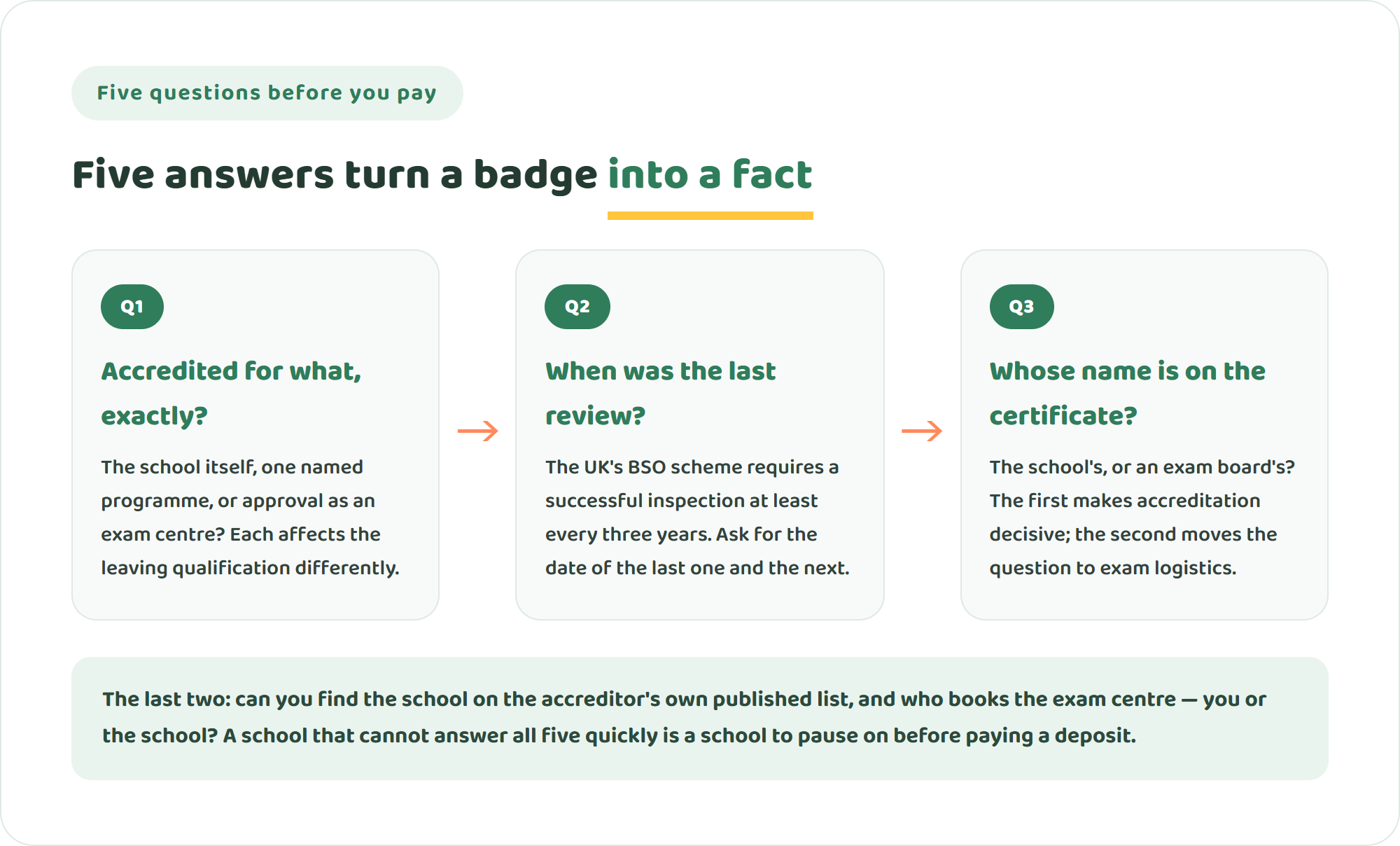
- Accredited for what, exactly? The school as an institution, one named programme, or approval as an exam centre?
- When was your last review, and when is the next one? Under BSO, a successful inspection is required at least every three years.
- Whose name appears on the leaving certificate? If it is the school’s, the accreditor is what the qualification rests on. If it is an exam board’s, turn to the logistics of sitting the papers.
- Can I find your school on the accreditor’s own published list? Verification from the accreditor’s side — not the school’s — is the single most reliable check available to you. GIAS does this for OEAS-accredited providers in England.
- Where will the external exams be sat, and who books the centre — you or us? Schools genuinely differ here, and families discover it late.
A school that answers all five quickly has earned the description “accredited online international school” in a way you can check. If any one of them turns vague, pause before paying a deposit. The practical side of sitting exams from outside the UK is covered in Can you take IGCSE online?, and the wider selection criteria in How to choose an online international school. For who the providers actually are, see our list of online international schools available from Asia.
Common questions
Should we rule out a school with no accreditation?
Not automatically. Both UK schemes are voluntary, and some schemes require a provider to have been operating for a period before it can apply, so a new school may simply not be eligible yet. A missing badge is a question; a badge you cannot verify is a problem.
Does accreditation guarantee university entry?
No — they are separate systems. Universities set their own entry requirements and decide what they will accept as equivalent to a school leaving qualification, and those judgements differ by country and by institution. Check the admissions requirements of two or three target universities directly rather than inferring from an accreditation logo.
Does accreditation matter for a self-paced school?
Yes, but you look in a different place. Self-paced providers usually route students to external exams, so the live questions are which board and which subjects they support, and how the exam centre is arranged — more than who accredits the institution. A self-paced provider such as the one covered in Wolsey Hall Oxford fees and reviews is a good case for starting there.
Are more accreditors better?
No. As the Cognia example shows, a longer list can describe a single organisation under legacy names. Verify who assessed what, and when, one item at a time.
For a worked example of reading one school’s accreditation claim and fees together, see Minerva Virtual Academy fees.
Don’t trust the badge — look it up from the other side
Choosing an online school is hard precisely because you cannot walk the corridors. That makes independently published facts the most reliable material you have. Can you find the school on the accreditor’s list? When was the last review? Whose name goes on the certificate? Those three answers tell you more than any prospectus.
NIJIN GLOBAL ACADEMY is scheduled to open in September 2027, with a preview term of trial classes planned for April and May 2027. Most schemes are not even open to a school that has not started teaching, so we will say plainly that we do not yet hold an accreditation of our own. Which external qualifications we will connect to, and which framework we will invite third-party scrutiny under, are still being designed. When those are settled we will publish them at the same level of detail this article asks of everyone else. How the school day itself is built is set out in our learning model.
An accredited online international school is not one with the most badges. It is one whose claims you were able to look up from the other side. Accreditation is not decoration meant to reassure you — it is a handle for checking.