If your family is moving to Manila and looking at homes in or around Bonifacio Global City (BGC), two schools will almost certainly be on your list: The British School Manila (BSM) and International School Manila (ISM). Both are in BGC, both are non-profit, and both let students graduate with the IB Diploma. Beyond that they are quite different. BSM follows the English system through IGCSE into the IB; ISM, founded in 1920 and now 2,465 students strong, pairs an American-style high school diploma with the IB and some AP courses. Their fee structures, admissions rules and waiting arrangements differ too. So how does the British School Manila tuition fee really compare with ISM’s?
This guide sets The British School Manila tuition fee schedule for 2026-27 next to ISM’s, then compares curriculum, English requirements, admissions, waiting lists and size, using only what the two schools publish. BSM’s fees come from the “School Fees | 2026-2027” page of its official Admissions Guide SY2026-2027; ISM’s come from its official School Fees page, which matches its fee PDF dated 29 May 2026. Both were checked on 31 October 2026. Approximate US dollar totals use European Central Bank reference rates for 30 October 2026 (GBP 1 = US$1.3399, PHP 1 = US$0.015704) and are rough guides only.
The short answer: English route vs IB-and-AP route, fees once the CDF is added, and how waiting works
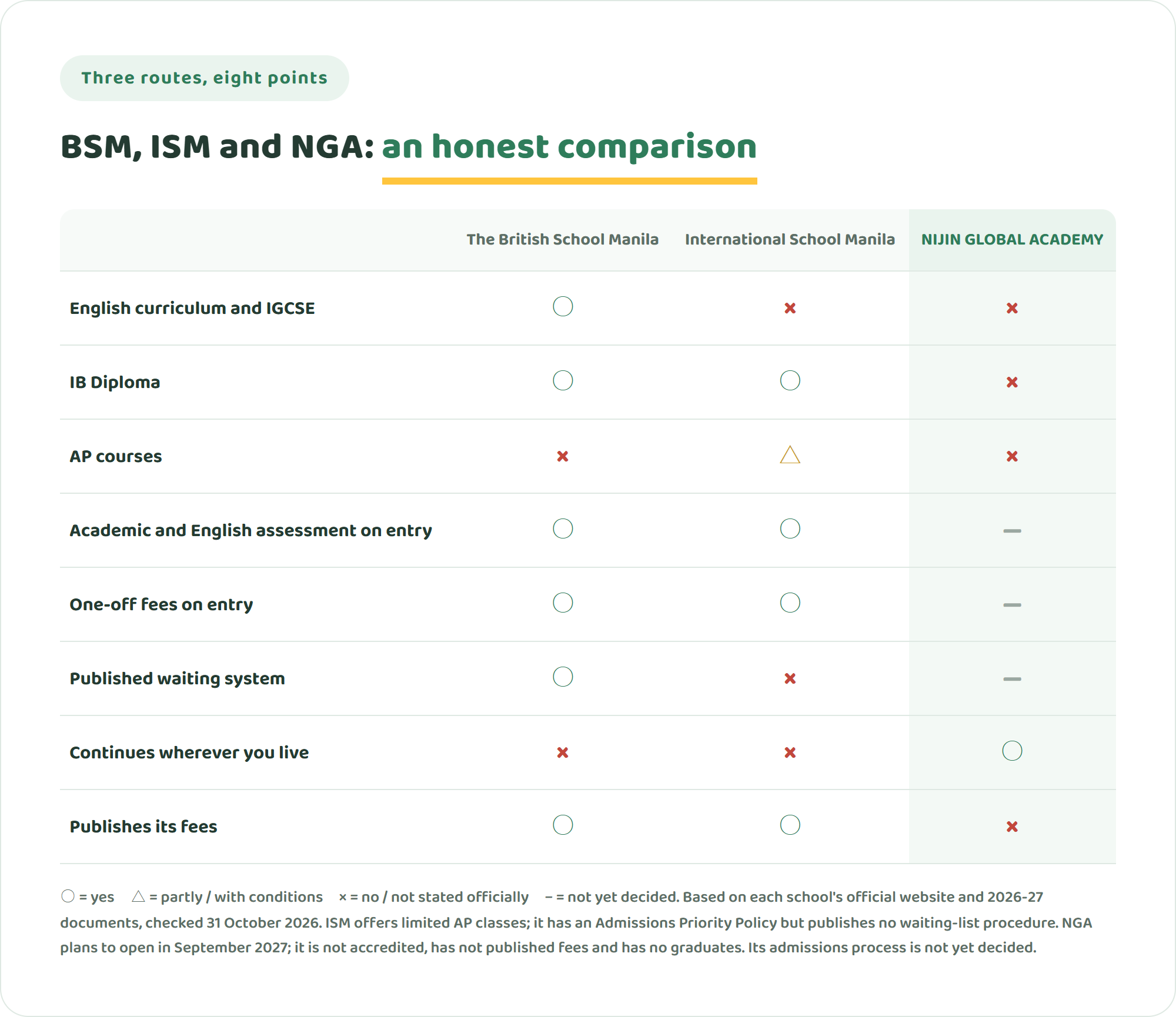
- Curriculum: BSM adapts the English National Curriculum, with IGCSE in Years 10–11 and the IB Diploma Programme in Years 12–13. It offers no AP. ISM teaches its own international curriculum; high school students earn the ISM High School Diploma and can take the full IB Diploma or individual IB certificates, plus a limited number of AP classes. Neither school’s website mentions the IB Primary Years or Middle Years Programmes (PYP or MYP).
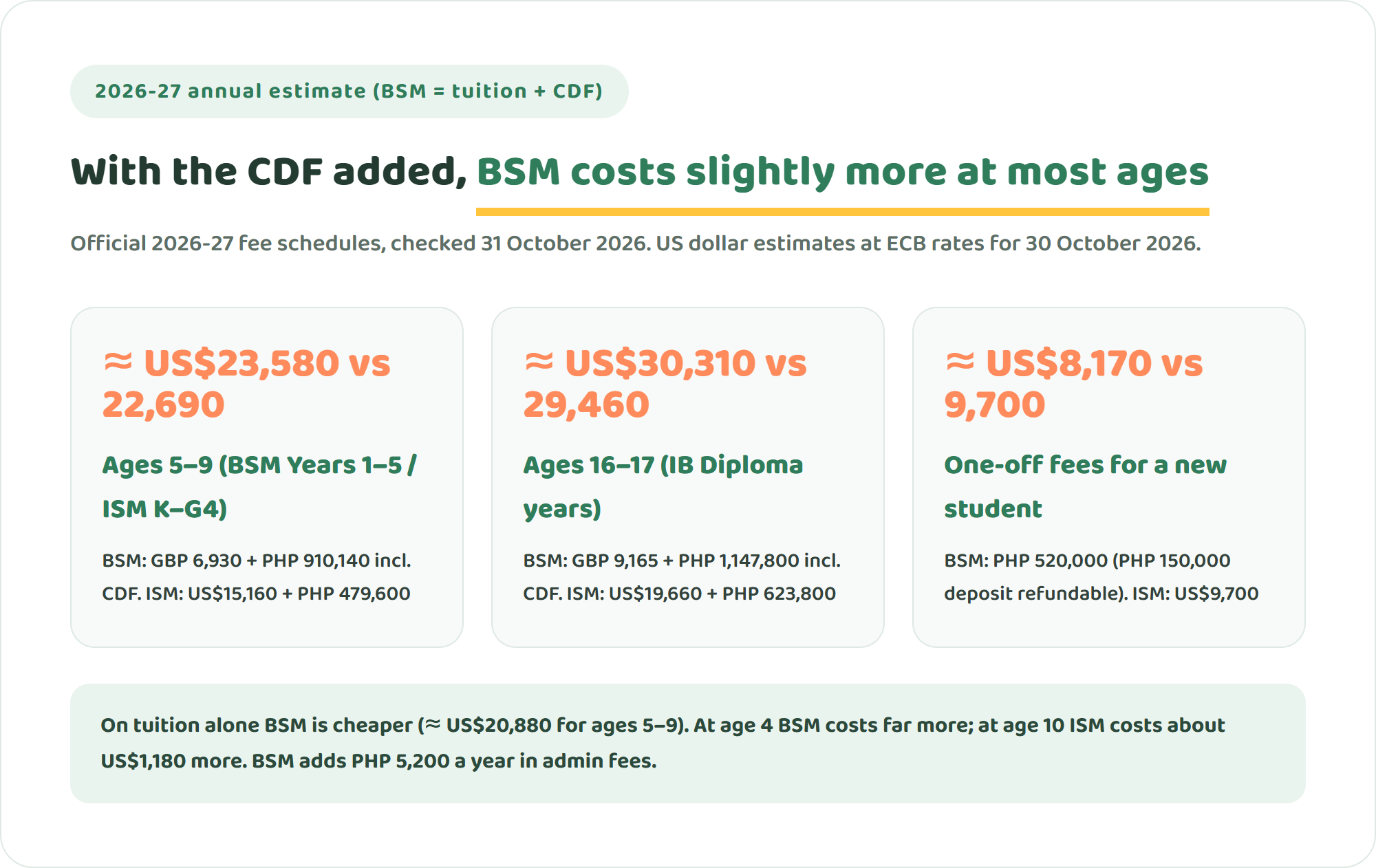
- Fees: on tuition alone BSM looks cheaper, but every BSM student also pays a non-refundable Capital Development Fee (CDF) of PHP 171,630 a year. Add it in and, for ages 5–9, BSM costs about US$23,580 a year against ISM’s US$22,690. In the two IB Diploma years it is about US$30,310 against US$29,460. At most ages BSM ends up roughly 3–6% more expensive, and far more at age 4, when BSM already charges its primary rate. The exception is age 10 (BSM Year 6, ISM Grade 5), where ISM costs about 5% more.
- One-off fees for a new student: PHP 520,000 at BSM (about US$8,170, of which a PHP 150,000 deposit is refundable when you leave) against US$9,700 at ISM.
- Size: BSM has 955 students from more than 50 nationalities; ISM has 2,465 students from 91 countries.
- Admissions: BSM publishes three application deadlines a year, priority categories based on nationality and employment status, and a wait pool. ISM runs rolling admissions, and a place is only secured once you have been accepted, enrolled and paid.
In short, BSM is the natural fit if you want the IGCSE-to-IB route towards universities in the UK, Hong Kong or Australia. ISM suits families who want to keep US universities in view, prefer a large school with both IB and AP options, or want to see English-language support priced in the fee schedule before applying. From age 5, either way you are looking at roughly US$22,000–31,000 a year before one-off fees. Before you weigh one school against the other, it may matter more to confirm what your employer covers and how long you expect to stay in Manila.
British School Manila tuition fees vs ISM fees for 2026-27 (official figures)
Manila’s international schools bill tuition in two currencies, and you pay both parts. BSM bills in British pounds plus Philippine pesos; ISM bills in US dollars plus pesos. They are not alternative prices. Because the two schools group grades differently, the table below lines them up by age (BSM Year 1 is age 5, the same as ISM Kindergarten). The BSM column includes the compulsory annual CDF.
| Age (at 1 September) | The British School Manila (tuition + CDF) | International School Manila (tuition) |
|---|---|---|
| 3 | Nursery: GBP 4,170 + PHP 615,810 (≈ US$15,260) | Preschool 3: US$9,720 + PHP 306,400 (≈ US$14,530) |
| 4 | Reception: GBP 6,930 + PHP 910,140 (≈ US$23,580) | Preschool 4: US$9,720 + PHP 306,400 (≈ US$14,530) |
| 5–9 | Years 1–5: GBP 6,930 + PHP 910,140 (≈ US$23,580) | Kindergarten–Grade 4: US$15,160 + PHP 479,600 (≈ US$22,690) |
| 10 | Year 6: GBP 6,930 + PHP 910,140 (≈ US$23,580) | Grade 5: US$16,520 + PHP 524,600 (≈ US$24,760) |
| 11–13 | Years 7–9: GBP 7,785 + PHP 1,002,360 (≈ US$26,170) | Grades 6–8: US$16,520 + PHP 524,600 (≈ US$24,760) |
| 14–15 | Years 10–11 (IGCSE): GBP 8,190 + PHP 1,044,810 (≈ US$27,380) | Grades 9–10: US$17,620 + PHP 558,400 (≈ US$26,390) |
| 16–17 | Years 12–13 (IB DP): GBP 9,165 + PHP 1,147,800 (≈ US$30,310) | Grades 11–12: US$19,660 + PHP 623,800 (≈ US$29,460) |
| One-off fees (new student) | Application PHP 30,000 + entrance PHP 340,000 + enrolment/security deposit PHP 150,000 = PHP 520,000 (≈ US$8,170; deposit refundable on leaving) | Matriculation US$4,500 + facilities enhancement US$4,500 + application US$700 = US$9,700 |
BSM’s tuition on its own, without the CDF, is GBP 4,170 + PHP 444,180 for Nursery, GBP 6,930 + PHP 738,510 for Reception to Year 6, GBP 7,785 + PHP 830,730 for Years 7–9, GBP 8,190 + PHP 873,180 for Years 10–11 and GBP 9,165 + PHP 977,790 for Years 12–13. The CDF is PHP 171,630 a year from Nursery to Year 11 and PHP 170,010 in Years 12–13. BSM also charges PHP 5,200 a year in administrative fees (yearbook, photos, ID and class fund), and external exam fees are billed at cost.
Sources: BSM Admissions Guide SY2026-2027, “School Fees | 2026-2027”; ISM “SY26-27 School Fees and Payment Schedules” (both checked 31 October 2026). For the full detail of ISM’s refund rules, programme fees and payment schedule, see our International School Manila tuition fees guide.
Why BSM looks cheaper on tuition but costs more once the CDF is added
Converted at the same rates, BSM’s tuition for ages 5–9 is about US$20,880, roughly US$1,800 below ISM’s US$22,690. But BSM bills its non-refundable CDF every term to every student, and over a year that adds about US$2,700. The total comes to about US$23,580, around US$890 more than ISM. When you compare international school fees, add up every compulsory annual charge, not just the line labelled “tuition”.
The ages where the gap flips are worth knowing. BSM charges its full primary rate from Reception (age 4), so at that age it costs about US$9,050 more than ISM’s preschool. ISM moves to its Middle School rate from Grade 5 (age 10), so for that one year ISM is about US$1,180 more expensive.
The first-year bill is close at both schools
Once one-off fees are added, the difference narrows further. For a new five-year-old, BSM’s first year (tuition, CDF, admin fee and one-off fees) comes to about US$31,830, and ISM’s (Kindergarten tuition plus US$9,700) to about US$32,390. For a 16-year-old starting the IB Diploma Programme it is about US$38,550 at BSM and US$39,160 at ISM. Because BSM’s PHP 150,000 security deposit (about US$2,360) comes back when your child leaves, BSM’s non-refundable first-year cost is lower. Note also that from 2026-27 BSM charges students in Year 3 and Year 7 a one-off fee for a school-managed device (PHP 43,000 or PHP 105,000), followed by an annual technology fee.
Different currency mixes mean different exchange-rate exposure
For ages 5–9, about 60% of BSM’s tuition plus CDF is billed in pesos; about two-thirds of ISM’s tuition is billed in US dollars. A strong dollar weighs more on ISM; a strong pound weighs more on BSM’s sterling portion. BSM accepts the sterling portion in US dollars or pesos, but at the school’s own exchange rate, which includes a mark-up for conversion costs. If your employer pays, ask which currency they pay in and which charges they cover.
Curriculum: IGCSE then IB at BSM; an American-style diploma with IB and AP at ISM
The British School Manila: English year groups, IGCSE, then the IB
BSM opened in 1976 with 36 students in the old Union Church and moved to its BGC campus in 2002. It describes itself as the oldest and only non-profit international school in Manila offering a British education, and says all its teachers are UK or Commonwealth trained. It is accredited by CIS, WASC and COBIS, and in 2007 became the first school in the Philippines to gain CIS accreditation. It is also a founding member of FOBISIA.
The school follows English year groups and Key Stages. Nursery and Reception (ages 3–4) learn through play; Years 1–6 make up the Primary School. Years 7–9 follow what the school calls an enhanced version of the British National Curriculum, Years 10–11 take the two-year IGCSE, and Years 12–13 follow the IB Diploma Programme. BSM has offered the IB Diploma since 2003, and its graduating classes now number more than 65 students. The website gives a 100% IB Diploma pass rate without naming the year. Language acquisition options in the Diploma are French, Mandarin and Spanish, with English as the only Group 1 language. The most common university destinations are the UK, the US, Australia, Canada and Hong Kong.
International School Manila: its own curriculum and an American-style diploma
ISM opened in 1920 as the American School and took its current name in 1970. It introduced the IB in 1976 and describes itself as the first school in Asia to offer the IB Diploma. It has 2,465 students from 91 countries on a seven-hectare campus, and is accredited by ACS WASC and the IB.
In the Elementary School (Kindergarten–Grade 4), concept-based units are aligned with the Common Core standards for maths and English and the Next Generation Science Standards. Students who complete High School (Grades 9–12) receive the ISM High School Diploma, and in Grades 11–12 they choose between the full IB Diploma and individual IB certificates. ISM also offers limited AP classes, and students can prepare for some AP exams on their own, such as Calculus AB and BC. The school reports that 98% of its IB candidates received the full Diploma in 2025. A question families often ask: ISM’s website makes no mention of the PYP or MYP; its IB offer is at Diploma level only.
Admissions, English and waiting lists
BSM: three deadlines a year, priority categories and a wait pool
BSM accepts students of every nationality, provided they pass the school’s assessment, including English, and there is space in the year group. Every applicant takes an age-appropriate English assessment, and the older the child, the more important it is that they can already learn in English. BSM lists learning support, but does not describe a separate EAL programme or fee. Assessments last one hour for Nursery and Reception, one to two hours for Years 1–2, a day and a half for Years 3–6, and a full morning plus a 15-minute interview for Years 7–13. From Year 7 the school uses the CAT4 cognitive abilities test and a short English test; IB Diploma applicants also need several references and an interview. Families usually hear within seven school days.
The deadline for Term 1 of 2027-28 (August 2027 entry) is 10 May 2027. The deadline for Term 3 of 2026-27 (April 2027) is 12 February 2027, but the school says offers for Terms 2 and 3 are made only in exceptional circumstances. Applications are accepted up to 12 months before the expected start date.
When a year group is full, places go in this order of priority:
- Children of British diplomats and British expatriates in the Philippines, Commonwealth diplomats and other foreign diplomats
- Children of Commonwealth nationals and other nationals living in the Philippines because of expatriate employment
- Siblings of current students, children of other expatriates resident in the Philippines, and children of BSM alumni
- All other families
Eligibility is judged on the child’s own passport. Categories 1 and 2 are invited for assessment once their file is complete; Categories 3 and 4 wait in an applicant pool until after the next deadline. Children who meet the standard but cannot be placed go into the wait pool, ordered by category. The pool is reviewed every year, families must keep their child’s reports up to date, and a family that declines an offered place twice will normally be removed.
ISM: rolling admissions, resident visas and payment to secure a place
ISM accepts applications all year round, up to nine months before the school year your child will start. It admits students when there is space in the grade, when interviews, tests and past records show they can benefit from the programme, and when the child lives with their parent(s) in the Philippines. Parents and children need a valid temporary or permanent resident visa; tourist visas are not accepted for continued study. Testing covers English and mathematics, and older students who have studied French, Japanese, Spanish or Mandarin may be tested in that language. Every family meets a school counsellor.
ISM follows an Admissions Priority Policy, because its primary mission is to educate expatriate children temporarily living in the Philippines, but the categories and any waiting-list procedure are not set out on its admissions pages. What it does make clear is that an inquiry or online application does not reserve a place; you must enrol and pay as soon as your child is accepted. English support is priced in the fee schedule: EAL serves Grades 1–10 and costs US$1,625 per semester in the first year. EAL is not listed for Grades 11–12, so a student joining in the last two years needs to be ready to learn fully in English. To see how Manila fees compare with other Asian cities, read our guide to international school fees across Asia.
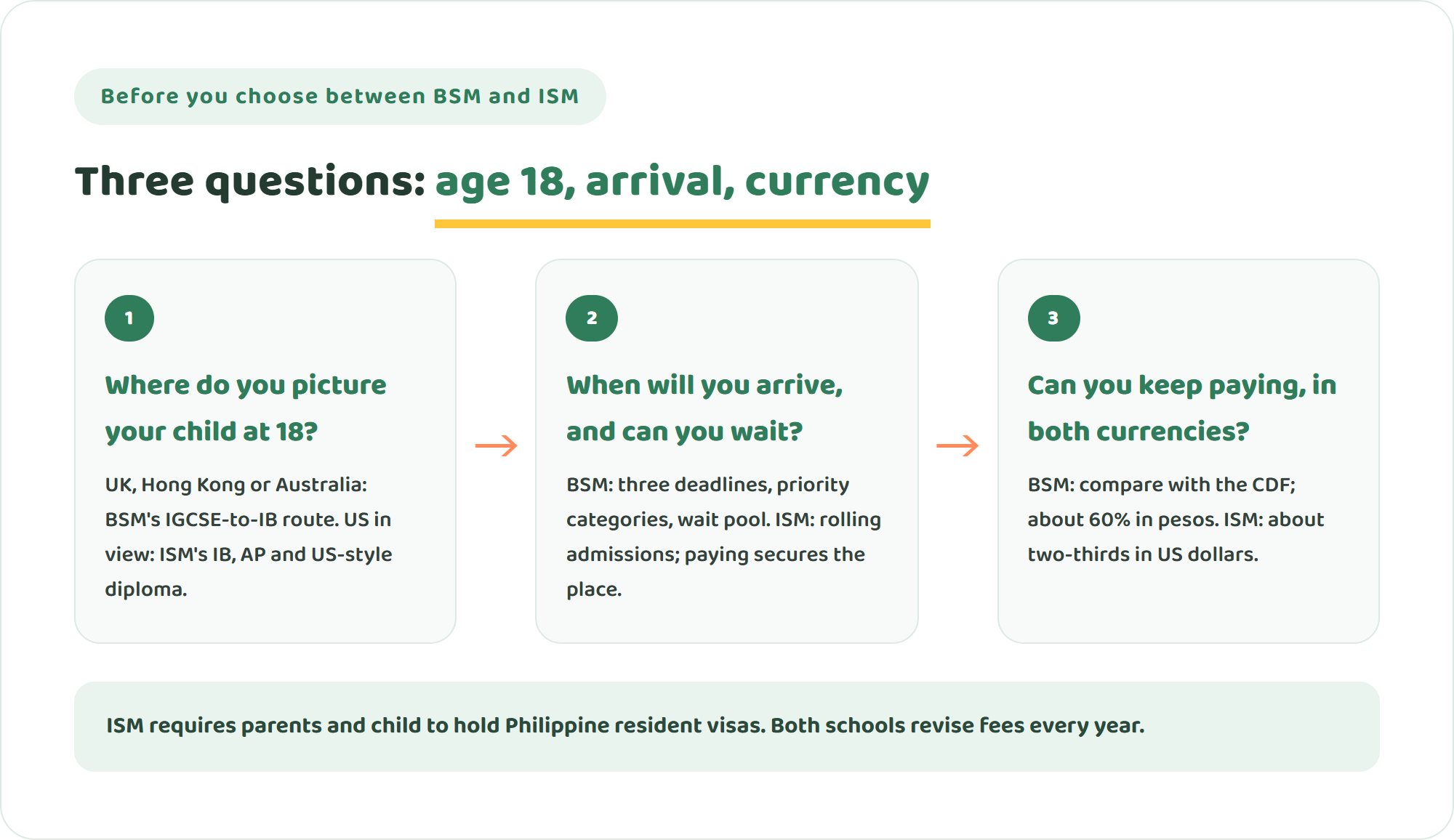
BSM or ISM? Three questions to talk through as a family
1. Where do you picture your child at 18?
If you are aiming for universities in the UK, Hong Kong or Australia and like the idea of building up through IGCSE to the IB, BSM’s route is the natural one. If US universities are on the table and you want AP options and an American-style diploma alongside the IB, ISM fits better. It also helps to ask whether your next posting is more likely to have British or American schools.
2. When will you arrive, and how will you handle a wait?
BSM has three deadlines a year and treats mid-year entry as an exception, but because its priority categories and wait pool are published, you can work out roughly where your family stands. ISM accepts applications at any time and asks you to pay straight away once your child is accepted. As soon as your move date is fixed, talk to both schools at the same time.
3. Can you keep paying the full annual cost, in both currencies?
Compare BSM with the CDF included, and remember how much of ISM’s fee is in dollars. Check whether your employer’s cap covers one-off fees, the CDF and transport, and what happens to deposits and fees if you are reassigned. For the bigger picture, see our guide to international schools in Manila, our side-by-side of Brent International School vs International School Manila, our list of more affordable international schools in Asia, and, if a Japanese school is also an option, our overview of Japanese school tuition in Asia, including Manila.
A second option that continues wherever you live
Waiting in BSM’s wait pool, waiting for an ISM place to be confirmed, or expecting another move in a few years: the in-between periods are unsettling for children and parents alike. For families in that position, it can help to keep one option that does not depend on where you live: an online international school. You can see how our lessons work on our curriculum page.
Where NIJIN GLOBAL ACADEMY fits
NIJIN GLOBAL ACADEMY (NGA) is an online international school for ages 6–18, planned to open in September 2027. It is run by NIJIN Inc., which also operates NIJIN Academy, a learning community in Japan for children who do not attend school, where more than 1,000 children have studied so far. NGA plans admission that is not based on test-score rankings, small live classes, and subjects taught in English with support from bilingual English–Japanese mentors.
To be clear about what NGA is not: it has not opened yet, it is not accredited, it has not published its fees and it has no graduates. If your child needs IGCSEs, the IB Diploma or an American-style high school diploma, NGA cannot replace BSM or ISM. We hope it can be worth comparing as a bridge while you wait for a place, as continuity for families who move often, or as extra time learning in English for children attending a Japanese or local school in Manila.
FAQ
How much is the British School Manila tuition fee?
For 2026-27, BSM tuition is GBP 4,170 + PHP 444,180 for Nursery, GBP 6,930 + PHP 738,510 for Reception to Year 6, GBP 7,785 + PHP 830,730 for Years 7–9, GBP 8,190 + PHP 873,180 for Years 10–11 and GBP 9,165 + PHP 977,790 for Years 12–13. A Capital Development Fee of about PHP 170,000 is added every year, making ages 5–9 about US$23,580 a year at 30 October 2026 rates. New students pay PHP 520,000 in one-off fees, including a refundable PHP 150,000 deposit.
How much are ISM’s fees?
For 2026-27, ISM tuition is US$9,720 + PHP 306,400 for Preschool, US$15,160 + PHP 479,600 for Kindergarten–Grade 4, US$16,520 + PHP 524,600 for Grades 5–8, US$17,620 + PHP 558,400 for Grades 9–10 and US$19,660 + PHP 623,800 for Grades 11–12. New students pay US$9,700 in one-off fees.
BSM vs ISM: which is more expensive?
BSM looks cheaper on tuition alone, but with its annual CDF it costs roughly 3–6% more than ISM at most ages (and much more at age 4); at age 10 ISM costs about 5% more. ISM’s one-off fees are about US$1,500 higher, so the first-year totals are close.
Can non-British children attend BSM?
Yes. BSM accepts all nationalities. Children of non-Commonwealth families living in the Philippines because of expatriate employment fall into priority Category 2. Every applicant must pass the assessment, including English, and there must be space in the year group.
Does BSM offer AP, or the IB PYP and MYP?
No. BSM follows an English curriculum through IGCSE to the IB Diploma. ISM’s website does not mention the PYP or MYP either; it offers the IB at Diploma level, plus limited AP classes.
Choose for where your child is heading at 18, not just the neighbourhood
The British School Manila and International School Manila share a district and charge broadly similar fees. Even so, they suit different families: the English route through IGCSE or an American-style diploma with AP; a school of 955 or one of 2,465; published deadlines, categories and a wait pool, or rolling admissions where payment secures the place. Talk as a family about where you want your child to be at 18 and how long you expect to stay in Manila, then book visits at both schools.
If you would also like to compare a way of learning that does not depend on where you live, you are welcome to keep NIJIN GLOBAL ACADEMY on your list alongside your school search in Manila. Ahead of its planned September 2027 opening, we expect to run trial classes in April–May 2027.