If you are considering a private school teacher career change, the first obstacle is usually not a shortage of jobs. It is that there is no shared yardstick to compare against. In the private and independent sector, pay scales, appraisal, leave and severance are set school by school — each institution writes its own employment rules and salary regulations. You can hold the same licence and teach the same timetable as a colleague across town and still have no idea what their contract says. This article narrows the picture to the four things that are specific to private schools: (1) terms are defined per institution, (2) there is no district transfer, so your career and one school become the same thing, (3) mission and admissions marketing are part of the job, and (4) full-time, fixed-term and part-time contracts lead to very different futures.
What this article deliberately leaves out is generic career-change advice — taking stock, setting criteria, age-related worries. That lives in career change from teaching and a second career for teachers. At the end, we introduce one option, without a pitch: a founding role at the online international school we open in September 2027 — fully remote, where founding roles begin as volunteer positions ahead of the opening, with detailed terms shared later in the process. Because if you have seen how a school actually stays alive from the inside, that experience counts most on the side that builds one.
Four things that make a private school teacher’s move different
None of this is about one sector being better than the other. The difference is structural: how you gather the information a decision requires.
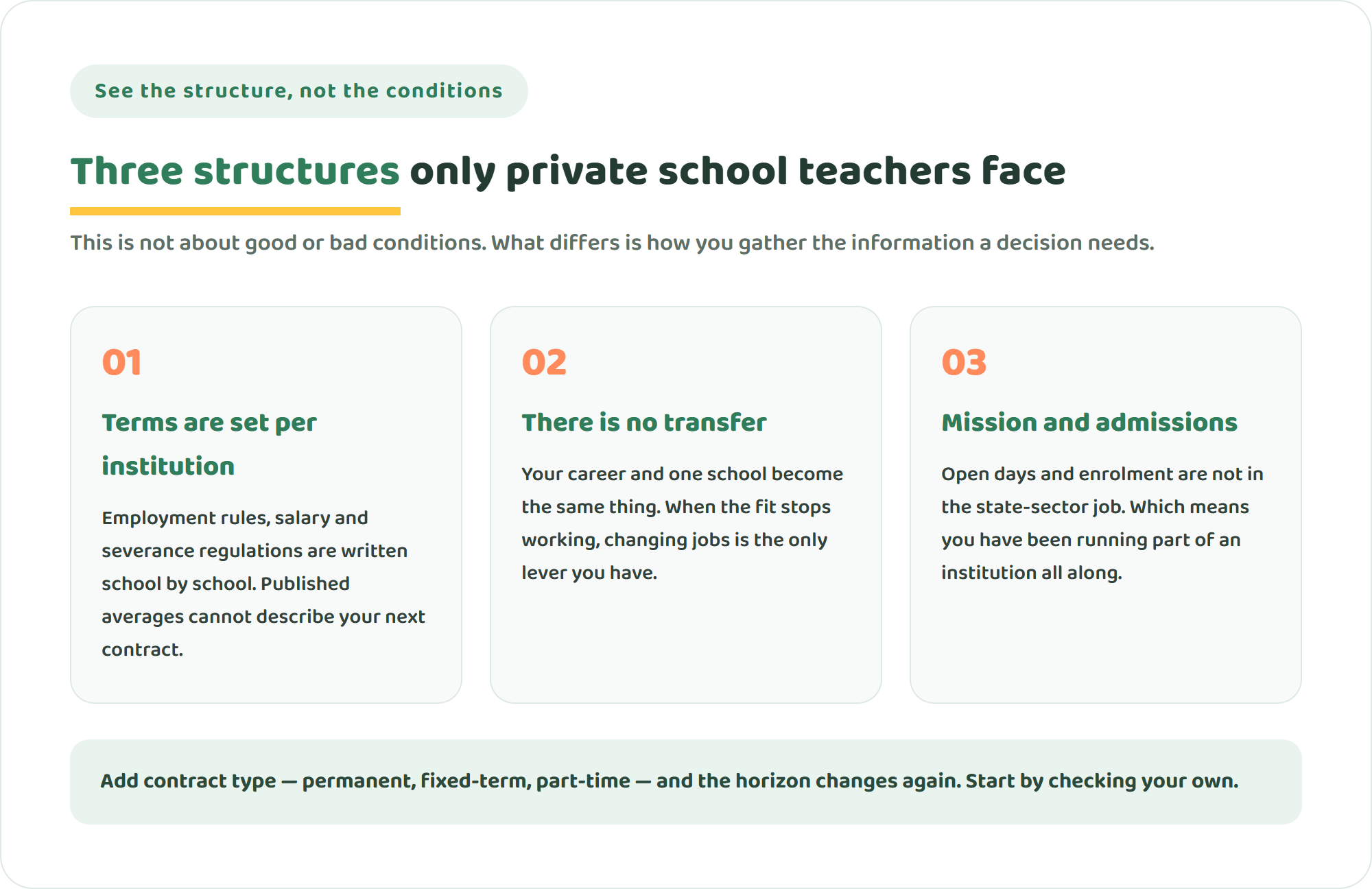
First, terms are written per institution. In most state systems, teacher pay follows a published scale you can look up before you apply. Private and independent schools set their own employment rules, salary regulations and severance rules, and the content differs from school to school. That makes the usual “average private school teacher salary” article close to useless as a decision input — the only figures that describe your next job are the ones in that school’s own documents.
Second, there is no transfer. In a state system, a posting changes every few years and the relationships, the culture and the workload reset with it. Private schools generally have no such mechanism. The upside is real: you can grow a curriculum, a programme or an event over many years, and your career becomes part of the school’s story. The flip side is that when the fit stops working, changing jobs is the only lever you have. What a colleague in the state sector can solve by waiting for a transfer becomes, for you, a career decision from day one.
Third, mission and admissions. A private school is built on a founding ethos, and it survives on enrolment. Open days, tours, the prospectus and website, outreach, social media, entrance assessments — teachers are involved in recruiting the next intake, not just teaching the current one. It is a genuine workload. It also means you have been carrying part of the running of an institution while teaching a full timetable. Fourth, contract type: permanent, fixed-term and part-time colleagues can sit in the same staffroom with different pay, different renewal logic and different horizons.

Before you look at a single vacancy: three documents to reread
The practical first step is not opening a jobs board. It is rereading three documents you already have. Note that all of the following vary by institution, and rules and schemes are revised over time — always confirm against your school’s current regulations and the official information published by the relevant authority.
1. Employment rules. Hours, leave, what happens if you resign mid-year, and how much notice is required. Teaching resignations tend to be tied to the academic calendar, so when you tell people, in what order shapes both your exit and your arrival somewhere else. Treat it as procedure, not emotion.
2. Salary and severance regulations. How increments work, what allowances exist, how bonuses are decided, how any severance is calculated. Variation between institutions is widest here, so published averages cannot stand in for your own figures. The same applies to any pension or mutual-aid scheme covering private school staff: entitlements are defined by the scheme and can be revised, so we quote no amounts here. Check with your school office and the scheme’s own official source.
3. Your contract. Permanent, fixed-term or part-time? Is there an end date? On what basis is renewal decided? While that is vague, you cannot tell whether to search or to wait. Read all three, and only then look at vacancies — reverse the order and you end up chasing whichever listing looks best.
See NIJIN GLOBAL ACADEMY’s founding-member roles → — internationally, founding roles begin as volunteer positions ahead of the opening, with detailed terms shared later. That is not a better offer than the sector; it is simply told to you before you invest any hope in it.
What you saw running a school counts most on the side that builds one
Teachers in private schools routinely describe writing the open-day script, shaping the prospectus, reviewing application numbers to plan next year’s approach, and growing an event into the school’s calling card as “everything besides teaching”. From outside, that is marketing, communications, product design and operations. Very few teachers anywhere have watched, from the inside, how a school stays open, gets chosen and pays for itself. The extra load that only private schools carry is also an asset only they produce.
There is one place where that asset needs no translation at all: the side that builds a school. NIJIN GLOBAL ACADEMY (NGA) is an online international school opening in September 2027, recruiting founding members now, and it is designed so the same person teaches and runs part of the business.
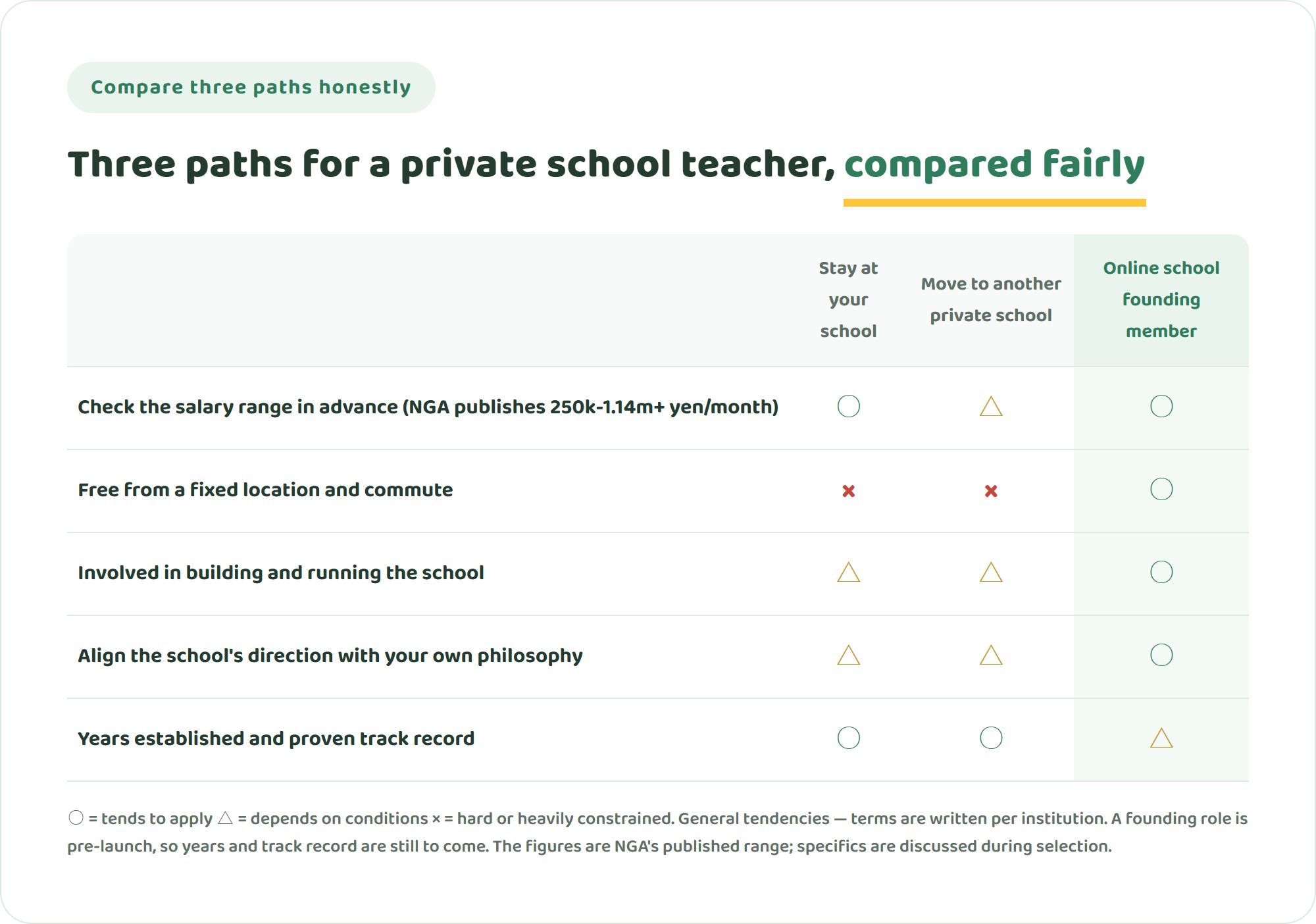
As the table shows, the founding route does not win on every line. The foundation an established school has built over decades of alumni is something a pre-launch team still has to earn. What it does offer, for a private school teacher, is this. First, we say plainly what the terms are: founding roles on this track begin as volunteer positions ahead of our September 2027 opening, and the detailed terms are shared later in the process. That is not a better offer than the sector — it is simply not hidden from you. For a wider sense of international-school economics, our international school tuition database gives you a yardstick.あわせて、インターナショナルスクールの学費はなぜ高いのか(相場の内訳と、対面の約1/5に下げる方法)で、費用の構造そのものを分解しています。
Second, it is fully remote, designed around working while travelling the world, with no commute and no fixed posting. If what you actually want back is the time that went into commuting and weekend school events, that is a structural change rather than a cosmetic one. Third, five working styles from part-time to full, with scope beyond teaching in marketing, web, partnerships and HR — a natural extension for anyone who has spent years putting a school’s appeal into words. Fourth, continuity: NIJIN Inc., which runs NGA, spans a group of eleven companies.
What we ask is roughly English at CEFR B2+ and an appetite for building from zero. What we stand for is learning beyond test scores, set out in how we learn. Anyone who knows the weight of the phrase “founding ethos” tends to understand faster than most what it means to start a school from a philosophy.
Three steps to your next move
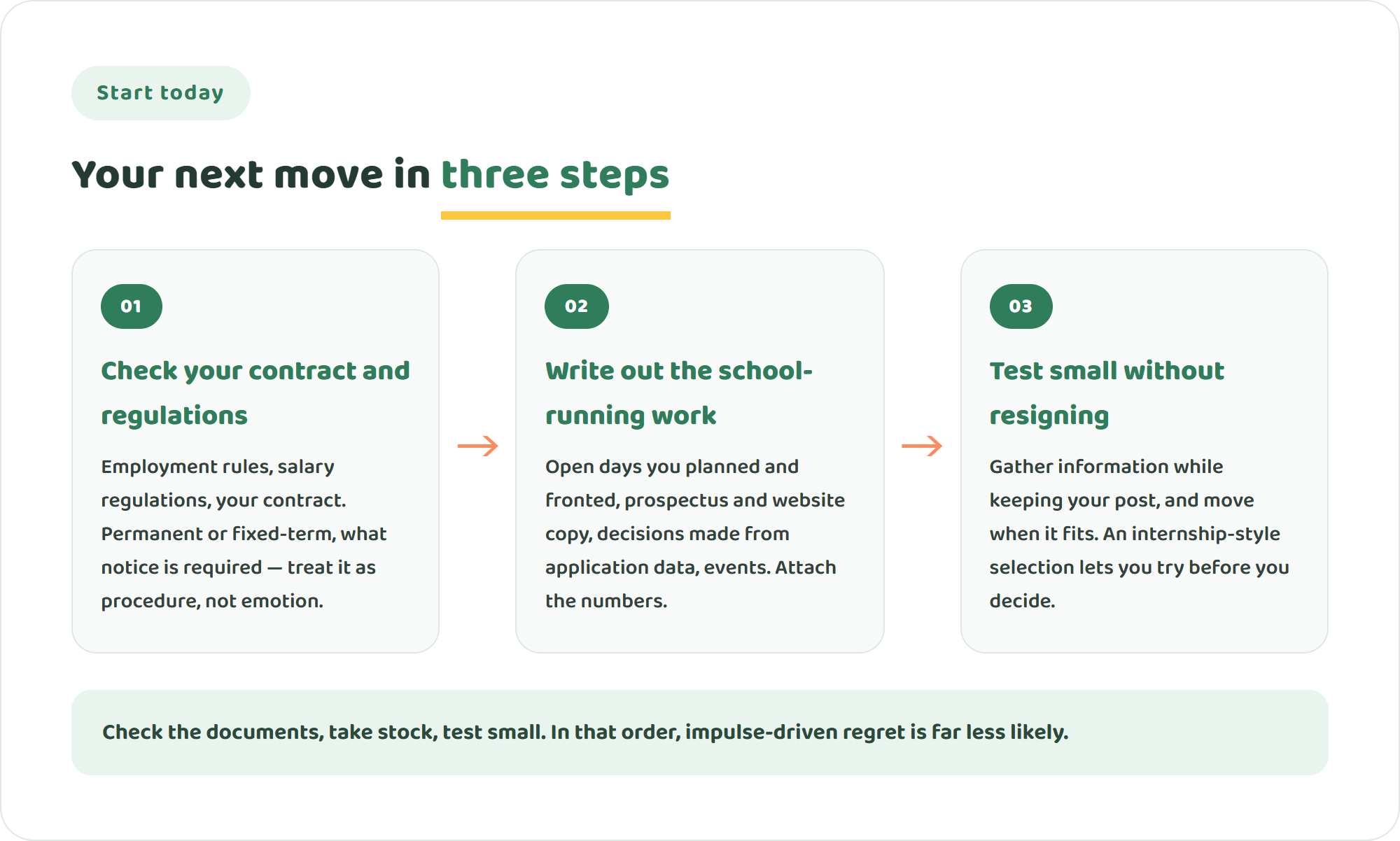
First, check your contract and regulations — permanent or fixed-term, notice period, mid-year rules. Start with the three documents above. Second, write out the school-running work you have carried: open days you planned and fronted, prospectus and website copy, decisions made from application data, events, curriculum design. Attach the numbers — how many people, how many years, what scale — and it reads completely differently. Third, test small without resigning. NGA’s selection runs from document screening to a group interview, an internship at NIJIN Academy, and a final presentation (applications via a Google Form), so you can try before you decide.
Frequently asked questions
Should I use a recruitment agency for a private school teaching move?
It depends how you use one. Agencies and job boards specialising in independent and international schools do exist, and they help when you are still employed and cannot approach schools directly. But terms are defined by each institution. Even through an agency, read the employment rules, salary regulations and contract yourself before you commit.
I teach at a private high school. Is moving to another private school or leaving education more realistic?
The dividing line is whether what you want to change is the school or the way you work. If it is the department, the students, the timetable or the commute, moving to another private school often solves it. If it is being tied to a location at all, changing schools tends to reproduce the same problem a year later — in which case remote and multi-stream ways of working are worth looking at.
Can I move between the private and state sectors?
The teaching qualification is usually the same, but the hiring mechanism is not. State systems recruit through an authority-run selection process; private schools hire institution by institution. Categories, eligibility and requirements differ by authority and by school, and change from year to year, so always check the current official recruitment guidelines.
What happens to severance and my pension scheme?
We deliberately quote no figures. Severance is governed by each institution’s own regulations, and pension or mutual-aid schemes for private school staff are defined by the scheme and can be revised. Ask your school office for the severance regulations and read the scheme’s own official source. Take numbers only from primary sources — that goes for prospective employers too.
You open in September 2027. Is there any point applying now?
Yes. Pre-launch is exactly when founding members shape the substance of the learning and the shape of the school itself. And if you have been quietly wondering what it would be like to work from another country, a fully remote design makes that a practical option rather than a daydream.

People who have kept a school running can build one.
What weighs on a private school teacher is not summed up by pay. The terms exist only inside your own institution, there is no transfer to wait for, and you have been carrying the school’s survival while teaching a full timetable. But that weight is exactly what made you a teacher who knows how a school actually holds together. That does not evaporate whether you step outside education or step over to the side that builds. Check the documents, write out what you have carried, test it small. Step by step — without ever letting go of the joy of teaching.
Working at an International School — More Articles
- international school teacher salary
- how to become an international school teacher
- career change from teaching
- career change from teaching in your 30s and 40s
- how much do teachers earn?
- how to become an IB teacher
- jobs for moving abroad
- teach abroad without relocating
- thinking of quitting teaching
- career change from tutoring
- life after leaving teaching
- a second career for teachers
- teacher bonuses in Japan
- private school teacher salary in Japan
- teach one class a week online
- online teaching jobs from home in India
- part-time online teaching jobs from home
- online international school teacher salary
Turn your passion for teaching into your next way of working.