If you searched “how to become an IB teacher,” you are probably ready to raise the ceiling on your own practice. So let’s start with the numbers rather than the romance. The International Baccalaureate runs four programmes — PYP, MYP, DP and CP, covering learners from roughly age 3 to 19. Official professional development for teachers is built in three tiers: Category 1, 2 and 3. The DP itself dates back to 1968, when the IB was founded in Geneva. In Japan, the education ministry (MEXT) has actively promoted IB adoption with a stated target of 200 or more authorised schools (check MEXT’s IB consortium for the current count). The places to teach are genuinely expanding.
Quick answer: there is no such thing as an “IB teaching licence”
- The International Baccalaureate runs four programmes — PYP, MYP, DP and CP, covering learners from roughly age 3 to 19. Official professional development for teachers is built in three tiers: Category 1, 2 and 3.
- No single credential makes you an “IB teacher.” This article sets out three realistic routes, and the four things to check in an IB job posting.
- “Collect the credentials first, then move” is not the only sequence — inquiry- and project-based teaching can be practised, documented and evidenced outside an IB World School.
- NIJIN GLOBAL ACADEMY (NGA) is an online international school opening in September 2027, operated by NIJIN Inc., for children aged 6–18 across Asia and Oceania. Its founding-member selection process is published up front, and we say plainly that the international founding track begins as a volunteer role. See the founding member roles →
What you actually want to know, though, is how you get in. Here is our honest position: there is no single certificate that turns you into an IB teacher overnight. Be sceptical of any source that claims otherwise. This article walks through it in order — the four programmes, what “IB teacher qualifications” really means, three realistic routes in, how to read a job posting, and a third way of working that looks at what you can build rather than what you hold.
What is an IB teacher? The four programmes, and where the jobs are
The IB began with the DP (Diploma Programme, roughly ages 16–19), the university-facing qualification. The PYP (Primary, 3–12), MYP (Middle Years, 11–16) and the career-related CP followed, giving the four-programme structure schools use today. What unites them is that inquiry, not memorisation, sits at the centre. Students raise questions, research, discuss, and present in essays and projects. The teacher designs that process and walks alongside it — closer to a facilitator of thinking than a deliverer of content.
Geographically, IB roles cluster in international schools across Asia and the wider world, and increasingly in national-system schools too. Japan is a clear example: to make the DP workable inside the domestic system, a framework allowing some DP subjects to be taught in Japanese has been developed, which has widened demand for teachers who can handle IB pedagogy. Numbers and locations shift year to year, so always check current official figures and each school’s own careers page rather than a blog’s snapshot.
IB teacher qualifications — there is no such thing as an “IB teaching licence”
This is where most people get stuck, so let’s be blunt. No standalone national or international “IB teaching licence” exists. In practice, three layers stack up.
1. A teaching credential from some jurisdiction
Most IB World Schools expect a recognised teaching qualification — a state licence, a PGCE, a teaching degree, or the equivalent from your own country. Where an IB programme runs inside a national school system, the local licence is often effectively required. Requirements vary considerably by school, so the honest answer to “do I need a licence?” starts with “which kind of school?”
2. Official IB workshops (Categories 1, 2 and 3)
The IB provides its own professional development. Category 1 introduces you to a programme or role, Category 2 deepens classroom practice, and Category 3 explores a specific topic in more depth. Teachers newly appointed to an IB World School commonly take Category 1 first, often funded and arranged by the school.
3. IB Educator Certificates (IBEC)
Recognised universities offer certificate programmes in IB teaching and learning, including institutions in Japan. These are not mandatory, but they are objective evidence that you have studied the IB’s thinking systematically — useful if you are coming from outside the system.

How to become an IB teacher — three realistic routes
Put together, the answer is not one road but roughly three routes. None is superior; your starting point decides which is shortest.
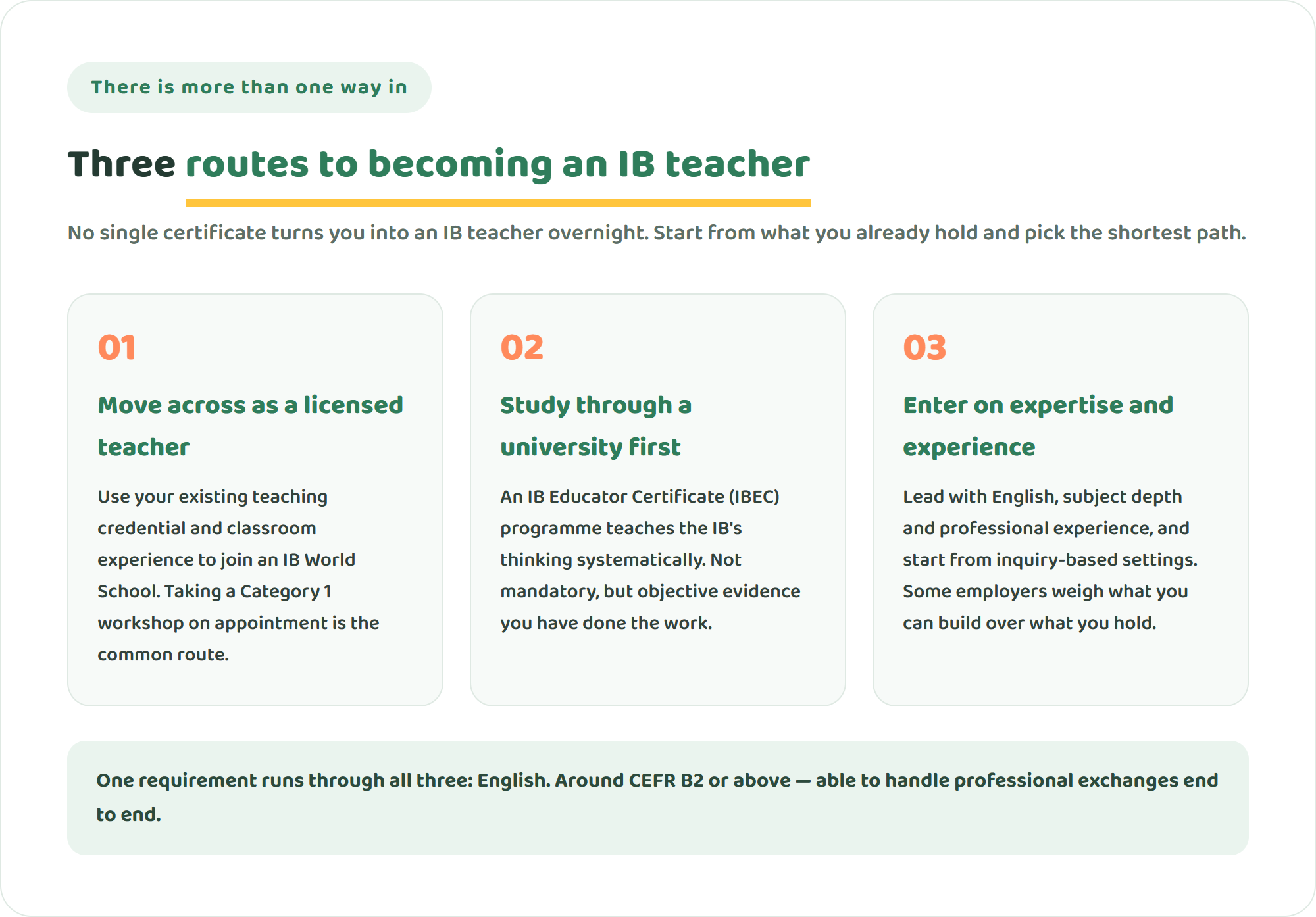
One requirement runs through all three: English. IB documentation, workshops and staffroom conversation are usually in English, and even in a subject taught in another language you will read and collaborate in it. Around CEFR B2 or above — able to handle professional exchanges end to end in English — is where options open up. If you are not there yet, it is a skill you build, and building it on the job is usually the fastest way.
Reading an IB teacher job posting — four things to check
When you reach the applications stage, four checks close the gap between the dream and the day job. First, which programme and what scope (PYP, MYP or DP; homeroom or subject specialist). Second, the language of instruction. Third, how professional development is handled — whether the school funds and schedules official workshops directly shapes how fast you grow. Fourth, employment terms and pay transparency: how much a posting says about salary, allowances and contract renewal tells you a great deal about the school itself.
For pay benchmarks, see our piece on international school teacher salary, and for the wider picture, how to become an international school teacher. Framing the IB as one route to deeper expertise — rather than the only destination — makes the whole career easier to plan.
One more angle worth adding: “collect the credentials first, then move” is not the only sequence. Inquiry- and project-based teaching can be practised, documented and evidenced outside an IB World School. See NIJIN GLOBAL ACADEMY’s founding member roles → — the selection process is published up front, and we say plainly that the international founding track begins as a volunteer role, so you can weigh it before you invest years in qualifications.
A third way of working — where what you can build matters more than what you hold
We are NIJIN GLOBAL ACADEMY (NGA), an online international school opening in September 2027, and we are hiring founding members. Honestly first: NGA is not an IB World School. We cannot award an IB Diploma, so if that is what you need, this is not your fit. Philosophically, though, we overlap deeply with inquiry- and project-based learning. We stand for education beyond deviation scores — no ranking children by test results — with small-group dialogue at the centre.
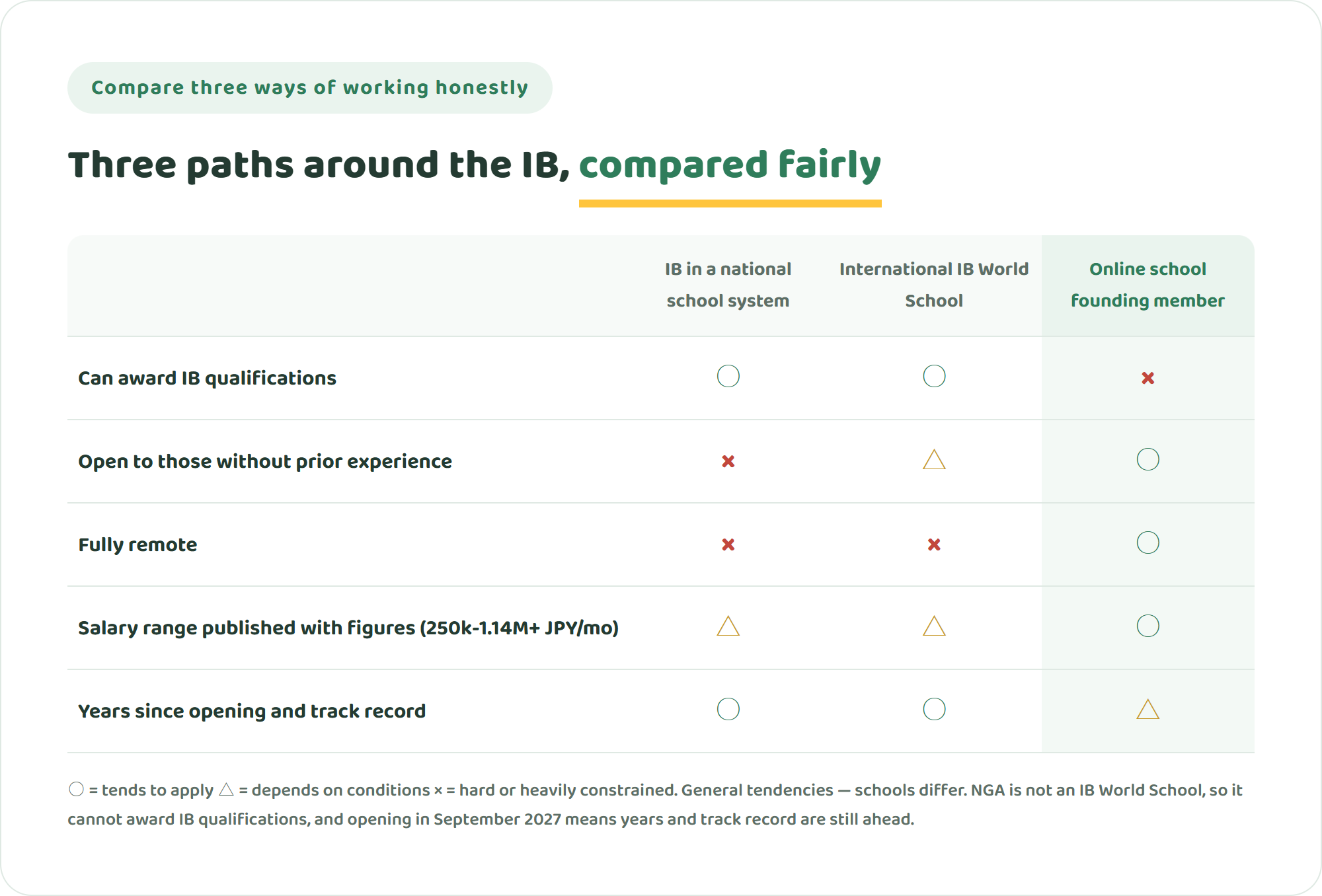
Three things NGA is built around. First, what we hire on: not the number of certificates you hold, but whether you can build from zero — curriculum and systems are still being made. English at around CEFR B2+ is the guide. Second, how the work runs: fully remote, designed around working while travelling the world. If you have wanted to see more of it with your own eyes, that may matter more than a credential. Third, the terms: founding roles on this track begin as volunteer positions ahead of our September 2027 opening, and the detailed terms are shared later in the process. Beyond teaching, you can take on marketing, web, partnerships or HR across five working models.
Preparing for an IB career — three steps you can start today
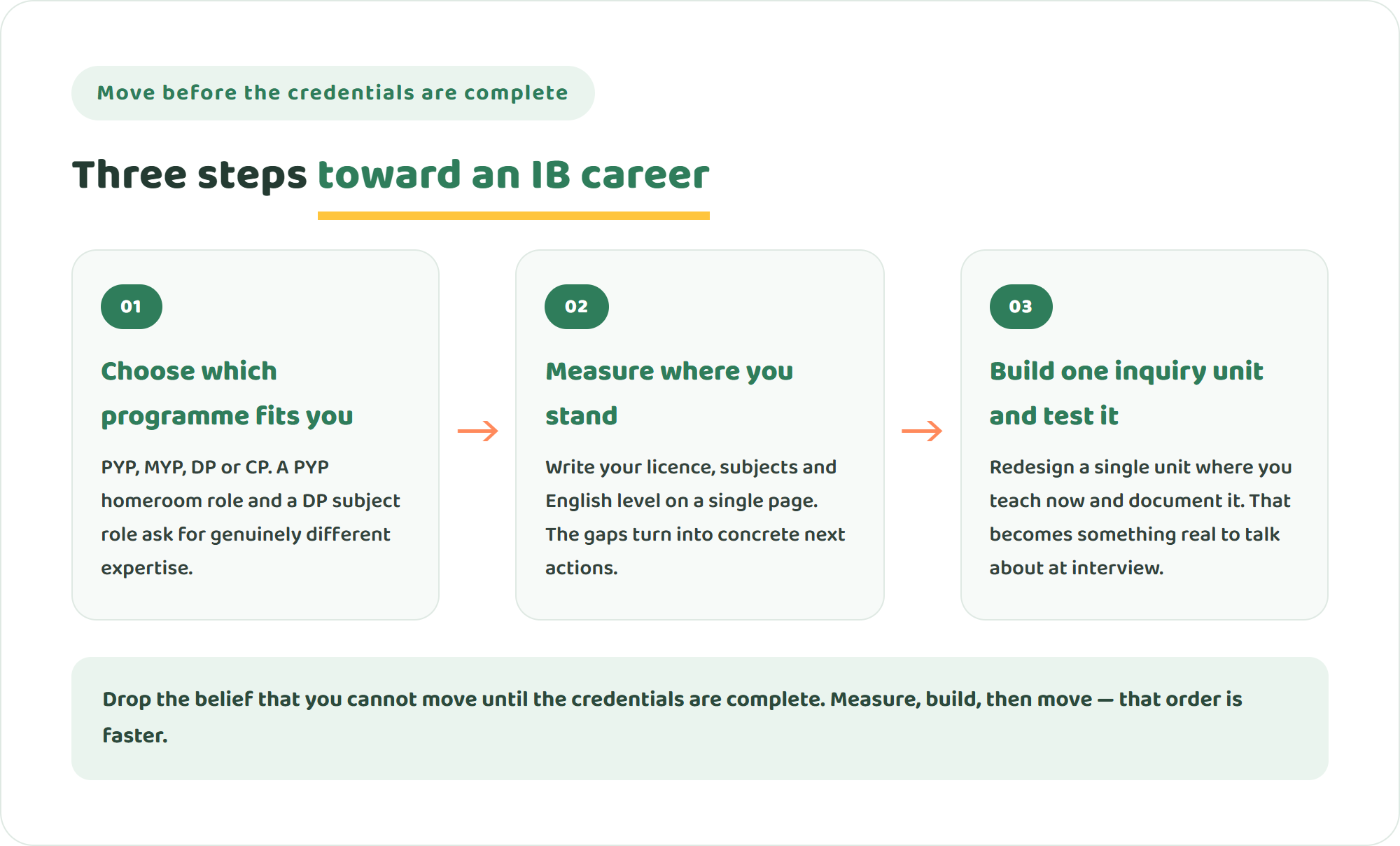
First, choose which of the four programmes fits you. A PYP homeroom role and a DP subject role demand different expertise. Second, measure where you stand — write your licence, subjects and English level on a single page and the gaps turn into concrete actions. Third, build one inquiry-based unit and test it small. Redesign a single unit where you teach now and document it; that becomes something you can genuinely talk about at interview.

FAQ
Can I become an IB teacher without a teaching licence?
It depends on the school. Most IB World Schools expect a recognised teaching qualification, and where an IB programme runs inside a national system the local licence is often effectively required. Requirements differ school by school, so check each posting directly. Outside IB World Schools, some international education employers weigh practical ability and the capacity to build above formal credentials.
Can I take IB workshops (Category 1, 2, 3) on my own?
Conditions vary by format and provider. Attending through a school is the common path, and availability changes by year and region, so confirm current terms via official IB information. The positioning of the three categories themselves stays consistent.
What is an IB teacher’s salary?
There is no single going rate. Programme, subject, experience, region and school policy all move the figure, and stating one number would be misleading. We cover this in more depth in our international school teacher salary article. For NGA, the international founding-member track begins as a volunteer role ahead of the 2027 opening, and detailed terms are shared later in the process.
You open in September 2027 — can I apply now?
Yes. What we are hiring for now is the founding team that builds the school. Selection runs from application to a group interview, an internship at NIJIN Academy, and a final presentation (applications via Google Form). With five working models from part-time to full-time, you can discuss staying in your current role while you get involved.
A credential is not the goal. It is how your teaching reaches a child.
If you searched “how to become an IB teacher,” you almost certainly want to give the children in front of you something better — and that wish arrived in the search box wearing the clothes of qualifications and licences. So keep the order straight. A credential is a means, not an end. Choosing the IB’s framework is one good answer. Carrying the spirit of inquiry into a school that does not exist yet and building it from nothing is another. Either way, what you have earned — reading how well a child understands, drawing real questions out of them — travels with you. Keep the passion for teaching; change only the way you work.
Working at an International School — More Articles
- international school teacher salary
- how to become an international school teacher
- career change from teaching
- career change from teaching in your 30s and 40s
- how much do teachers earn?
- jobs for moving abroad
- teach one class a week online
- online teaching jobs from home in India
- part-time online teaching jobs from home
- teaching jobs without a license
- careers with a teaching license
- qualifications to teach English
- junior high school teacher salary in Japan
- high school teacher salary in Japan
- school principal salary in Japan
- how the Japanese teacher pay scale works
- teacher bonuses in Japan
- private school teacher salary in Japan
Take your passion for teaching into a new way of working.