If you’re moving to Seoul — or already here and rethinking your child’s schooling — the list of international schools can feel both exciting and overwhelming. Which one actually fits your family? Can your child even enrol? And what will it really cost? This honest guide walks through seven of Seoul’s leading international schools, with their curricula, real fee ranges, admission rules, and the kind of family each one suits. By the end, you should know exactly what your next step is.
Quick Answer: Your Options in Seoul
If you only read one section, read this. Below are the schools covered in this guide, plus the online option — so you can see every route side by side before the details.
- Seoul Foreign School (SFS) — Ages: 2–18 (early years to Grade 12) / Fee guide: approx. KRW 28M–54M per year (about USD 20,000–39,000; billed as KRW + USD — see the 2026-27 table below)
- Seoul International School (SIS) — Ages: 3–18 / Fee guide: approx. KRW 28M–42M per year (about USD 20,000–30,000; billed as KRW + USD — see the 2026-27 table below)
- Yongsan International School of Seoul (YISS) — Ages: 5–18 / Fee guide: approx. KRW 33M–38M per year (about USD 24,000–28,000)
- Dwight School Seoul — Ages: 2–18 / Fee guide: approx. KRW 28M–36M per year (about USD 20,000–26,000)
- Chadwick International (Songdo) — Ages: 4–18 (PK–G12) / Fee guide: approx. KRW 52M–66M per year (about USD 38,000–48,000)
- Korea International School (KIS) — Ages: 3–18 / Fee guide: approx. KRW 34M–47M per year (about USD 25,000–34,000)
- Dulwich College Seoul — Ages: 3–18 / Fee guide: approx. KRW 43M–48M per year (about USD 31,000–35,000)
- NIJIN GLOBAL ACADEMY (online) — Ages 6–18 / opening September 2027, currently taking opening-update registrations / fees around one-fifth of a typical campus international school / Japanese-language support. An option when commute or fees are the wall.
International schools in Seoul: the landscape and the fees
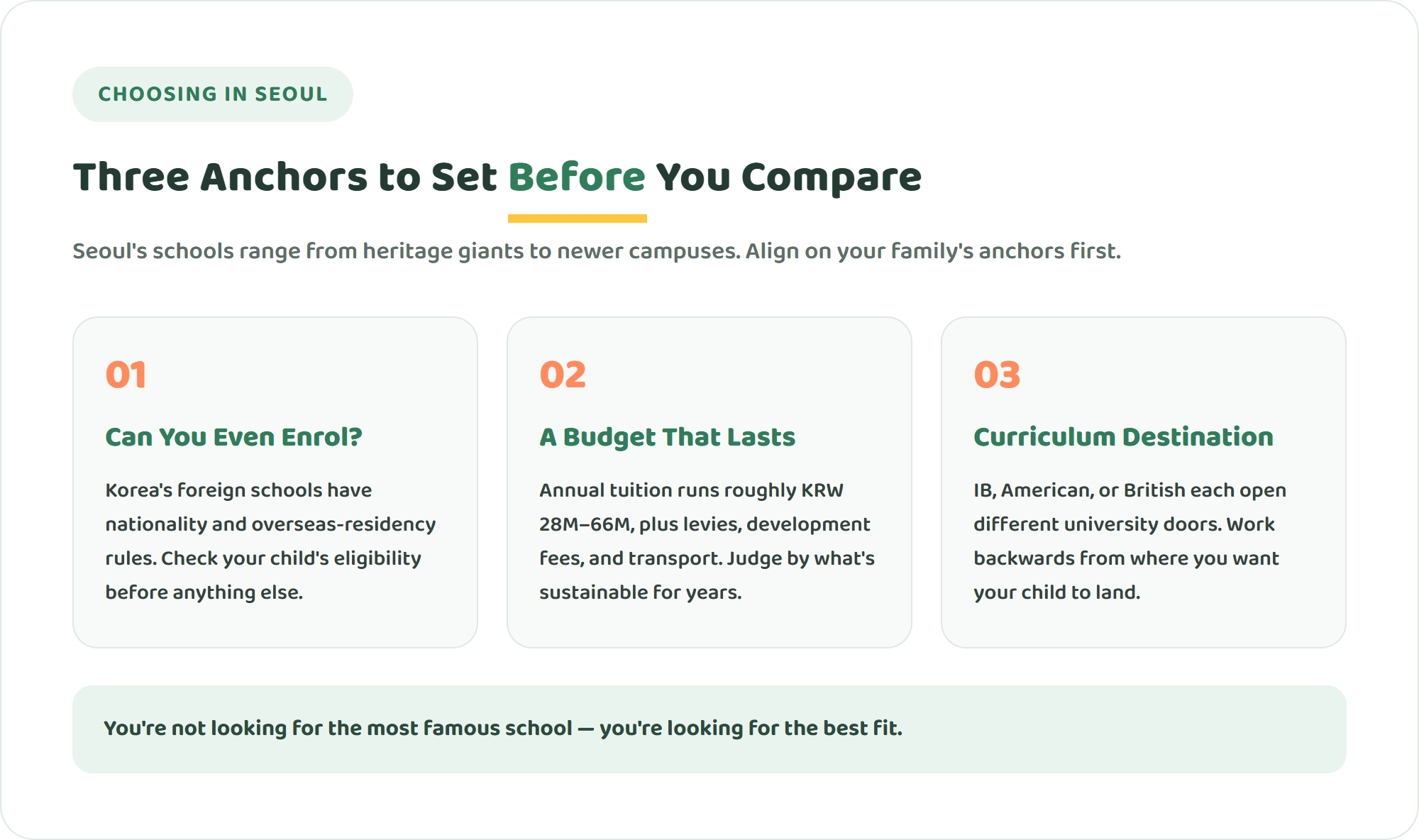
Greater Seoul — including Gyeonggi Province and Songdo in Incheon — is home to more than 40 international schools. They range from Seoul Foreign School, founded in 1912 and Korea’s oldest, to newer campuses offering the full International Baccalaureate continuum. Broadly, you’ll find three curriculum families: American (AP), British (IGCSE and A-Levels), and the globally portable IB. Each opens a different set of university doors, so the “destination” is worth thinking about early.
Fees vary widely: roughly KRW 28M to 66M per year (about USD 20,000 to 48,000). The heritage names sit at the top — Chadwick International in Songdo runs past KRW 50M — while options like Dwight School Seoul are comparatively gentler on the budget. On top of tuition, nearly every school adds registration, a capital or development fee, bus costs, and materials in the first year, so build those into your planning.
The most important — and most overlooked — factor in Seoul is eligibility. Korea’s “foreign schools” are, by law, established to serve foreign nationals. A Korean-citizen child generally qualifies only if they have lived or studied abroad for at least three years, or if at least one parent holds foreign nationality — and even then, Korean nationals are capped at a share of total enrolment (30% in most districts). This matters for two groups. For expat and diplomatic families, spots reserved for foreign passport-holders are the more accessible ones. For returnee (해외 거주 경험) families and mixed-nationality households, the three-year rule and quota decide whether a school is realistically open to you at all. Many locally raised Korean families who want an international education simply cannot enrol — a real constraint worth naming honestly.
For a deeper look at what drives the numbers, see our breakdown of international school tuition costs.
The 7 best international schools in Seoul
The seven schools below were chosen for a balance of reputation, curriculum variety, and price. This isn’t a ranking — read each one for the kind of family it fits.
1. Seoul Foreign School (SFS)
Founded in 1912 in Seodaemun-gu, SFS is Korea’s oldest international school and a perennial first name on any Seoul shortlist. Known for a strong British-and-IB offering and a leafy, spacious campus, it pairs deep heritage with a proven university-placement record.
- Curriculum: British (IGCSE) plus IB Diploma
- Ages: 2–18 (early years to Grade 12)
- Fee guide: approx. KRW 28M–54M per year (about USD 20,000–39,000; billed as KRW + USD — see the 2026-27 table below)
- Best for: families who value heritage, facilities, and a strong track record, with room in the budget.
2. Seoul International School (SIS)
An established American-curriculum school in Seongnam, just south of Seoul. Its AP programme and US-style college counselling make it a natural fit for families aiming at American universities.
- Curriculum: American (AP)
- Ages: 3–18
- Fee guide: approx. KRW 28M–42M per year (about USD 20,000–30,000; billed as KRW + USD — see the 2026-27 table below)
- Best for: families anchored to a US pathway and American-style academics.
3. Yongsan International School of Seoul (YISS)
A US-curriculum Christian school in central Yongsan, easy to reach from the city’s expat neighbourhoods. YISS is known for close-knit, values-based education and an engaged community.
- Curriculum: American (AP), Christian ethos
- Ages: 5–18
- Fee guide: approx. KRW 33M–38M per year (about USD 24,000–28,000)
- Best for: families wanting a central location and a faith- and community-centred environment.
4. Dwight School Seoul
Part of the global Dwight network founded in New York, located in Eunpyeong-gu. It offers the full IB continuum at a comparatively accessible price point, with a philosophy built around igniting each child’s “spark.”
- Curriculum: IB (PYP, MYP, DP)
- Ages: 2–18
- Fee guide: approx. KRW 28M–36M per year (about USD 20,000–26,000)
- Best for: families who want an IB education without the top-tier price tag.
5. Chadwick International (Songdo)
Located in the Songdo International Business District in Incheon, reachable from Seoul by train or bus, Chadwick delivers all four IB programmes (PYP, MYP, DP, CP) on a large, modern campus. It is among Korea’s most highly regarded schools — and its fees are the country’s highest.
- Curriculum: Full IB continuum
- Ages: 4–18 (PK–G12)
- Fee guide: approx. KRW 52M–66M per year (about USD 38,000–48,000)
- Best for: families in the Songdo area seeking top-tier IB facilities and programming.
6. Korea International School (KIS)
A large American-curriculum school with its main campus in Pangyo, Gyeonggi, plus a Seoul campus. KIS is known for its strength in technology and STEM, a lively student culture, and a wide co-curricular programme.
- Curriculum: American (AP)
- Ages: 3–18
- Fee guide: approx. KRW 34M–47M per year (about USD 25,000–34,000)
- Best for: families in the Pangyo / southern-Seoul area wanting a dynamic US-style school.
7. Dulwich College Seoul
A member of the global network of the storied Dulwich College, set in Mapo-gu in western Seoul. It centres on a British curriculum (IGCSE and A-Levels) with IB pathway options, appealing to families oriented toward a UK-style education.
- Curriculum: British (IGCSE, A-Levels) plus IB
- Ages: 3–18
- Fee guide: approx. KRW 43M–48M per year (about USD 31,000–35,000)
- Best for: families drawn to a traditional British education and UK university routes.
Please note: fees and details reflect publicly available information as of July 2026. Tuition is revised annually, and admission criteria and enrolment caps change by school and year. Always confirm the latest figures on each school’s official website.
Seoul Foreign School and Seoul International School tuition 2026-27 (official fees)
Both schools bill tuition in two parts — a Korean won portion plus a U.S. dollar portion — so any single “per year” figure you see quoted online is a conversion. Below are the official 2026-27 figures as each school publishes them (checked October 2026). Add the two columns together at the exchange rate you are quoted to get your real annual cost.
Seoul Foreign School (SFS) tuition 2026-27
| Grade | KRW portion | USD portion |
|---|---|---|
| Pre-K 2 & 3 (partial day) | ₩18,280,000 | $7,185 |
| Pre-K 2 (full day) | ₩26,990,000 | $8,625 |
| Pre-K 3 & 4 (full day) | ₩26,740,000 | $12,960 |
| K – Grade 5 | ₩27,285,000 | $13,500 |
| British School Foundation (full day) | ₩26,740,000 | $12,960 |
| British School Years 1–6 | ₩27,285,000 | $13,500 |
| Grades 6–8 | ₩27,930,000 | $14,625 |
| Grades 9–12 | ₩33,370,000 | $14,955 |
One-time fees for new students: application ₩450,000, registration ₩650,000 and an entrance fee of ₩5,500,000 (all non-refundable). Round-trip bus is ₩4,200,000 a year, and Grade 12 adds a ₩450,000 senior fee. The 2026-27 school year runs from 10 August 2026 to 11 June 2027. Source: Seoul Foreign School, Tuition and Fees.
Seoul International School (SIS) tuition 2026-27
| Grade | KRW portion | USD portion |
|---|---|---|
| PK3 | ₩18,880,000 | $6,720 |
| JK and SK | ₩22,620,000 | $8,040 |
| Grades 1–5 | ₩22,880,000 | $8,140 |
| Grades 6–8 | ₩24,850,000 | $8,840 |
| Grades 9–12 | ₩27,840,000 | $9,900 |
New students pay a ₩500,000 application fee and a ₩4,000,000 initial registration fee, due within seven days of acceptance (both non-refundable). The bus is optional at ₩3,000,000 a year, and there is a refundable book deposit of ₩150,000–250,000 depending on grade. SIS is in Seongnam, just south of Seoul — factor the commute in. Source: Seoul International School, Tuition and Fees.
What it adds up to: at roughly ₩1,400 to the dollar, a Grade 9–12 place costs about ₩54 million a year at SFS (₩33.37M + $14,955) and about ₩42 million at SIS (₩27.84M + $9,900) — before the one-time entrance or registration fee and the bus. That gap of around ₩12 million a year is the honest headline when families compare the two.
How to compare and find the right fit for your family
Even with seven schools side by side, the honest question remains: which one is right for us? It helps to see schools as three types — premium heritage schools, mid-tier and newer campuses, and online international schools — and then narrow by what your family values most: affordability, ease of admission, commute, on-site facilities, and home-language support. Rank those, and the answer starts to reveal itself.
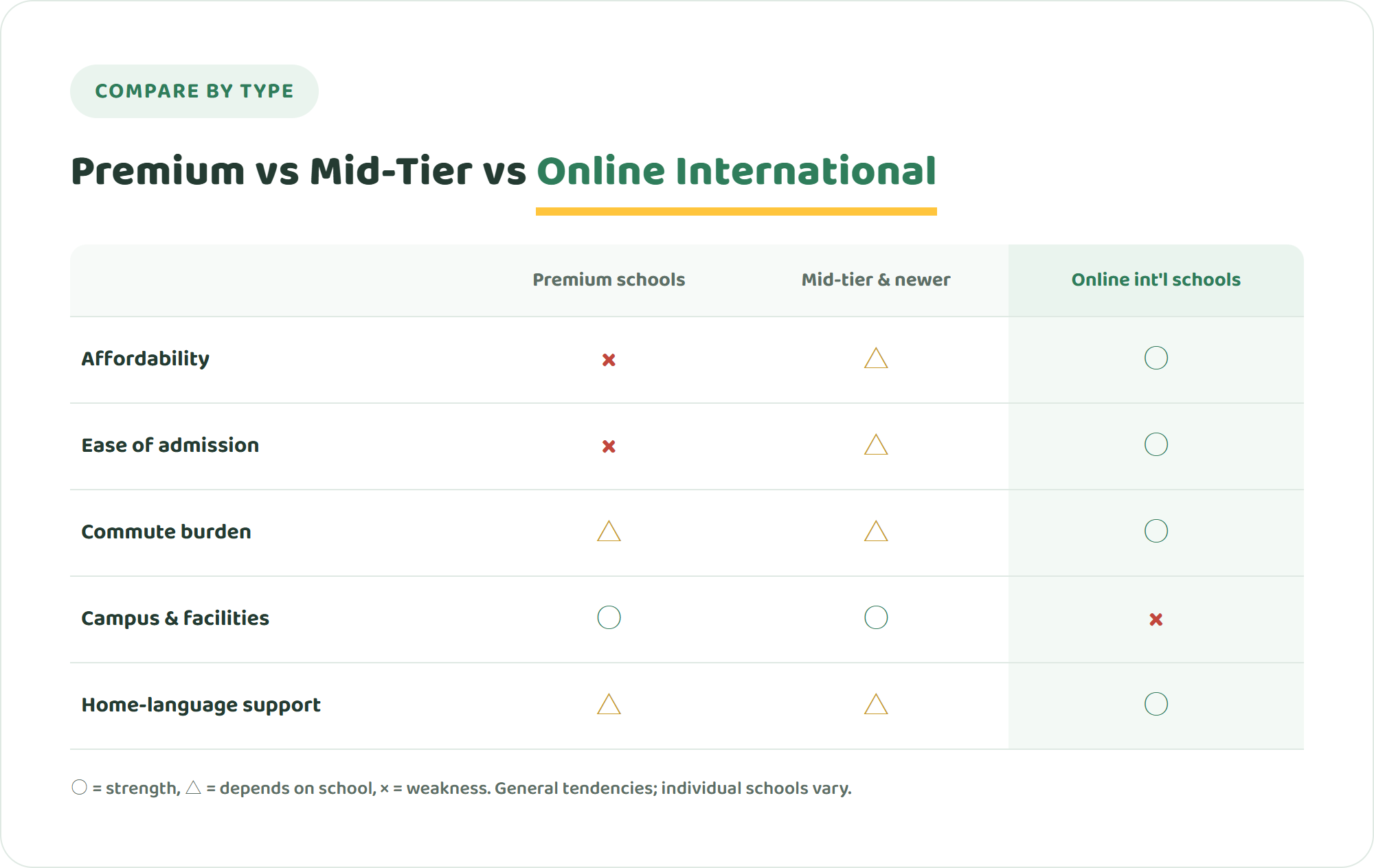
A campus-based international school offers real value — playing fields, facilities, and the irreplaceable experience of being with peers in person. For some families, though, fees or eligibility rules are genuine barriers. If you’d like to start by understanding the learning itself, see how learning works online →.

When fees or the commute are the barrier: an eighth option, online
After reading through seven schools, you may be thinking “I’m not sure we can sustain these fees,” or “we don’t meet the foreign-school eligibility rules,” or “there’s no school within a realistic commute.” Those feelings are completely understandable — and families in exactly that position are who the eighth option, online, is for.
NIJIN GLOBAL ACADEMY (NGA) is an online international school scheduled to open in September 2027. It’s run by NIJIN Inc. in Japan, whose alternative school “NIJIN Academy” already enrols more than 1,000 students.
NGA is built around learning beyond test scores and rankings, with small-group, dialogue-centred classes and a guiding idea: to help children “come to love themselves and the world.” It’s designed for ages 6–18 across Asia and Oceania, and because it’s location-independent, it isn’t bound by Korea’s foreign-school eligibility rules or by how far you live from a campus. Lessons are designed so children can ease into English with their home language as a support — reassuring for families not ready to jump straight into an all-English setting. The goal is tuition around one-fifth of a campus-based international school.
In the interest of honesty: NGA hasn’t opened yet, so there’s no graduate track record to point to — that’s still to come. And an online school can’t replicate everything about a physical campus, from the sports field to the in-person atmosphere. But for families who need it, we want to offer a clear promise: you shouldn’t have to give up on a global education because of a rule, a fee, or a distance.
Frequently asked questions
Q. From what age can my child start?
A. Many campus schools in Seoul admit from ages 2–5 in early-years classes (this varies by school). NGA is for ages 6–18. Whether you want an English environment from the earliest years, or are considering an online option from primary age onward, will shape which schools to look at.
Q. Can returnee or Korean-national children enrol?
A. For Korean-citizen children, foreign schools generally require three or more years of overseas residence or schooling, or a foreign-national parent, and there’s a cap on the share of Korean nationals enrolled. If you don’t meet the criteria, admission may not be possible — always confirm with the school and the relevant education office. Online, NGA is not bound by these nationality requirements.
Q. Is there home-language or transition support?
A. Campus international schools teach mainly in English (or English plus Korean), and structured home-language support varies widely. NGA is designed with home-language support built in, making it easier for families who want to move into English gradually rather than all at once.
Not just “a school you can get into” — a place your child can grow
Seoul has genuinely excellent international schools. It also has real barriers — fees, and eligibility rules that don’t bend for every family. The goal isn’t to settle for whichever school you can technically get into, but to choose, together as a family, an environment where your child can learn as themselves. In that set of choices, a campus and an online school can stand as equals. There’s no need to rush. Whatever your next step, we’re cheering you on.
International Schools in Other Cities
- International Schools in Fukuoka: Fees
- International Schools in Ho Chi Minh City
- International Schools in Melbourne
- International Schools in Nagoya: All 8 Schools
- International Schools in Minato: Fees
- International Schools in Setagaya: All 14 Schools
- International Schools in Taipei
- International Schools in Shanghai
- International Schools in Tokyo
- International Schools in Osaka
- International Schools in Singapore