If you have searched for the disadvantages of early English education, you have probably run into two confident and completely contradictory answers. One says the window closes early and every month you wait is a month lost. The other says early exposure confuses children, damages the mother tongue, and produces a child who is fluent in nothing. Both are usually delivered without a single citation.
Here is the honest version. There is no research consensus that starting English early harms children. What does cause harm is well documented, and it has nothing to do with the birthday on the calendar: harm appears when the home language gets displaced, and when a child accumulates hours of exposure without any real reason to use the language. This article goes through what the studies actually found — with the sources linked so you can check them — and then hands you the practical line you can draw at home.
Quick Answer: What the Research Actually Says
- “Earlier is always better” does not hold in classroom settings. A large Spanish project tracking around 2,000 learners found that after the same number of instructed hours, later starters outperformed earlier starters.
- But there is no cliff either. A statistical reanalysis of the datasets used to support the critical period hypothesis concluded that age patterns in second language acquisition are not governed by a critical period.
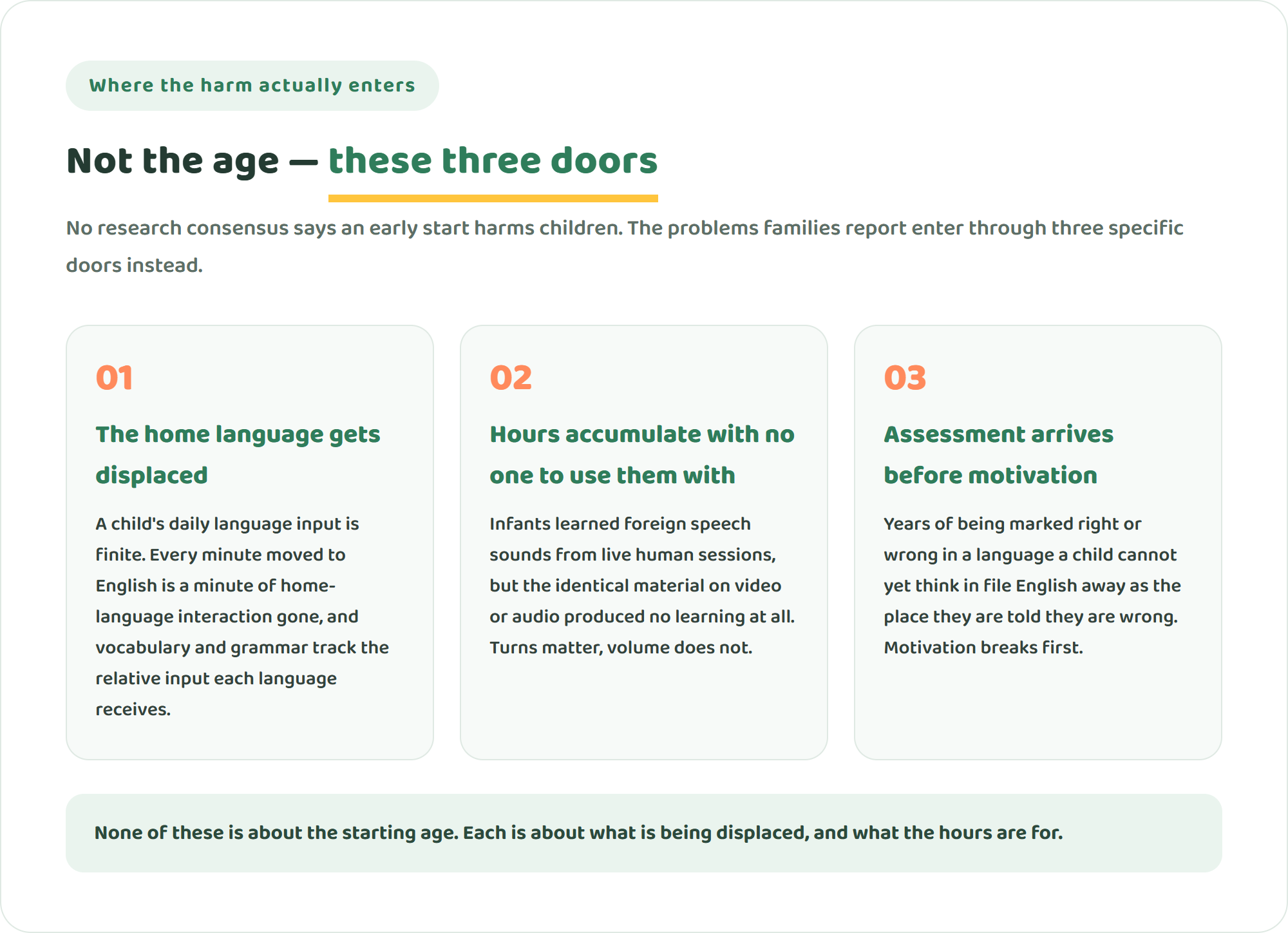
- The first real risk is displacement of the home language. A child’s daily language input is finite; vocabulary and grammar in each language track the relative amount of input received in that language.
- The second real risk is exposure with no interaction. Infants learned foreign speech sounds from live human contact, but the identical material delivered by video or audio produced no learning at all.
- Mixing two languages in one sentence is normal, not a symptom. Code-mixing is treated in the literature as an ordinary part of being bilingual.
- “Semilingualism” has been abandoned as a scientific concept. The thing genuinely worth protecting is not a word count — it is the child’s ability to talk about difficult things with the people who raise them.

What actually goes wrong — and what does not
Let us be honest first, because families do report real problems. They are simply not caused by the starting age. Three patterns come up again and again.
One: the family’s conversation gets replaced rather than extended. If thirty minutes a day moves from talking with your child in the home language to drilling English, those thirty minutes of home-language interaction are physically gone. In a study of bilingually developing toddlers, every measure of vocabulary and grammar was related to the relative amount of input the child received in that language (Hoff et al., Journal of Child Language, 2012). Notably, the same study found that when both languages were counted together, bilingual and monolingual children’s total vocabulary was virtually identical. Nothing was lost overall — it was distributed differently. Allocation, not damage, is the real issue.
Two: the child stops liking English. This one rarely appears in journals, but it is the most common outcome families regret. When a young child spends years being marked right or wrong in a language they cannot yet think in, English becomes filed as the place where they are told they are wrong. The heaviest disadvantage of early English education is not academic. It is motivational, and it arrives first.
Three: the same study gets quoted in both directions. Marketing uses age research to sell urgency; anxious articles use it to sell fear. Both go well past what the data supports. So below, each claim is separated from the next.
The research on age: neither “earlier is always better” nor “early is harmful”
The critical period is not a cliff. The idea that a window slams shut at a certain age comes from the critical period hypothesis. A reanalysis of the datasets used to support it found that scores decline at essentially the same rate on either side of the proposed cut-off, and concluded that age patterns in second language acquisition are not governed by a critical period (Vanhove, PLOS ONE, 2013). Early starters in long-term immersion do tend to end up ahead — but that is an argument about years of immersion, not about a deadline.
In school settings, later starters actually move faster. The Barcelona Age Factor project followed roughly 2,000 learners who began a foreign language at ages 4, 8, 11, 14 and 18+. After a comparable number of instructional hours, the late starters outperformed the younger starters, because older learners can use explicit reasoning that four-year-olds cannot. Where exposure is limited to a few hours a week, buying an early start buys very little. That is why “early English is pointless” keeps circulating — in that specific format, the scepticism is well founded.
So when does starting early pay off? When there is a human being on the other side. In a well-known experiment, nine-month-old infants were exposed to Mandarin. Live sessions with a person preserved the infants’ ability to hear the foreign contrasts, while the identical material delivered by television or audio produced no effect (Kuhl, Tsao and Liu, PNAS, 2003).
The finding generalises. Analysing home recordings of four- to six-year-olds, researchers found that the number of back-and-forth conversational turns — not the number of adult words — predicted language scores and language-related brain activity (Romeo et al., Psychological Science, 2018). Language grows on turns, not on volume. If you remember one line from this article, make it that one. For the wider question of protecting a first language while adding a second, see raising a bilingual child without losing the mother tongue.
Mixing, “semilingualism,” and what is genuinely worth worrying about
The single most common worry parents raise is that their child mixes the two languages in one sentence. This one can be answered cleanly. Mixing is not a malfunction. A research summary written for parents describes code-mixing as a normal part of being bilingual and of interacting with other bilingual speakers (Byers-Heinlein and Lew-Williams, LEARNing Landscapes, 2013). A child who mixes has two systems available to mix. A child with neither cannot mix at all.
On delay, the clinical position is equally clear. The American Speech-Language-Hearing Association states that the ability to learn and use language does not appear to be negatively affected by learning more than one language, and that recommending monolingualism for multilingual children showing delay is neither necessary nor beneficial. Dropping English because a child seems slow is not the standard advice. If you have genuine concerns, take them to a speech-language professional rather than to a forum.
And what about the fear underneath all of this — the child who ends up “half in both languages”? Here the honest answer is uncomfortable for both camps. Semilingualism, as a scientific concept, has been discarded. A review of the evidence claimed to support it found that evidence to be either spurious or irrelevant, and argued that the notion should be abandoned on empirical, theoretical and moral grounds (MacSwan, Hispanic Journal of Behavioral Sciences, 2000). Its core problem is that it dressed a value judgement about how minority-language speakers talk in scientific clothing. More myths of this family are unpacked in the disadvantages of raising a bilingual child, myth by myth.
That said, discarding the label does not mean nothing can go wrong. Something can, and it is more specific than the label ever was. A national survey of language-minority families in the United States found that children who began learning the majority language before school often lost the home language, and that losing a primary language spoken by the parents is very costly to children and families (Wong Fillmore, Early Childhood Research Quarterly, 1991). The loss that matters is not vocabulary. It is the ability to say something difficult to the person who is raising you. Two or three English hours a week in a home where the family language is spoken all day does not create that. Relocating, switching the home language, or moving into full immersion can.
Where to draw the line at home
Four lines are more useful than any age recommendation.
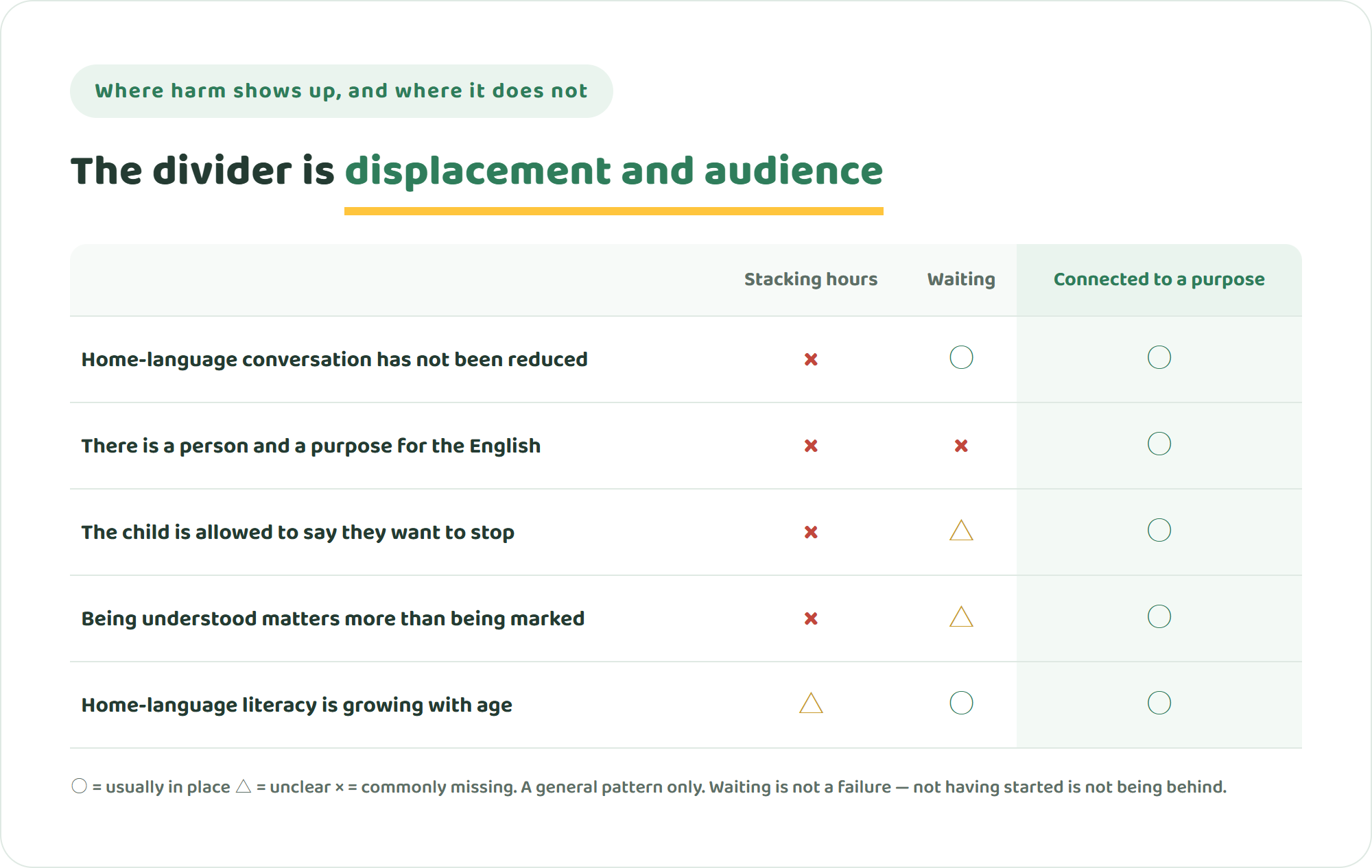
Line 1: count the home-language turns before adding anything. For one week, note how many minutes a day you and your child spend in genuine back-and-forth conversation in the home language. Instructions and reminders do not count. If adding English makes that number fall, you are not adding — you are substituting. If it does not fall, the classic disadvantages of early English education mostly do not apply to you.
Line 2: give the English an audience. Following the Kuhl findings, twenty minutes twice a week with a person who answers beats an hour a day of video. Ask who the child is speaking to, not how many hours they logged.
Line 3: write the advantages and the disadvantages on the same page. The advantages of early exposure are real: comfort with unfamiliar sounds, low anxiety about foreign languages, and the memory that English is something enjoyable. The disadvantages are cost, displaced home-language time, and the risk of burning out motivation years before it is needed. Deciding from one column only guarantees a correction later.
Line 4: agree the exit signal before you start. “Three consecutive weeks of not wanting to go and we pause.” Families who set that in advance rarely overshoot. If you are also weighing a full international education, the honest pros and cons of international school covers the same trade-off at a larger scale.
One reassuring fact for families in Japan: under the national curriculum, foreign language activities begin in grade 3 at 35 hours a year, and English becomes a graded subject in grades 5 and 6 at 70 hours a year, fully implemented from the 2020 school year (MEXT, national Course of Study). Not having started before school is not being behind.
See how learning works online →

A third option: design for necessity, not for speed
Put the evidence together and the design brief is short: do not displace the home language, and make sure the second language has someone to be used with. Most available options fail one of the two. Full immersion buys the audience by spending the home language. A weekly class protects the home language but never creates a reason to speak.
NIJIN GLOBAL ACADEMY (NGA) is being designed for exactly that gap, opening in September 2027. It is an online international school that does not rank children by test scores, built around small-group dialogue that starts with “what do you think?” rather than with a correct answer. English is treated as something you reach for because there is someone to reach, not as a quantity to accumulate. It is for 6- to 18-year-olds across Asia and Oceania, designed so that the home language stays supported while English is added gradually. Fees are targeted at around one-fifth of a campus international school. It is operated by NIJIN Inc., whose alternative school in Japan, NIJIN Academy, enrols over 900 students.
Honestly: we have not opened yet, so there are no outcomes to show you. Online will never reproduce a playground. A pre-opening period of trial classes is planned for April and May 2027, which is the sensible place to find out whether it fits your child. We are not here to tell you to start early. We would only ask that if you start, you start with a listener attached.
Three things to do this week
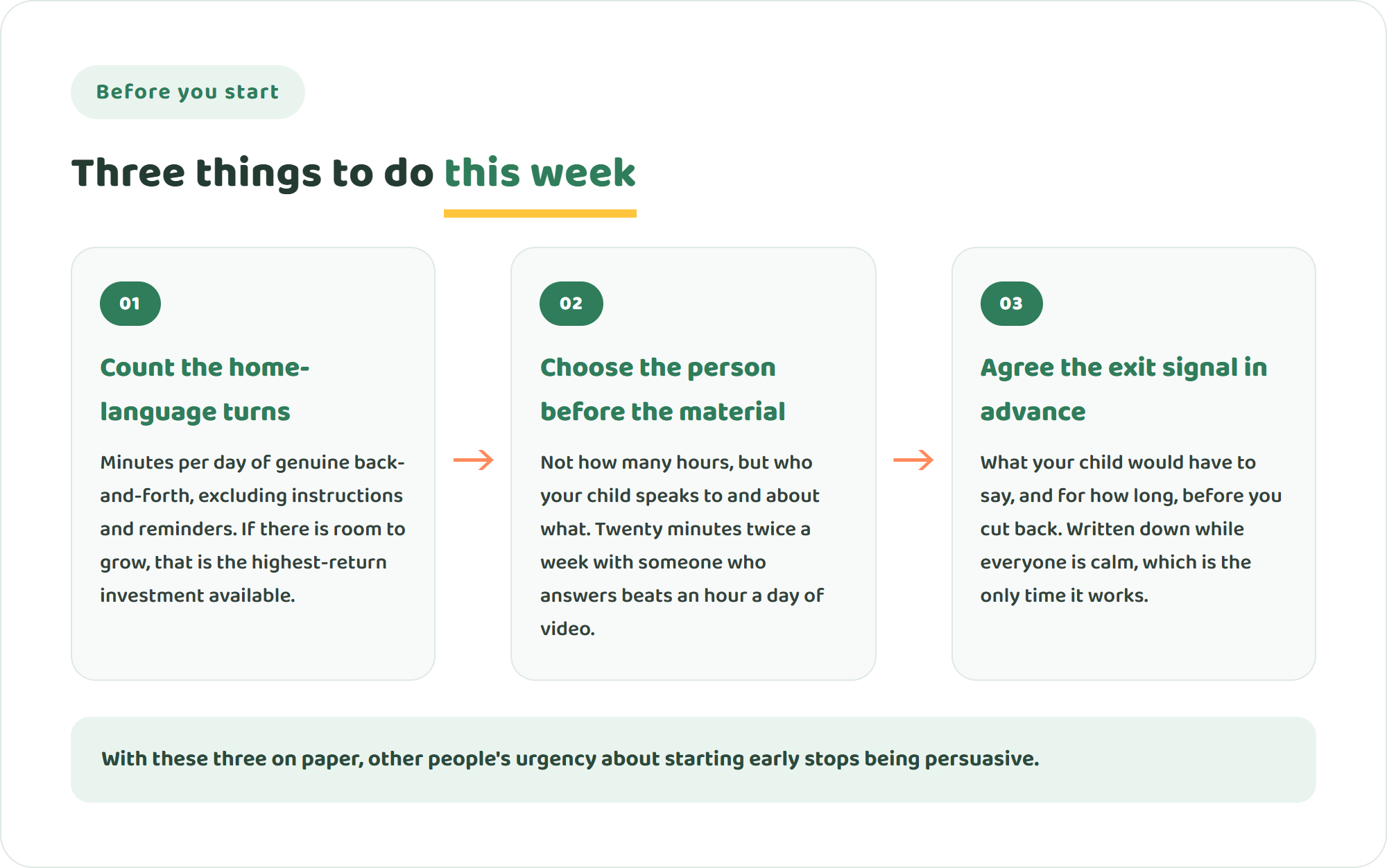
1. Count the turns. Minutes per day of real back-and-forth in the home language. If there is room to grow, that is the highest-return investment available to you. 2. Choose the person before the material. Who will your child speak to, and about what. 3. Agree the exit signal. Decided while everyone is calm, which is the only time it works.
Frequently asked questions
Does early English education actually harm children?
Not by virtue of being early. The harms that do occur are displacement of home-language interaction and loss of motivation from years of early assessment. Both are consequences of how the exposure is arranged, not of the child’s age when it began.
Is early English education pointless?
If “early English” means a short weekly class, the scepticism has evidence behind it: after equal instructional hours, later starters have been found to progress faster. If it means regular interaction with a person who responds, the picture is different and the effects are real. What is pointless is exposure without turns.
What are the advantages and disadvantages of starting early?
Advantages: ease with unfamiliar sounds, low anxiety about foreign languages, and an early memory of English as something enjoyable. Disadvantages: cost, reduced home-language time, and the risk of exhausting motivation long before it matters. List both before deciding.
My child mixes English and the home language in one sentence. Is that a problem?
No. Code-mixing is described in the research literature as a normal feature of bilingual speech. What deserves attention is not mixing but conversations that stay short in both languages — and the response to that is more interaction, not fewer languages.
Should we stop English if the home language seems delayed?
Professional guidance says recommending a single language for a multilingual child showing delay is neither necessary nor beneficial. Reduce one-way exposure rather than the number of languages, and if the concern persists, consult a speech-language professional rather than deciding alone.
So what age should we start?
No study gives a single number. Judge by two conditions instead: home-language conversation has not been reduced, and there is a real person your child uses English with. If both hold, early is fine. If neither holds, waiting costs you far less than the internet suggests.
If nothing is being taken away, early is not something to fear.
Searching for the disadvantages of early English education does not make you an anxious parent. It means you wanted to check that the hours in front of your child are worth what they cost. Asking that question is itself the strongest protection against the harms this article describes.
Children who start early flourish, and so do children who start late. The variable is not the age. It is whether the child has something to say and someone who will answer. Language grows on the number of times a child has been understood — not on the number of hours logged. This week, the highest-value thing you can do may not be adding another English resource. It may be five minutes of real conversation after dinner, in whatever language your family already loves each other in.
NGA opens in September 2027, with trial classes planned for April and May 2027. We send occasional updates on how small-group dialogue works online and on enrolment for the first cohort.
Honest Answers to Your Worries — related reading
- Will My Child Lose Their Mother Tongue?
- The Honest Pros and Cons of International School
- Disadvantages of Bilingualism in Childhood: Myths vs Research
- Who Regrets International School — and Who Doesn’t
- International School Special Needs: What to Look For
- International School vs Local School: How to Decide
- Does International School Hurt Your Child’s Home Language?
- When Your Child Is Struggling at International School
- Do International Schools Make Children Fluent in English?
- Is International School Worth It? What Happens to Graduates
- Should I Send My Child to International School?
- Transfer From a Local School to an International School
- What Happens to International School Graduates