If you’re relocating to Shanghai — or already here and quietly wondering whether your child is in the right school — the options can feel both abundant and confusing. Shanghai has one of Asia’s deepest international school markets, and it also has a rule that catches many families off guard: some schools are legally open only to children holding a foreign passport. This honest guide walks through seven international schools in Shanghai worth shortlisting, with curricula, real fee ranges in RMB, the eligibility rules that decide where you can even apply, and the kind of family each school suits. By the end, you should know exactly what your next step is.
Quick Answer: Your Options in Shanghai
If you only read one section, read this. Below are the schools covered in this guide, plus the online option — so you can see every route side by side before the details.
- Shanghai American School (SAS) — Ages: Pre-K to Grade 12 / Fee guide: approx. RMB 246,000–311,000 per year (about USD 36,000–46,000), plus…
- Concordia International School Shanghai — Ages: Preschool to Grade 12 / Fee guide: approx. RMB 250,000–330,000 per year (about USD 37,000–49,000); application…
- Dulwich College Shanghai Pudong — Ages: 2–18 / Fee guide: approx. RMB 282,000–411,750 per year (about USD 41,000–61,000)
- Shanghai Community International School (SCIS) — Ages: 2–18 / Fee guide: approx. RMB 152,500–335,500 per year (about USD 22,000–49,000), depending on…
- Yew Chung International School of Shanghai (YCIS) — Ages: 2–18 / Fee guide: approx. RMB 244,000–366,000 per year (about USD 36,000–54,000)
- Western International School of Shanghai (WISS) — Ages: early years to 18 / Fee guide: approx. RMB 162,000–277,000 per year (about USD 24,000–41,000)
- Shanghai Livingston American School (SLAS) — Ages: early years to 18 / Fee guide: approx. RMB 140,500–233,000 per year (about USD 21,000–34,000); application…
- NIJIN GLOBAL ACADEMY (online) — Ages 6–18 / opening September 2027, currently taking opening-update registrations / fees around one-fifth of a typical campus international school / Japanese-language support. An option when commute or fees are the wall.
New to this? Start with What is an international school? Types, fees, admission and how to choose for the full picture.
Can’t justify Shanghai international school fees?
Families in Shanghai often face the same wall: the school is right, the fee is not. NIJIN GLOBAL ACADEMY is an online international school with no campus — and no campus fees. Live, small-group lessons in English, at roughly one-fifth the cost of an in-person international school. It is built for children who are not yet fluent in English, so you do not need an English-speaking household to start.
🎁 Register and we will email you the school prospectus (English & Japanese) straight away — plus tuition and trial-class details before anyone else.
Free to join. Unsubscribe any time.
International schools in Shanghai: the landscape and the fees
Shanghai’s official directory of schools for children of foreign personnel runs to roughly 45 entries once kindergartens and supplementary centres are counted (source: the directory published by the Shanghai municipal authorities). American, British and IB schools sit alongside German, French, Singaporean and Japanese national-curriculum schools. Few cities in Asia offer this much variety — which is exactly why families need a filter before they start comparing.
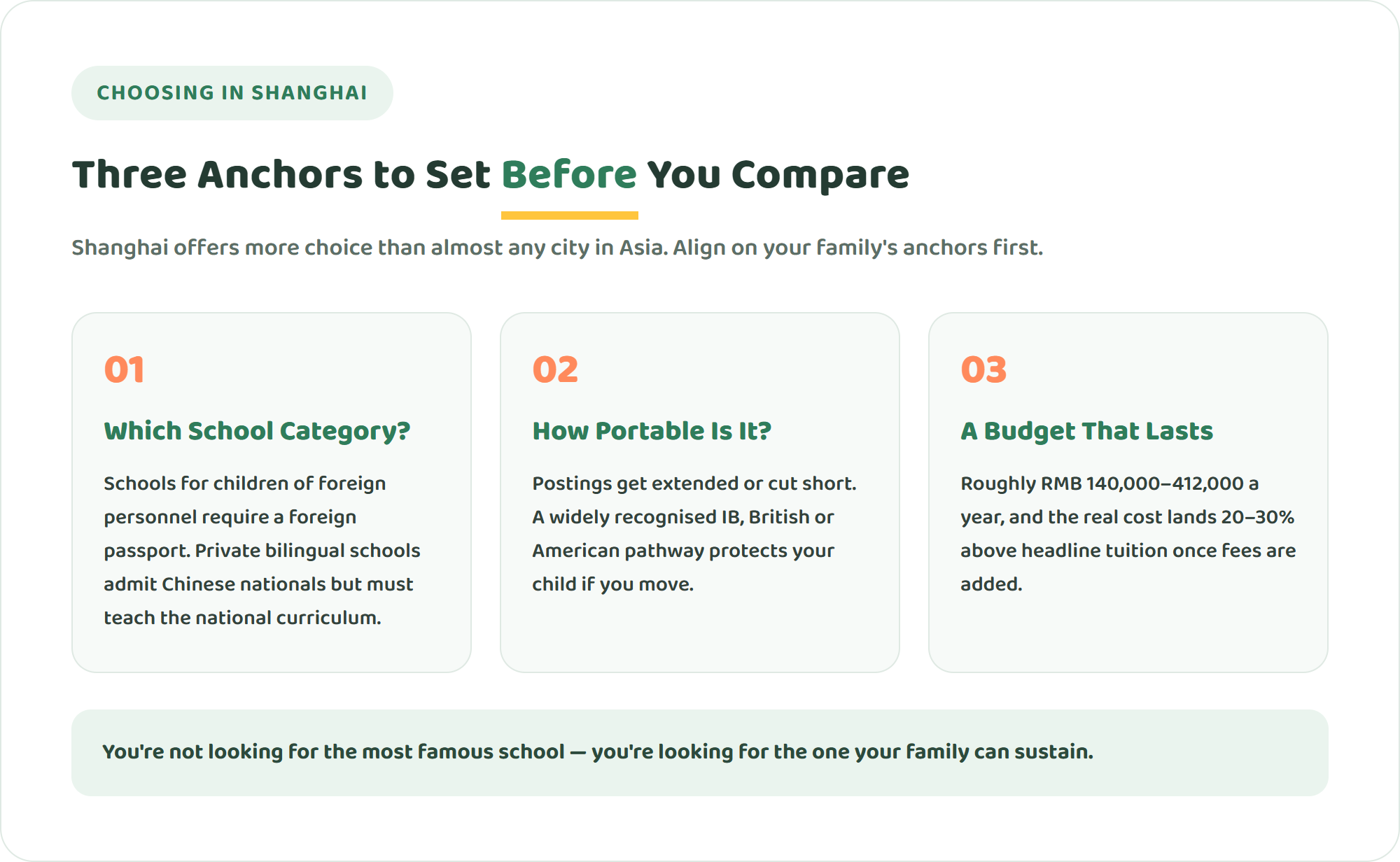
That filter is school category, and in China it is a legal distinction rather than a marketing one. There are two broad types:
- Schools for children of foreign personnel (外籍人员子女学校): established specifically for the children of foreign nationals legally residing in China. Shanghai American School, Dulwich, SCIS and most of the names expats recognise sit in this group. As a rule, children holding only PRC nationality cannot enrol; a foreign passport plus the parent’s work and residence documentation is the normal precondition. Additional recognised categories exist — children born overseas to PRC citizens, and children of Hong Kong, Macau or Taiwan residents — each with its own paperwork.
- Private bilingual schools (民办学校): open to Chinese nationals as well as foreign families. In exchange, they must deliver the Chinese national curriculum through the compulsory-education years, layering IB, IGCSE or A-Level pathways in more fully at upper secondary. For families planning a long stay in China — or wanting genuine Mandarin fluency — these are worth serious consideration.
So the correct order of operations in Shanghai is: confirm which category your child is eligible for, then compare schools within it. Eligibility is verified administratively, not negotiated with the school, so check both the school’s admissions office and the Shanghai municipal service portal before you fall in love with a campus.
On fees, the honest range across reputable schools is roughly RMB 140,000 to RMB 412,000 per year (roughly USD 21,000–61,000 — rounded figures, converted at approximately RMB 6.8 to the dollar as of July 2026). Shanghai Livingston American School starts in the RMB 140,000s; senior years at Dulwich College Shanghai Pudong reach the RMB 410,000s. So “Shanghai international schools are expensive” is true only at the top of the market. Budget separately for an application fee (RMB 2,500–3,800), a first-year capital or entry fee (RMB 8,000–33,000), school bus (around RMB 9,000 per semester), and technology or materials charges. A useful planning rule: the real annual cost tends to land 20–30% above the headline tuition.
If you want to understand what actually drives those numbers before you compare schools, see our breakdown of international school tuition costs. And if the totals above made you pause, you’re not alone — we’ve written honestly about that too in is an international school too expensive?
One more Shanghai-specific factor: assignment length. Many families arrive on a three-year posting that becomes five, or ends after eighteen months with a move to Singapore or back home. That uncertainty should shape your choice as much as curriculum does. A widely portable programme — IB, or a well-recognised British or American pathway — protects your child if the next move comes sooner than expected.
The 7 best international schools in Shanghai
The seven schools below were chosen for a balance of reputation, curriculum variety and price — from the most affordable in the group to the most premium. This isn’t a ranking. Read each entry for the kind of family it fits. Fees are annual ranges drawn from official school schedules or established fee databases.
1. Shanghai American School (SAS)
With roots going back to 1912 and campuses in both Puxi (Minhang) and Pudong, SAS is the anchor name in Shanghai’s American-curriculum sector. It offers Advanced Placement and the IB Diploma side by side, giving students access to both US and global university pathways, and its scale shows in facilities, counselling and co-curricular depth.
- Curriculum: American (AP) plus IB Diploma
- Ages: Pre-K to Grade 12
- Fee guide: approx. RMB 246,000–311,000 per year (about USD 36,000–46,000), plus application and entry fees
- Best for: families wanting a large, well-resourced school with both AP and IB routes open.
2. Concordia International School Shanghai
An American-curriculum Christian school in Jinqiao, Pudong — in the heart of one of the city’s main expat residential areas, which makes the commute a genuine selling point. Concordia pairs AP with a strong Mandarin programme and well-developed STEM and arts offerings, and provides structured English language support where needed.
- Curriculum: American (AP), with a dedicated Mandarin programme
- Ages: Preschool to Grade 12
- Fee guide: approx. RMB 250,000–330,000 per year (about USD 37,000–49,000); application RMB 2,500, capital fee RMB 25,000
- Best for: families living in Pudong/Jinqiao who want a close-knit American school culture.
3. Dulwich College Shanghai Pudong
Part of the international network of the historic Dulwich College in London, this Pudong campus delivers an English National Curriculum foundation leading to IGCSE and then the IB Diploma. It is known for the strength of its music, drama and sport programmes — and it sits at the top of Shanghai’s fee table.
- Curriculum: British (English National Curriculum, IGCSE) plus IB Diploma
- Ages: 2–18
- Fee guide: approx. RMB 282,000–411,750 per year (about USD 41,000–61,000)
- Best for: families oriented toward a British education and a rich co-curricular life, with budget headroom.
4. Shanghai Community International School (SCIS)
A non-profit IB school with campuses in Hongqiao and Pudong, offering the IB continuum from early years through Grade 12. SCIS is unusual in Shanghai for its all-inclusive fee model — activities, resources, trips and documentation are bundled into tuition — which makes annual budgeting far more predictable than at schools that itemise everything.
- Curriculum: IB (PYP, MYP, DP)
- Ages: 2–18
- Fee guide: approx. RMB 152,500–335,500 per year (about USD 22,000–49,000), depending on campus and year group
- Best for: families who want a full IB pathway and predictable, bundled costs.
5. Yew Chung International School of Shanghai (YCIS)
Founded in Shanghai in 1993, YCIS is best known for genuine English–Chinese co-teaching: a native English-speaking teacher and a native Chinese-speaking teacher share the classroom, from the early years upward. If you want your child to leave China actually able to use Mandarin, rather than merely having studied it, this model is difficult to replicate elsewhere. Senior years lead to IGCSE and the IB Diploma.
- Curriculum: Bilingual English–Chinese, leading to IGCSE and IB Diploma
- Ages: 2–18
- Fee guide: approx. RMB 244,000–366,000 per year (about USD 36,000–54,000)
- Best for: families who want serious Mandarin alongside an international curriculum.
6. Western International School of Shanghai (WISS)
Located in Minhang, WISS was mainland China’s first full-continuum IB World School, authorised for all four programmes — PYP, MYP, DP and the Career-related Programme. That CP option matters: it gives students a credible route that isn’t a straight academic sprint to a research university. Fees bundle in lunch, textbooks, EAL support, exam fees and uniform, and sit in the mid-range rather than at the premium end.
- Curriculum: Full IB continuum (PYP, MYP, DP, CP)
- Ages: early years to 18
- Fee guide: approx. RMB 162,000–277,000 per year (about USD 24,000–41,000)
- Best for: families committed to IB who also want flexibility in the final pathway — and a mid-range budget.
7. Shanghai Livingston American School (SLAS)
A mid-sized American-curriculum school in Changning District, with students from more than 30 countries. It is the most affordable option in this list by a clear margin, and offers English Language Development classes at both elementary and secondary level. Its admissions team also runs language-specific support desks, which helps families arriving mid-assignment with little time to navigate a new system.
- Curriculum: American (nursery through Grade 12)
- Ages: early years to 18
- Fee guide: approx. RMB 140,500–233,000 per year (about USD 21,000–34,000); application RMB 2,500, capital fee RMB 8,000
- Best for: families needing a genuine international education on a tighter budget.
Please note: fees and details reflect publicly available information as of July 2026. Tuition is revised annually, and eligibility criteria, enrolment caps and campus-specific pricing change by year. Always confirm the latest figures directly with each school. Nothing here is an endorsement or a guarantee of admission.
International schools in Shanghai compared: fees, location and age range
The seven schools above, set side by side. Fees are annual ranges from official school schedules or established fee databases and exclude application fees, capital fees and transport; US dollar figures are rounded approximations at roughly RMB 6.8 to the dollar as of July 2026. Where the guide above does not state a detail, the cell is left as an em dash.
| School | Campus location | Ages (stage) | Curriculum | Annual tuition guide |
|---|---|---|---|---|
| Shanghai American School (SAS) | Two campuses: Puxi (Minhang) and Pudong | Pre-K to Grade 12 | American (AP) plus IB Diploma | approx. RMB 246,000–311,000 (about USD 36,000–46,000) |
| Concordia International School Shanghai | Jinqiao, Pudong | Preschool to Grade 12 | American (AP) with a dedicated Mandarin programme | approx. RMB 250,000–330,000 (about USD 37,000–49,000) |
| Dulwich College Shanghai Pudong | Pudong | Ages 2–18 | British (English National Curriculum, IGCSE) plus IB Diploma | approx. RMB 282,000–411,750 (about USD 41,000–61,000) |
| Shanghai Community International School (SCIS) | Two campuses: Hongqiao and Pudong | Ages 2–18 | IB (PYP, MYP, DP) | approx. RMB 152,500–335,500 (about USD 22,000–49,000) |
| Yew Chung International School of Shanghai (YCIS) | — | Ages 2–18 | Bilingual English–Chinese co-teaching, then IGCSE and IB Diploma | approx. RMB 244,000–366,000 (about USD 36,000–54,000) |
| Western International School of Shanghai (WISS) | Minhang | Early years to 18 | Full IB continuum (PYP, MYP, DP, CP) | approx. RMB 162,000–277,000 (about USD 24,000–41,000) |
| Shanghai Livingston American School (SLAS) | Changning District | Early years to Grade 12 | American (nursery through Grade 12) | approx. RMB 140,500–233,000 (about USD 21,000–34,000) |
How to compare international schools in Shanghai and find your fit
Even with seven schools side by side, the honest question remains: which one is right for us? It helps to see the market as three types — premium legacy schools, mid-range and newer campuses, and online international schools — then narrow by what your family will not compromise on: affordability, ease of admission, commute, on-site facilities, and home-language support. Rank those five, and the shortlist writes itself.
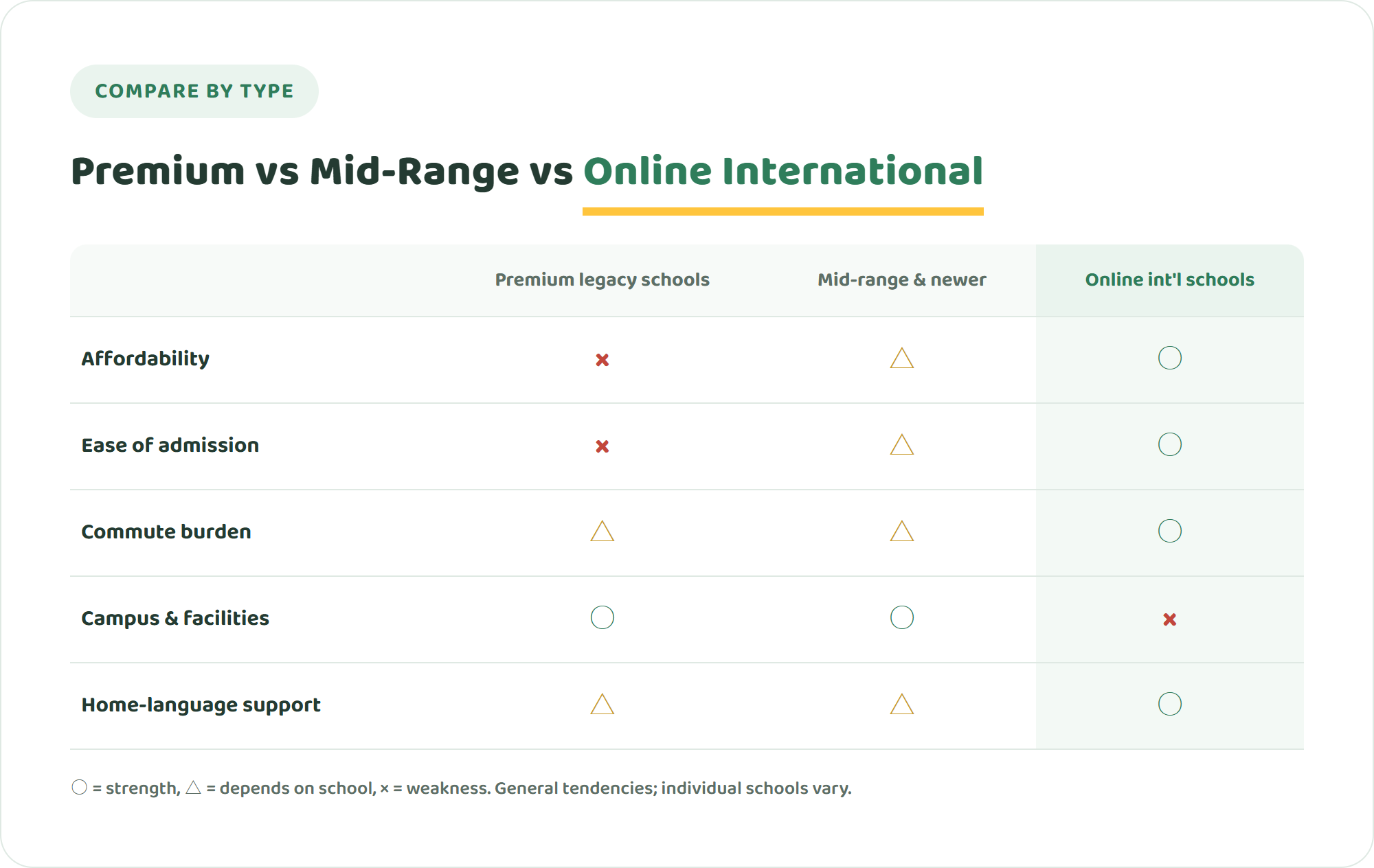
A campus school offers things nothing else can — playing fields, a music block, and the everyday friction of being among peers. But for families whose posting length is uncertain, or whose budget won’t stretch across twelve years, continuity is its own kind of value. If you’d like to start with the learning itself rather than the buildings, see how learning works online →.
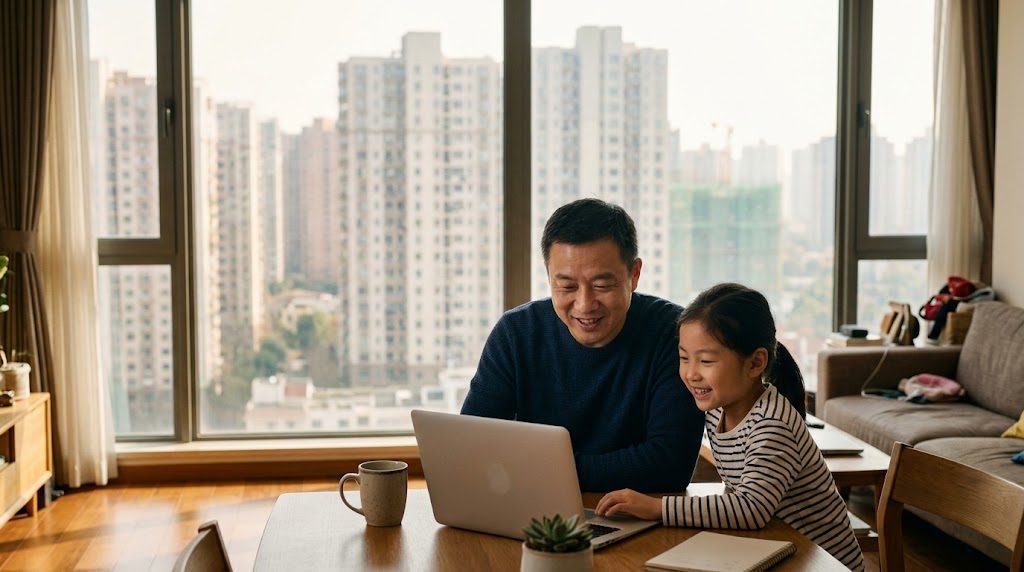
When fees or eligibility are the barrier: an eighth option, online
Having read through seven schools, you may be thinking: can we sustain these fees for a decade? What happens when the assignment ends? Do we even meet the eligibility rules? Those questions are entirely reasonable — and families asking them are exactly who the eighth option, online, is for.
NIJIN GLOBAL ACADEMY (NGA) is an online international school scheduled to open in September 2027. It is run by NIJIN Inc. in Japan, whose alternative school “NIJIN Academy” already enrols more than 1,000 students.
NGA is built around learning beyond test scores and rankings, with small-group, dialogue-centred classes and a guiding idea: to help children come to love themselves and the world. It serves ages 6–18 across Asia and Oceania. Because it is location-independent, a family can move from Shanghai to Tokyo to the next posting without changing schools — and without being filtered by passport category or visa status. Lessons are designed so children can move into English gradually, with home-language support as a foundation. The goal is tuition around one-fifth of a campus-based international school.
In the interest of honesty: NGA has not opened yet, so there is no graduate track record to point to. And an online school cannot replicate everything a physical campus offers, from the sports field to the atmosphere of a shared classroom. But for families who need it, we want to make one thing clear: a rule, a fee, or a relocation should not be the reason a child gives up on a global education.
Frequently asked questions
Q. From what age can my child start, and can we join mid-year?
A. Most campus schools in Shanghai admit from ages 2–3 in early years (this varies by school). Mid-year entry depends entirely on availability, and popular schools and year groups often run waiting lists. If a posting is confirmed, contact admissions before you arrive rather than after. NGA serves ages 6–18.
Q. Does my child need a foreign passport to attend?
A. For schools for children of foreign personnel, yes in most cases — a foreign passport plus the parent’s work and residence documentation is the standard requirement, with additional recognised categories for children born overseas to PRC citizens and for Hong Kong, Macau and Taiwan residents. Private bilingual schools admit Chinese nationals but must teach the national curriculum during compulsory education. Confirm which category a school belongs to before applying; eligibility is verified administratively and is not usually negotiable.
Q. What if my child’s English isn’t strong yet?
A. Most Shanghai international schools run EAL or ELD support, and several bundle it into tuition rather than charging separately — though a few levy a one-off English support fee. Ask two specific questions: how many hours per week, and at what point a student exits support. Home-language provision (beyond Mandarin) varies far more widely, so ask about that separately if it matters to your family.
Q. What should we budget for beyond tuition?
A. Expect an application fee of RMB 2,500–3,800, a first-year capital or entry fee of RMB 8,000–33,000, school bus charges of around RMB 9,000 per semester, and technology or materials costs. As a planning rule, the real annual outlay tends to land 20–30% above the headline tuition. SCIS bundles activities, resources and trips into its fees, and WISS includes lunch, textbooks, EAL support, exam fees and uniform, so both make annual budgeting more predictable.
Q. Which schools should we look at first on a tighter budget?
A. Of the seven here, Shanghai Livingston American School is the most affordable at roughly RMB 140,500–233,000 a year. Shanghai Community International School follows at about RMB 152,500–335,500, and the Western International School of Shanghai at about RMB 162,000–277,000. Compare on the all-in figure rather than tuition alone, since application fees, capital fees and transport are charged separately at most schools.
Q. We want our child to leave China genuinely able to use Mandarin. Where should we look?
A. Yew Chung International School of Shanghai runs true English–Chinese co-teaching, with a native English speaker and a native Chinese speaker sharing the classroom from the early years upward — a model that is hard to find elsewhere. Concordia International School Shanghai pairs its American curriculum with a dedicated Mandarin programme. And if Mandarin matters above all else, the private bilingual schools are worth adding to the list, bearing in mind that they must teach the Chinese national curriculum through the compulsory-education years.
Q. How much should the length of our posting influence the choice?
A. Quite a lot. Three-year assignments frequently become five, or end after eighteen months with a move to Singapore or back home. A widely portable programme — the IB, or a well-recognised British or American pathway — protects your child if the next move arrives sooner than expected, so weigh portability alongside curriculum fit and fees rather than treating it as an afterthought.
Not the school you can get into — the place your child can grow
Shanghai genuinely has world-class international schools. It also has real constraints: fees at the top of the global range, and a category system that decides where you may apply before you decide where you’d like to. The goal isn’t to settle for whichever school will technically take you, but to choose — together, as a family — an environment where your child can learn as themselves. In that set of choices, a campus and an online school can stand as equals. There’s no need to rush. Whatever your next step, we’re cheering you on.
International Schools in Other Cities
- International Schools in Kobe: All 20 Schools
- International Schools in Yokohama: Full Comparison
- International Schools in Chofu and ASIJ Fees
- International Schools in Fukuoka: Fees
- International Schools in Ho Chi Minh City
- International Schools in Melbourne
- International Schools in Dubai: Fees
- International Schools in Edogawa, Tokyo
- International Schools in Seoul
- International Schools in Taipei
- International Schools in Tokyo
- International Schools in Osaka
- International Schools in Singapore
- International Schools in Bangkok