You might be driving home from a parent–student–teacher conference, or sitting up late with a notice that came home from school. If you are going to move your child into international education, when is the right moment? That single question can hover unanswered for months. The more you read, the more you find two confident and opposite answers — that earlier is always better for language, and that you should wait until the mother tongue is solid. Both sound reasonable. So nothing gets decided, and every school year that passes adds a little more weight to the feeling of having missed the window.
Here is the most useful thing we can tell you first. If you cannot decide when to switch to international education, it is usually not because you are missing information. It is because you have not yet settled on the criteria you are going to judge by. This article narrows those criteria down to three. Then it walks through each school stage, pairing what makes it a good moment with what to watch out for — and it says honestly when waiting is the better call. We are not going to tell you that earlier is better. We are not going to tell you to move now.

The problem isn’t missing information — it’s undefined criteria
“International education” covers several very different things: attending a physical international school, studying with an online international school, or keeping your current school and adding hours of learning in English through after-school or home study. These three differ enormously in cost and in how they use a family’s time, yet search results discuss them as if they were one option. So a question about timing comes back with answers drawn from incompatible situations, and the confusion is guaranteed.
Narrow it to three criteria: your child’s current state, their language foundation, and your financial outlook. That is enough to get most of the way. Year group, it turns out, is not the primary criterion. Two nine-year-olds in the same classroom — one quietly worn down by school, one happy to go every morning — should not be moved at the same time.
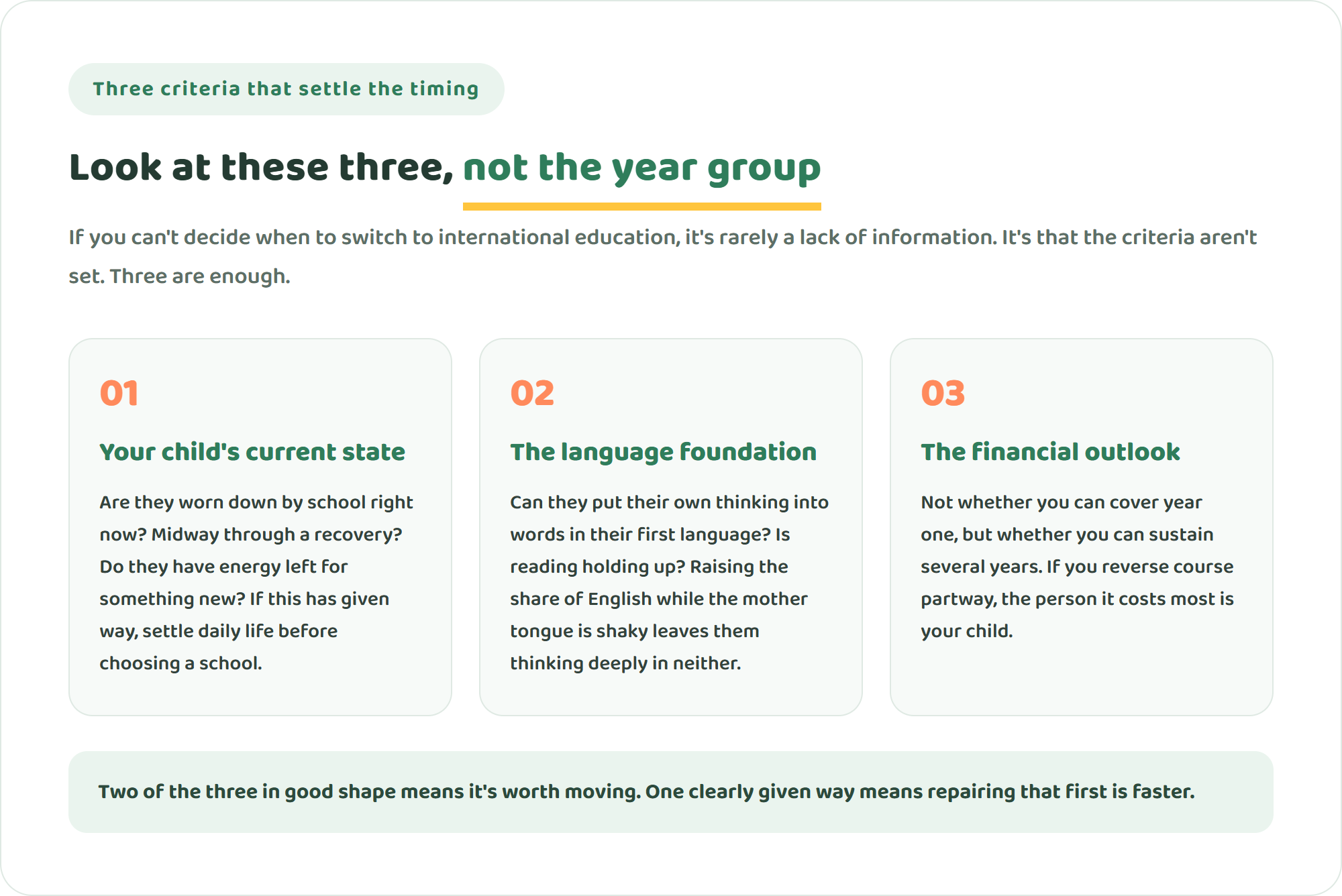
Use them like this. If two of the three are in good shape, it is worth moving. If one is clearly not in place, sorting that out first is faster in the end. If all three are unsteady, the thing to decide right now is not a school — it is daily life. Simply respecting that order sharply reduces the chance of a switch that ends badly. For the mechanics of changing schools, see our guide on deciding whether to change schools.
One more thing: you do not have to settle these three today. Look at the same three again in three months. That is enough. With criteria in place, your position stops being “we’re still not sure” and becomes “the second one isn’t ready yet, so we wait.” Those are two very different kinds of waiting.
When to switch to international education, stage by stage
What follows is stage by stage, with the reason it suits and the thing to watch out for, side by side. Every stage has both. There is, unfortunately, no single best year group.
Preschool and the first years of primary
Children this age are far less self-conscious about new sounds and about speaking up, so they settle into hours spent in English quickly. Because the habits of school life are not yet fixed, a change of environment tends to cost less. What to watch: the mother tongue is still being built. If time in the home language shrinks, families worry — reasonably — about ending up halfway in both. In Japan, compulsory schooling also enters the picture from primary age; the next section covers that.
Upper primary
Children can put their own thinking into words, which is exactly when inquiry-based learning starts to pay off. Reading and writing in the first language are reasonably established, so adding English is less likely to destabilise the foundation. This is the stage we are asked about most often. What to watch: friendships are at their most intense. Leaving the current group can matter far more to your child than any difference in curriculum. A move made without their agreement stumbles regardless of how good the new environment is.
Lower secondary
Your child can now treat their own path as their own question, and articulate why learning in English matters to them. A switch with a real motive behind it is a strong one. At the same time, in Japan the high school entrance timetable runs alongside. How attendance and internal assessment are handled varies by school and municipality, so no general rule applies. Ask the school where your child is enrolled about the effect on their pathway before you move. A decision made without that conversation is the hardest kind to reverse.
Upper secondary
Compulsory schooling is behind you and the range of choices widens. If universities abroad are in view, moving into an English-medium environment at this stage carries real weight. What to watch is equally clear: you have to settle graduation credentials and credits first. Do you need a domestic high school diploma, or are you pursuing an international qualification? Entering with that unresolved narrows the options three years later. This is also the stage with the least slack in the calendar, so “try it and then decide” is genuinely harder to do.
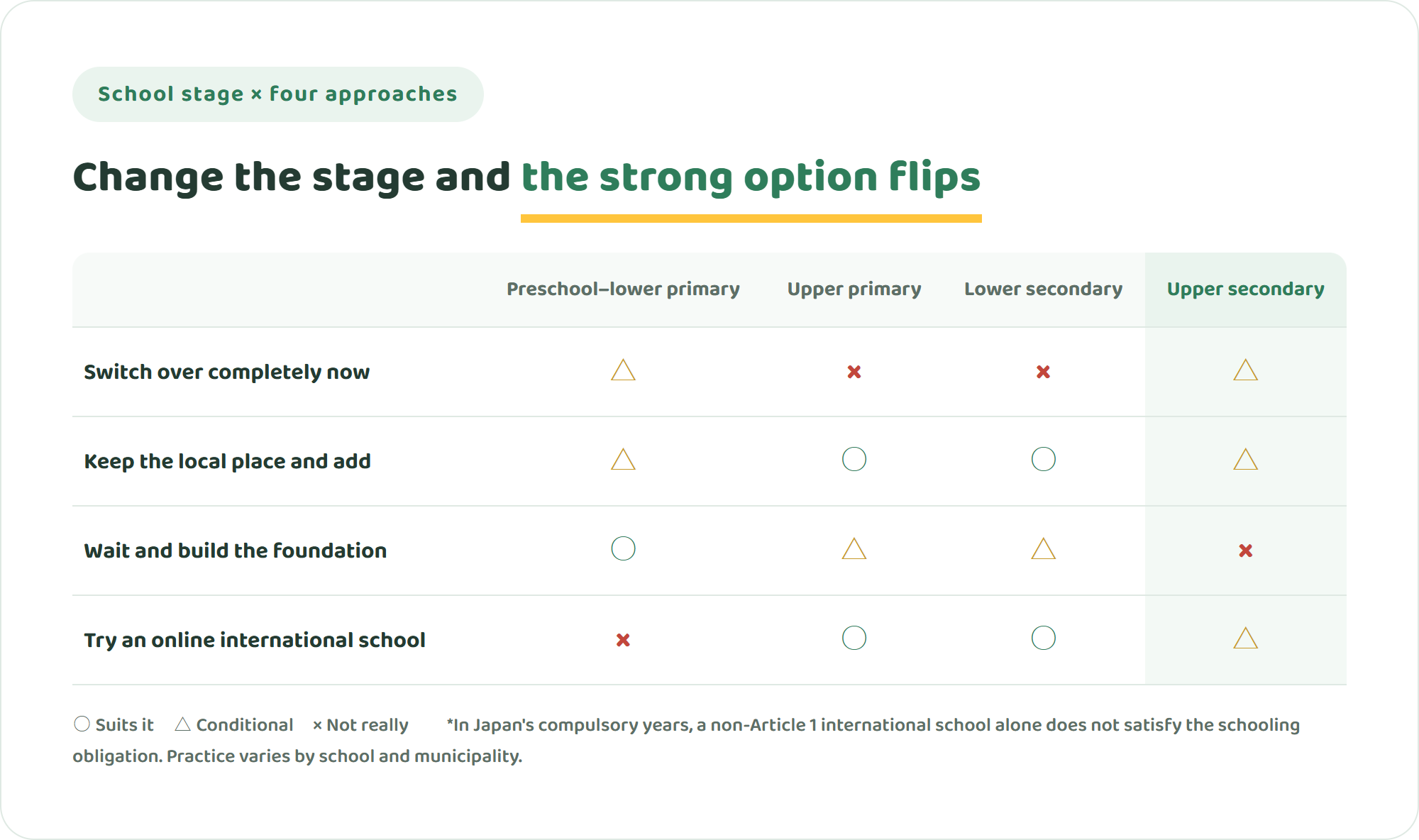
The table makes one thing plain: switching over completely is awkward at almost every stage. Meanwhile, keeping the local school and adding on top works remarkably well from upper primary through lower secondary — and then becomes hard to sustain in upper secondary, where time runs out. The approach is not fixed by year group. What changes with the year group is which approach has the advantage.
In Japan’s compulsory years, plan on keeping the local school place
This part is a matter of law, so we will be direct. During Japan’s compulsory education years — elementary and lower secondary — attending an international school that is not an ichijōkō (a school defined under Article 1 of the School Education Act) does not by itself satisfy the compulsory schooling obligation. Skip this point while planning your timing and you will meet it later, in the form of enrolment and pathway paperwork.
The workable approach is to keep your child’s place at the local elementary or lower secondary school and add international education alongside it. How attendance is recorded, how grades are assigned, and what is required for graduation are decided by the enrolling school and the local board of education, and practice differs between municipalities. We cannot give you a general answer here. Speak to both your current school and your municipal board of education before you move.

Signs that waiting is the better decision
Saying “wait” in an article about timing is not what anyone wants to hear. We are saying it anyway, because when one of the following four is true, settling things first usually works out better than moving now.
One: your child is midway through a recovery. After a period of finding school hard, they have started going again. A change of environment at that exact point swings hard in one direction or the other. Waiting even six months, until the recovery feels stable to them, is worth it.
Two: the first-language foundation is shaky. Reading comprehension is faltering; putting feelings into words looks painful. Sharply increasing the share of English in that state tends to produce a child who cannot think deeply in either language. On sequencing English without losing the mother tongue, see raising a bilingual child without losing the mother tongue.
Three: you cannot see the finances beyond year one. Judge it on whether you can sustain it for several years, not on whether you can cover the first invoice. If you have to reverse course partway, the person it costs most is usually your child.
Four: your child feels left out of the decision. The parents decided, and the child was told the outcome. Switches that begin that way rarely last, however good the school. Going back a step and starting with a conversation is the faster route.
You don’t have to switch everything
The word “switch” suggests one large, irreversible decision: leave this school, enter that one. In practice, the families we see doing well take a much quieter route. They keep the local school place and add international education gradually — the double-school approach. It also happens to be the version that fits the compulsory schooling rules described above.
Its real advantage is that if it goes wrong, it goes wrong small. If it does not suit, you drop what you added. The friendships and the academic record are still there. Switch completely and, if it does not work, you are looking for somewhere to return to from scratch; add on top and the place to return to was never given up. That structure is why, in the families we have talked with, a staged move tends to go wrong less badly.
It is not all upside. Running two things is a load on your child and on you. So do not be ambitious at the start. Work out how many hours a week is genuinely sustainable, test it for a month, and only then increase. That order alone changes the odds of it lasting.
Three steps for making the decision
Finally, the decision itself. Rather than trying to guess the right moment, decide in advance how you will decide. There are three steps.
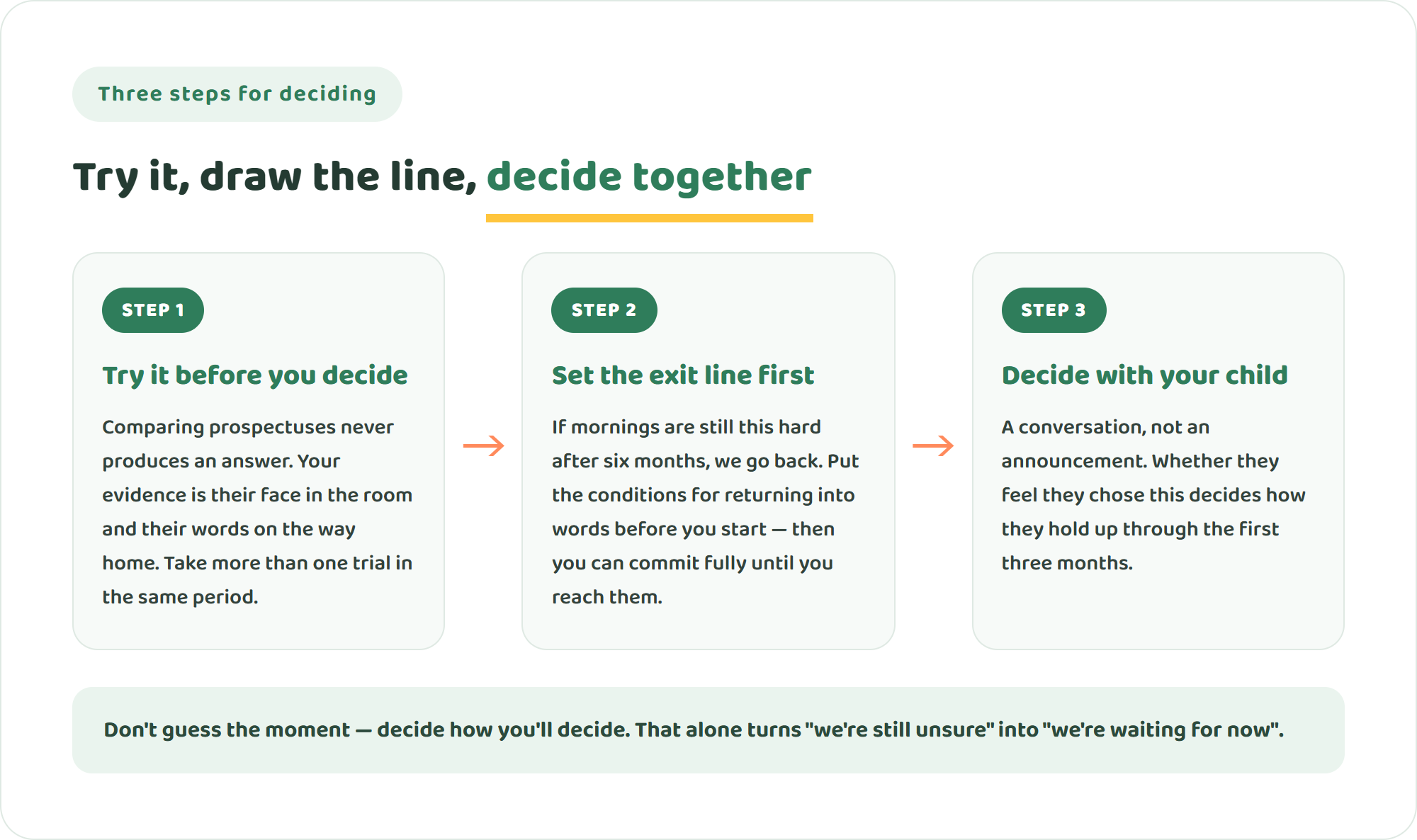
Step one: try it before you decide. No amount of time spent comparing prospectuses will produce an answer. What produces an answer is your child’s face while they are actually in the room, and the words they use on the way home. If trial classes or open days are available, take more than one in the same period. With only one, there is nothing to compare it against, and first impressions do the deciding for you.
Step two: set the exit line first. “If mornings are still this hard after six months, we go back.” “If a year in, English is only a burden, we reduce it.” Put the conditions for returning into words before you begin. This is not pessimism. Because the line exists, you can commit fully up until you reach it. Without one, every difficult day puts the whole decision back on trial.
Step three: decide with your child, not for them. Not an announcement — a conversation. Start with “here are the options; what do you think?” Whether your child feels they chose this determines how they hold up through the first three months. Even with a younger child who cannot weigh it all, framing it as “what we are thinking about” rather than “what has been decided” changes how it lands.
See how learning works at NGA →
A third option: one way to try the switch in stages
Some of you will have reached this point thinking: adding on top makes sense, but there is no international school within reach. So here is where we stand, stated plainly. NIJIN GLOBAL ACADEMY (NGA) is an online international school built to move beyond the exam-score race, opening in September 2027 (planned). It is run by NIJIN Inc. Our sister school, NIJIN Academy, already has more than 900 children enrolled.
We put NGA forward as one way to try the switch in stages. Because there is no campus, a family can keep their place at the local school and add on top of it. The timeline fits this article’s subject too: ahead of the full opening, a pre-opening period of trial classes is planned for April–May 2027. Rather than committing to a path first, you try it and then think — exactly the order described in step one. Learning is designed around small-group dialogue, using the world itself as the material, on one simple idea: that a child should come to like both themselves and the world.
It will not suit every family. If daily in-person contact and time in a schoolyard are what you value most, online will feel thin. Supporting the daily rhythm places a real load on parents. And if what your child needs right now is rest, then adding any new learning may simply be too early. Compare it fairly against the alternatives, and choose it only if it genuinely fits.
Frequently asked questions
Is it always better to switch to international education as early as possible?
On the single question of getting comfortable in a language, younger children do tend to meet less resistance. But whether a switch works is not decided by acquisition speed alone. Your child’s state, their first-language foundation, the financial outlook, and their own agreement all matter. Moving early while those are unsettled achieves little if it cannot be sustained. Treat “earlier is better” as a claim that holds only when the other conditions are equal.
Is it all right to move partway through a school year?
Admission windows and conditions vary by school, so there is no general answer. What is consistent is the value of talking to your current school first. In the compulsory years, the enrolment place is at stake; in upper secondary, credit handling feeds straight into your child’s pathway. Once you have a rough target date, raise it with the current school three to six months ahead and you will have more options available.
Can we start with an online international school and move to a campus school later?
It is possible, but entry requirements differ a great deal between schools. How prior study in English is assessed, and what a transfer exam looks for, is each school’s own call. If you have a school in mind, ask about its requirements early. Do not build the plan on the assumption that you can move later.
Our child isn’t keen. Should we go ahead anyway?
No — we would not recommend hurrying in that state. But look closely at what “not keen” contains. Is it anxiety about a new environment, reluctance to leave friends, or resentment at being decided for? The response differs completely depending on which it is. Starting by asking why is enough for now.
Don’t guess the moment. Decide how you’ll decide.
There is no universal right answer to when to switch to international education. There is only the right sequence for your family. Check the three criteria. Know what each stage favours and what it costs. Look for the signs that say wait. Rather than switching everything, start by adding. Then try it, draw the line, and decide together with your child. Having read this far, you are already past the point of leaving the timing to chance.
NIJIN GLOBAL ACADEMY opens in September 2027 (planned), with pre-opening trial classes planned for April–May 2027. We will send you news first by email: how a school without a campus works, learning built around small-group dialogue, and the opening of applications for our first cohort. Nothing needs deciding today. Just keep in mind that when you are ready to move, there is a road available.