If you are searching for online teaching jobs in Malaysia, here is the most useful number nobody tells you first: Malaysia Standard Time is UTC+8, exactly one hour behind Japan (UTC+9). A lesson that begins at 9:00 in Tokyo begins at 8:00 where you are. That single hour is the whole reason a Japan-facing online school can hire a teacher living in Kuala Lumpur, Penang or Johor Bahru, and cannot easily hire one living in London or Toronto. Your address is not an obstacle here. It is the qualification.
The second thing worth knowing is the shape of the offer. NIJIN GLOBAL ACADEMY, an online international school opening in September 2027 (with pre-opening trial classes in spring 2027), is hiring founding members for its international track — and those roles begin as volunteer positions, with detailed terms shared later in the process. What is fixed from the start is that the work is fully remote, costs you no visa and no relocation, and that even one class a week is welcome. This article is about how remote hiring actually works from Malaysia: what the categories are, what schools genuinely check, and why starting small is the normal route rather than a fallback.
What “online teaching jobs in Malaysia” actually covers
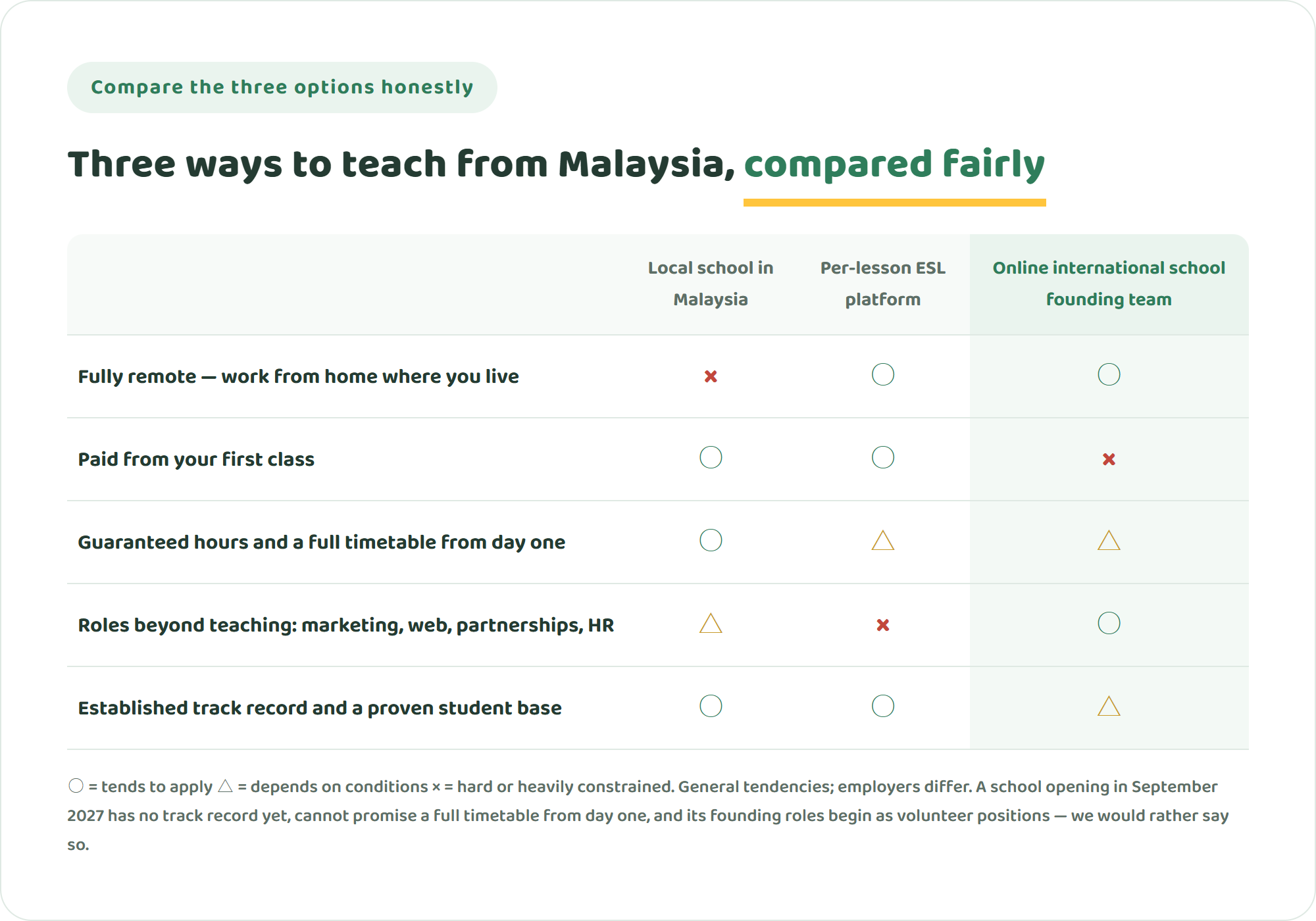
The phrase hides three very different kinds of work, and they reward very different people. Mixing them up is the single most common reason a good teacher applies to the wrong thing.
| Type of role | What the work is | What it asks of you |
|---|---|---|
| Per-lesson platforms | ESL or tutoring marketplaces. You take bookings, often 25 to 50 minutes, from learners across many time zones. | Low barrier to entry, fast to start. Pay is per lesson and set by each platform, income is unpredictable, and your hours fragment. |
| Remote teaching at an online international school | A real timetable, the same children each week, a curriculum you help shape, colleagues you actually know. | A qualification or demonstrable subject depth, reliable hours in one time band, and the ability to hold a group through a screen. |
| Non-teaching roles in education | Curriculum design, marketing, web, partnerships, HR — the work that makes a school run. | Often overlooked by teachers, often the fastest route to a higher and steadier income. Teaching experience is a real advantage here. |
Pay structures differ by employer and platform and change over time. Always confirm the current terms with the organisation itself before applying.
Notice that only the first category is what most people picture, and it is the one with the weakest hold on your calendar. If you want a timetable rather than a queue of bookings, you are looking for the second and third rows. See the founding member roles at NIJIN GLOBAL ACADEMY → — the second and third rows are what the founding-member roles look like: a real timetable and work beyond teaching, fully remote. The terms, said plainly: founding roles on the international track begin as volunteer positions ahead of the 2027 opening, and detailed terms are shared later in the process. Check that against your own situation in Malaysia before you spend an evening on an application.

What a school is actually checking
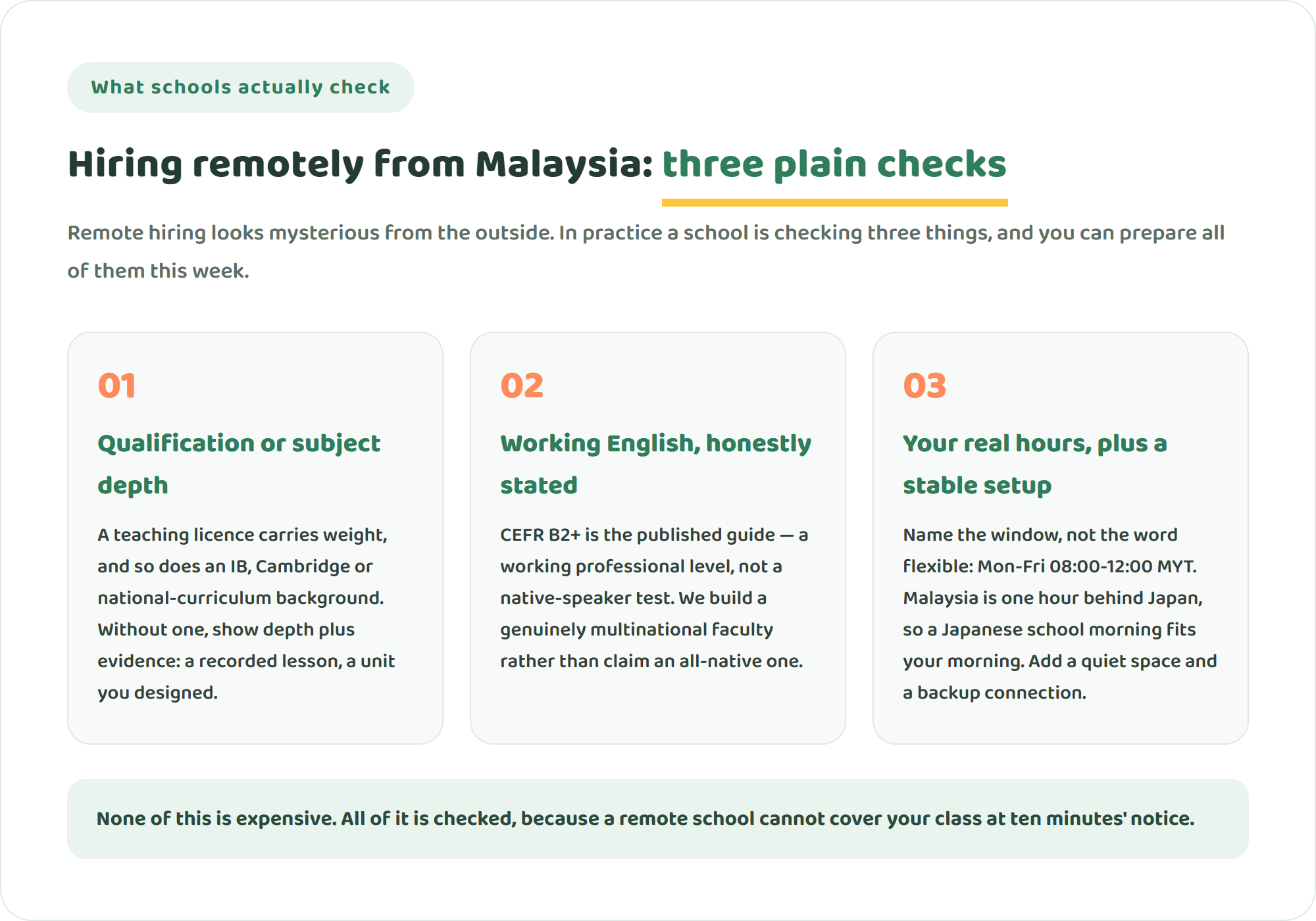
1. A qualification, or subject depth you can demonstrate
A teaching licence from Malaysia, the UK, Australia or elsewhere carries weight, and so does an IB, Cambridge or national-curriculum background. If you do not hold a licence, depth in a subject plus evidence that you can teach it — a recorded lesson, a unit you designed, learners you have taken somewhere — does a surprising amount of the same work. Say plainly what you have. Overclaiming is caught in the first interview.
2. English at a working level, honestly stated
NIJIN GLOBAL ACADEMY publishes CEFR B2+ as its guide for English. That is a working professional level, not a native-speaker test. Plenty of schools advertise an all-native faculty; we would rather describe what we are actually building, which is a genuinely multinational faculty. For a child learning to think across cultures, a room of adults from different countries is not a compromise. It is the point.
3. The hours you can really teach, in your own time zone
This is where most remote applications quietly fail. Do not write “flexible”. Write the actual window: Monday to Friday, 08:00–12:00 MYT, for example. Because Malaysia sits one hour behind Japan, an ordinary Japanese school morning lands inside an ordinary Malaysian morning. Applicants in Europe cannot say that. Put it in the first three lines of your application.
4. Connection, setup and self-management
A stable home connection, a decent headset and camera, a quiet corner with a plain background, and a backup for the day your line drops — a mobile hotspot is enough. None of this is expensive. All of it is checked, because a remote school cannot send someone to cover your class at ten minutes’ notice.
Starting part-time is the normal route, not a fallback
Almost nobody moves from a classroom in Malaysia to a full remote timetable in one step, and no sensible school asks them to. The usual path is a small commitment that both sides can evaluate honestly, growing as it proves itself. Even one class a week is welcome, and you are welcome to start as a volunteer and give back while you build up — several of the most valuable people at a young school begin exactly that way.
This is why the five ways of working matter more than they sound. They run from a light part-time involvement through to a full founding role, and you choose where you sit rather than being sorted into a slot. If you are teaching at a school in Malaysia now, a few morning hours before your own term timetable begins is a real, workable start.
Fully remote means no visa, no relocation, no moving costs
An overseas teaching job has traditionally meant a work permit, a flight, a deposit on an apartment and a year of distance from family. A fully remote role removes every line of that. There is no visa to sponsor, no relocation budget to negotiate, no school-provided housing to depend on. You keep your home, your community and your cost base in Malaysia — which, measured against a salary set in Japanese yen, is a genuine advantage rather than a compromise. And if you ever move cities, or countries, the job does not notice.
It also changes who a school can hire. When location stops being a filter, the deciding questions become what you can teach and when you are awake for it. That is why an online school built for children learning across cultures ends up with colleagues in several countries at once — not as a diversity statement, but as the ordinary consequence of hiring on ability. If you have spent years being told that the good international posts are somewhere you would have to move to, this is worth sitting with for a moment.
The roles that are not teaching
Teachers routinely undervalue what they already do. You plan projects, communicate with anxious families, design materials, run events, coach adults, and hold a budget of attention across thirty people. Outside a school those are called project management, customer communication, content design and operations. At NIJIN GLOBAL ACADEMY the founding roles deliberately combine teaching with marketing, web, partnerships or HR, and that combination is what a founding role is built around — its scope grows because you carry more than one kind of work, not because you teach more lessons.
If your ambition is to grow, not merely to relocate, this is the part worth reading twice. Building a school from before it opens is a rare line on a career history, and it is available to you from a desk in Malaysia.
Three steps to apply from where you are
Nothing here requires you to leave your current job first.
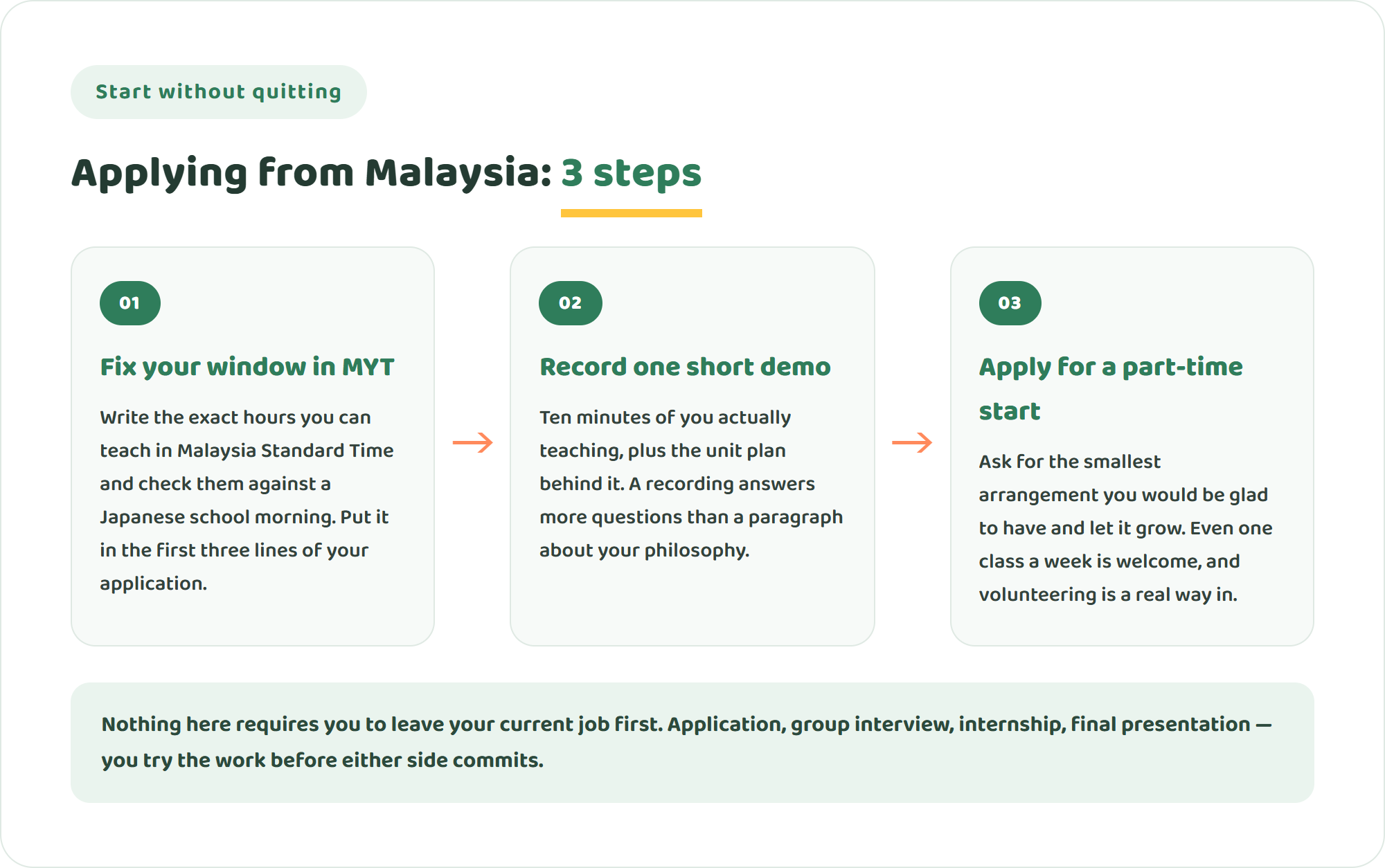
First, write down the exact window you can teach in MYT and check it against a Japanese school morning. Second, prepare one short demo — ten minutes of you actually teaching, plus the unit plan behind it — because a recording answers more questions than a paragraph about your philosophy. Third, apply for the smallest arrangement you would be glad to have, and let it grow. The selection process at NIJIN GLOBAL ACADEMY runs from application to a group interview, an internship with the sister school NIJIN Academy, and a final presentation, so you get to try the work before either side commits.
Frequently asked questions
Do I need a visa or to move to Japan?
No. The role is fully remote and you work from your home in Malaysia. There is no relocation and no work permit to arrange.
Do I need to speak Japanese?
The published language guide is English at around CEFR B2+. Requirements beyond that depend on the role, so it is worth asking directly during the process rather than assuming you are excluded.
Can I do this alongside my current teaching job?
Yes — that is the most common way people begin. A part-time arrangement in the Malaysian morning sits before or alongside many local school timetables, and you can scale up later.
The school opens in September 2027. Why apply now?
Because founding roles exist only before opening. Pre-opening trial classes are planned for spring 2027, and the people who shape the curriculum, the systems and the culture are being chosen now.
Are the roles paid, or voluntary?
On the international track, founding roles begin as volunteer positions while the school builds toward opening, and detailed terms are shared later in the process. There is genuine room for experienced educators who want to contribute a class a week without a full contract — and if you need paid work from the start, this is the point to say so and check where the conversation goes.

Your address is not the obstacle you think it is
For a long time, teaching internationally meant leaving. It meant a permit, a plane and a gap where your family used to be. That is no longer the only shape the work comes in. If you are in Malaysia with a qualification, working English and a few reliable morning hours, you are not on the edge of this market — because of one hour of time difference, you are close to the centre of it. What is left is to say clearly what you can do, and when.
Working at an International School — More Articles
- international school teacher salary
- how to become an international school teacher
- career change from teaching
- career change from teaching in your 30s and 40s
- how much do teachers earn?
- how to become an IB teacher
- jobs for moving abroad
- high-paying jobs that use English
- elementary school teacher salary in Japan
- junior high school teacher salary in Japan
- high school teacher salary in Japan
- school principal salary in Japan
- how the Japanese teacher pay scale works
- teacher bonuses in Japan
- private school teacher salary in Japan
- online international school teacher salary
- remote teaching jobs from the Philippines
- international school staff jobs
Teach where you already live. Build something that has not existed before.
Sources and references
- Malaysia Standard Time (UTC+8) and Japan Standard Time (UTC+9), IANA Time Zone Database: iana.org/time-zones
- Council of Europe, Common European Framework of Reference for Languages (CEFR) level descriptors: coe.int
- NIJIN GLOBAL ACADEMY founding member roles: fully remote, beginning as volunteer positions with detailed terms shared later in the process: nijinglobal.academy/en/join-us