
Do teachers in Japan get bonuses? Yes — twice a year, and they are a substantial part of annual pay. But they are not called a bonus. Public school teachers receive two separate allowances, the end-of-term allowance (kimatsu teate) and the diligence allowance (kinben teate). Under the 2025 National Personnel Authority recommendation, national civil servants moved from 4.60 to 4.65 months of salary per year. Under the 2025 Tokyo Metropolitan Personnel Commission recommendation, Tokyo Metropolitan Government employees, including the education service, moved from 4.85 to 4.90 months.
One warning before the numbers: there is no single national figure for teachers in Japan. Public school teachers are local government employees, and their pay is set by each of the 47 prefectures and 20 designated cities through its own salary ordinance. Private schools follow the rules of each school corporation. So this article explains how the two allowances work, when they land, how to estimate the amount with an explicit formula, and finally a different way of designing income altogether.
| Item | Figure | Source (as of) |
|---|---|---|
| Months per year and timing | National civil servants 4.65 months / Tokyo Metropolitan employees (incl. education service) 4.90 months. Paid generally in June and December | NPA and Tokyo Personnel Commission recommendations, 2025 |
| Formal name | No allowance called a bonus: end-of-term + diligence allowance | Act on Remuneration of Officials in the Regular Service, Art. 19-4 |
| Reference dates | Paid to those in service on 1 June and 1 December (national rule) | Same Act, Art. 19-4 |
| Service-period rate | 6 months = 100% / 5–6 = 80% / 3–5 = 60% / under 3 months = 30% | Same Act, Art. 19-4 (national rule) |
| Private-sector benchmark | Average bonus JPY 750,000 (within average annual pay of JPY 4.78 million) | National Tax Agency survey, 2024 data |
Here is how each of those figures is actually determined.
Two allowances, not one bonus
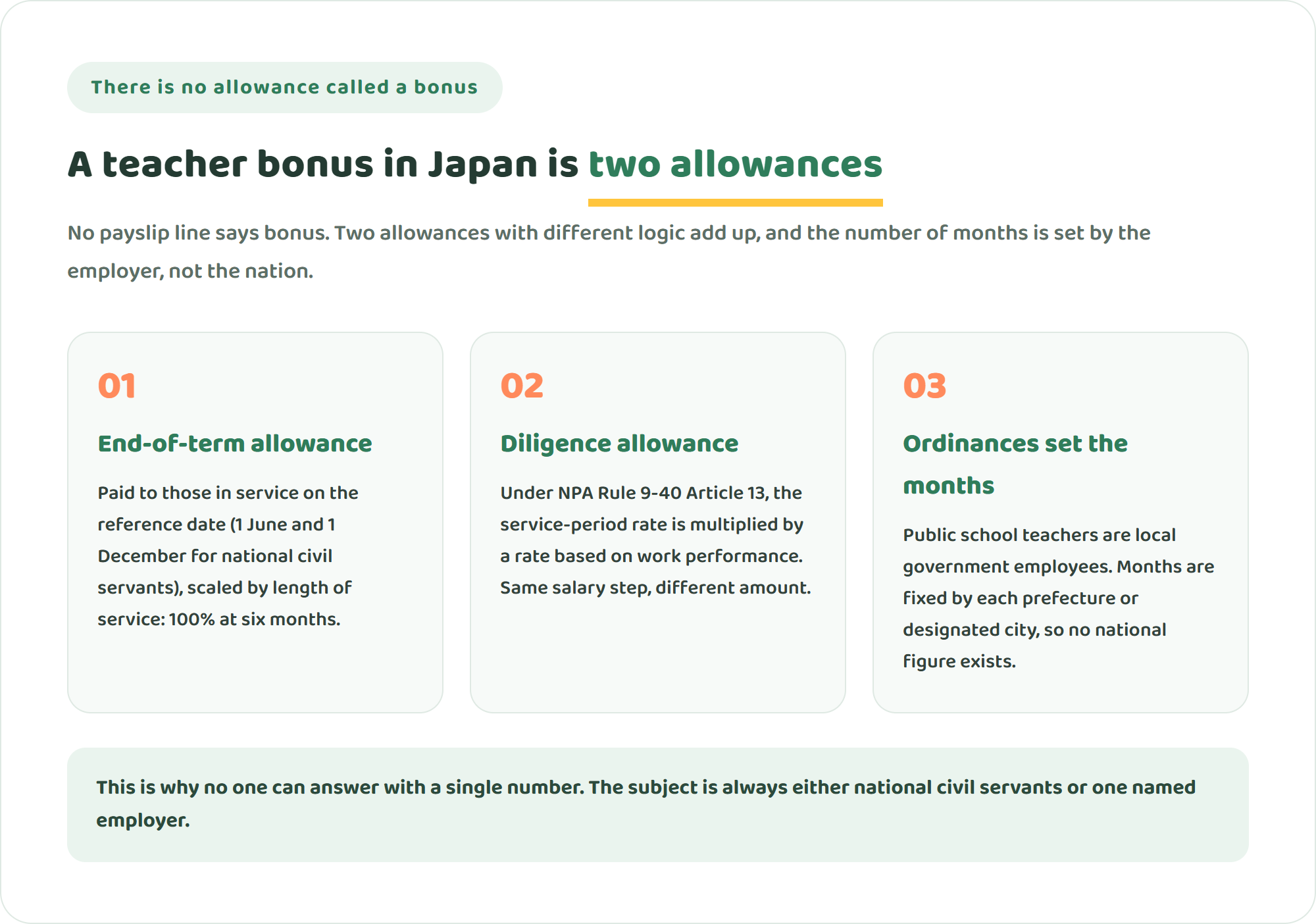
The payslip of a Japanese public school teacher shows no line called a bonus. It shows two allowances with different logic. The end-of-term allowance depends on being in service on the reference date and on how long you have been in service. The diligence allowance depends on performance: National Personnel Authority Rule 9-40, Article 13 defines its rate as the service-period rate multiplied by a rate based on work performance. Two teachers on the same salary step can therefore receive different amounts.
These provisions govern national civil servants. For public school teachers, who are local government employees, the salary ordinance and rules of each prefecture or designated city play the same role — which is exactly why no nationwide figure exists.

When do they land? Reference dates are 1 June and 1 December
For national civil servants the law is explicit: the end-of-term allowance goes to employees in service on 1 June and on 1 December. The payment dates themselves are fixed in an appended table under Rule 9-40, Article 14, and in practice fall in June and December. Public school teachers are commonly paid in the same two months, but the exact dates come from each employer’s ordinance and rules, so check the prefecture or city you work for.
Why the first June is small
The national rule sets a rate by length of service: 100 percent at six months or more, and 30 percent under three months. Teachers in Japan are typically appointed on 1 April, which means only two months of service by the 1 June reference date. A small first payment is not a sign of low pay — it is the service-period rate at work. By the December reference date, service exceeds six months.
How much? An honest estimate, with the formula shown
We will not state a national average amount in yen, because we could not confirm one in primary sources: the Ministry of Internal Affairs and Communications survey states that its monthly allowance figures exclude end-of-term and diligence allowances. Instead, here are two estimates built from published figures. Both are simple multiplications and will not match any actual payment.
Estimate 1: from a Tokyo starting salary
The Tokyo Metropolitan Board of Education publishes an example starting salary for a university graduate appointed to a Tokyo elementary, junior high or high school: about JPY 326,100 per month as of 1 April 2025. Multiplied by Tokyo’s 4.90 months, that is JPY 326,100 x 4.90 = approximately JPY 1,597,890 a year. The real calculation base adds dependant and regional allowances, then applies the service-period rate and the performance rate — so treat this as an estimate.
Estimate 2: from the national average salary
In the 2025 Local Public Service Salary Survey (as of 1 April 2025), the average monthly salary for the elementary and junior high education service was JPY 364,069 (this survey’s definition includes the teaching adjustment payment). Multiplied by the national 4.65 months: JPY 364,069 x 4.65 = approximately JPY 1,692,921. Note that 4.65 months is the national civil service figure and differs by employer, and that using salary alone as the base can understate the result.
Roughly a quarter of annual pay
The same survey gives average monthly remuneration of JPY 424,411; multiplied by 12 that is JPY 5,092,932. Adding the JPY 1,692,921 above gives JPY 6,785,853, or about JPY 6.79 million — an estimated annual income for public elementary and junior high teachers (average age 41.3). Within that estimate, the twice-yearly allowances account for about 25 percent. For comparison, the National Tax Agency reports average annual pay of JPY 4.78 million for private-sector employees, made up of JPY 4.03 million in salary and allowances plus JPY 750,000 in bonuses.
That is the shape of income built around two annual peaks. See the NIJIN GLOBAL ACADEMY founding member roles → — we will be plain about the terms: founding roles begin as volunteer positions ahead of the opening, with the detail shared later in the process. Whether you want to leave the classroom for freedom of place or to deepen a specialism, better to know that before you decide anything.
Two annual peaks, or income spread across months
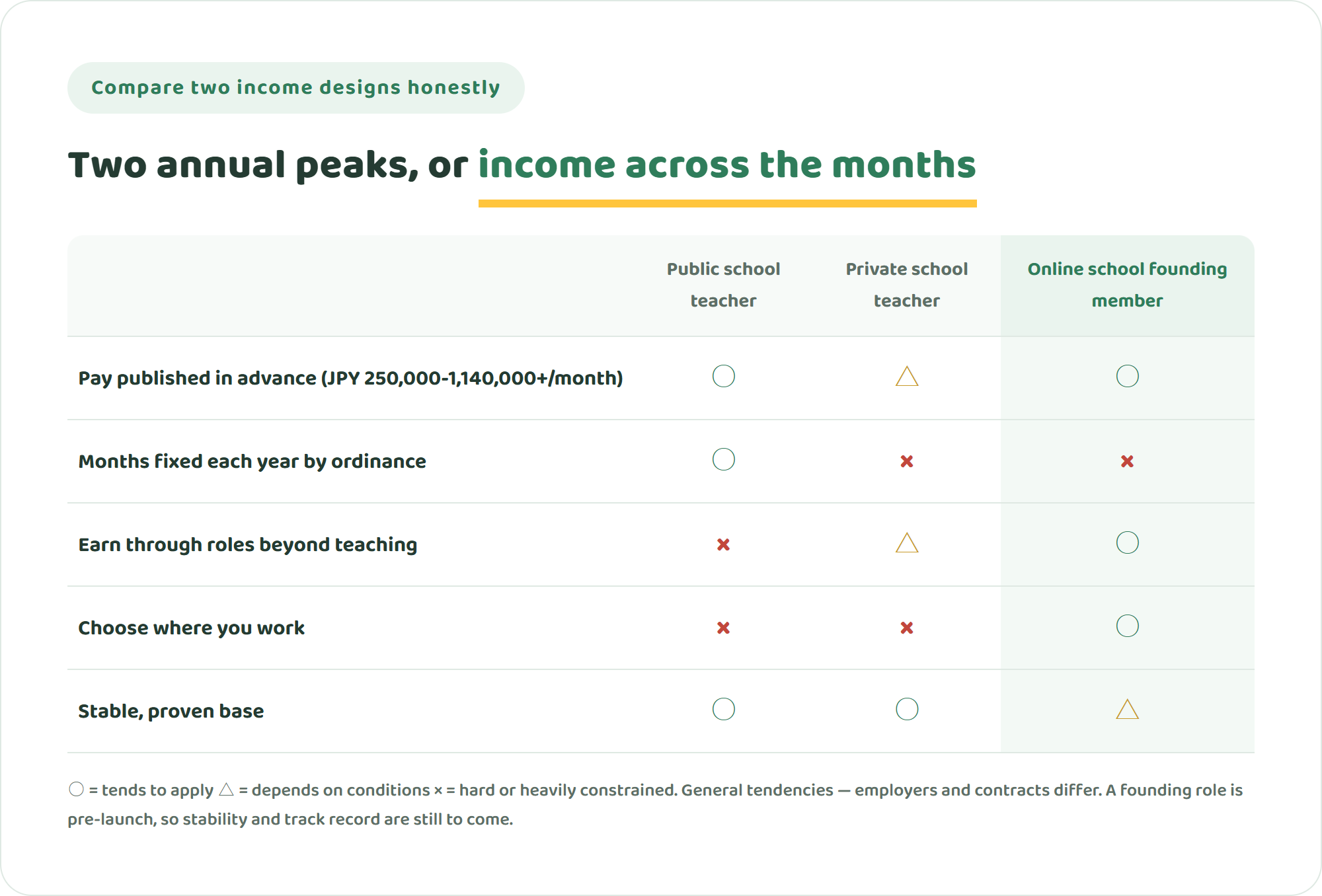
End-of-term and diligence allowances are set every year through a personnel commission recommendation and a local ordinance. You cannot negotiate them upward, but nobody can cut them arbitrarily either, and two predictable peaks make large expenses easier to plan. That is a genuine strength.
The flip side is that the pace of growth belongs to the system rather than to you. The other design spreads income across the months and across several roles: teaching, plus building (materials and curriculum), communicating (outreach and marketing) or connecting (partnerships and operations). The skills teachers accumulate — moving a room of people, structuring complex ideas, reading whether someone has understood — transfer directly.
A third way of working: the terms, stated up front
The hard part of any pay conversation is not knowing the number until you are already inside. The founding members 脱偏差値のオンラインインターナショナルスクール NIJIN GLOBAL ACADEMY (NGA) is recruiting for its September 2027 opening face that directly, even when the answer is uncomfortable: internationally, founding roles begin as volunteer positions ahead of the opening, with detailed terms shared later in the process; five working patterns from part-time to full, with marketing, web, partnerships and HR alongside teaching; and fully remote work designed around travelling the world. We look for English at roughly CEFR B2+ and the appetite to build from zero, experience or not. It is not a universal answer: there is no ordinance guaranteeing your months, and the school has yet to open.
Three steps to check your own figures
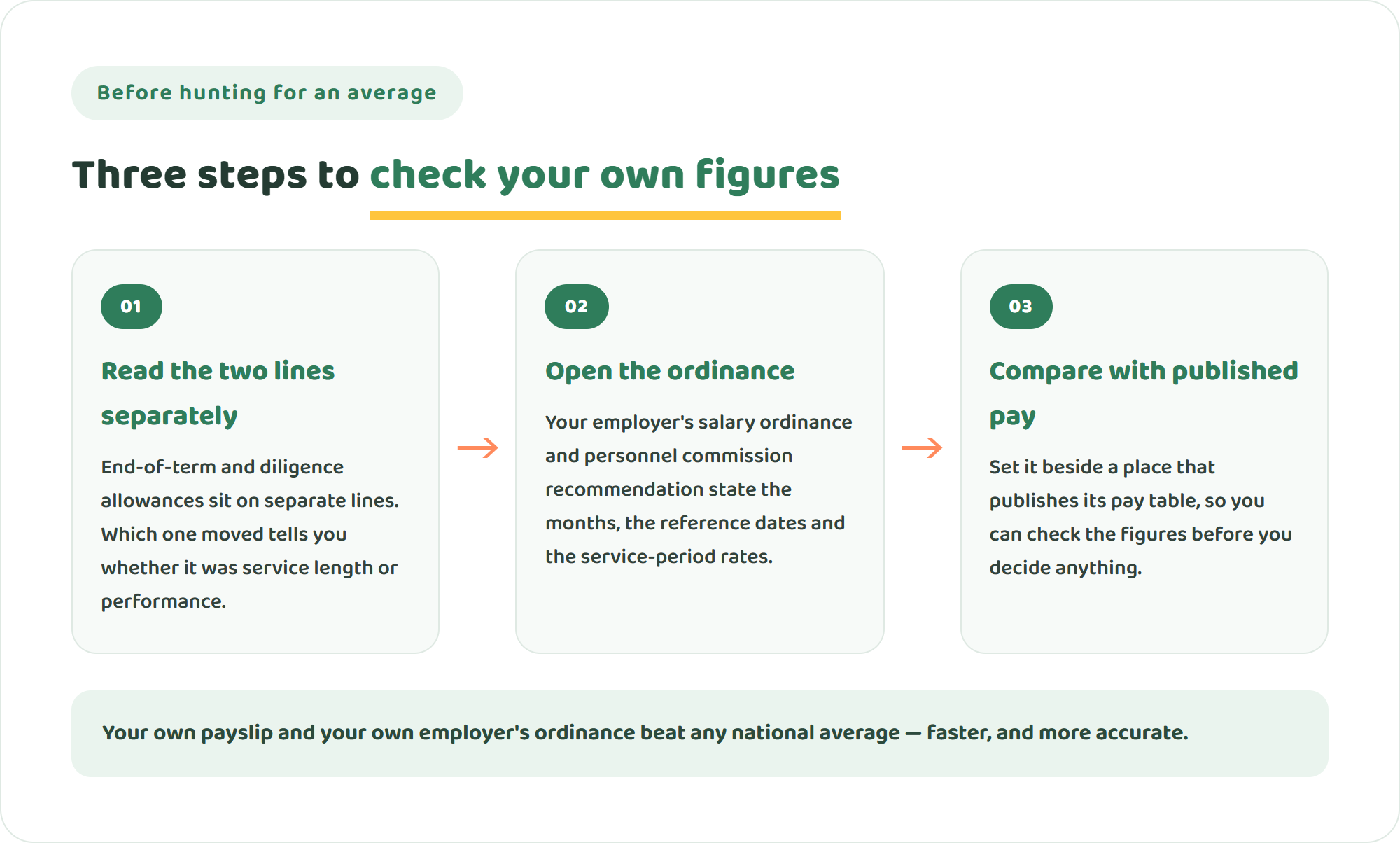
First, read the two allowances separately on your payslip; knowing which one moved tells you whether the cause was length of service or performance. Second, open your employer’s salary ordinance and its personnel commission recommendation, which state the months, the reference dates and the service-period rates. Third, compare against somewhere that states its terms plainly. NGA’s process runs from application to a group interview, an internship at NIJIN Academy and a final presentation, so you can try before you commit.

FAQ
How many months of bonus do teachers in Japan get?
There is no nationwide figure. The published values are 4.65 months for national civil servants (2025 NPA recommendation) and 4.90 months for Tokyo Metropolitan employees including the education service (2025 Tokyo Personnel Commission recommendation). Check the ordinance of the prefecture or designated city concerned.
When are they paid?
The national reference dates are 1 June and 1 December, with payment generally in June and December. For public school teachers the exact dates are set by each employer’s ordinance and rules.
Do private and international schools pay the same?
No. Private schools set their own pay rules by school corporation, so public-sector months do not apply, and international schools differ school by school. For how school pay is structured overall see how much teachers earn, and for the international school side see international school teacher salaries.
A bonus is something you can design, not only look up
If you asked whether teachers in Japan get bonuses, the honest answer is yes — two allowances, twice a year, at a level decided by your own employer’s ordinance rather than by any national rule. Read that ordinance and your own payslip and the number stops being a mystery. And beyond the twice-yearly peaks, there is the option of building income across the months yourself. Keeping the joy of teaching while changing only the design of the income around it is a real choice.
Main sources: National Personnel Authority, 2025 recommendation / Tokyo Metropolitan Personnel Commission, 2025 / NPA Rule 9-40 (e-Gov) / MIC Local Public Service Salary Survey 2025 and others.
Working at an International School — More Articles
- international school teacher salary
- how to become an international school teacher
- career change from teaching
- career change from teaching in your 30s and 40s
- how much do teachers earn?
- how to become an IB teacher
- jobs for moving abroad
- online teaching jobs in Malaysia
- international school staff jobs
- high-paying jobs that use English
- elementary school teacher salary in Japan
- junior high school teacher salary in Japan
- high school teacher salary in Japan
- school principal salary in Japan
- how the Japanese teacher pay scale works
- private school teacher salary in Japan
- online international school teacher salary
- remote teaching jobs from the Philippines
Keep the passion for teaching. Redesign the income around it.