You probably didn’t type “should I send my child to international school” because you wanted a list of pros and cons. You typed it because of a conversation. A parent-in-law said the local school was good enough. A partner said the fees would be better spent elsewhere. A friend at pickup went quiet when you mentioned the open day. Or nobody said anything at all, and the doubt is entirely your own, arriving reliably at about eleven at night.
So here is the honest answer up front. There is no general answer to this question, because international school is not one thing and your child is not a category. What separates a good decision from a hopeful one is not the school type — it is whether the decision starts from your child’s present, and whether you have agreed in advance on the conditions for stopping. This guide gives you five tests you can apply yourself, an honest look at who actually chooses these schools, and what to say when the people around you push back.

Should I send my child to international school? Start with the question underneath
Almost every family arrives at this search with a different real question hidden inside it. Some are asking whether their child will cope. Some are asking whether the money is defensible. Some are asking whether they are being a good parent or an ambitious one. These need different answers, and the generic “pros and cons” article answers none of them.
Before going further, write down the sentence you would use if a stranger asked why you are considering it. If the sentence is about the future and about the world — “English matters now”, “the global economy” — you are still at the general stage. If the sentence contains something that happened in your house last week, you are further along than you think. The difference between those two sentences is the whole subject of this article.
The honest case against it, before anything else
Let’s take the criticism seriously, because parts of it are correct.
Your child did not choose this. A six-year-old does not request an international education. Adults decide, and that is unavoidable — but the phrase “for my child” is used most emphatically in exactly the situations where the child had no say. That is worth noticing rather than dismissing.
Fees make reversing hard. Once a family has committed a significant sum, the sunk cost starts to protect the decision rather than the child. Signs of a poor fit get reinterpreted as an adjustment period. If you read nothing else here, read this: the cost is not only what you pay, it is how much harder it becomes to change your mind.
Parental wishes come first more often than we admit. The wish for a child to be fluent, mobile, at ease in the world usually grows out of something the parent lacked. That feeling is real. It is also, for now, your story rather than your child’s. A decision can start there — it just cannot end there.
If reading that felt uncomfortable, take it as a good sign. The families who never once ask whether this is about them are the ones most likely to get it wrong.
Why this decision feels heavier than it should
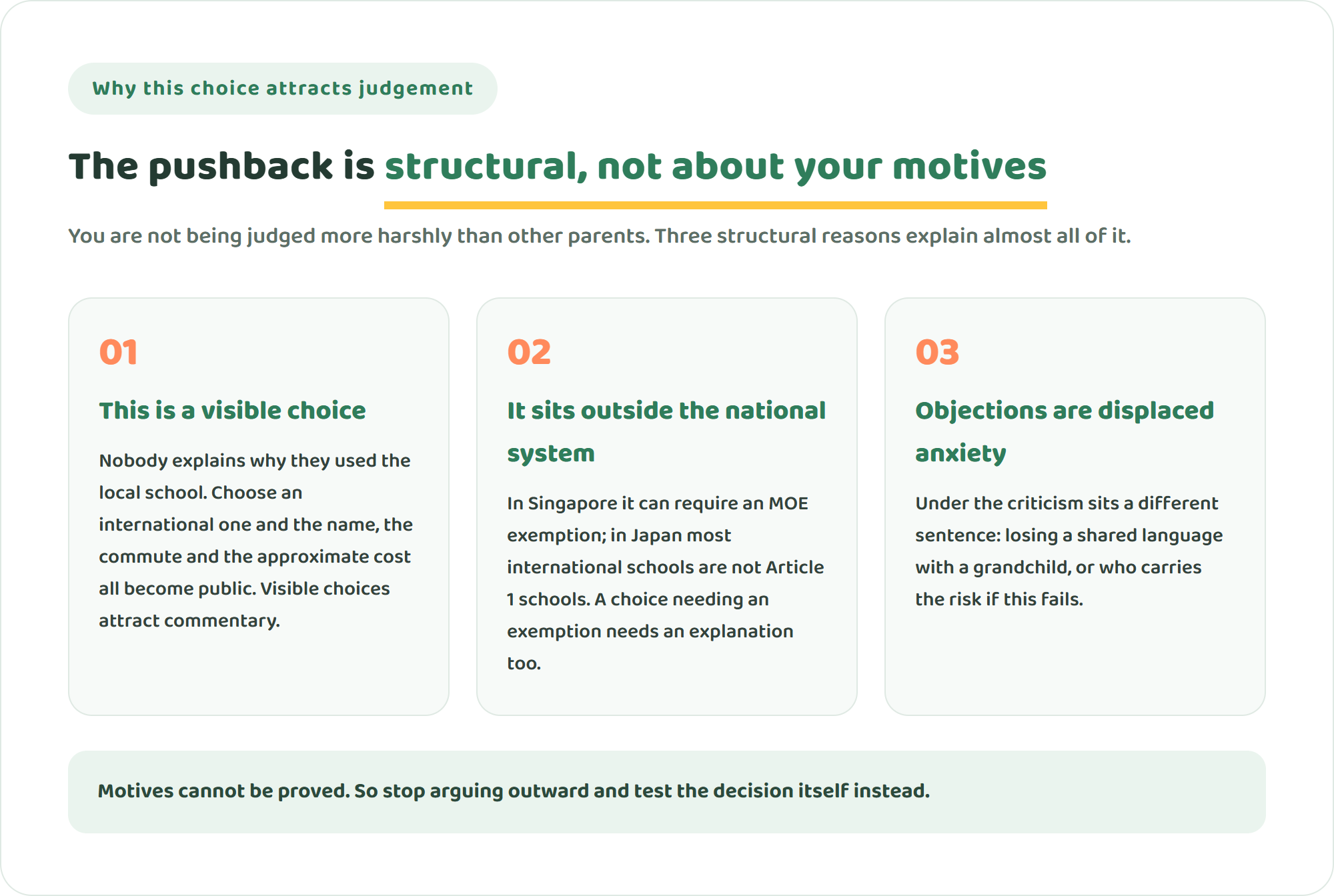
First, this is one of the few school choices that is visible. Nobody explains why they used the local catchment school, because no explanation is required. Choose an international school and the name, the commute, the uniform and the approximate cost all become public. Visible choices attract commentary; invisible ones never do. You are not being judged more harshly than other parents — you are simply being seen.
Second, in most of Asia this choice sits outside the national system. In Singapore, all Singapore Citizens born after 1 January 1996 and living in Singapore must attend a national primary school unless an exemption is granted by the Ministry of Education. In Japan, most international schools are not schools under Article 1 of the School Education Act, and the Ministry of Education states that enrolling a Japanese national in one does not discharge the compulsory schooling obligation. Rules differ by country and by municipality, so check your own before you commit. A choice that requires an exemption will always require an explanation too.
Third, most objections are displaced anxiety. When a grandparent says the fees are indulgent, the sentence underneath is usually about losing a shared language with a grandchild. When a partner objects, it is usually about who carries the risk if it fails. Answer the sentence underneath and the argument changes shape.
Five tests that separate a sound decision from a hopeful one
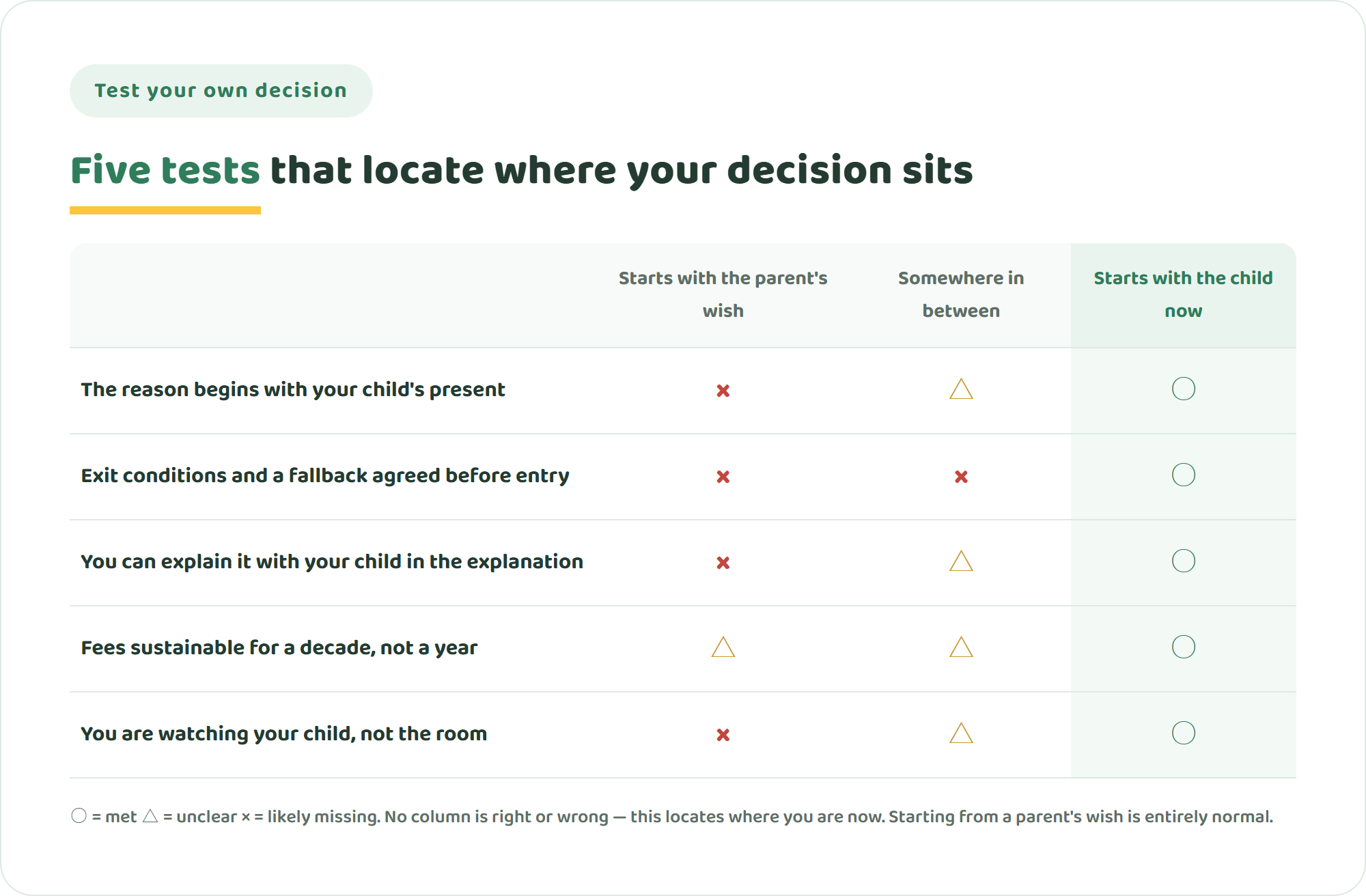
You do not need anyone’s permission to run these. Write the five questions down and answer them honestly.
Test 1: Does the reason begin with your child’s present? “The world is globalising” is a reason about the future and about everyone. “She stopped talking about school in March” is a reason about now and about her. Decisions that begin in the second place are almost always sounder, whatever they conclude.
Test 2: Have you agreed the exit conditions before entry? This is the strongest single predictor. Families who decide in advance — “if this pattern continues for two terms, we stop, and this is where we go back to” — rarely drift. Families who don’t go looking for an exit only once their child is already struggling, with the fees already paid, which is the worst possible moment to think clearly.
Test 3: Can you explain it to your child, with your child in the explanation? Age-appropriately is fine. What matters is whether the explanation contains them. “You get overwhelmed in a class of thirty-five, so we’re looking at somewhere smaller” is an explanation. “It’s better for your future” is an announcement. Their reaction to it will tell you more than any open day.
Test 4: Are the fees sustainable for a decade, not a year? Briefly, because the cost question deserves its own article. The number to test is not what you can afford now, but what you can pay calmly through a job change or a currency move. Withdrawing for financial reasons is a specific kind of damage: children tend to read it as being about them.
Test 5: Are you watching your child, or the room? After a school visit, what surfaces first — the facilities, or your child’s face as they walked into the classroom? When a decision starts serving the parent, the parent’s attention has already moved off the child and onto other adults. For the mechanics of narrowing a shortlist, how to choose an international school covers the practical filters.
See how learning works online →
Who actually sends their children to international school?
Part of the doubt is a suspicion that these schools are for other people — wealthier, more international, more certain. It is worth checking that assumption against what the sector actually looks like now.
ISC Research, which tracks the sector globally, puts it at more than 15,000 schools and 7.7 million students, with growth increasingly driven by local family demand. In much of Asia, the international school is no longer primarily a school for diplomats’ children. In Kuala Lumpur, Bangkok and across the region, an increasing share of demand appears to come from families who live there permanently and are choosing a curriculum rather than following a posting.
In broad terms, and without claiming statistics that do not exist, families tend to fall into a handful of patterns:
- Mobile families — a posting that may end or extend without warning, making continuity the deciding factor rather than prestige.
- Multilingual households — one parent educated in another language or country; the school is being matched to the home, not the reverse.
- Parents working in international environments — research, aviation, tech, multinationals. Less about income than about having seen the world their child will enter.
- Self-employed and business-owning families — flexible enough to choose a format rather than accept the nearest option.
- Families whose child is not thriving where they are — the least-discussed group, and one of the largest.
- Families planning on university abroad — working backwards from a destination.
On that fifth group, one figure. Japan’s Ministry of Education reported that school non-attendance among primary and lower secondary students rose for a twelfth consecutive year, to roughly 354,000 children. Japanese families living in Singapore, Malaysia or Thailand often arrive at an international school for exactly this reason rather than an aspirational one. What these families share is not an income bracket or a profession. It is that something about their situation is not explained by the default option.
What to say when family or friends push back
Do not argue about educational philosophy. You cannot prove a motive, and the attempt makes you sound defensive. Three things work better.
Offer one observation instead of an argument. “Three mornings a week he says his stomach hurts.” Observations cannot be debated the way opinions can, and they return the conversation to the actual child.
State your exit conditions unprompted. Naming in advance what would make you stop is the fastest way to show you are not on a runaway train — which is what most objectors are actually afraid of.
Name the other person’s worry before they do. “You’re worried he’ll lose his Japanese.” “You’re worried we can’t sustain the fees.” Anxiety that has been named out loud rarely arrives as an attack. With grandparents in particular, most opposition turns out to be concern wearing a harsher face.
You may still not convince everyone. That is allowed. The decision belongs to the people who see the child every day.

Three things to do before you decide
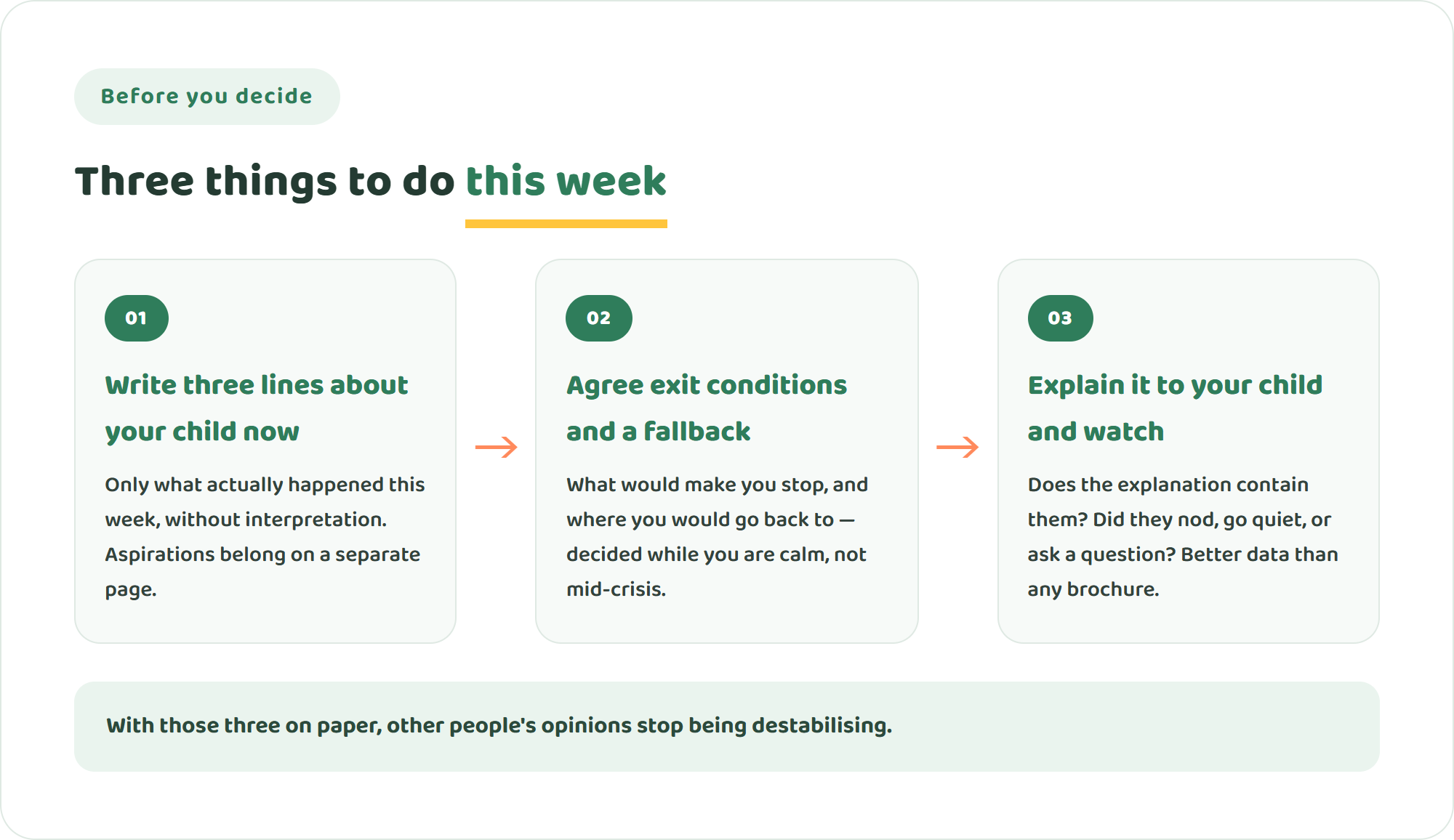
1. Write three lines about your child now. Only what actually happened this week, without interpretation. Aspirations go on a separate page. 2. Agree the exit conditions and the fallback. What would make you stop, and where would you go back to — decided while you are calm, not while your child is struggling. 3. Explain it to your child and watch what happens. If you want to know what tends to go wrong afterwards, the families who regret it are unusually consistent about which warning signs they ignored.
A third option: when the price stops making the decision for you
Notice how much of the criticism in this article rests on cost. Fees make the choice irreversible. Fees make it visible. Fees make the family choosing it look unlike everyone else. Lower the number, and most of the objection loses its grip.
NIJIN GLOBAL ACADEMY opens in September 2027 and is being designed around exactly that. It is an online international school built without ranking children by test scores, with small groups and discussion — starting from “what do you think?” — at the centre of learning. It serves children aged 6 to 18 across Asia and Oceania, wherever they live, with a design that supports the home language while English is introduced gradually. Fees are targeted at around one-fifth of typical in-person international school tuition. It is run by NIJIN Inc. in Japan, whose alternative school NIJIN Academy enrols more than 900 children.
Honestly: online is not the same as a playground, and it does not replicate the incidental contact of a physical campus. The school has not opened yet, so there is no track record to show you. Compulsory schooling rules still apply as described above, and you should check them locally. But a fee you can sustain, and a decision you can reverse, together turn this from a statement about the parents into an ordinary practical option.
Frequently asked questions
Is international school worth it for my child specifically?
The honest answer is that no article can tell you. What can be tested is your decision: does it begin with your child’s current situation, do you have exit conditions, can you explain it to them, and are the fees sustainable for a decade? A yes to those makes the decision sound regardless of which school you pick.
At what age is it best to start?
It varies by child and by school, and admissions requirements differ, so treat any single rule with suspicion. Generally, earlier entry eases language transition while later entry preserves stronger home-language foundations. The more useful question is what your child is capable of absorbing right now, alongside everything else in their life.
What kind of families send their children to international schools?
Increasingly ordinary ones. Sector data shows growth increasingly driven by local families rather than by expatriate postings alone. The recognisable patterns are mobile families, multilingual households, parents in international fields, self-employed families, families whose child is not thriving locally, and those planning on university abroad.
Will my child lose their home language?
It is a real risk, not a certainty, and it depends heavily on what happens at home rather than at school. Families who keep reading, arguing and joking in the home language generally hold it. Ask any school you visit what it actively does to support home languages, and treat a vague answer as an answer.
What if my own English isn’t strong?
It is not a disqualification. What matters practically is whether the school communicates with parents in a language you can act on — ask about report formats, parent meetings and day-to-day messaging before you enrol.
Can we change our minds later?
Usually yes, and planning for it makes the whole decision safer. Confirm before enrolling how re-entry to the national system works where you live, what documentation is needed, and how mid-year withdrawal affects fees. A family with a mapped route back rarely needs to use it.
The fact that you are hesitating is the point.
Parents who genuinely interrogate their own motives are rarer than you would think. Most people decide and move on. Reading this far, late, on a question nobody is grading you on, is itself evidence that your child is at the centre of it. The people offering opinions do not know that about you.
When your reason shifts from “English opens doors” to “this is how she is at the moment, and this is when she comes alive”, the decision stops belonging to you and starts belonging to her. Wanting more for your child is not a fault. The only thing that matters is whether the wish has been connected to who they actually are right now. Three lines on paper about this week is enough to start.
NIJIN GLOBAL ACADEMY opens in September 2027. We’ll share how small-group, discussion-led learning is designed to work, and send first-intake news early, by email.
Honest Answers to Your Worries — related reading
- Will My Child Lose Their Mother Tongue?
- The Honest Pros and Cons of International School
- Disadvantages of Bilingualism in Childhood: Myths vs Research
- Who Regrets International School — and Who Doesn’t
- International School Special Needs: What to Look For
- International School vs Local School: How to Decide
- Does International School Hurt Your Child’s Home Language?
- When Your Child Is Struggling at International School
- Do International Schools Make Children Fluent in English?
- Is International School Worth It? What Happens to Graduates
- Transfer From a Local School to an International School
- Disadvantages of Early English Education: What Research Says
- What Happens to International School Graduates