If you searched “international school staff jobs,” you are probably looking for a way into international education that does not involve standing at the front of a classroom. You want to support the school — admissions, office administration, communications, IT, finance. And if you searched in Japan, the suggestions that came with it were almost certainly place names: staff jobs in Tokyo, in Osaka, in Yokohama. That pairing tells the whole story. Most people are searching for two things at once: a role and a location. This article covers what non-teaching school roles actually involve, how to read pay ranges honestly, how the search differs across Tokyo, Osaka and Yokohama — and a third option where the commute radius stops mattering at all.
One firm number up front. We are NIJIN GLOBAL ACADEMY (NGA), an online international school opening in September 2027, and we are straight about how the international track starts: founding roles begin as volunteer positions ahead of the opening, with the detailed terms shared later in the process. You choose your involvement from five working styles (part-time through full-time), and beyond teaching you can take on marketing, web, partnerships or HR (specifics are discussed during selection). What we will not do is state a going rate for school administration jobs across the industry. Keeping published figures and figures that need caveats separate is the first discipline of a good job search.
International school jobs are not only teaching jobs
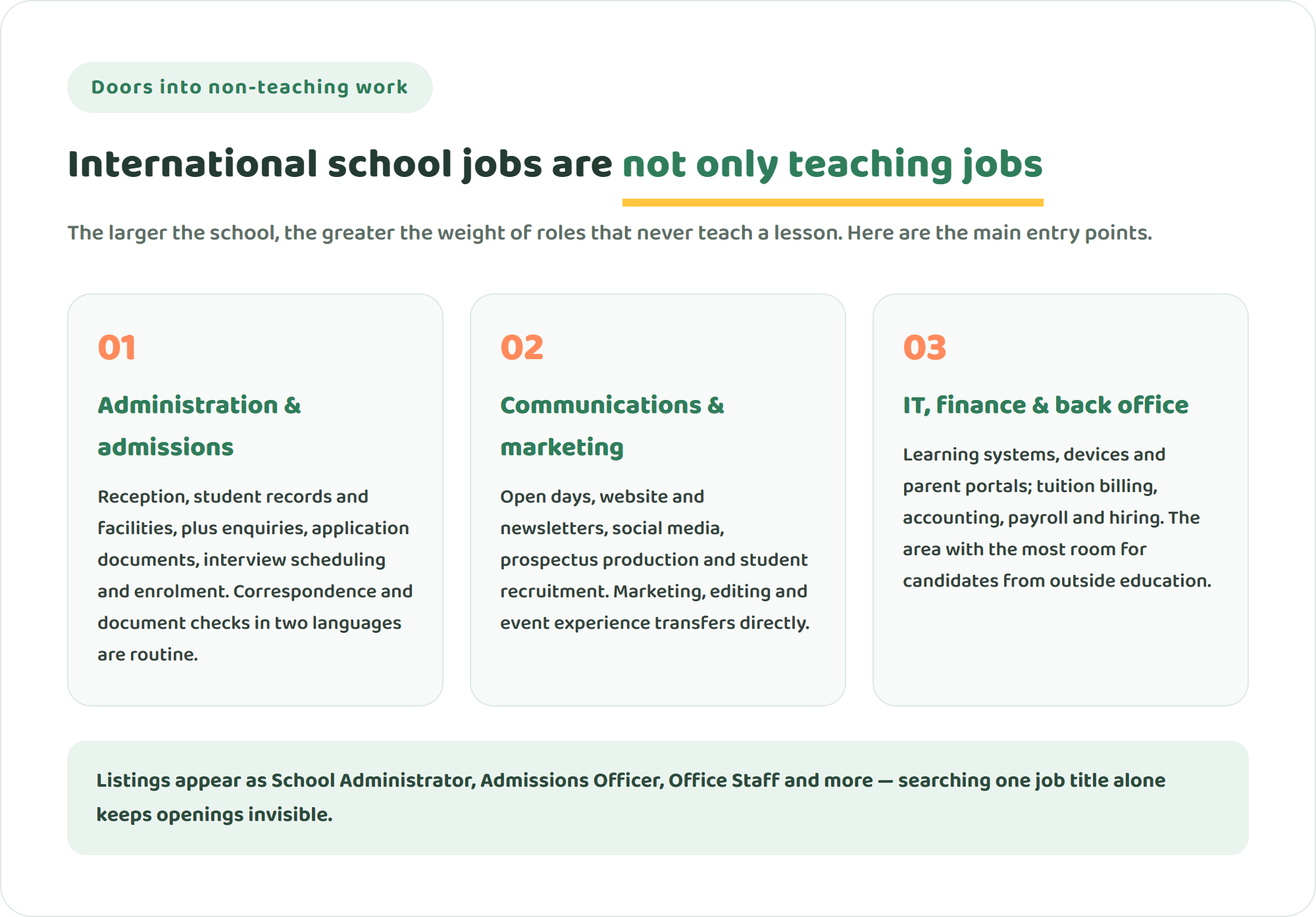
A school does not run on teachers alone. The larger the school, the greater the weight of the roles that never teach a lesson. Listings appear under titles like School Administrator, Admissions Officer, Office Staff, Communications Manager or School Secretary — so searching for a single job title will always leave openings invisible to you. Here are the main entry points.
Office administration and admissions
Reception, phone and email handling, student records, facilities and supplies — plus admissions: enquiries, application documents, interview scheduling and enrolment. Because families relocating from abroad are a constant part of the flow, these roles usually involve handling correspondence in English and checking documents in two languages. It is the first face of the school a family ever meets.
Communications and marketing
Open days and information sessions, website and newsletter updates, social media, prospectus production — and student recruitment itself. Enrolment is the lifeblood of a school, so experience in marketing, editing or event management from outside education transfers directly here.
IT, finance and back office
Learning management systems, devices and parent portals on the IT side; tuition billing, accounting, payroll and hiring on the finance and HR side. This is the area where a candidate with no education-sector background has the most room to apply on the strength of ordinary professional skills.

How to read the pay range — and why we will not quote a going rate
Pay is what you most want to know. Honestly, though: there is no single going rate for non-teaching school roles. Listings show salaried full-time posts, hourly part-time posts and annually renewed contracts, and the ranges differ by employment type as much as by anything else. Even within “administration,” a reception-centred post and a head of admissions or communications manager with real budget and discretion sit at different levels. It varies by school size, employment type, language requirement and years of experience — that is the honest answer.
So carry a way of reading a listing rather than a number in your head. Three things matter. First, employment type and contract length — permanent, or annually renewed, and is there a renewal cap? Second, how specific the language requirement is — “English an advantage” and “business-level English required” describe very different jobs. Third, whether a pay range is published at all. Being able to check the money before you decide feeds straight into how you plan your life.
That is also why we would rather be blunt about our own terms than dress them up. On the international track, founding roles begin as volunteer positions ahead of the 2027 opening, and the detailed terms are shared later in the process. What you can choose from the start is the shape of the role — business work such as marketing, web, partnerships and HR alongside teaching. We are pre-launch, and this is the least comfortable thing to say about it. But knowing how the role actually starts is something we would rather say first than last.
Searching by region: how Tokyo, Osaka and Yokohama differ
Those place-name searches exist for a reason. A campus-based international school has a physical building, and administrative staff are generally expected there every working day. The volume and variety of openings is therefore tied hard to where you live.
Tokyo has by far the deepest market. Schools cluster in the central wards, and roles are specialised enough — admissions, communications, IT — that you can apply on a specific skill. The trade-off is competition. Checking each school’s own Careers page on a regular cycle beats waiting for aggregators.
Osaka and the wider Kansai region has fewer schools, so the openings themselves appear less often, clustering around the turn of the academic year. The stance that works is readiness to move fast when one appears. With fewer staff per school, roles often span administration, communications and IT at once — good if your strength is breadth.
Yokohama combines long-established schools with easy access to Tokyo. In practice it is worth treating Tokyo and Kanagawa as a single commuting area, which widens the field. But commuting is a real cost: an hour each way is several hundred hours a year spent moving.
Which raises the obvious question. What if you live in none of those three? No international school nearby, or family reasons that rule out relocating. As long as the school has a campus, that unfairness does not go away. We would rather say so plainly.
Removing the commute radius: the online international school option
This is the part we most wanted to write. At an online international school, the commuting radius stops existing. Tokyo, Osaka, Yokohama, Hokkaido, Okinawa, or another country entirely — you apply for the same administrative and operations roles on the same terms. There is no building, so “there is no school near me” stops being a reason to give up. For anyone who wants to work from home, and for anyone who has quietly wanted to see more of the world, that changes the premise of the job itself.
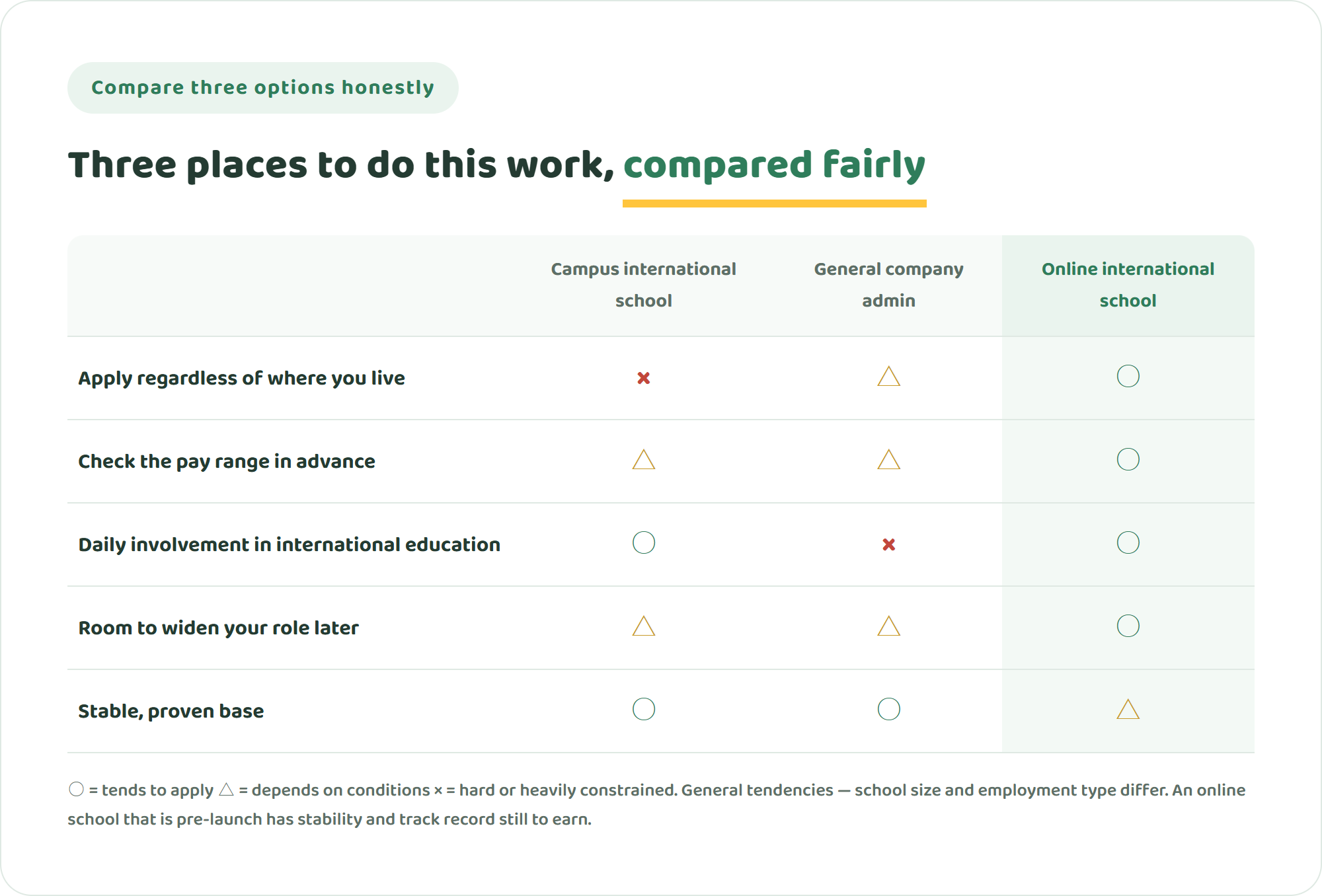
At NIJIN GLOBAL ACADEMY we are recruiting founding members ahead of our September 2027 opening. The work is fully remote with no assigned location. What we ask for is English at roughly CEFR B2+ and, even with no sector experience, an appetite for building from zero. The administration, communications, IT and finance skills you built elsewhere are exactly what starting a school requires. NGA is part of the NIJIN group of eleven companies.
See NIJIN GLOBAL ACADEMY’s founding-member roles → — internationally these roles begin as volunteer positions ahead of the opening, with detailed terms shared later; better to know that before you decide whether to apply.
Three steps to applying for a non-teaching role
A practical order for making the move.
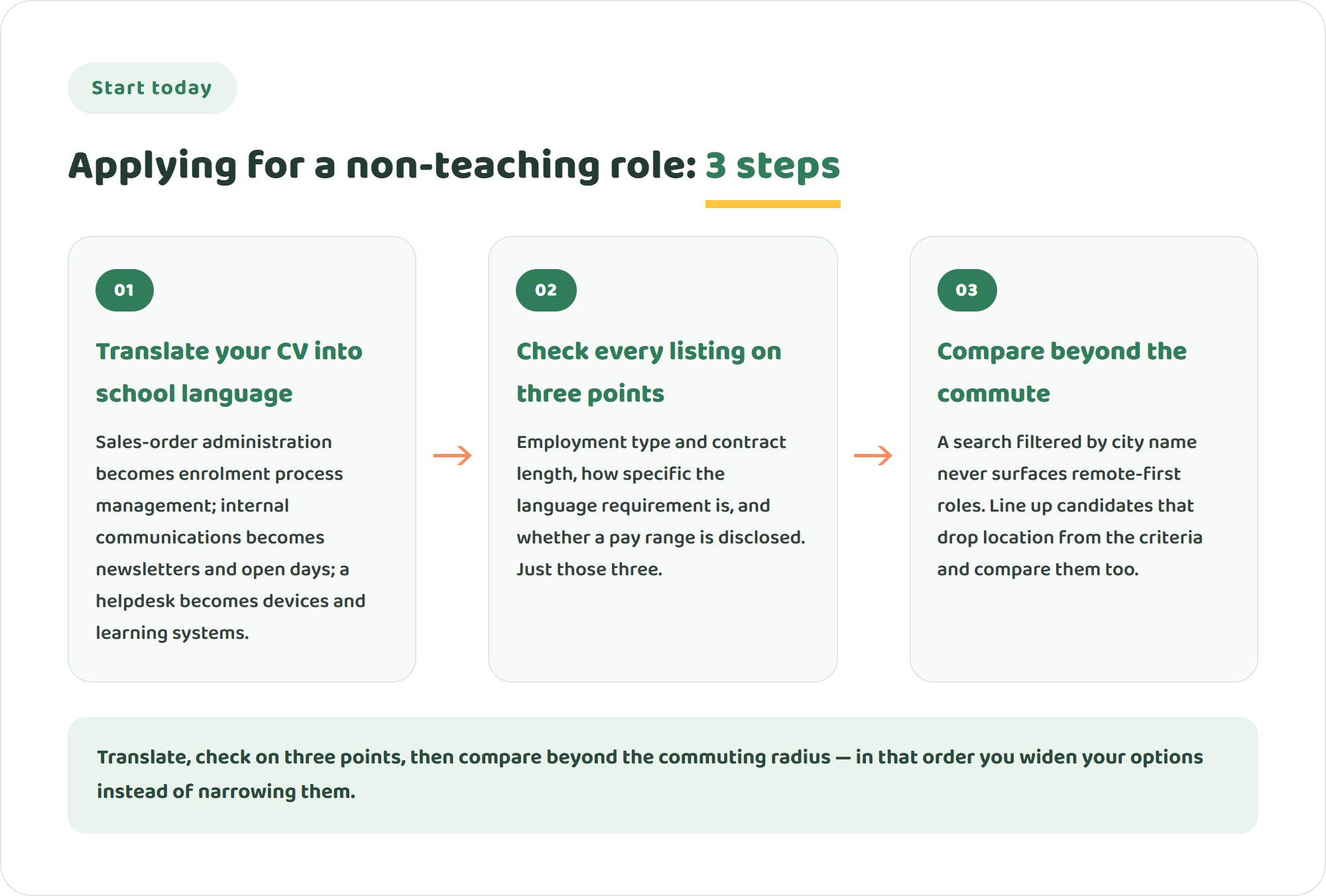
First, translate your CV into school language. Sales-order administration becomes enrolment process management; internal communications becomes newsletters and open days; an IT helpdesk becomes devices and learning systems. Second, check every listing on three points — employment type and contract length, how specific the language requirement is, and whether the pay range is disclosed. Third, compare options that are not bounded by a commute, because a search filtered by city name never surfaces remote-first roles. It is worth reading our guides to international school jobs more broadly and to working at an online school alongside this one.
Frequently asked questions
I have no education-sector experience. Can I still apply for an administrative role?
It varies by school, but administration, communications, IT and finance are the areas where outside professional experience carries the most weight. What NGA asks for is people who can build from zero — we look at whether you can design a system and run it, more than at where you have worked.
How much English do I need?
Because parent correspondence and document checks routinely happen in English, most listings ask for a solid reading and writing level. For NGA founding members the guide is CEFR B2+ — not native fluency, but a level you can work in and keep growing.
What do these jobs pay?
There is no single rate; it varies widely by school size, employment type and scope of responsibility. Check base pay, allowances and employment type listing by listing. For NGA, the international founding-member track begins as a volunteer role ahead of the 2027 opening, and detailed terms are shared later in the process.
I live outside Tokyo, Osaka and Yokohama. Is there anything for me?
Campus schools are bound by the commute, but an online international school is not bound by where you live. NGA is fully remote with no assigned work location, so you apply on the same terms from any city.
The school opens in September 2027. Can I apply now?
Yes — preparing for the opening is the founding member’s work. Selection runs from application to a group interview, an internship at NIJIN Academy, and a final presentation, with applications via a Google Form. The internship means you can try before you decide.

Supporting the school is international education work too
If you searched “international school staff jobs,” you want to help build the place where children connect with the world — without needing a classroom of your own to do it. That contribution holds a school up just as much as teaching does. May it not be limited by whether a school happens to exist near your home. Where you put your experience is your decision to make.
Working at an International School — More Articles
- international school teacher salary
- how to become an international school teacher
- career change from teaching
- career change from teaching in your 30s and 40s
- how much do teachers earn?
- how to become an IB teacher
- jobs for moving abroad
- high-paying jobs that use English
- elementary school teacher salary in Japan
- junior high school teacher salary in Japan
- high school teacher salary in Japan
- school principal salary in Japan
- how the Japanese teacher pay scale works
- teacher bonuses in Japan
- private school teacher salary in Japan
- online international school teacher salary
- remote teaching jobs from the Philippines
- online teaching jobs in Malaysia
Build an international school with the skills you already have.