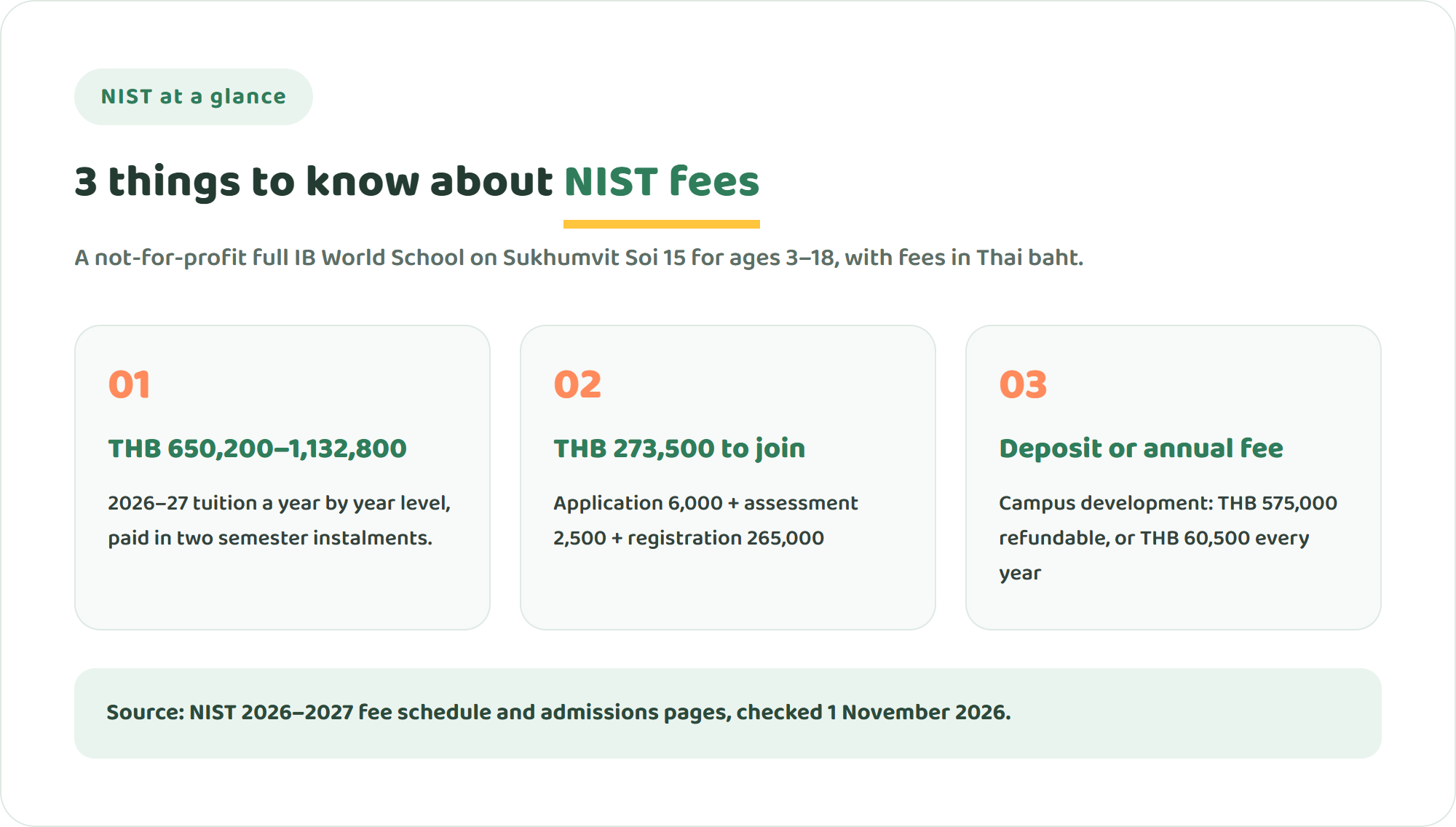
NIST International School tuition for 2026–27 ranges from THB 650,200 a year in Early Years to THB 1,132,800 a year in Years 12–13, paid in two equal semester instalments (official Tuition & Fees page and the “NIST International School Fees: 2026–2027 Academic Year” schedule linked from it, checked 1 November 2026). A new student also pays a THB 6,000 application fee, a THB 2,500 assessment fee and a one-time THB 265,000 registration fee, and every family must choose between a refundable THB 575,000 campus development deposit or a non-refundable THB 60,500 annual campus development fee. For a new Year 12 student on the annual option, year one therefore comes to THB 1,466,800, before uniforms, food, the bus and exam entries.
If you searched “NIST International School fees” or “NIST Bangkok tuition”, you are probably a family moving to Bangkok on a diplomatic, NGO or corporate posting, or a Bangkok-based family comparing Thailand’s first full IB World School with Bangkok Patana, International School Bangkok (ISB) and Shrewsbury. You want the real numbers in one place, what the campus development choice actually means, what is included, how entry works and how NIST compares with nearby schools. This page answers from NIST’s official site and fee schedule first, then compares it fairly with other Bangkok schools and with NIJIN GLOBAL ACADEMY — a different kind of option: an online international school for Asia and Oceania that opens in 2027. For the wider field, see our guide to international schools in Bangkok.
The short answer: who NIST International School suits — and who it doesn’t
- Suits: families who want the full International Baccalaureate continuum on one campus — the Primary Years Programme (PYP), Middle Years Programme (MYP) and Diploma Programme (DP) — from age 3 to 18.
- Suits: families who want a central location. NIST is at 36 Sukhumvit Soi 15, minutes from Asok BTS and Sukhumvit MRT, with a free shuttle from the station and many families living within walking distance.
- Suits: internationally mobile families who value diversity and a not-for-profit model. The school was founded in 1992 through the efforts of United Nations families and says it invests all fee income in its operations and campus.
- Suits: younger children still learning English. NIST accepts beginner English learners in elementary school and states that it does not charge an extra fee for EAL support.
- Harder fit: secondary students who are beginners in English. The official FAQ says secondary support is only available for intermediate and advanced English learners.
- Harder fit: families who need a scholarship or financial aid — none is published on the official site — or who may leave mid-semester, because tuition is not refunded if a student leaves before the end of a semester.
- Harder fit: families needing a guaranteed place at short notice. The admissions page says NIST “may not have available space” and uses a wait pool.

What NIST International School is
NIST opened its gates on 13 August 1992 with 502 students. According to its history page, it was set up by parents, students and teachers working with members of the United Nations who wanted a school “free from any one national curriculum”, and by 1999 it was offering all three IB programmes. It describes itself as Thailand’s first full IB World School and “one of the few not-for-profit international schools in the country with strong ties to the diplomatic community”. Today the official site lists over 1,800 students aged 3–18 (different official pages give from 75 to over 90 nationalities; the admissions FAQ says about 25% of students are Thai nationals) and 500+ staff.
The campus covers 25 rai (about 4 hectares) in the Sukhumvit business district, with ten buildings and more than 90 classrooms. NIST is a day school with no boarding; students must live with a parent or a legal guardian appointed by their parents, within commuting distance. Year levels follow the British-style numbering: Early Years 1–2 (ages 3–4), Years 1–6 in the PYP, Years 7–11 in the MYP and Years 12–13 in the DP. NIST’s official conversion chart for 2026–27 places Year 1 alongside US kindergarten and Year 13 alongside US grade 12.
| Item | NIST International School (official) |
|---|---|
| Type | Private, not-for-profit, co-educational IB day school (no boarding) |
| Founded | 1992 (opened 13 August 1992) |
| Ages / year levels | Early Years 1 (age 3) to Year 13 (age 17–18) |
| Campus | 36 Sukhumvit Soi 15, Klongtoey-nua, Wattana, Bangkok 10110 (25 rai) |
| Curriculum | IB PYP, MYP and DP; NIST High School Diploma; Global Citizen Diploma; International Award |
| Students | Over 1,800 aged 3–18 |
| Accreditation | IB World School; CIS; NEASC; ONESQA (Thailand). Its DP page also states the NIST Diploma is accredited by CIS and WASC |
| Tuition 2026–27 | THB 650,200 to THB 1,132,800 a year |
NIST International School fees (2026–27, official)
NIST publishes a three-page schedule, “NIST International School Fees: 2026–2027 Academic Year”, linked from its Tuition & Fees page. It states that “all fees and figures are in Thai baht (THB)”. Every figure below comes from that schedule or the official admissions pages, checked 1 November 2026. Third-party listings for NIST often mix years, so we use only the school’s own documents.
Annual tuition by year level
| Year level (approx. US grade) | Semester 1 (THB) | Semester 2 (THB) | Tuition for the year (THB) |
|---|---|---|---|
| Early Years 1–2 (pre-school, ages 3–4) | 325,100 | 325,100 | 650,200 |
| Year 1 (kindergarten) | 420,250 | 420,250 | 840,500 |
| Years 2–6 (grades 1–5) | 444,600 | 444,600 | 889,200 |
| Years 7–9 (grades 6–8) | 478,000 | 478,000 | 956,000 |
| Years 10–11 (grades 9–10) | 519,450 | 519,450 | 1,038,900 |
| Years 12–13 (grades 11–12, IB Diploma) | 566,400 | 566,400 | 1,132,800 |
Semester payments are due on fixed dates: Wednesday 1 July 2026 for Semester 1 and Tuesday 1 December 2026 for Semester 2. Overdue payments incur a 1.25% per month surcharge, and all fees must be paid before a student can attend. Students joining after the year has begun pay pro-rated tuition based on their entry date.
One-time fees and the campus development choice
| Fee | Amount (THB) | Official note |
|---|---|---|
| Application fee | 6,000 | Non-refundable; paid with the full application; does not guarantee a place |
| Assessment fee | 2,500 | Non-refundable; paid at the time of assessment |
| Registration fee | 265,000 | One-time, non-refundable; paid on acceptance |
| Campus development deposit (option 1) | 575,000 | Refundable within 45 days of withdrawal, net of any outstanding bills |
| Annual campus development fee (option 2) | 60,500 per year | Non-refundable; paid every year; 50% (30,250) for second-semester joiners |
| IB Diploma examination fee (Year 13 only) | Approximately 25,000 | Charged at cost by the IB, collected by NIST |
| Sibling discount | Not published on the official site | — |
The campus development choice is the decision most families miss. The deposit ties up THB 575,000 but comes back when you leave; the annual fee costs THB 60,500 a year and never comes back. Ignoring interest and exchange rates, the deposit only works out cheaper if your child stays roughly ten years (575,000 ÷ 60,500 ≈ 9.5). For a typical three-year posting, the annual fee costs THB 181,500 in total but keeps over half a million baht in your account.
What is included — and what is extra
NIST’s schedule states that stationery and basic materials, books, computers and devices (including a personal MacBook Air for every secondary student) and curriculum-related field trips are “provided by the school at no additional cost”, along with basic personal accident insurance. EAL support carries no extra fee. The following are extra:
| Item | Official cost |
|---|---|
| Uniform | “Approximately THB 5,000 per child” (admissions FAQ); bought at the NIST Shop |
| Elementary meal plan (Early Years – Year 6) | Approximately THB 25,000 per school year |
| Secondary food | Students typically spend THB 130–150 per day |
| Shuttle from Asok BTS / Sukhumvit MRT | Free |
| Montri door-to-door bus | Not published on the official site (fees set by Montri) |
| External exams (MYP Certificate, SAT, TOEFL etc.) | Invoiced separately; amounts not published |
| Laptop insurance | Optional; price not published |
| Individual support (allied health or Student Support Coach on an IEP) | Added per semester; rates available from NIST accounting |
| Extra parent ID card | THB 300 each |
A worked total-cost example (official numbers only)
One child joining Year 12 for the two-year IB Diploma, annual campus fee. Year one: 1,132,800 + 6,000 + 2,500 + 265,000 + 60,500 = THB 1,466,800. Year two: 1,132,800 + 60,500 + about 25,000 DP exam fees = about THB 1,218,300. With the deposit instead, year one is THB 1,981,300, of which 575,000 is refundable.
Two children starting together in Year 3 and Year 8, annual campus fee. Year 3: 889,200 + 273,500 + 60,500 = THB 1,223,200. Year 8: 956,000 + 273,500 + 60,500 = THB 1,290,000. Year one for the family is THB 2,513,200, plus uniforms and the meal plan.
Four years from Year 10 to graduation, if 2026–27 fees stayed flat (they usually rise): 1,372,900 + 1,099,400 + 1,193,300 + 1,193,300 = THB 4,858,900, plus about 25,000 for IB exams. NIST does not publish prices in other currencies. At the open.er-api.com mid-market rate of 1 THB = 0.029635 USD (31 October 2026), THB 1,132,800 is about US$33,570, the Year 12 first-year total is about US$43,470 and the four-year example about US$144,000.
Refunds
The schedule is strict: “NIST will not refund tuition fees if the student leaves the school prior to the end of a semester”, and it will not discount fees if a family plans to leave part-way through. In a force majeure closure, no fees are refunded. The deposit, if chosen, is returned within 45 days of withdrawal, net of outstanding bills.
NIST fees vs nearby schools: Bangkok Patana, ISB and Shrewsbury
Most families who look at NIST also look at three other large Bangkok schools. Each publishes 2026–27 fees on its own site, and each structures them differently, so compare the year-one total rather than tuition alone. Figures below are for a new student in NIST’s Year 12 (US grade 11), using each school’s cheapest one-time route and counting refundable deposits separately.
| School (curriculum) | Tuition 2026–27, entry year | Senior-year tuition | One-time fees for a new student | Year-one total, Year 12 / grade 11 |
|---|---|---|---|---|
| NIST (IB PYP–MYP–DP), Sukhumvit Soi 15 | THB 650,200 (Early Years) | THB 1,132,800 (Years 12–13) | Application 6,000; assessment 2,500; registration 265,000; plus 60,500 a year or 575,000 refundable deposit | THB 1,466,800 |
| Bangkok Patana School (British curriculum, IGCSE, IB Diploma) | THB 515,000 (Nursery) | THB 1,014,000 (Year 12); 749,000 (Year 13, two terms) | Application 5,500; entrance 250,000 (200,000 for second and later children); refundable deposit 50,000; capital assessment fee 30,000 a year | THB 1,299,500 + 50,000 refundable deposit |
| International School Bangkok (American, AP and IB), Nichada Thani, Nonthaburi | THB 659,000 (Pre-K) | THB 1,197,000 (grades 9–12) | Application processing 4,700; registration 260,000; annual fee 22,000; ISA membership 10 | THB 1,483,710 |
| Shrewsbury International School Bangkok (British, IGCSE, A Level) | THB 696,300 (Nursery, City Campus) | THB 1,256,700 (Year 12); 837,800 (Year 13, two terms) | Application 5,000; guaranteed place fee 225,000; refundable deposit 225,000 | THB 1,486,700 + 225,000 refundable deposit |
Three things stand out. First, NIST’s senior tuition sits between Patana and ISB, but its one-time fees are among the highest unless you pick the annual campus fee. Second, Patana and Shrewsbury charge only two terms in Year 13 (and both in Year 11), while NIST and ISB charge a full year. Third, inclusions differ: Patana includes primary lunch and residential visits; Shrewsbury includes lunch, snacks and books; NIST includes books, devices and curriculum field trips; ISB’s page lists fees without an inclusions list. Sources: Bangkok Patana School Fees Announcement 2026/27, ISB 2026/27 School Fees Schedule and Shrewsbury Bangkok fees 2026-27, checked 1 November 2026. Our Bangkok Patana School fees review covers Patana in the same detail.
Scholarships, discounts and entry requirements
Scholarships and financial aid: not published on the official site. NIST’s fee schedule and admissions pages do not mention scholarships, bursaries or a sibling discount (Patana and Shrewsbury both publish third-child discounts; Shrewsbury also runs a scholarship programme). If your employer pays school fees, ask HR which of the one-time fees and the campus development option they cover.
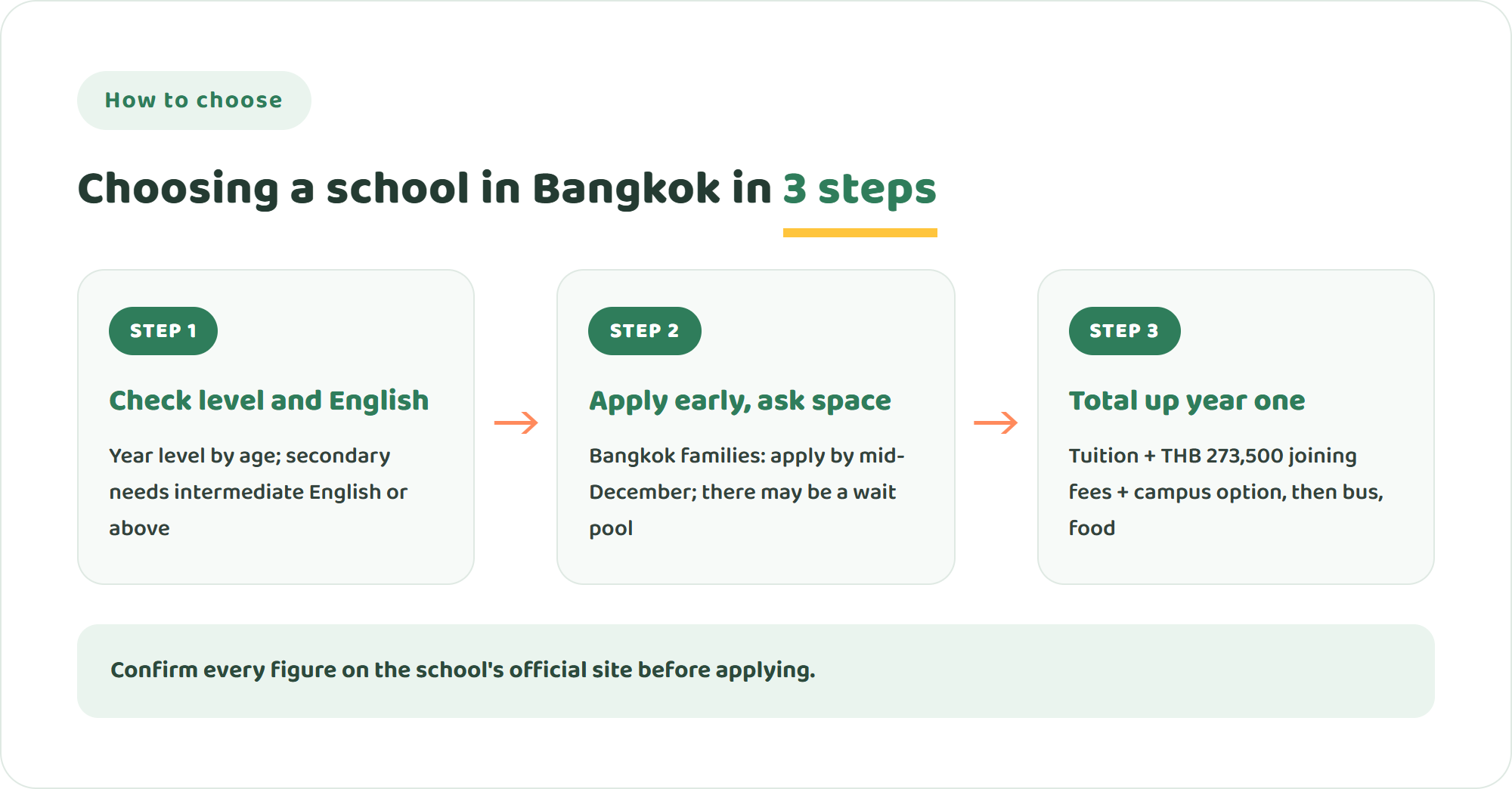
How entry works. NIST accepts applications throughout the year. Bangkok-based families are asked to apply for the following school year by mid-December, as processing starts in January; overseas applicants can apply at any time but are told the process “can take time”. The five steps are:
- Step 1 — Pre-application form online; an admissions officer discusses year level and whether space exists.
- Step 2 — Full application with school reports, teacher recommendation forms, a medical form, identity documents and any IEP or psychoeducational reports, plus the THB 6,000 fee.
- Step 3 — Admissions Committee review, which considers age and year level, space, English proficiency, previous records, nationality, academic ability, IB experience and language choices.
- Step 4 — Assessment and/or interview (THB 2,500). Elementary assessments are one-to-one or in small groups; secondary students sit a test for their grade level. Both can sometimes be done online or at the current school.
- Step 5 — Acceptance letter, accepted within a limited time with the registration fee and campus development payment.
English. English is the language of instruction at every level. Beginners can join in elementary, where EAL runs in Years 1–6; in Years 7–11 the English Language Acquisition programme supports intermediate and advanced learners only, and the school may cap EAL/ELA numbers per year level. Placement is by age (1 September cut-off on the conversion chart) in elementary, and by age and academic record in secondary. Entry to the full IB Diploma depends on performance in Years 10–11. Applicants who cannot be offered a place at that stage may be placed in a wait pool.
How a school day works: schedule, calendar and getting there
Hours (admissions FAQ): Early Years 8:30 a.m.–2:55 p.m.; Years 1–6 8:00 a.m.–2:55 p.m.; Years 7–9 8:30 a.m.–3:20 p.m.; Years 10–13 8:30 a.m.–3:25 p.m. NIST runs a 10-day timetable cycle (days A to J) so that weekday public holidays do not keep cancelling the same lessons. Bangkok is on UTC+7 all year.
Class sizes (official maximums): Early Years 18–19 students with one teacher and two assistants; Year 1 20 students; Years 2–6 23 students; Years 7–11 23–24 students; Years 12–13 advisory groups of about 20, with subject classes varying.
2026–27 calendar. The first day for students is 19 August 2026 (new-student orientation 17–18 August). October break is 12–16 October, winter break begins 18 December, students return on 11 January 2027, February break is 22–26 February, Songkran holiday 10–18 April and the last day is 18 June 2027. There are over 300 after-school activities, many free or at minimal cost, and summer programmes for NIST students.
Getting there. Sukhumvit traffic is heavy, and the school encourages public transport. A free NIST shuttle links the campus with Asok BTS / Sukhumvit MRT throughout the day; Montri Transport runs a private door-to-door bus for families who want it, with fees set by Montri.
Accreditation, IB results and university recognition
The About page lists NIST as an IB World School with accreditation from the Council of International Schools (CIS), NEASC (New England Association of Schools and Colleges) and Thailand’s ONESQA, and membership of EARCOS and ISAT. The Diploma Programme FAQ adds that “the NIST Diploma is fully accredited by the Council of International Schools (CIS) and the Western Association of Schools and Colleges (WASC)”. Because the official pages name different US-style accreditors, families who need a specific accreditor for a US school district or employer should check that accreditor’s directory.
Students who do not complete the full IB Diploma still receive the NIST High School Diploma (24 credits across four years) and certificates for individual IB courses. The school profile reports for 2025: 110 IB Diplomas awarded, a 98% pass rate (worldwide average 81%), 28% scoring 40+ points (worldwide 9%), and 63% of students graduating with a bilingual diploma; the About page gives an average IB score of 37. The Class of 2025 attended 20 of the world’s top 50 universities, including Oxford, Imperial, UCL, Penn, Cornell, Toronto and Melbourne. DP languages include English, Thai, Japanese, Korean, Mandarin and several European languages.
NIST vs NIJIN GLOBAL ACADEMY vs two other options (official data)
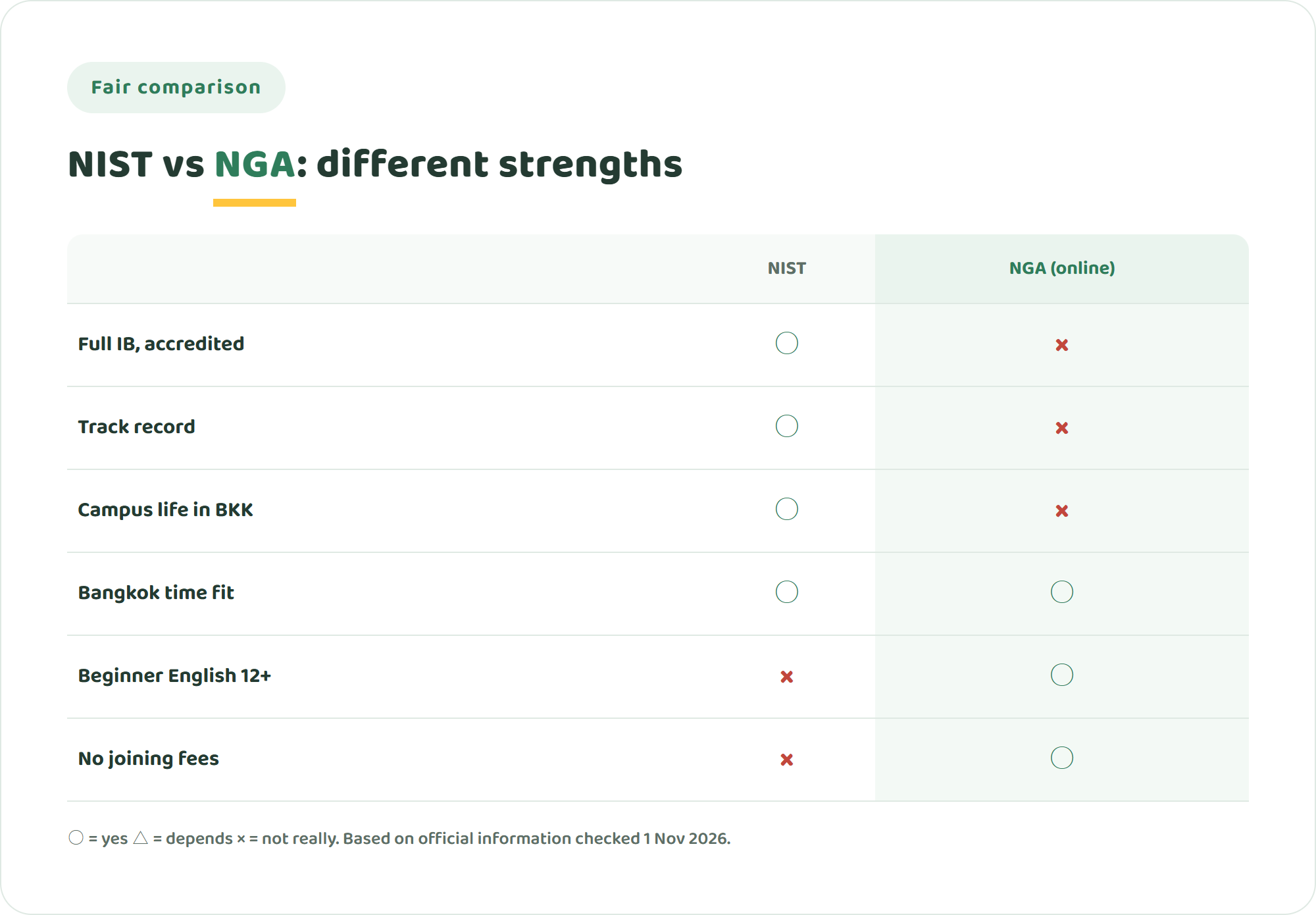
NIJIN GLOBAL ACADEMY (NGA) is included as a different kind of option rather than a like-for-like competitor: it is online, opens in September 2027 and has no accreditation or graduates yet. Bangkok fees are in THB for 2026–27.
| NIST International School | NIJIN GLOBAL ACADEMY | Bangkok Patana School | International School Bangkok | |
|---|---|---|---|---|
| School type | In-person not-for-profit IB day school, central Bangkok | Online international school (Asia & Oceania focus) | In-person not-for-profit British international school | In-person not-for-profit American school, Nichada Thani |
| Ages / grades | Early Years (3) to Year 13 (18) | Ages 6–18 | Nursery to Year 13 | Pre-K to grade 12 |
| Tuition 2026–27 | THB 650,200–1,132,800 a year + campus fee 60,500 a year (or 575,000 deposit) | Not yet published (shared first with the email list); no enrolment, facility or uniform fees; materials included; sibling discounts | THB 515,000–1,014,000 + capital assessment fee 30,000 a year | THB 659,000–1,197,000 + annual fee 22,000 |
| Curriculum | IB PYP, MYP, DP; NIST High School Diploma | Subjects learned in English with a bilingual (English–Japanese) mentor; CEFR-based English levels; optional Cambridge IGCSE / A-Level pathway | British curriculum, IGCSE, IB Diploma | US-based curriculum with AP and IB pathways |
| Classes & time zone | Full in-person day in Bangkok (UTC+7); classes of up to about 23–24 | Small live online groups of about 8; timetable built for Asia & Oceania daytime — fits Bangkok, may not fit the Americas or Europe | Full in-person day in Bangkok | Full in-person day in Bangkok |
| Accreditation / diploma | IB World School; CIS, NEASC, ONESQA (DP page also cites WASC) | Not yet accredited; no graduates yet | IB World School accredited by CIS | WASC and CIS (listed on official site) |
| Admission | Application, committee review, assessment/interview; secondary needs intermediate English or above | No academic entrance exam and no English requirement | See official site | See official site |
| Start dates | August; mid-year (January) entry possible subject to space | Opening September 2027 (planned); free trial classes monthly from September 2026; pre-opening trials April–May 2027 | Term 1 starts 19 August 2026 | See official site |
Sources: NIST Tuition & Fees 2026–2027, About NIST (accreditations), Bangkok Patana tuition and fees, ISB tuition and fees and NGA’s curriculum and timetable page — checked 1 November 2026.
Reviews and common concerns, answered honestly
NIST is one of the first schools most relocating families shortlist in Bangkok, and the recurring questions are about cost structure, space and fit rather than quality. Here is what the official site says.
“Why is the first year so much more expensive?”
Because THB 273,500 of one-time fees (application, assessment, registration) and the campus development payment all fall in year one. From year two you pay tuition plus, on the annual option, THB 60,500. If your employer reimburses fees, check whether it covers the deposit — some employers prefer the refundable deposit because it comes back.
“Will there be a place for us?”
Not always. The admissions page says NIST is “a popular choice for families in Bangkok” and may not have space in every year level; applicants without a place can join a wait pool. Bangkok-based families should apply by mid-December for the following August. Waiting list lengths and acceptance rates are not published.
“Our teenager’s English is still basic.”
This is the main limit. NIST accepts beginner English learners in elementary only; in secondary it supports intermediate and advanced learners, and may cap numbers. For an older beginner, a school with secondary beginner EAL or a bilingual option may suit better for now.
“What if we leave mid-year?”
Tuition is not refunded if a student leaves before the end of a semester, and the registration fee is non-refundable. Because fees are billed by semester, timing your departure for the end of December or June avoids paying for a semester your child does not attend.
“Is the Sukhumvit location a plus or a minus?”
Both. It is central, close to the BTS and MRT and surrounded by housing, hospitals and parks, but the school itself warns that traffic “can be heavy”. Many families live within walking distance or use the free station shuttle; families living further out may compare ISB’s suburban Nichada Thani campus.
Alternatives to NIST International School worth comparing
Bangkok Patana School — a not-for-profit British school and IB World School accredited by CIS, with IGCSE and the IB Diploma and 2026/27 tuition from THB 515,000 to THB 1,014,000 plus a THB 30,000 capital fee; see our Bangkok Patana fees review.
International School Bangkok (ISB) — founded in 1951, Thailand’s first international school, with an American curriculum, AP and the IB Diploma in Nichada Thani; 2026/27 tuition THB 659,000–1,197,000. Shrewsbury Bangkok offers a British curriculum with A Levels (THB 696,300–1,256,700). Families looking at other Asian cities can compare our Singapore American School fees page, which follows the same official-only method.
NIJIN GLOBAL ACADEMY (NGA) — an online international school for ages 6–18 focused on Asia and Oceania, opening in September 2027 (planned), with a first cohort of 100 students. Classes are small live dialogue groups of about 8; subjects are learned in English with a bilingual (English–Japanese) mentor, English is taught by CEFR level, and there is no academic entrance exam and no English requirement. It can run alongside a local school or as the main school, and it travels with the family if they relocate again. The timetable is built for Asia–Oceania daytime, which fits Bangkok. Tuition is not yet published; NGA says it will be far more affordable than a typical international school, with no enrolment, facility or uniform fees, materials included and sibling discounts. The honest limitations: it is not yet open, not yet accredited, has no graduates and is not a campus school — families who want the full IB continuum taught on site, 300+ activities and a Bangkok campus community should choose a school like NIST. Free trial classes run monthly from September 2026. NGA is operated by NIJIN Inc. in Japan, whose alternative school NIJIN Academy has more than 1,000 students.
For a wider view, see online international schools compared, the cost of online vs in-person international schools and how a day at an online international school works.
FAQ
How much does NIST International School cost per year?
For 2026–27, tuition is THB 650,200 (Early Years), 840,500 (Year 1), 889,200 (Years 2–6), 956,000 (Years 7–9), 1,038,900 (Years 10–11) and 1,132,800 (Years 12–13), paid in two semester instalments. New students add THB 273,500 of one-time fees, and every family pays either a THB 60,500 annual campus fee or a refundable THB 575,000 deposit.
Is NIST International School accredited?
Yes. NIST is an IB World School offering the PYP, MYP and DP, and its official site lists accreditation by CIS, NEASC and Thailand’s ONESQA; its Diploma Programme page also states the NIST Diploma is accredited by CIS and WASC. Graduates receive the IB Diploma and/or the NIST High School Diploma.
Can international students enrol at NIST?
Yes — NIST welcomes applicants of all nationalities and accepts overseas applications all year. Students must live in Bangkok with a parent or appointed legal guardian (there is no boarding). Beginners in English can join in elementary; secondary applicants need at least intermediate English.
Is NIST International School worth it?
For families who want the full IB from age 3 to 18 in central Bangkok, strong published IB results (98% pass rate and 28% at 40+ points in 2025) and a diverse not-for-profit community, many find it is — especially when an employer pays. It is harder to justify for a short posting paid from your own pocket, for a secondary student who is a beginner in English, or if you need financial aid, which is not published.
What are the alternatives to NIST?
Bangkok Patana School (British, IGCSE and IB), International School Bangkok (American, AP and IB) and Shrewsbury Bangkok (British, A Levels) are the usual comparisons. For families in Asia and Oceania who want a small bilingual live-online option with no academic entrance exam and no English requirement, NIJIN GLOBAL ACADEMY opens in September 2027 (planned); it is not yet accredited and its tuition is not yet published.
Choosing calmly before a move to Bangkok
NIST publishes one of the clearer fee schedules in Bangkok, and the useful next steps are concrete: find your child’s year level on the official conversion chart, check the English support available at that level, submit the pre-application early and ask directly about space. Then add up year one honestly — tuition, the THB 273,500 of one-time fees, your campus development choice, uniforms, food and transport — and compare it with Patana, ISB and Shrewsbury on the same basis. If your posting is short, your teenager is still growing into English, or you want something that moves with your family, it is worth keeping one flexible option in view as well; our curriculum and timetable page shows how NGA’s live classes sit in Bangkok’s day.
Tuition and admissions details were checked on the official websites on 1 November 2026. Schools revise fees every year — always confirm on the official site before applying.