If you are searching for international schools in Minato, Tokyo, you have landed in the densest school neighborhood in the country. Moto-Azabu, Hiroo, Shirokanedai, Minami-Aoyama — within a short walk of one another you will find several world-class schools. That abundance is a gift, but it can also make the decision harder: which one actually fits your child and your family? In this guide we compare seven real international schools located in Minato honestly, by curriculum, fee range, nearest station, and character. You will find an at-a-glance fee table, an area-by-area commute guide, and a straight answer on admissions and transfer timing. We also share an eighth option — an online path — for families for whom fees or the daily commute have become a real barrier. By the end, the criteria that matter for your child should feel much clearer.
Quick Answer: Your Options in Minato
If you only read one section, read this. Below are the schools covered in this guide, plus the online option — so you can see every route side by side before the details.
- Nishimachi International School — Ages: Kindergarten to Grade 9 (roughly 5–15) / Approx. fees: Tuition around 2.98 million yen a year (about 3.38 million total;…
- Tokyo International School — Ages: Kindergarten to around Grade 8 (roughly 4–14, upper grades expanding)
- The British School in Tokyo (Azabudai Campus) — Ages: Azabudai campus mainly Nursery to Year 6 (roughly 3–11) / Approx. fees: Tuition around 2.82 to 2.93 million yen a year (by year group;…
- The Montessori School of Tokyo — Ages: 2 to 14
- Laurus International School of Science — Ages: 1.5 to 18 (early years through upper secondary)
- Capital Tokyo International School (CTIS) — Ages: Elementary to junior high (roughly 6–15)
- Willowbrook International School — Ages: 15 months to 5 years
- NIJIN GLOBAL ACADEMY (online) — Ages 6–18 / opening September 2027, currently taking opening-update registrations / fees around one-fifth of a typical campus international school / Japanese-language support. An option when commute or fees are the wall.
International schools in Minato: the landscape and typical fees
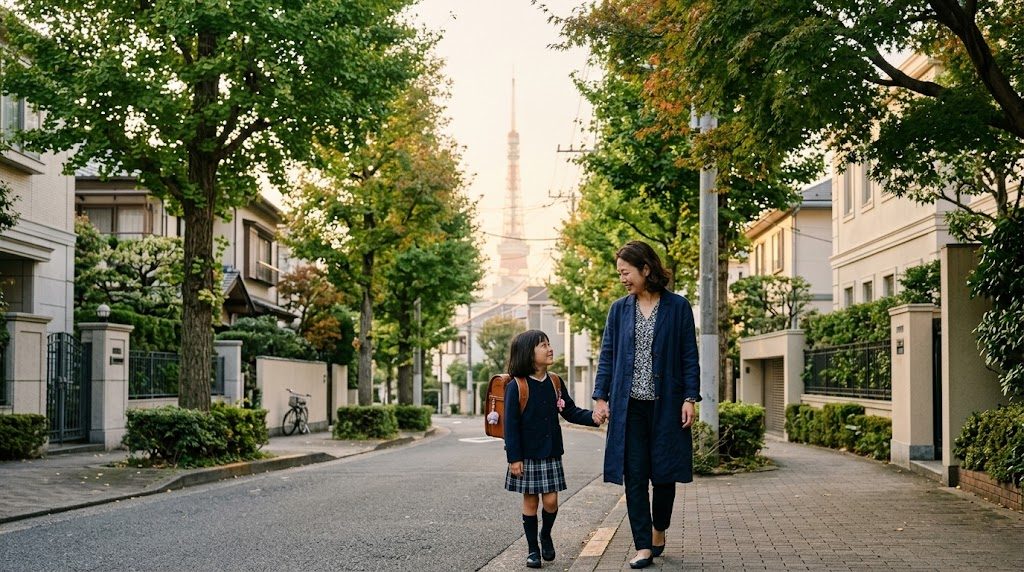
Counting international preschools, Minato-ku is home to more than thirty schools. With embassies and multinational companies concentrated here, the ward has long drawn expatriate families, international couples, and globally minded Japanese households — and schools have grown to meet that demand. Geographically, the established K-9 and K-12 schools cluster around Azabu, Moto-Azabu, and Minami-Azabu; science-focused and newer schools sit in Shirokanedai and Minami-Aoyama; and early-years preschools dot Akasaka, Toranomon, and Shibakoen. This concentration is the highest of any Tokyo ward, which is why so many families start their search in Minato.
On fees: for full international schools spanning early years through secondary, annual tuition in Minato typically runs from roughly 1.7 to 3.4 million yen. The best-known K-9 and K-12 schools cluster in the 2.8 to 3.4 million yen range, and once you add registration, building, and bus fees, the first year can exceed 4 million yen. Science- and Cambridge-oriented schools offer more moderate options, with primary tuition around 2 million yen a year.
Note: all fees reflect publicly available information as of July 2026. Always confirm the latest figures on each school’s official website.
The best international schools in Minato: our 7 picks
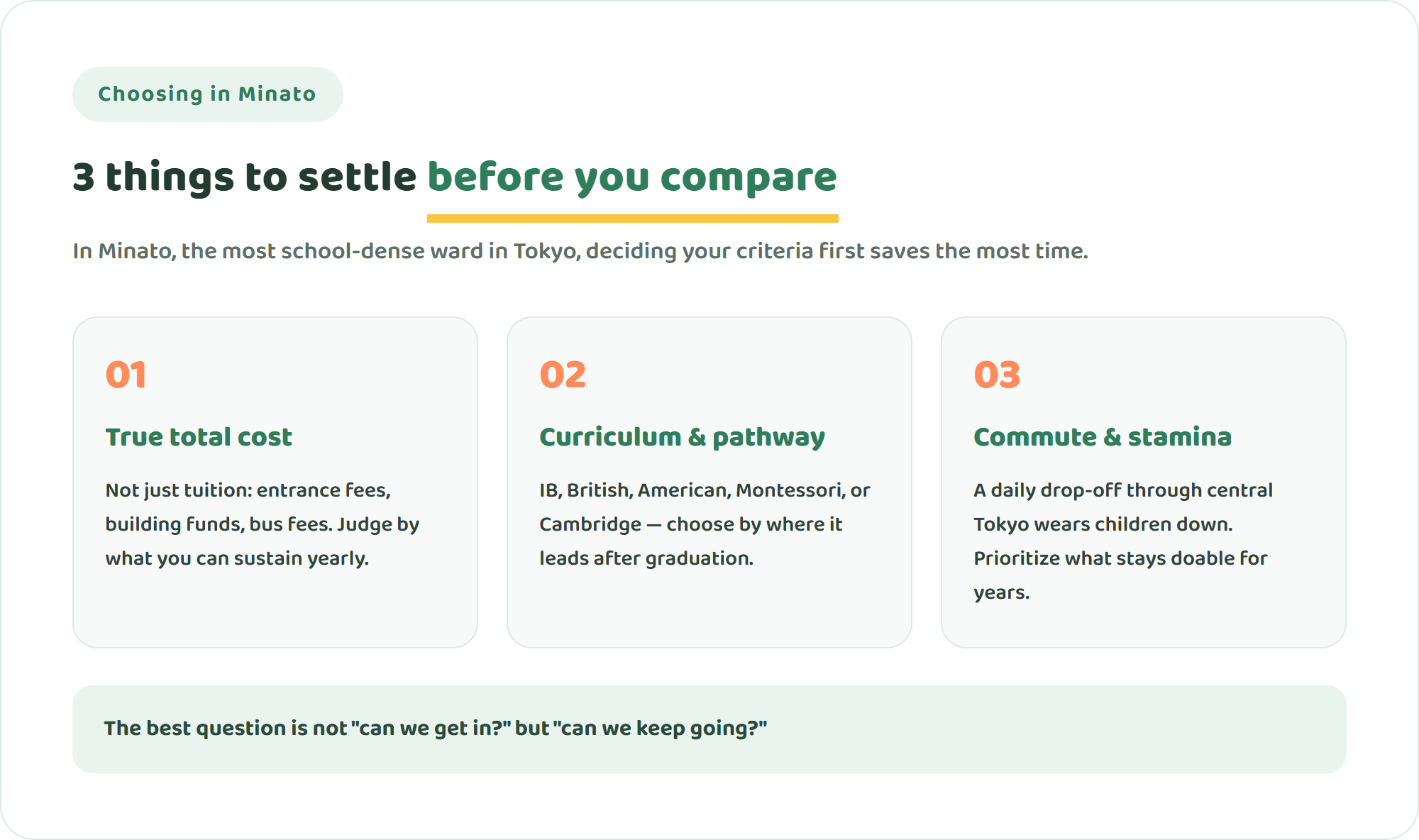
Below are seven international schools that genuinely sit within Minato-ku, chosen to balance reputation, curriculum variety, and fee level. They differ sharply in character. Read not for “which is famous,” but for “which matches our family’s values.”
1. Nishimachi International School
Founded in Moto-Azabu in 1949, Nishimachi is one of Minato’s flagship schools. Serving from kindergarten through Grade 9, it is known for a genuinely bilingual, bicultural education — strong English alongside meaningful Japanese — and for a close-knit, student-centered culture. It is accredited by CIS and WASC.
- Curriculum: International liberal-arts program with English–Japanese bilingual education (CIS/WASC accredited)
- Ages: Kindergarten to Grade 9 (roughly 5–15)
- Area / nearest stations: Moto-Azabu (walkable from Azabu-Juban and Hiroo stations)
- Approx. fees: Tuition around 2.98 million yen a year (about 3.38 million total; registration and building fees additional in year one)
- Best for: Families wanting both English and Japanese developed seriously from an early age
2. Tokyo International School
An IB World School in Minami-Azabu delivering the IB Primary Years and Middle Years Programmes, with the Diploma Programme being phased in from 2025-26. With children from more than 70 nationalities, it offers a genuinely multinational, inquiry-driven environment.
- Curriculum: International Baccalaureate (IB PYP and MYP, DP being introduced)
- Ages: Kindergarten to around Grade 8 (roughly 4–14, upper grades expanding)
- Area / nearest stations: Minami-Azabu (walkable from Hiroo and Shirokane-Takanawa stations)
- Approx. fees: Around 3.0 to 3.3 million yen a year (varies by grade; one-time fees additional)
- Best for: Families who value inquiry and diversity and are eyeing an IB global pathway
3. The British School in Tokyo (Azabudai Campus)
A popular school delivering the English National Curriculum. The Minato-based Azabudai campus serves mainly early years and primary (Nursery to Year 6), with secondary years continuing at another campus. Its appeal lies in a structured, well-sequenced British education.
- Curriculum: English National Curriculum
- Ages: Azabudai campus mainly Nursery to Year 6 (roughly 3–11)
- Area / nearest stations: Azabudai (walkable from Kamiyacho, Azabu-Juban, and Roppongi-Itchome stations)
- Approx. fees: Tuition around 2.82 to 2.93 million yen a year (by year group; entrance-related fees additional in year one)
- Best for: Families wanting a systematic British education, with UK or European progression in mind
4. The Montessori School of Tokyo
A full Montessori school in Minami-Azabu serving children from age 2 to 14 in one continuous path. Multi-age classes and respect for the child’s independence build genuine self-directed learning. It appeals to families seeking a calm, small-scale environment.
- Curriculum: Montessori education in an English-language international setting
- Ages: 2 to 14
- Area / nearest stations: Minami-Azabu (walkable from Azabu-Juban and Hiroo stations)
- Approx. fees: Around 3.19 million yen in the first year (including one-time fees; varies by age and year)
- Best for: Families who prize intrinsic motivation and focus over rote instruction
5. Laurus International School of Science
A Cambridge-accredited school with campuses in Shirokanedai, Shiba, Minami-Aoyama, and Takanawa, built around STEM. It offers a continuous path from early years to high school, and its primary tuition is comparatively moderate for a full international school in Minato.
- Curriculum: Cambridge International Curriculum plus a distinctive science (STEM) program
- Ages: 1.5 to 18 (early years through upper secondary)
- Area / nearest stations: Shirokanedai, Shiba, Minami-Aoyama, Takanawa (Shirokanedai, Shirokane-Takanawa, Omotesando stations)
- Approx. fees: Primary around 1.97 to 2.48 million yen a year (overall range roughly 1.74 to 3.26 million; by grade)
- Best for: Families keen on science and inquiry who also want to keep costs more moderate
6. Capital Tokyo International School (CTIS)
A relatively new international school in Minami-Azabu serving elementary through junior-high ages (roughly 6–15) with small classes and an English-medium international education. It offers a more intimate, flexible alternative to the large established schools.
- Curriculum: English-medium international education (small classes)
- Ages: Elementary to junior high (roughly 6–15)
- Area / nearest stations: Minami-Azabu (walkable from Shirokane-Takanawa and Hiroo stations)
- Approx. fees: Please confirm on the official website (varies by grade and year — contact directly)
- Best for: Families wanting a small, family-like environment with flexibility
7. Willowbrook International School
An international preschool in Moto-Azabu, running since 1998. Minato’s early-years scene is exceptionally deep, and for families who want to ease their child into an international environment before formal school, an established preschool like this is a strong entry point. Its ethos centers on human values, empathy, and multicultural awareness.
- Curriculum: Early-years education built on human values and multicultural awareness (English environment)
- Ages: 15 months to 5 years
- Area / nearest stations: Moto-Azabu (walkable from Azabu-Juban and Hiroo stations)
- Approx. fees: Please confirm on the official website (preschool fees vary by age and hours — contact directly)
- Best for: Families wanting a gentle first step into English and an international setting before school
A note on names you may see nearby: Seisen / Sacred Heart (Seishin) International School sits in Hiroo, Shibuya-ku, and Aoba-Japan International School is in Meguro/Nerima — both outside Minato. If you are searching within Minato but open to neighboring areas, see our wider guide to international schools across Tokyo, the neighboring international schools in Shibuya, and the greener, school-rich international schools in Setagaya.
International schools in Minato: fees at a glance (7-school comparison table)
School, curriculum, ages, and fee range on a single screen. Use it to grab the big picture first, then jump back to any school’s detail.
| School | Curriculum | Ages | Approx. annual fee range (confirm) |
|---|---|---|---|
| Nishimachi International School | Bilingual (Eng/Jpn; CIS/WASC) | ~5–15 | Tuition ~¥2.98M (total ~¥3.38M) |
| Tokyo International School | IB (PYP, MYP; DP phasing in) | ~4–14 | ~¥3.0M–3.3M |
| The British School in Tokyo (Azabudai) | English National Curriculum | ~3–11 | ~¥2.82M–2.93M |
| The Montessori School of Tokyo | Montessori (English setting) | 2–14 | First year ~¥3.19M (incl. one-time) |
| Laurus International School of Science | Cambridge + STEM | 1.5–18 | ~¥1.74M–3.26M (primary ~¥1.97M–2.48M) |
| Capital Tokyo International School (CTIS) | English-medium international (small classes) | ~6–15 | Confirm with school |
| Willowbrook International School | Early years (English setting) | 15 months–5 | Confirm with school |
Fees are indicative ranges based on publicly available information as of July 2026. Registration, building, and bus fees are additional, so the first-year total can be considerably higher. Always confirm current figures on each school’s official website. For a closer look at what makes up the total, see our guide to international school tuition costs.
International schools in Minato by area: neighborhoods, nearest stations, and commute
Minato’s international schools cluster heavily around Azabu. Even within the same ward, how easy the commute is can change with a single station. Here is a quick orientation by neighborhood and nearest stations.
- Moto-Azabu / Minami-Azabu (Azabu-Juban, Hiroo, Shirokane-Takanawa): The busiest cluster in Minato — Nishimachi, Tokyo IS, Montessori, CTIS, and Willowbrook. A quiet, embassy-lined residential area, though the density of popular schools means admission is competitive.
- Azabudai / Roppongi (Kamiyacho, Roppongi-Itchome): Home to the British School’s Azabudai campus. Rapid redevelopment and excellent central access.
- Shirokanedai / Shirokane / Takanawa (Shirokanedai, Shirokane-Takanawa, Takanawa Gateway): Science-focused and newer schools such as Laurus. Convenient from the Shinagawa side, too.
- Minami-Aoyama / Aoyama (Omotesando, Gaienmae): A Laurus campus and several early-years schools; also easy to reach from the Shibuya side.
- Akasaka / Toranomon / Shibakoen (Akasaka-Mitsuke, Kamiyacho, Onarimon): Mostly international preschools — a common “get comfortable in English first” entry point before formal school.
The point is not only tuition but whether the daily commute is sustainable for years. Central Tokyo trains and roads get crowded, and drop-off/pick-up can weigh more than expected. Checking walking minutes from the station, whether a school bus runs, and how it fits your own commute will reduce surprises after enrollment.
How to find the right international school in Minato for your family
Even with seven schools laid out, “so how do I actually choose?” is the honest question. It helps to think of Minato’s options in three types: (1) established major international schools, (2) mid-size and newer international schools, and (3) online international schools that require no commute. The table below shows, honestly, how each type tends to perform on cost, ease of admission, commute, and more.
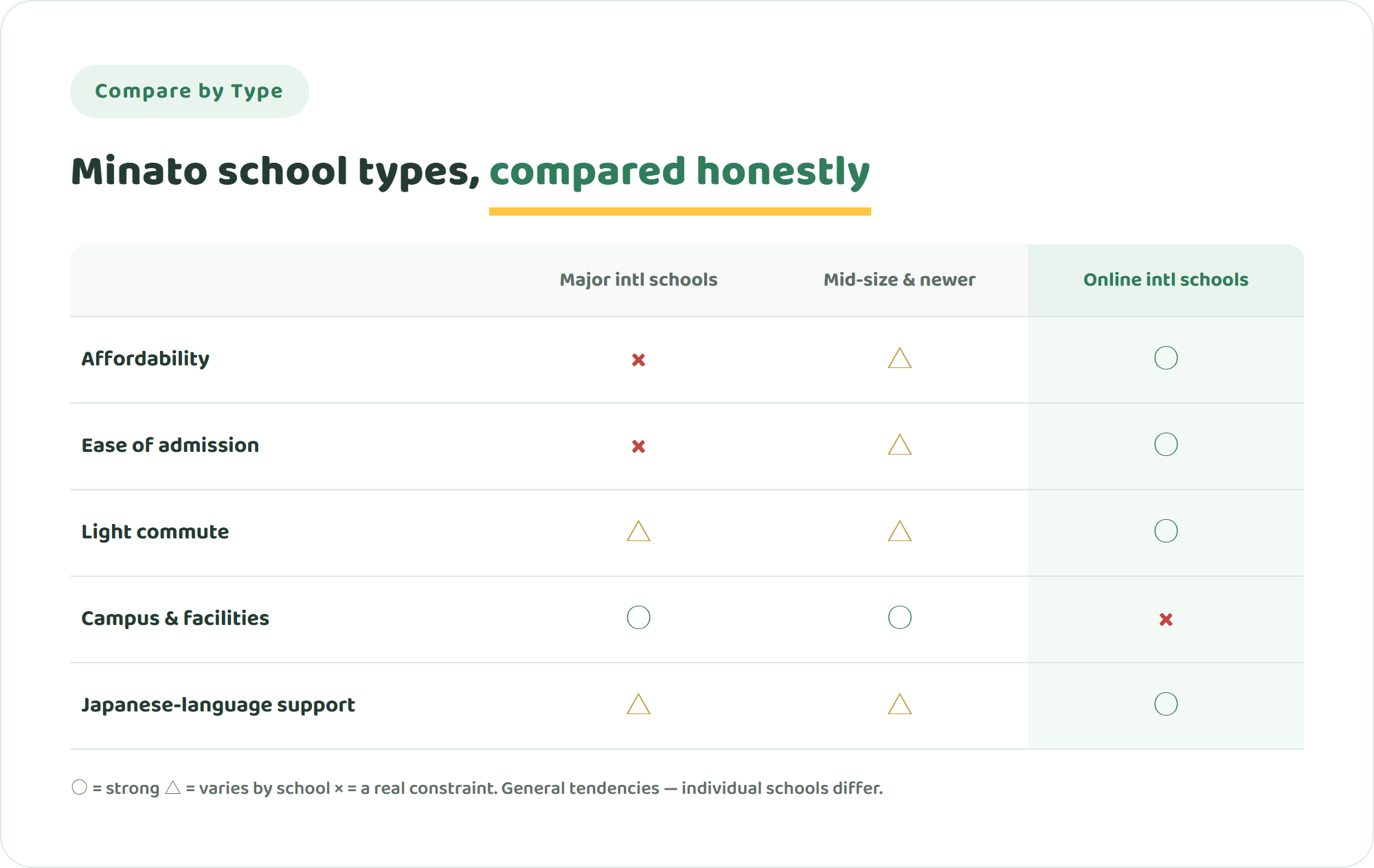
Major schools offer superb facilities and strong pathways, but with higher fees and tougher admission. Mid-size, newer, and science-focused schools can be easier to choose on cost and flexibility, though some are still building their scale and track record. And the option not to overlook: schooling that does not depend on a daily commute. It is worth asking honestly whether fees are straining the household, and whether a long cross-city commute is wearing your child down. If the sticker price feels overwhelming, our piece on whether international school is really too expensive may help you think it through.
See how learning works online →
Admission, availability, and transfer timing at Minato international schools
Minato has many schools, yet popular ones fill up, and the grade you want may have no space. This is not a judgment on any particular school — treat it as general guidance.
- How to think about availability: Entry grades — kindergarten and lower elementary — tend to have more places, while spaces get scarcer in the upper grades. Popular schools may keep a waiting list.
- Transfer and start timing: Most schools run an August/September academic year. Transfers mostly happen at the year boundary, though some accept mid-year entry at term breaks (e.g., January or April). Once a relocation or repatriation date is set, inquire as early as you can.
- Admission requirements: Interviews, a light assessment, and a parent meeting are common; upper grades may expect a certain English level. For a child who has been mostly in Japanese, a school with English support — or a design that lets a child lean on Japanese while easing into English — can be a better fit.
- Preparation timeline: Request materials and book visits 6–12 months before your intended start. Popular schools’ information sessions fill early, so line up several schools in parallel.
Looking beyond “can we get in?” to “can we sustain it for years?” tends to lead to fewer regrets.
When fees or the commute are the barrier — an online eighth option
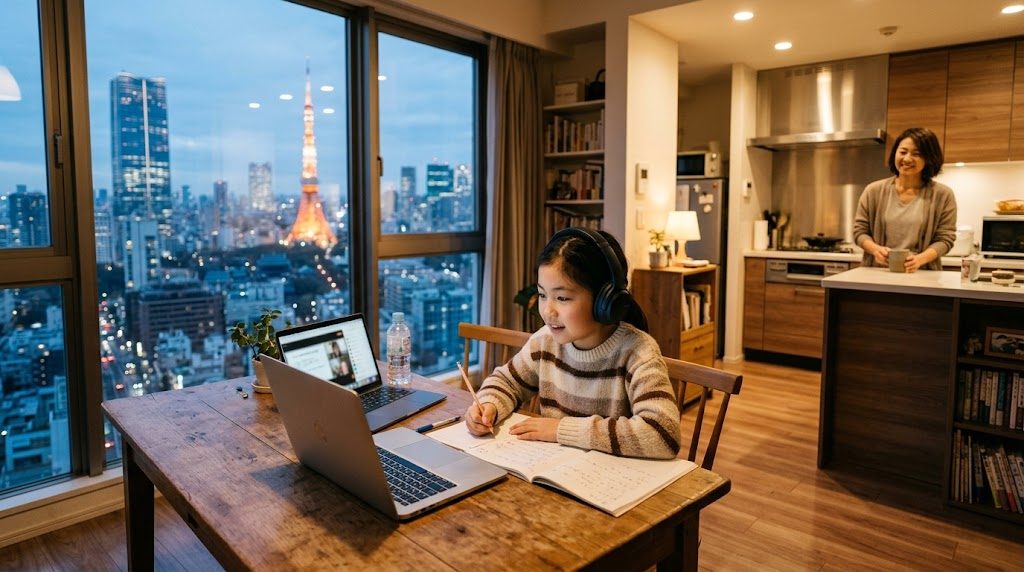
Minato is a privileged place for school choice. Even so, annual tuition above 3 million yen, or a daily drop-off and pick-up through crowded central Tokyo, becomes a real barrier for many families. If you find yourself thinking, “I want an international education for my child, but I’m not sure we can sustain this for years,” there is an eighth option that does not depend on commuting: an online international school.
We are NIJIN GLOBAL ACADEMY (NGA), an online international school scheduled to open in September 2027. It is run by NIJIN Inc., the company behind NIJIN Academy, an alternative school in Japan with more than 1,000 enrolled students. Rooted in a “beyond test scores” philosophy — not ranking children by exam points — NGA centers on small-group dialogue and a mission to help children “come to love themselves and the world.” It serves ages 6 to 18 across Asia and Oceania, regardless of where you live, and is designed so children can lean on Japanese while gradually growing into English. We aim for tuition at roughly one-fifth of a bricks-and-mortar international school.
In honesty: NGA has not opened yet, and its track record is still to come. It cannot offer the same playground and on-campus experience as a commuting school. Even so, for a family weighing options in Minato, learning that connects to the world without the commute and at a lower cost may be a path worth considering.
International schools in Minato: frequently asked questions
Q. From what age can children enter international schools in Minato?
A. Many preschools accept children from around 12–18 months, and Minato is especially rich in early-years options. Schools like Nishimachi and The Montessori School of Tokyo run continuously from early childhood into the secondary years. A good first step is to shortlist schools that accept your child’s current age.
Q. How much do international schools in Minato cost?
A. For full schools spanning early years to secondary, tuition typically runs roughly 1.7 to 3.4 million yen a year. The best-known schools cluster in the 2.8 to 3.4 million range, and adding registration, building, and bus fees can push the first-year total above 4 million yen. Science- and Cambridge-oriented schools offer more moderate primary options around 2 million yen (all figures as of 2026 — confirm with each school).
Q. Is Japanese-language support available?
A. It varies greatly by school. Some, like Nishimachi, are explicitly bilingual in English and Japanese; others teach primarily in English. If you want a solid Japanese foundation maintained, look at bilingual schools, or an online school (such as NGA) designed with Japanese-language support in mind.
Q. Are popular Minato schools easy to get into? Can my child transfer in mid-year?
A. Most schools accept transfers, but popular ones rarely have openings, and conditions vary by term and grade. Entry grades (kindergarten and lower elementary) tend to be easier, while upper grades are tighter. Entrance tests, interviews, or English-level requirements may apply, so it is wise to contact schools directly 6–12 months before your intended start date.
Q. Is there a way to get an international education in Minato with a lighter commute or lower fees?
A. When the central-Tokyo commute or a 3-million-yen-plus tuition bill becomes a strain, an online international school is an option that removes the commute entirely. You can live in Minato and keep learning that connects to the world from home, usually at a lower cost than an on-campus school. The honest trade-off is that you miss the physical campus and playground — but for families who want to protect both the household budget and their child’s daily rhythm, it is a realistic move.
The time you spend deciding is time spent loving your child
There is no single “right answer” to choosing a school. Even in a place as rich in options as Minato, what matters is less “can we get in?” and more “can we sustain this learning, comfortably, for years?” Fees, commute, your child’s temperament — every family’s situation is different. That is exactly why the time you spend hesitating is proof of how seriously you are thinking about your child’s future. Take your time, visit a few schools in person, and compare. And if you would like to keep a “beyond the commute” path on your list too, we would be glad for you to consider our opening.
International Schools in Other Cities
- International Schools in Melbourne
- International Schools in Nagoya: All 8 Schools
- International Schools in Setagaya: All 14 Schools
- International Schools in Nakano, Tokyo
- International Schools in Tsukuba: Fees
- International Schools in Sendai: 7 Picks and Fees
- International Schools in Musashino, Tokyo
- International Schools in Nerima, Tokyo
- International Schools in Osaka
- International Schools in Tokyo
- International Schools in Shibuya, Tokyo
- International Schools in Koto, Tokyo
- International Schools in Shinagawa, Tokyo
- International Schools in Meguro: All 8 Schools
- International Schools in Chofu and ASIJ Fees